
How to hire a technician: a step-by-step guide for 2027
Steps to hire a technician in about three weeks: define the trade, source wide, test skills, run a hands-on task, check licenses and offer.

A technician who looks perfect on paper can still freeze when a real fault shows up on the floor. Resumes cannot show that, and with demand far above supply, a bad hire or a slow offer costs you either way.
How to hire a technician who works safely on day one comes down to seven steps, run in order over about three weeks. Name the trade, screen online, prove skills in a scored hands-on task, then verify and offer within 48 hours.
TL;DR:
- To hire a technician, define the trade first, screen skills online, prove them in a scored hands-on task and make an offer within 48 hours.
- A well-run technician hire takes about 15 working days if you book hands-on slots before the ad goes live.
- Demand outruns supply: the TechForce Foundation counts about 241,800 technician openings a year through 2029 against roughly 101,700 new graduates.
- Verify only the credentials the job legally needs, such as EPA Section 608 for HVAC, and pay for the rest in year one.
- Treat a skipped safety step in the hands-on task as an automatic fail, whatever the repair quality.
- US median pay runs from $49,590 for general maintenance to $64,100 for industrial machinery mechanics, per BLS May 2025 data.
- Pair every new hire with a senior technician for the first 90 days, because most early exits happen before skills settle.
 ChatGPT
 Gemini
 Claude
 Grok
 Perplexity
Which type of technician do you need to hire?
The type of technician you need to hire depends on the equipment the person will work on most, the setting and the level. A generic "technician" ad pulls in HVAC installers, IT help desk staff and car mechanics at once, and few of them fit.
Name the equipment, then pick entry, experienced or lead level.
Most hiring teams choose from five common types:
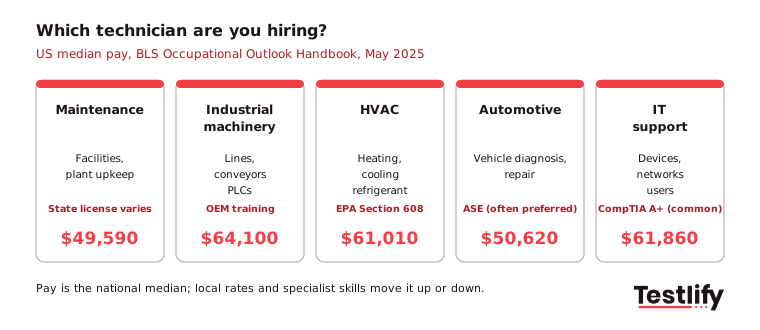
Technician type | Typical work | Key credential | US median pay (May 2025) |
|---|---|---|---|
General maintenance | Building and facilities upkeep, minor electrical and plumbing | State or local license for some trades | $49,590 |
Industrial machinery | Production lines, conveyors, hydraulics, PLC-controlled machines | Employer or manufacturer training | $64,100 |
HVAC | Install and repair heating, cooling and refrigeration | EPA Section 608, state license in some areas | $61,010 |
Automotive | Diagnose and repair cars and light trucks | ASE certification, often preferred | $50,620 |
IT support | Devices, accounts, networks and user tickets | Entry-level certification such as CompTIA A+ | $61,860 |
Pay figures are national medians from the BLS Occupational Outlook Handbook.
Hiring for one trade? Testlify has deeper guides on how to hire an HVAC technician, an automotive technician and a repair technician, plus a full maintenance technician hiring guide.
Decide the employment model at the same time. Steady, daily work suits a full-time employee. Seasonal peaks, a single site with light upkeep or a one-off install can suit part-time staff or a contractor, which changes the ad, the pay and the checks you run.

Why is it hard to hire a technician in 2026?
Hiring a technician is hard in 2026 because demand keeps outrunning the training pipeline. The TechForce Foundation's 2026 supply and demand report found that US employers hired about 1.18 million technicians in 2025 but lost about 1.14 million, and that employers need about 241,800 new technicians a year through 2029 while schools produce about 101,700 graduates.
The report's own verdict: "The problem is recruitment, not retention."
The squeeze shows up across sources:
- Roles stay open: The BCG maintenance talent report says many companies report 10% to 30% of maintenance jobs unfilled, and roughly one-third of the workforce is 55 or older.
- Skills are the bottleneck: In the Modern Materials Handling 2025 MRO survey of 130 operations leaders, only 13% had no trouble hiring and keeping technicians. The top problem was finding people with the right skill sets (44%).
- Some trades are far short: TechForce reports that new graduates fill only 15% of annual demand for industrial machinery technicians and 64% for HVAC.
- Demand keeps growing: BLS projects industrial machinery mechanic and maintenance jobs to grow 14% from 2025 to 2035, and HVAC jobs 11%.
What this means for a hiring team: slow processes lose candidates, and a resume is a weak signal when many applicants come from adjacent trades. Speed and a fair skills test matter more than a long list of requirements.
How to hire a technician step by step: what are the 7 stages?
Hiring a technician step by step runs through seven stages, from role definition to offer, with skills evidence in the middle. Each stage removes guesswork, and because the stages overlap, the process can finish in about 15 working days.
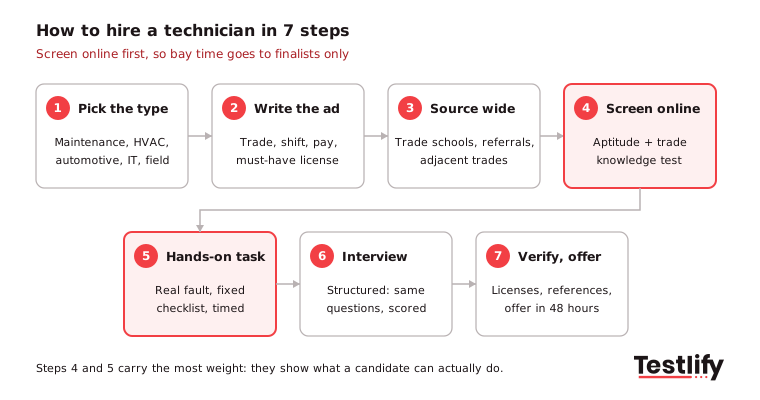
- Pick the technician type: Name the equipment, the setting (plant, field, shop, office) and the level: entry, experienced or lead.
- Write a specific job ad: State the trade, shifts, on-call needs, pay range, must-have licenses, tool policy and the training you offer.
- Source wide: Combine job boards with trade schools, referrals and people from adjacent trades.
- Screen online: Send every qualified applicant a short aptitude and trade knowledge test. Shortlist on scores, not resume polish.
- Run a hands-on task: Give finalists a real or staged fault to diagnose and fix, scored with a fixed checklist.
- Hold a structured interview: Ask every candidate the same questions and score the answers against agreed criteria.
- Verify and offer fast: Check licenses and references, then make an offer within 48 hours. Strong technicians often hold more than one offer.
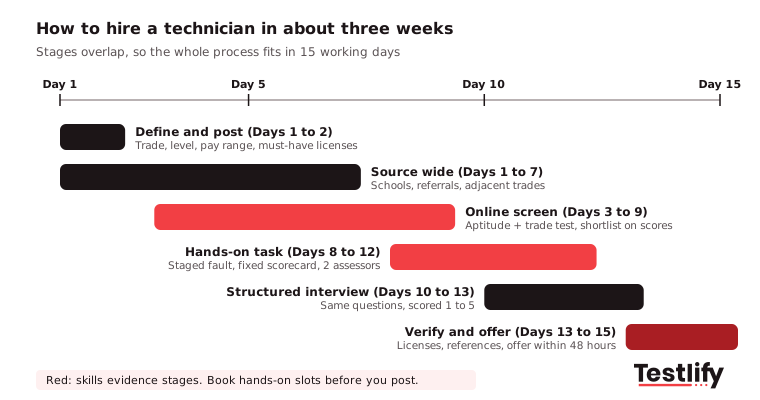
Pro tip: Book the hands-on task slots and the assessors before the ad goes live. Waiting for a free workshop slot is the most common reason a technician hire slips from three weeks to six.
What skills should you look for when you hire a technician?
The skills to look for when you hire a technician fall into two groups: trade skills that show the person can do the work safely, and working skills that show they can do it reliably alongside a team and customers. Test both, because a gifted fixer who skips safety steps or cannot explain a repair costs you later.
Trade skills
- Diagnosis and troubleshooting: Finding the real cause of a fault, not just the symptom.
- Mechanical and electrical aptitude: Understanding how parts, circuits and forces work together.
- Reading manuals, schematics and wiring diagrams: Following a spec instead of guessing.
- Tool and test equipment use: Multimeters, pressure gauges, diagnostic scanners or software tools, depending on the trade.
- Safety practice: Lockout/tagout, PPE and safe handling of refrigerants, electricity and chemicals.
- Documentation: Clear work orders and service notes the next person can act on.
Working skills
- Clear communication: Explaining a fault and its fix to a customer or manager in plain words.
- Attention to detail: Small misses cause repeat call-outs and safety incidents.
- Time management: Handling a queue of tickets or a route of field visits.
- Learning ability: Equipment changes, and technicians who keep learning stay useful.
- Customer handling: In field and IT roles, the technician is often the face of your company.
Skill | Best way to check it |
|---|---|
Mechanical and electrical aptitude | Online aptitude test |
Trade knowledge (codes, components, procedures) | Online trade test for the role |
Diagnosis and repair | Hands-on task with a real or staged fault |
Safety practice | Hands-on task (watch for it) plus scenario questions |
Communication | Explain-the-fix step in the hands-on task, interview |
Attention to detail | Online attention to detail test, task review |
Reliability and teamwork | Behavioral interview questions, references |
Which certifications and licenses should you check before you hire?
Technician certifications depend on the trade and the state, so list only the ones the job truly needs and verify each one with the issuing body before the offer. Some are legal requirements; others are proof of training that employers prefer.
- HVAC: According to the BLS HVAC profile, the EPA requires nearly all HVAC technicians to be certified in refrigerant handling, and some states and cities also require a license.
- Automotive: ASE certifications by specialty, such as brakes or electrical systems, are widely preferred. BLS notes that technicians who buy or work with vehicle refrigerants also need EPA certification.
- Electrical and building maintenance: State or local licenses apply to many electrical and plumbing tasks. Check your state's rules before you write the ad.
- IT support: No license is required. Entry-level certifications such as CompTIA A+ show baseline knowledge but do not replace a practical test.
- Industrial and specialist equipment: Manufacturer training on the machines you run is often worth more than a general certificate.
Split the list into "must have on day one" and "we will pay for it in year one". Many good candidates from adjacent trades lack one certificate you can fund, and a must-have list that is too long shrinks an already small pool.
Where can you find technicians to hire?
The best places to find technicians to hire are trade schools and community colleges, employee referrals, job boards with trade-specific titles and adjacent trades. Since the pool is small, use several channels at once and track which ones produce hires, not just applicants.
- Trade schools, community colleges and apprenticeships: In the Modern Materials Handling survey, 33% of employers work with community colleges and 25% run apprenticeships or internships with a career path.
- Employee referrals: Your current technicians know who is good in your area. The same survey found 23% of employers use signing or referral bonuses; pay them on a clear schedule.
- Job boards with exact titles: Use the title candidates search for, such as "HVAC service technician" or "industrial maintenance technician", not a generic "technician".
- Adjacent trades: About 24% of employers in the survey hire from other industries. Construction, automotive, military and appliance repair backgrounds bring transferable skills.
- Manufacturers and dealers: Equipment makers and dealer networks train technicians on the exact machines you run.
- Staffing agencies: Useful for short-term cover or a sudden ramp, at a higher cost per hire.
Make applying easy on a phone. Many technicians apply from the job site, so a long desktop-only form loses them before they reach your test.
How do you test a technician's skills before you hire?
Testing a technician's skills before you hire works best as a two-stage check: an online screen for aptitude and trade knowledge, then a hands-on task for finalists. The online screen ranks a large applicant pool quickly and fairly.
The hands-on task shows how the person actually works, which no resume or interview can.
Stage 1, online screen: A 30 to 45-minute test sent right after the application works well. Good building blocks from the Testlify library include:
- The repair technician test for general fault-finding and repair knowledge
- Mechanical reasoning and electrical aptitude tests for core aptitude
- Trade tests such as HVAC or field service
- Attention to detail for error-prone work
Stage 2, hands-on task: Set up a fault on the equipment the hire will use, give the candidate the normal tools and a time limit, and score with the same checklist for everyone. Ask two assessors to score separately, then compare.
A paid working interview of a few hours is a fair alternative for senior roles.
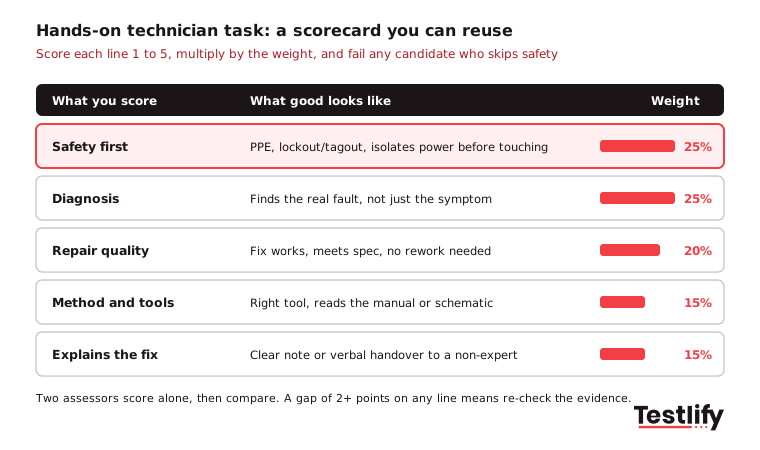
The scorecard below splits the hands-on task into five weighted criteria. Give every assessor the same sheet so each candidate is scored the same way.
- Safety first (25%): Isolates power, uses PPE, follows lockout/tagout. Treat a skipped safety step as a fail.
- Diagnosis (25%): Finds the root cause and explains how.
- Repair quality (20%): The fix works and meets spec.
- Method and tools (15%): Uses the right tools and checks the manual or schematic.
- Explains the fix (15%): Writes a clear service note or explains it to a non-technical person.
For a deeper look at test types for these roles, see Testlify's guide to pre-hire assessments for technicians.
What interview questions should you ask a technician?
The best interview questions for a technician ask for real past work and walk through how the candidate thinks, not textbook definitions. Use the same questions for every candidate and score each answer from 1 to 5 against what a strong answer contains.
Technical questions
- Walk me through the last fault you diagnosed. What did you check first, and why?
- Which equipment, brands or systems have you worked on most in the last two years?
- Tell me about a repair that did not work the first time. What did you do next?
- How do you use a schematic, wiring diagram or service manual on a job?
- Which test instruments do you use daily, and what readings tell you to stop and escalate?
Safety and quality questions
- Describe your lockout/tagout steps before you work on a powered machine.
- Tell me about a time you stopped a job because it was unsafe.
- How do you check your own work before you sign off a repair?
Working style questions
- How would you explain a costly repair to a customer or manager who is not technical?
- You have four open tickets and an urgent call comes in. How do you decide what to do first?
- How do you keep up with new equipment in your trade?
- Tell me about a time you trained or helped a less experienced colleague.
Strong answers name specific equipment, describe a clear order of checks and mention safety without being prompted. Vague answers ("I just figure it out") are a signal to probe.
Testlify also has a ready list of maintenance technician interview questions.
Technician job description template
A technician job description should state the trade, the equipment, the schedule, the must-have licenses and the pay range in the first few lines. Copy the template below and replace the brackets.
Job title: [Trade] Technician (for example, HVAC Service Technician, Industrial Maintenance Technician)
About us: [Company] [what you do, in one sentence]. Our technicians [what they keep running and who depends on it].
What you will do
- Carry out planned maintenance, inspections and repairs on [equipment or systems].
- Diagnose faults using [test tools, software, schematics] and fix them to spec.
- Follow safety procedures, including lockout/tagout and PPE rules.
- Record work orders and service notes in [CMMS or ticketing system].
- Explain issues and fixes to [customers, operators, users] in plain language.
- [Install new equipment / respond to on-call requests/travel to client sites].
What you need
- [X] years of experience with [equipment or trade], or completion of a [trade program or apprenticeship].
- [Required license or certification, for example EPA Section 608].
- A valid driver's license (field roles).
- Ability to [lift X lb, work at heights, work in confined spaces], if the role requires it.
Nice to have: [Manufacturer training, ASE or CompTIA certification, PLC experience].
What we offer: [Pay range], [shift pattern and overtime], [tools provided or tool allowance], paid training and certifications, [vehicle], health benefits and a clear path to senior or lead technician.
How to apply: Apply in under five minutes from your phone. Shortlisted applicants complete a short online skills test, followed by a hands-on task at our site.
Need a template for one role? Start from the maintenance technician job description or the field service technician job description.
How much does it cost to hire a technician?
The cost to hire a technician has two parts: the salary and the cost of filling the role. US median pay ranges from about $49,590 a year for general maintenance and repair workers to $64,100 for industrial machinery mechanics, based on BLS May 2025 data.
Experienced, licensed or on-call technicians earn more.
Technician type | Median pay per year | Median pay per hour | Projected job growth 2025 to 2035 | Openings per year |
|---|---|---|---|---|
General maintenance and repair | $49,590 | $23.84 | 4% | 148,700 |
Automotive service | $50,620 | $24.34 | 5% | 66,200 |
HVAC | $61,010 | $29.33 | 11% | 40,600 |
Computer user support (IT) | $61,860 | n/a | Decline of 3% | n/a |
Industrial machinery mechanics | $64,100 | $30.82 | 14% | 51,900 |
Source: BLS May 2025 data for industrial machinery mechanics and the BLS profiles for each trade.
The cost of filling the role includes job ads, referral or agency fees, assessor time for hands-on tasks and the cost of an empty seat: overtime for the rest of the team, outsourced repairs or downtime. In the Modern Materials Handling survey, 30% of employers outsource work they cannot staff, which is often the most expensive line.
Screening online before the hands-on stage keeps assessor time for the few candidates likely to pass.
How to hire a technician at volume: what changes across sites?
Hiring technicians at volume or across several sites changes the process in one way: every location must test, score and decide the same way, or quality drifts from site to site. Mid-market and enterprise teams that hire dozens of technicians a year usually add four controls.
- One test per role family: Use the same online screen for every "industrial maintenance technician" opening, whatever the site, so scores compare across locations.
- One shared scorecard: Give every site the same hands-on task sheet and weights, and train assessors on it once a year.
- Results in the ATS: Send test scores to the applicant tracking system so recruiters see the ranked list without exporting files.
- Languages and devices: Offer the test in the languages your crews speak and make it work on a phone, since many applicants never sit at a desk.
Track three numbers per site: days from application to offer, offer acceptance rate and 90-day retention. A site with a slower process or weaker retention shows up quickly, and you fix the step, not the whole program.
How do you keep a new technician after you hire them?
Keeping a new technician after the hire depends on the first 90 days: a safety induction, a named senior buddy, paired work that widens in steps and a clear training plan. BCG recommends pairing recruits with experienced technicians to shorten ramp-up time, and TechForce reports that 1.14 million US technicians left their jobs in 2025, so the onboarding plan protects the hire you just paid for.
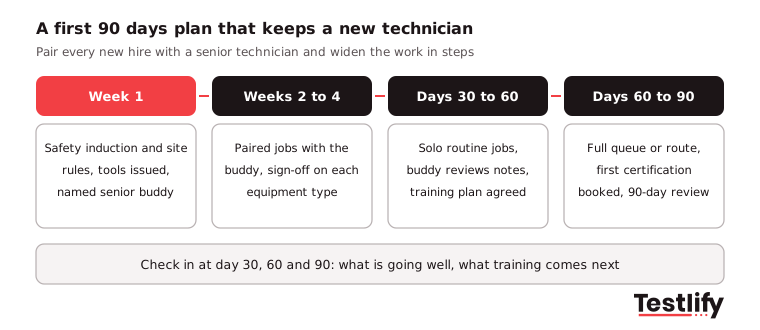
Pay, schedule and growth matter as much as onboarding. Predictable shifts, a clear on-call rota, a tool allowance and a visible path to senior or lead technician are what technicians compare when a competitor calls.
What mistakes should you avoid when hiring technicians?
The most common mistakes when hiring technicians are a vague role, a slow process and hiring on interview charm instead of shown skill. Each one is easy to fix.
- Posting a generic "technician" role: Name the trade and equipment so the right people apply.
- Asking for every certificate: Keep the must-have list short and fund the rest.
- Skipping the hands-on task: Candidates can talk through a repair they cannot do.
- Unscored interviews: Without a scorecard, the most confident talker wins.
- Moving slowly: In a short market, a two-week gap between interview and offer loses good people.
- Ignoring onboarding: A new hire left alone in week one is the easiest one for a competitor to poach.
Key takeaway: How to hire a technician well: define the trade first, screen online to rank the pool, prove skills with a scored hands-on task, offer within 48 hours and plan the first 90 days.
How does Testlify help you hire technicians?
Testlify helps hiring teams screen technician applicants on skills before anyone spends time in a workshop. You send one link after the application, every candidate gets the same trade and aptitude questions scored automatically, and your team books hands-on slots only for people likely to pass.
- Ready-made and custom tests: Choose from 3,500+ tests in the Testlify test library, including mechanical reasoning, electrical aptitude and trade tests, or build an assessment from your job description with the AI test builder.
- Fair, cheat-resistant results: 20+ proctoring checks, such as webcam snapshots, tab monitoring and copy-paste blocking, are part of anti-cheating and proctoring for remote tests.
- Fits your tools: Results sync through 100+ ATS and HR integrations, and tests run in 15+ languages for multilingual crews.
- Mobile-friendly invites: Candidates can be invited via WhatsApp, which suits field technicians who rarely sit at a desk.
Start a 7-day free trial with no credit card needed. Book a demo to see a technician hiring workflow built for your team.
Frequently asked questions (FAQs)

People and Talent Partner
Arushi Shah runs day-to-day talent acquisition and candidate experience at Testlify. She writes on interviewing, structured hiring, and giving candidates a fair, fast process.
LinkedInRelated resources
View all
Hiring Guide
How to hire parking attendants?

Hiring Guide
How to Hire a Miner: Skills, Cost, and Certifications

Hiring Guide
How to Hire a Millwright

Hiring Guide
How to hire a mechanic?

Hiring Guide
How to hire a manufacturing worker?

Hiring Guide
How to hire a packer: steps, skills, tests and interview questions
Get started.
Hire on proof, not resumes.
Run your first skills-based assessment free — no credit card required.