
How to choose the right cognitive ability test for hiring top talent
A practical way to pick cognitive tests for hiring: match abilities to the role, set your own cut score, check fairness and vet vendors.

Knowing how to choose the right cognitive ability test for hiring top talent comes down to one rule: start with the job, not the test catalog. The right test measures the few thinking skills the role really uses, runs early and short, is checked for fairness, and is scored against a cut score you set from your own people.
TL;DR:
- Choose a cognitive test by starting from a job analysis: list the 2 or 3 thinking skills the role uses daily, then pick tests that measure exactly those.
- Test 1 or 2 abilities, not 5. Overlapping tests such as problem solving plus critical thinking add time and drop-off without adding much signal.
- Keep it short and early: 10 to 20 minutes of timed questions at the screening stage, before interviews.
- Set your own cut score by piloting the test on current employees, instead of using a generic vendor norm.
- Check fairness at the test step: if any group passes at less than 80% of the top group's rate, the four-fifths rule flags possible adverse impact.
- Ask every vendor 8 questions on job fit, fairness evidence, accommodations, cheating controls, reports and ATS sync before you buy.
- Use the score as one input next to a structured interview and a job skills test, never as the only reason to reject.
 ChatGPT
 Gemini
 Claude
 Grok
 Perplexity
What does a cognitive assessment measure in hiring?
A cognitive assessment measures how well a candidate learns, reasons and solves problems they have not seen before. Most tests cover a few of these abilities: numerical reasoning, verbal reasoning, logical or abstract reasoning, attention to detail, critical thinking, spatial or mechanical reasoning, and processing speed.
Each ability matters in different jobs. A financial analyst lives in numbers. A customer support agent reads, writes and checks details all day. A software engineer spends hours on logic and abstract patterns. A good cognitive ability test for hiring picks the abilities the job uses and ignores the rest.
Learning ability matters more as jobs change. SHRM's 2025 Talent Trends survey found that 28% of organizations now require new skills for full-time roles and 47% are updating existing roles to include them. A cognitive assessment helps you spot people who will pick up those skills fast.
What a cognitive assessment does not measure is just as important. It says nothing about job knowledge, personality, motivation or how someone works with a team. Those need a skills test, a structured interview or a reference check.

Why does the choice matter for quality of hire?
The choice matters because a test that does not fit the role screens out good people and lets weak ones through, and you will not see the damage until months after they start. The wrong test also adds time and drop-off to every application, which hurts most in volume hiring.
Talent teams know the stakes. LinkedIn's Future of Recruiting 2025 found that 93% of talent acquisition professionals say accurately assessing skills is crucial to quality of hire, yet only 25% are highly confident they can measure quality of hire at all. The same report found that 89% expect measuring it to become more important.
The pressure is not easing either. SHRM's 2025 survey of 2,040 HR professionals found that 69% of organizations still struggle to fill full-time roles. When the pool is thin, a badly chosen test that rejects capable people costs you hires you cannot replace. For a wider view on measuring outcomes, see how to improve quality of hire.
How to choose the right cognitive ability test for hiring top talent in 7 steps
Choosing the right test takes seven steps: run a job analysis, map abilities to the role, pick the format and stage, check job-relatedness and fairness evidence, pilot on current staff, protect integrity and candidate experience, and confirm it fits your ATS. Most teams can finish all seven in two to three weeks.
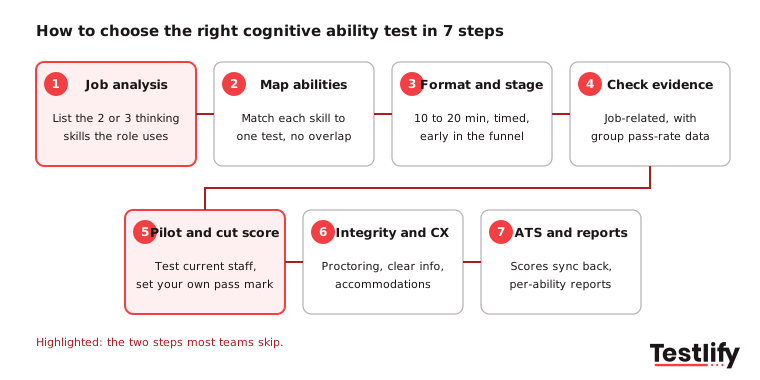
1. Start with a job analysis
Write down what the person in the role does every week and which thinking tasks decide success. Ask the hiring manager and two or three strong performers three questions: what problems they solve without a script, what information they handle (numbers, text, code, diagrams), and what mistakes are most costly. The answers point to 2 or 3 abilities. A short job analysis also gives you the record you need if anyone later asks why the test was used.
2. Map each ability to the role
Turn the job analysis into a short list of abilities, then match each one to a test. Use the role table in the next section as a starting point. Keep the list short: two tests that measure nearly the same thing, such as problem solving and critical thinking, add minutes without adding much new information. One cognitive test plus one role-specific skills test usually tells you more than three cognitive tests.
3. Pick the format, length and stage
Use timed, multiple-choice tests of about 10 to 20 minutes per ability for screening. Longer batteries belong later, for senior or specialist roles where fewer candidates reach that stage. Place the cognitive test early, right after knockout questions, so candidates take it while they are fresh and before your team spends time on interviews. Mobile-friendly tests matter for frontline and volume roles, where many candidates apply from a phone.
4. Check job-relatedness and fairness evidence
Ask the vendor how each test was built and checked, and for which kinds of roles. You want evidence that scores relate to performance in jobs like yours, plus data on how different groups score. The EEOC's guidance on employment tests says tests must be job-related and consistent with business necessity, and that employers should check tests for each position even when a vendor supplies its own evidence.
5. Pilot on current employees and set your own cut score
Before launch, have 15 to 30 current employees in the role take the test. Compare the scores of your strongest and average performers. Set your pass mark where the test separates them, not at a generic vendor norm or a round number like 70%. Recheck the cut score after your first 50 to 100 candidates, and again after six months when you can compare test scores with early performance.
6. Protect integrity and candidate experience
Online tests need cheating controls: randomized questions, full-screen mode, tab-switch tracking, webcam snapshots and checks for AI-assisted answers. At the same time, keep the experience clean. Tell candidates how long the test takes, what it measures and how the score is used. Offer accommodations such as extra time or a screen reader for candidates who ask.
7. Confirm it fits your ATS and reporting
The best test fails if recruiters have to copy scores by hand. Check that invites go out from your ATS, scores sync back to the candidate profile, and reports show a per-ability breakdown a hiring manager can read in a minute. Benchmarks against other candidates for the same role help you compare people fairly.
Pro tip: Run the pilot in step 5 before you sign a long contract. A two-week pilot on your own staff tells you more about fit than any sales demo.
Which cognitive assessment fits which role?
The right cognitive assessment depends on the thinking the role uses most: numerical reasoning for finance and analytics, verbal reasoning and attention to detail for support and operations, logical and abstract reasoning for engineering, and mechanical reasoning for technicians. The table below is a starting map; adjust it with your own job analysis.
Role family | Abilities to test | Example Testlify tests | Suggested length |
|---|---|---|---|
Finance, accounting, data analysis | Numerical reasoning, attention to detail | Numerical reasoning, attention to detail (textual) | 20 to 30 min |
Customer support, BPO, sales | Verbal reasoning, attention to detail | Verbal reasoning, attention to detail (textual) | 15 to 20 min |
Software engineering, IT | Logical and abstract reasoning, problem solving | Logical reasoning, abstract reasoning | 20 to 30 min |
Operations and project roles | Critical thinking, problem solving | Critical thinking, problem solving | 20 min |
Technicians, manufacturing, field service | Mechanical and spatial reasoning | Mechanical reasoning | 15 to 20 min |
Graduates and early careers | Learning ability across 2 areas | Numerical plus verbal or logical reasoning | 20 to 30 min |
Each ability has its own test in the Testlify library: numerical reasoning, verbal reasoning, logical reasoning, abstract reasoning, critical thinking and mechanical reasoning.
Senior roles are the exception. For leaders, experience and judgment matter more than raw reasoning speed, so a cognitive test should carry less weight than a case study or a structured interview.
What should you ask a cognitive test vendor?
A cognitive test vendor should be able to answer eight questions clearly and in writing: how the tests fit your roles, what fairness data exists, how accommodations work, how cheating is stopped, how cut scores are set, what reports look like, how it connects to your ATS and how pricing works. Vague answers to the first three are a reason to walk away.
Question to ask | What a good answer looks like |
|---|---|
Which roles were these tests built and checked for? | Named role families close to yours, with how the test relates to job performance |
How do different groups score? | Pass-rate data by gender and ethnicity, and how gaps were reduced |
Do you have an independent bias audit? | A third-party audit you can share, as required for automated tools in New York City |
How do candidates request accommodations? | Extra time, screen reader support and a simple request process |
How do you stop cheating? | Proctoring, randomized questions, AI-assistance detection, clear logs |
How should we set the cut score? | Help to benchmark on your own employees, not one fixed number |
What do reports and integrations look like? | Per-ability scores, benchmarks, two-way ATS sync |
How does pricing work at our volume? | A clear model per candidate or per year, with a free trial |
The bias audit question matters most if you hire in New York City, where Local Law 144 requires a bias audit within one year before an automated tool is used to score candidates, a public summary of the results and notice to candidates.
What are the red flags when choosing a cognitive test?
The red flags are tests that are too broad, too long, too easy to game or impossible to explain. Any one of them can cost you good candidates or create legal risk, so treat them as reasons to keep looking.
- IQ-style general tests: One score for "intelligence" is too broad to tell you how someone will do in a specific job, and it is harder to defend as job-related.
- Fixed vendor cut-offs: A pass mark set for someone else's workforce may reject strong candidates for your role.
- Untimed, unproctored tests: Without time limits and cheating controls, scores reflect who used help, not who can reason.
- Long batteries at the first stage: Every extra minute raises drop-off, and the people who leave first are often the ones with the most options.
- No accommodation process: If a candidate cannot ask for extra time or an accessible format, you are exposed under disability law.
- No group-level data: A vendor that cannot show how different groups score cannot help you check adverse impact.
- Score as the only filter: Rejecting on one number ignores experience and skills the test never measured.
Key takeaway: The best cognitive test is the one that measures the 2 or 3 abilities your role needs, with a cut score you set from your own people and fairness you can show on paper.
How do you keep cognitive testing fair and legal?
Cognitive testing stays fair and legal when the test is clearly linked to the job, pass rates are checked by group, accommodations are offered, and the score is one input among several. Reasoning tests can show larger score gaps between groups than skills tests or interviews, so monitoring is not optional.
- Check the four-fifths rule: Under the US Uniform Guidelines, 29 CFR 1607.4(D), a selection rate for any group below 80% of the rate for the group with the highest rate is generally treated as evidence of adverse impact. Check it at the test step, not only at the offer stage.
- Offer accommodations: The ADA requires reasonable accommodations in how a test is given, such as extra time or a reader, unless it causes undue hardship. Say how to ask for one in the invite.
- Document job-relatedness: Keep the job analysis, the abilities chosen and the pilot results. This record shows why the test fits the role.
- Combine measures: Pair the cognitive test with a role skills test and a structured interview. A mix of measures predicts better and narrows group gaps.
- Watch AI and local rules: New York City requires a yearly bias audit and candidate notice for automated scoring tools, and the EU AI Act treats AI used to evaluate job candidates as high-risk.
The EEOC's own guidance shows what happens when this is skipped. Ford replaced a written test of verbal, numerical and spatial reasoning after it was found to screen out African American applicants at a higher rate.
How does Testlify help you choose and run cognitive tests?
Testlify helps you choose and run cognitive tests by putting ready-made cognitive tests, role-based recommendations, proctoring and ATS sync in one platform. You can build an assessment from a job description, add one or two cognitive tests next to a skills test, and compare candidates on the same scores.
- Ready-made cognitive tests: The library of 3,500+ tests includes numerical, verbal, logical, abstract, inductive and deductive reasoning, critical thinking, attention to detail and mechanical reasoning, at beginner to advanced levels.
- Built from the job: The AI test builder turns a job description into a role-specific assessment and suggests tests for the role, so steps 1 and 2 start from a draft instead of a blank page.
- Your own cut score: Weighted scoring, score thresholds for auto-shortlisting and benchmarks against other candidates let you set and adjust a pass mark that fits your team.
- Integrity built in: 20+ proctoring checks cover full-screen mode, tab tracking, webcam snapshots, copy and paste blocking and AI-assistance detection.
- Fits your stack: Two-way sync with 100+ ATS and HRIS tools through Testlify integrations, and tests in 15+ languages for global hiring.
- Audited: Testlify's matching model completed a third-party NYC bias audit under Local Law 144 on June 16, 2023.
For more on building cognitive tests into your process, see how to add cognitive tests to your hiring process and reasons to use cognitive tests in recruitment.
Ready to build your first cognitive assessment?
Pick one open role, run the job analysis, and build a short assessment with one cognitive test and one skills test. Start a 7-day free trial of Testlify, no credit card required, or book a demo to see cognitive tests set up for your roles.
Frequently asked questions (FAQs)

Head of Assessments
Usha brings a rare depth of expertise to Testlify’s assessment function, over 40 years of multidisciplinary experience spanning banking, insurance, healthcare, automotive, IT services, manufacturing, pharmaceuticals, and enterprise software. At Testlify, she ensures that every assessment, scoring methodology, and competency structure meets the highest standards of enterprise-grade transparency, fairness, and consistency, the kind that holds up under audit and earns the trust of the world’s most rigorous hiring teams.
LinkedInRelated resources
View all
HR & recruitment
How to integrate cognitive ability tests into your hiring process

HR & recruitment
Culture fit assessments for hiring remote teams

HR & recruitment
How Situational Judgement Tests (SJTs) find the best fits

HR & recruitment
Talent assessment best practices: 10 rules for hiring teams

HR & recruitment
How to implement psychometric tests in recruitment

HR & recruitment
Remote technical skills assessments: Challenges and best practices
Get started.
Hire on proof, not resumes.
Run your first skills-based assessment free — no credit card required.