
Global hiring challenges and how enterprises are solving them
Discover the top global hiring challenges and how HR leaders are solving compliance, payroll, and remote workforce issues at scale.

Global hiring challenges are the legal, financial, cultural, and evaluation hurdles that show up the moment an enterprise starts employing people across borders. The short version: compliance and payroll get complicated fast, communication gets harder across languages and time zones, and judging talent fairly gets murky when a resume from one country tells you very little about a candidate in another. None of these are reasons to stay local. They are reasons to hire globally with a system instead of by improvisation.
The pressure to solve this is only rising. Migration into OECD countries hit a record 6.5 million permanent arrivals in a single year, up 10% year over year, with a third of member countries setting new highs (OECD, 2024). At the same time, 74% of employers worldwide say they cannot find the skilled people they need (ManpowerGroup, 2025). Put those two facts together and the message is blunt: the talent exists, it is just spread across the map, and the enterprises that can hire it well win.
 ChatGPT
 Gemini
 Claude
 Grok
Grok Perplexity
TL;DR
- Compliance is the highest-stakes global hiring challenge, because each country writes its own rules on contracts, tax, misclassification, and data privacy.
- Payroll, benefits, time zones, and language add operational drag, but they are solvable with an Employer of Record, global payroll, and async-first habits.
- The quieter, costlier problem is evaluation: a resume does not travel well across borders, so fair, like-for-like assessment of skills is what actually separates a good global hire from a lucky one.
- Global hiring solves real business problems too: talent shortages, high local costs, and a shortage of fresh thinking.
- The enterprises that get this right treat global hiring as a repeatable workflow with objective evidence at its center, not a series of one-off exceptions.
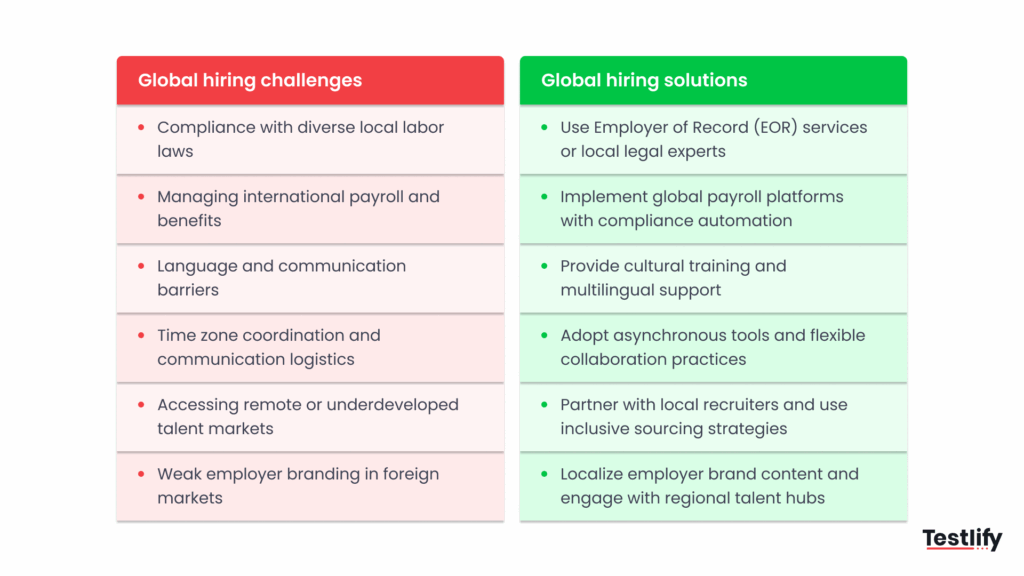

What are the biggest global hiring challenges?
The biggest global hiring challenges are compliance with local labor and tax law, international payroll and benefits, cultural and language differences, time-zone coordination, and fair candidate evaluation. Compliance sits at the top because getting it wrong is not a hiccup. It is legal exposure, back taxes, and brand damage in a market you were trying to grow in.
Here is the honest picture across the six that trip up enterprise teams most, and the move that actually works for each.
Challenge | Why it is hard | How enterprises solve it |
|---|---|---|
Legal and tax compliance | Every country sets its own contract, dismissal, tax, and benefit rules; a legal practice at home can be a violation abroad. | Hire through an Employer of Record or a local entity, backed by a compliance framework. |
Payroll and benefits | Multi-currency pay, statutory contributions, and localized benefits are easy to get wrong at scale. | Run global payroll platforms with a single consolidated view. |
Language and communication | Fluent English still hides regional tone, idiom, and context gaps that cause real misunderstandings. | Set clear written norms and offer communication and language support. |
Time-zone coordination | A 10-hour gap makes live meetings a tax on someone’s evening. | Default to async work with a few deliberate overlap hours. |
Fair candidate evaluation | Degrees, school brands, and past employers do not compare cleanly across countries. | Score every candidate on the same role-based skills evidence. |
Employer brand abroad | Local talent may have never heard of you, so trust is low. | Invest in local presence, referrals, and a strong candidate experience. |
What are the challenges of hiring international employees?
The core challenges of hiring international employees are staying compliant with local law, classifying workers correctly, running accurate cross-border payroll, and protecting candidate data under rules like GDPR. Get any one wrong and the cost lands on the business, not the worker.
Misclassification is the trap most teams fall into first. Treating someone as a contractor when local law says they are an employee can trigger back taxes, penalties, and mandatory benefits, sometimes years later. Then there is permanent establishment: hire one senior person in a new country the wrong way, and you can accidentally create a taxable business presence there. And immigration rules vary wildly. Some countries cap foreign workers or require you to prove a local candidate could not do the job.
Skills disruption makes the timing harder. WEF expects 39% of workers’ core skills to change by 2030, and 63% of employers already name skill gaps as the single biggest barrier to transforming their business (WEF Future of Jobs, 2025). So you are not just hiring across borders. You are hiring for roles that are shifting under your feet, which raises the bar on how carefully you assess.
Pro tip: Before you hire your first employee in a new country, decide contractor versus employee with a local expert, not a template. The classification choice drives tax, benefits, and termination rights, and it is the single decision most likely to become an expensive surprise 18 months later.
What business problems are solved with global hiring?
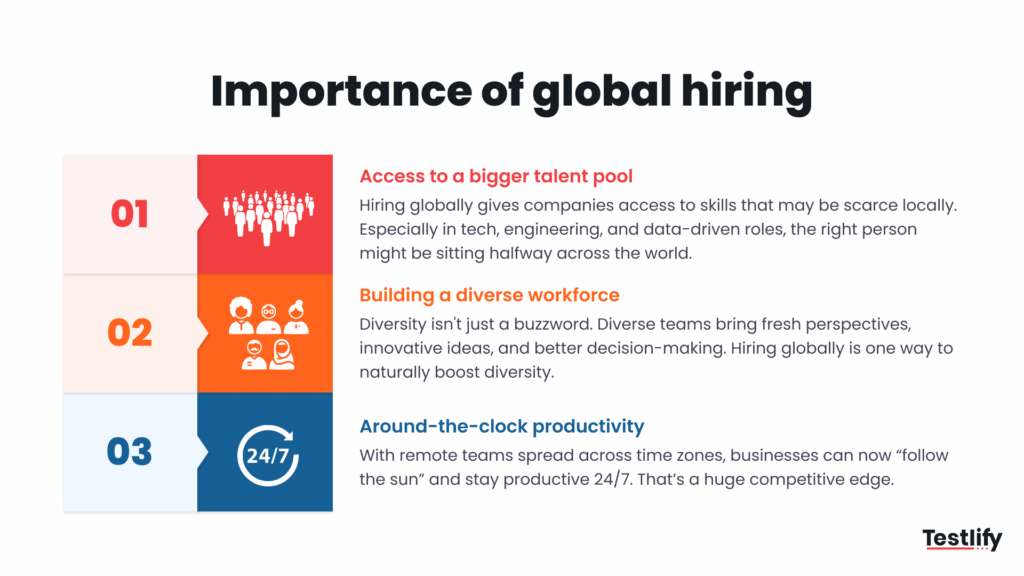
Global hiring solves three business problems at once: talent shortages, high local costs, and stale thinking. When you can hire anywhere, a scarce skill at home becomes an ordinary hire somewhere else, and the math on both speed and budget changes.
Start with scarcity. In the US alone there were roughly 7.4 million open jobs in mid-2025 (BLS JOLTS, 2025), and the global picture is tighter still. Widening the map is often the only realistic way to fill a specialized role this quarter instead of next year. Cost follows: access to markets with different salary bands can lower the cost of a role, though the smart framing is a better-matched hire, not just a cheaper one.
Then there is the quality argument, and it is not soft. Companies in the top quartile for executive-team diversity are 39% more likely to financially outperform their peers (McKinsey, 2023). A team built across markets brings different customer instincts and different problem-solving defaults. That mix is hard to fake with a domestic hire pipeline. This is where skills-based hiring earns its keep, because it lets you widen the pool without lowering the bar.
How enterprises are hiring employees globally
Most enterprises hire employees globally through one of two doors: set up a local legal entity, or hire through an Employer of Record that already has one. The entity route gives you full control and pays off at scale in a market you are committed to. The EOR route is faster and lighter, which is why it dominates early market entry and surge hiring, when a product launch suddenly needs 10 people in 3 countries without degrading the candidate experience.
Whichever door you pick, the operating pattern is consistent: run compliant local payroll, localize benefits, default to async communication with a couple of real overlap hours, and keep the whole thing inside a documented workflow rather than a pile of exceptions. Strong cross-border talent acquisition is repeatable, not heroic.
Talent assessment challenges for enterprise hiring teams
Enterprise hiring teams handle talent assessment challenges by scoring every candidate against the same role-based evidence, so a strong hire in Manila and a strong hire in Berlin are measured on identical criteria. This is the challenge the EOR and payroll conversation quietly skips. You can be perfectly compliant and still hire the wrong person because you trusted a resume that does not mean the same thing across two countries.
Degrees inflate at different rates. School prestige is local knowledge. Past-employer brand names carry weight in one market and none in another. Lean on those signals globally and you import bias and noise. The fix is to define what the role actually requires, then measure it directly. That is the idea behind the Testlify Competency-to-Evidence Matrix: map each role to the competencies that matter, connect every competency to measurable evidence through skills assessments, simulations, and structured interviews, and evaluate candidates consistently against that evidence instead of against their paperwork. One rubric, every country, same bar.
Remote assessment adds its own wrinkle: trust. When candidates test from home in a dozen countries, integrity controls (identity checks, proctoring signals, and reviewable evidence) keep the results credible without treating every candidate as a suspect. Pairing objective scoring with language fairness in assessments is what makes a global shortlist something you can actually defend to a hiring committee.
What makes the most reliable international employment platform for global talent acquisition?
The most reliable international employment platform for global talent acquisition is the one that standardizes evaluation across every market while respecting each country’s rules. Reliability here means consistency: the same competencies, the same scoring, and the same integrity controls whether the candidate sits in Lagos or Lisbon. Compliance tooling gets people legally onto payroll. Consistent, evidence-based evaluation is what makes sure the right people get there in the first place. Enterprises usually combine both, and connect the results into their ATS so nothing gets re-keyed by hand.
Challenges in global executive recruitment
Challenges in global executive recruitment run deeper than volume hiring, because the stakes and the scrutiny are higher. Assessing leadership judgment across cultures is genuinely hard: a decision style that reads as decisive in one market can read as reckless in another. Compensation expectations swing by region, notice periods stretch for months, and a single mis-hire at this level is expensive enough to erase the savings from a whole global program. Structured evidence matters even more here, paired with references and multiple reviewers, so the decision rests on more than one persuasive interview.
How are enterprises solving global hiring challenges?
Enterprises are solving global hiring challenges by combining compliant infrastructure with disciplined evaluation. On the infrastructure side, that means EOR or entity coverage, global payroll, a governance and risk framework, and async-first collaboration. On the people side, it means upskilling their own recruiters, because 85% of employers plan to make upskilling their top workforce strategy this decade, part of a labor market WEF expects to add 78 million net new jobs by 2030 (WEF, 2025), and a recruiter who understands both compliance and skills-based evaluation is worth more than another tool.
The through-line is simple. The winners stop treating each international hire as a special case and start running one repeatable system: define the role, gather objective evidence, stay compliant locally, and decide with humans who trust the data in front of them. That is also how you keep remote hiring at global scale from turning into chaos.
Hire the right people in every market, not just the compliant ones. Testlify lets enterprise teams evaluate candidates worldwide on the same role-based skills evidence, with built-in assessment integrity for remote testing. Give every hire the same fair bar, wherever they are.
Key takeaways
- Compliance is the load-bearing challenge. Local labor, tax, and misclassification rules carry the highest downside, so build compliant infrastructure (EOR or entity plus a risk framework) before you scale headcount, not after the first audit letter.
- Payroll and coordination are solved problems. Global payroll platforms and async-first habits handle multi-currency pay and time zones, which frees your team to spend attention on the parts that actually differentiate a good hire.
- Evaluation is the hidden failure point. Resumes and school brands do not translate across borders, so scoring candidates on the same role-based evidence is what prevents an expensive wrong hire that compliance tooling would never catch.
- Global hiring is a growth lever, not just a cost play. It fills scarce roles faster and adds the cross-market diversity linked to 39% higher odds of outperformance, so frame it as better hiring, not cheaper hiring.
- One system beats one-off exceptions. The enterprises that win treat every international hire through the same workflow: define the role, gather evidence, stay locally compliant, and let humans make the final call on trustworthy data.
- Upskill your recruiters. With 85% of employers betting on upskilling, a recruiter fluent in both compliance and skills-based evaluation returns more than any single new tool you could buy.
Frequently asked questions about global hiring

Content Writer
Yashika Khandelwal is a Content Writer with 3+ years of experience creating research-backed content on hiring, talent assessment, and HR technology. She is a registered Organizational Psychologist and subject matter expert who combines behavioral science with practical recruitment insights to produce accurate, evidence-based content.
LinkedInRelated resources
View all
HR & recruitment
When candidates show their true colors: interview red flags to look out for

HR & recruitment
Tips for conducting your first job interview as an HR intern

HR & recruitment
Optimizing Talent Acquisition: Integrating AI and PPC Strategies

HR & recruitment
Top reasons to study human resource management in 2026

HR & recruitment
Using gameplay as a resume: how professional skills are shown in game behaviour

HR & recruitment
Smarter operations: bridging talent management, workflow automation, and compliance
Get started.
Hire on proof, not resumes.
Run your first skills-based assessment free — no credit card required.