
Candidate persona: A complete guide for recruiters
Discover how candidate personas streamline recruitment by identifying ideal traits, enhancing hiring strategies, and building stronger, cohesive teams.

Have you ever struggled to find the perfect candidate despite countless job postings? You’re not alone. In today’s job market, attracting top talent demands a strategic approach.
This is where creating a candidate persona comes into play. It helps recruiters align their recruitment strategies with what truly matters to potential hires.
Understanding who your perfect candidate is allows you to create personalized job postings, and strengthen your employer brand. It also elevates the overall candidate experience.
This guide will walk you through creating a compelling candidate persona that can streamline your recruitment process and help you attract top-tier talent every time.
 ChatGPT
 Gemini
 Claude
 Grok
Grok Perplexity
What is a candidate persona?
A candidate persona is a clear representation of the ideal job candidate you want to hire. It serves as a strategic guide for shaping your recruitment efforts by focusing on the attributes that matter most for a specific role.
While skills and qualifications are fundamental, a well-defined candidate persona goes deeper. It highlights essential traits such as communication style, work ethic, motivations, and professional goals. These are the qualities that determine long-term success within your organization.
For example, if technical expertise in a particular field is crucial, your recruitment team should prioritize candidates with verified credentials in that area. Similarly, if promoting a collaborative work environment is a priority, focus on individuals who exhibit strong teamwork and adaptability.
Although adding personal details like a name or age can make the persona more relatable. It’s essential to avoid biases and ensure that your hiring criteria remain inclusive and centered on relevant professional attributes.

Why is a candidate persona important?
Creating a candidate persona is a critical strategy for businesses aiming to attract and retain top talent. Below are the reasons why developing a well-defined candidate persona matters:
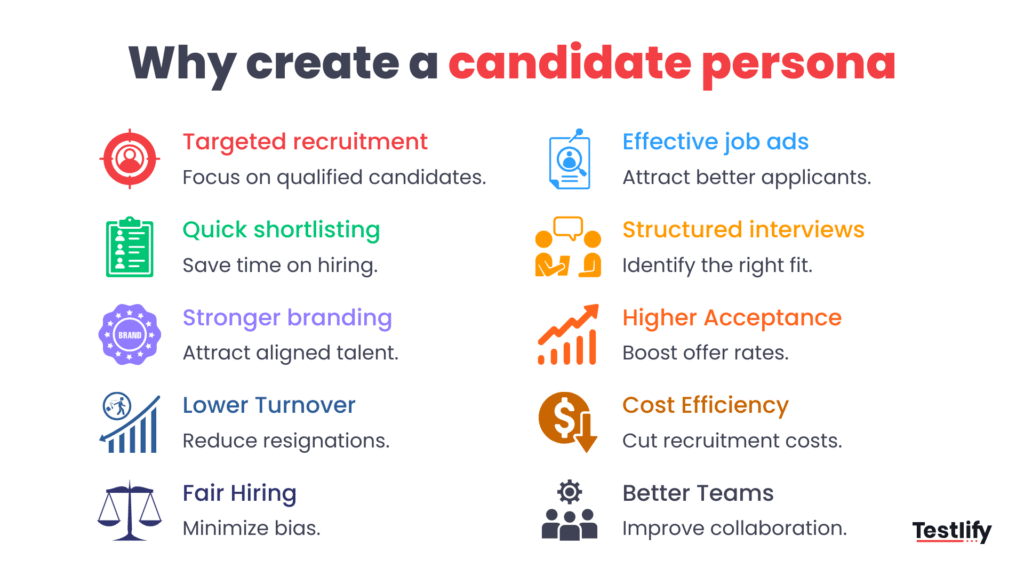
- Enhanced recruitment accuracy: It sharpens your focus on qualified candidates by outlining the exact skills and traits needed.
- Better job advertisements: Tailored job descriptions that resonate with the right candidates increase applicant quality.
- Streamlined shortlisting: A candidate persona helps narrow down applicants faster. This in turn saves time and effort.
- Improved interview process: With a clear understanding of the ideal candidate, interviews become more structured and effective.
- Stronger employer branding: Clear expectations build trust and attract talent aligned with your company’s values.
- Higher offer acceptance rates: Candidates see themselves reflected in personalized job postings, which boost acceptance rates.
- Lower employee turnover: Hiring people with the right cultural fit reduces the likelihood of early resignations.
- Optimized recruitment budget: Focusing on well-matched candidates means fewer hiring cycles and reduced cost per hire.
- Reduced hiring bias: Data-driven personas minimize subjective decisions. This in result ensures a fair and inclusive hiring process.
- Better team dynamics: Employees hired through well-defined personas are more likely to adapt, collaborate, and thrive.
How to create a candidate persona?
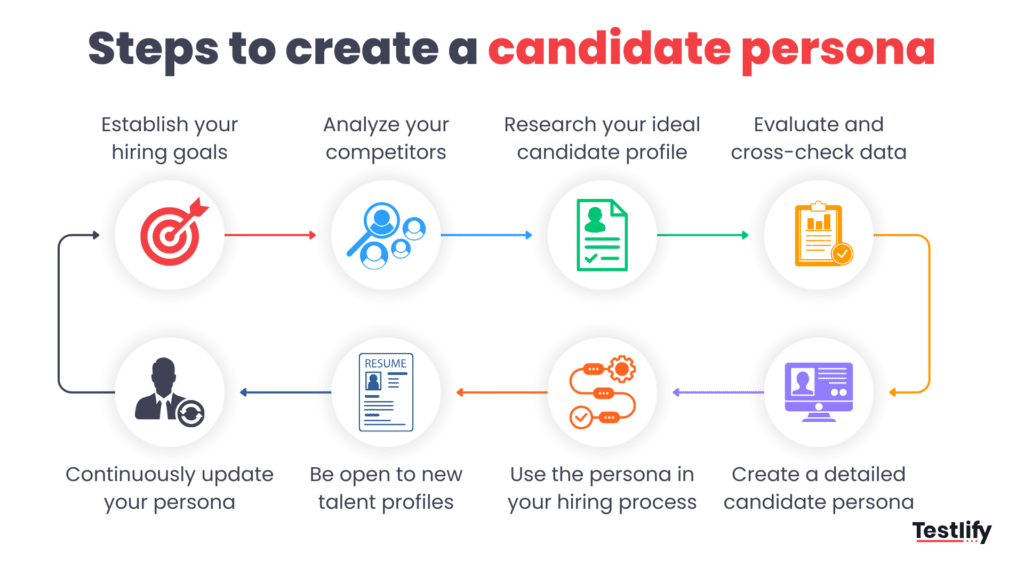
Creating a candidate persona is a strategic process that requires thorough research and planning. It involves understanding the ideal traits, skills, and experiences that align with your hiring goals. Let’s explore the essential steps involved in building an effective candidate persona.
Step 1: Establish your hiring goals
Begin by clearly defining what you want to achieve with your candidate persona. Are you trying to fill a specific role faster, improve the quality of applicants, or enhance team compatibility? Clarifying these goals will shape the entire process.
Step 2: Analyze your competitors
Research how your competitors approach hiring. Review their job postings, career pages, and employer branding strategies. Explore the types of candidates they attract through job boards, social media, and review platforms to identify market gaps or opportunities.
Step 3: Research your ideal candidate profile
Conduct in-depth research by interviewing hiring managers and top-performing employees. Analyze the profiles of past successful hires to identify common traits, skills, and career paths. Surveys and feedback sessions can also provide valuable insights into what makes a strong candidate.
Step 4: Evaluate and cross-check data
Examine all collected data for recurring qualities, skill sets, and personality traits. Compare findings with input from stakeholders. Here you need to ensure that nothing crucial is overlooked. This cross-verification prevents bias and enhances accuracy.
Step 5: Create a detailed candidate persona
With validated insights, build a comprehensive profile. Include critical aspects such as required skills, qualifications, experience, cultural fit, and career aspirations. Ensure the persona reflects realistic expectations without stereotypes or unnecessary specifics.
Step 6: Use the candidate persona in your hiring process
Apply your candidate persona by customizing job descriptions, crafting personalized interview questions. Also focus on marketing efforts on platforms where your ideal candidates are most likely to be active. Use the profile as a reference throughout the hiring process.
Step 7: Be open to new talent profiles
While having a specific persona is helpful, remain flexible. Consider candidates with transferable skills, diverse experiences, and a growth mindset. This approach can uncover hidden talent and encourage workplace innovation.
Step 8: Continuously update your persona
The job market evolves rapidly, and so should your candidate persona. Regularly revisit and adjust it based on new hiring outcomes, industry trends, and feedback from recruitment teams. This keeps your recruitment strategy fresh and effective.
How are candidate personas used in recruitment?
Candidate personas play a pivotal role throughout the recruitment process, enhancing efficiency and boosting hiring success. They guide recruitment marketing efforts by targeting specific talent pools, ensuring job ads reach the right audience.
Personas also streamline the application review process by helping hiring teams identify ideal candidates faster.
Additionally, they enhance interview preparation, which can enable tailored questions that assess both technical and cultural fit.
By integrating candidate personas into every hiring stage, businesses can optimize their recruitment strategies and build stronger, more cohesive teams.
Candidate persona example
Details | Description |
|---|---|
Professional Background | Currently a mid-level software developer with experience in developing scalable web applications. |
Current Occupation | Software Engineer or Developer in a similar role, preferably in a technology-driven organization or startup environment. |
Professional Experience | 4-6 years of programming experience, including working with JavaScript, Python, and cloud technologies. Experience with agile methodologies is a plus. |
Education | Bachelor’s degree in Computer Science or related field. Advanced certifications (e.g., AWS Certified Developer) are preferred but not mandatory. |
Key Skills | Proficient in full-stack development, problem-solving, and debugging. Experience in cloud services and frameworks like React and Node.js. |
Career Goals | Aims to take on lead developer roles within the next 2-3 years. Motivated by opportunities to work on challenging, high-impact projects. |
Personality Traits | Analytical, innovative, and team-oriented. Excels in collaborative settings and thrives in problem-solving environments. |
Communication Style | Clear and concise in written and verbal communication. Prefers structured discussions and efficient collaboration tools. |
Work Style | Adopts an agile mindset, thrives in fast-paced environments, and values productivity-driven flexibility. |
Culture Fit | Aligns with companies that value innovation, teamwork, and work-life balance. Supports open feedback and continuous learning cultures. |
Candidate persona vs job description: What’s the difference?
Understanding the distinction between a candidate persona and a job description is crucial for a cohesive recruitment strategy. While both tools are essential, they cater to different aspects of the hiring process.
Aspect | Candidate persona | Job description |
|---|---|---|
Purpose | Defines the ideal candidate’s attributes, motivations, and cultural fit. | Outlines the role’s responsibilities, required qualifications, and skills. |
Focus | Centers on the individual who will thrive in the position and organization. | Focuses on the tasks and expectations of the role itself. |
Components | Includes soft skills, personality traits, career goals, and preferred work style. | Lists technical skills, educational qualifications, and job-specific duties. |
Audience | Primarily for internal use by recruiters and hiring managers. | Written for potential candidates to understand job requirements. |
Use case | Guides recruitment strategies, shortlisting, and interview processes. | Acts as a formal job advertisement to attract applications. |
Utilizing both ways ensures recruiters achieve a balanced approach. This in turn offers clarity to candidates while effectively targeting the ideal talent pool.
Final thoughts
Developing and using candidate personas is a necessity in modern recruitment. These personas not only streamline the hiring process but also ensure the selection of candidates who align with your organizational culture and long-term goals.
When paired with well-crafted job descriptions, candidate personas become the cornerstone of a successful recruitment strategy. Start creating yours today to transform your hiring outcomes and build stronger, more cohesive teams.
Frequently asked questions (FAQs)

B2B SaaS Content Writer
Rishav Kumar is a B2B SaaS content writer with 4 years of experience. He loves crafting engaging content. Always exploring fresh ideas, he's passionate about helping businesses grow through impactful writing.
LinkedInRelated resources
View all
HR & recruitment
Why and how to choose the right recruitment CRM?
HR & recruitment
Compassionate leave: A guide for HR and employees

HR & recruitment
What is E-Recruitment? Pros, cons, strategies for 2026

HR & recruitment
11 core HR functions every recruiter should know in 2026

HR & recruitment
Interview to hire ratio: A complete guide for hiring teams

HR & recruitment
Revenue per FTE: Formula, Benchmarks, and How to Improve It
Get started.
Hire on proof, not resumes.
Run your first skills-based assessment free — no credit card required.