
Breaking hiring silos: Aligning TA with L&D and DEI
Break hiring silos by aligning TA, L&D, DEI, and business strategy to build a future-ready, inclusive, and agile workforce. Learn how in this guide.

Talent is every organization’s greatest asset and its greatest challenge. Yet despite investing heavily in recruitment, training, and diversity initiatives, many companies still struggle to build the workforce they need. Why? Because their talent functions are working in silos.
According to a LinkedIn report, 93% of organizations say they are concerned about employee retention, but only 48% align their learning and talent strategies effectively.
Too often, Talent Acquisition (TA), Learning & Development (L&D), Diversity, Equity & Inclusion (DEI), and business strategy operate independently, each pursuing its own goals with limited collaboration. This disjointed approach results in misaligned priorities, fragmented data, and wasted resources, all while the competition grows stronger.
It’s time to change that.
This blog explores why breaking hiring silos is critical, how to align your key talent functions, and what enterprise HR leaders can do today to create a more connected, agile, and future-ready workforce.
 ChatGPT
 Gemini
 Claude
 Grok
Grok Perplexity
Why silos in hiring exist in the first place?
Before we can solve the problem, we need to understand how it started. Hiring silos didn’t appear overnight they’re often the result of traditional structures, misaligned priorities, and a lack of communication between departments. Let’s explore why these silos persist and how they impact your talent strategy.
The traditional structure
Historically, large organizations have treated TA, L&D, DEI, and strategic planning as separate domains. Each has its own KPIs, leaders, budgets, and operational processes. This division was manageable when business environments were more stable and predictable. Today, it’s a liability.
Competing priorities
Each function is under pressure to deliver on its own metrics. TA wants to fill roles fast. L&D wants to focus on skill-building and career growth. DEI aims to ensure representation and equity. Meanwhile, business strategy might prioritize profitability, growth, or transformation. When these priorities don’t sync, confusion and inefficiencies follow.
Lack of shared language
Without a shared vocabulary and goals, cross-functional collaboration often breaks down. For example, TA may talk about “culture fit,” while DEI emphasizes “culture add.” Both want the same outcomea strong, inclusive teambut they’re not always aligned on how to get there.

Why it’s time to break the silos?
Keeping TA, L&D, DEI, and business strategy in separate lanes no longer works in the present environment.
Alignment isn’t just a nice-to-have; it’s a strategic necessity. Here’s why bringing these functions together is crucial for building a resilient and future-ready organization.
Talent is the bridge between strategy and execution
No matter how brilliant your business strategy is, it won’t succeed without the right people in the right roles at the right time. TA is the entry point for this talent, but L&D, DEI, and strategic planning must be involved to shape that talent pipeline effectively.
Skills are the new currency
According to numerous workforce studies, we’re in a skills-based economy now. This means hiring based solely on job titles or credentials is outdated. To stay competitive, enterprises must identify skills gaps, hire for potential, and upskill continuouslysomething that requires TA and L&D to work hand in hand.
Inclusion drives performance
Companies with strong DEI practices consistently outperform those without. But DEI can’t just be a post-hire initiative. It starts at the sourcing stage and continues through onboarding, development, and promotion. Alignment across TA, DEI, and L&D ensures that inclusion is embedded into the employee lifecycle.
Cost and efficiency pressures
Duplication of effort and misaligned programs cost money. When hiring and development efforts overlap or contradict, budgets are wasted. Integrated strategies reduce redundancy and maximize ROI.
How to break the silos: A step-by-step guide
Breaking silos requires more than just good intentions. It demands practical steps, consistent collaboration, and a unified vision.
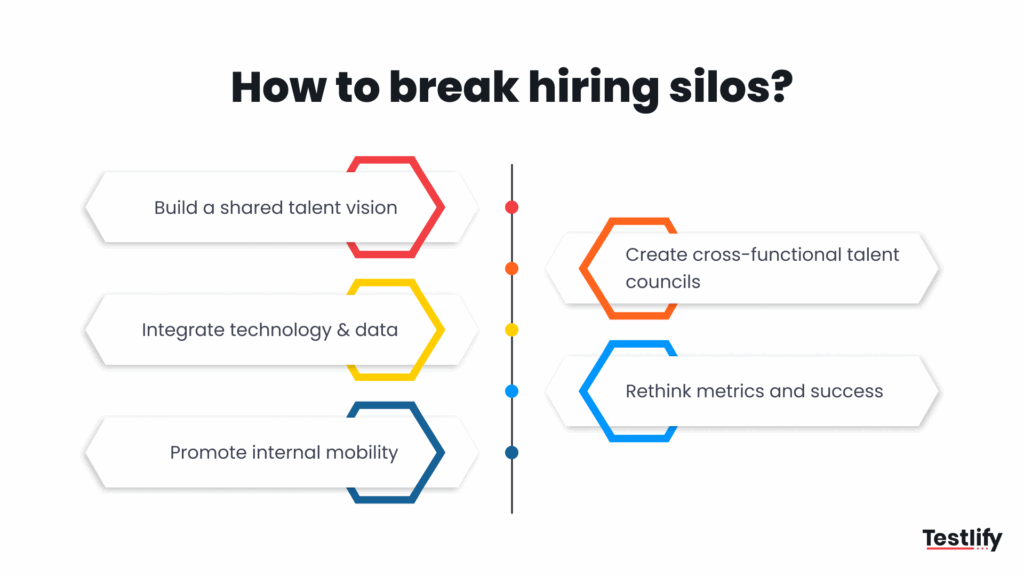
Step 1: Build a shared talent vision
Align TA, L&D, DEI, and business leadership around a unified talent vision. Ask key questions like: What skills and experiences does the future workforce need? What values are essential?
This shared vision serves as the guiding framework for all talent-related decisions and strategies, ensuring a unified approach that supports long-term organizational goals and drives collective ownership of talent development.
Step 2: Create cross-functional talent councils
Create regular meetings between TA, L&D, DEI, and business leaders to foster collaboration. These councils should share data, plan workforce initiatives, and track shared KPIs.
By reviewing hiring trends, discussing challenges, and co-owning talent strategies, teams can align their efforts more effectively. This approach goes beyond simple coordination, it’s about working together to achieve common talent goals, driving greater impact across the organization.
Step 3: Integrate technology and data
Integrate your organization’s systems for hiring, learning, and HR analytics to create a unified data platform. Use insights from L&D to inform hiring, evaluate internal development opportunities, and apply DEI data to guide sourcing and promotion.
Align workforce planning tools with business growth objectives. Effective data integration helps link TA, L&D, and DEI, creating a seamless flow of information for better decision-making and strategic alignment.
Step 4: Rethink metrics and success
Traditional TA metrics like time-to-hire are useful, but they don’t capture broader organizational goals. Shift focus to metrics that reflect alignment, such as long-term performance of hires, internal mobility rates, diversity in leadership pipelines, and time to productivity.
These metrics highlight the broader impact of talent strategies and ensure efforts are aligned with business outcomes. What gets measured gets managed measure what truly matters for success.
Step 5: Promote internal mobility
Internal mobility is crucial for reducing hiring costs, improving retention, and fostering equitable growth. To make it work, TA must prioritize internal candidates, L&D should focus on targeted upskilling, and managers should support internal transitions.
This approach not only drives DEI efforts but also strengthens the organization’s culture and growth. Breaking down silos here offers greater opportunities for employees and ensures a more agile and effective workforce.
Overcoming common challenges in breaking hiring silos
Even with the best plans, barriers will emerge. Resistance to change, data fragmentation, and leadership misalignment are just a few hurdles you might face. Here’s how to identify and tackle these common obstacles as you work to unify your talent ecosystem.
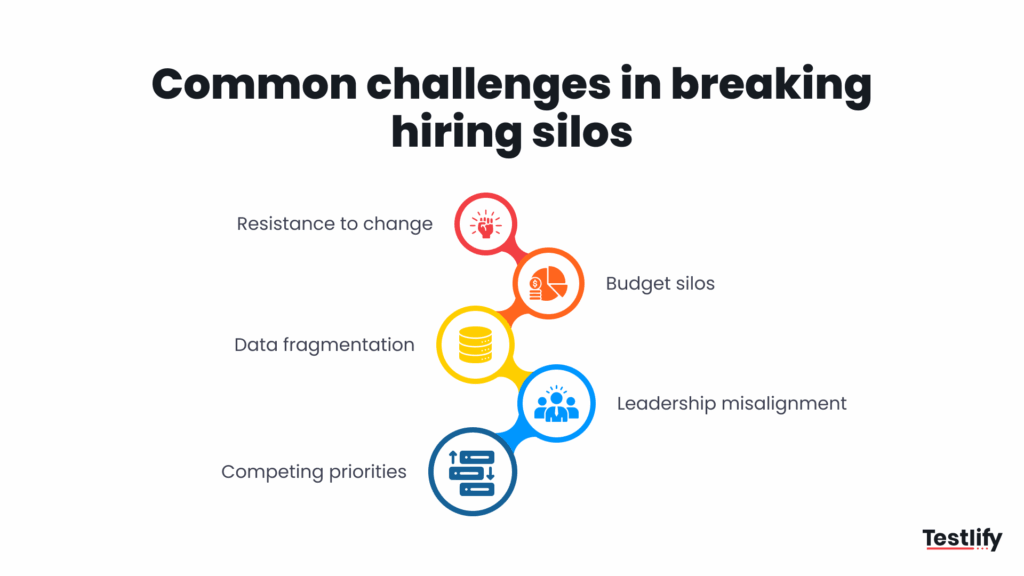
Resistance to change
People often resist leaving their comfort zones and established silos. Overcome this by starting with small pilot programs that demonstrate the benefits of cross-functional collaboration.
Celebrate early wins and successes to build momentum. Gradually scale these initiatives to show the value of working together, making the change feel more achievable and impactful for everyone involved.
Budget silos
Budgets are typically tied to individual departments, creating barriers for cross-functional initiatives. Advocate for a unified talent investment portfolio that supports initiatives benefiting multiple areas, such as internal mobility and leadership development.
Aligning budgets across functions ensures that strategic priorities are fully funded and enables the organization to invest in broader talent strategies that provide long-term value.
Data disconnect
Many organizations face challenges due to fragmented or disconnected data systems. Invest in unified analytics platforms that integrate data from hiring, learning, and employee performance.
A single, reliable data source will provide deeper insights into workforce needs, enabling smarter decision-making and helping teams collaborate more effectively. Proper data integration is essential for aligning talent strategies and maximizing impact across functions.
Leadership misalignment
When the C-suite isn’t aligned, it’s nearly impossible for cross-functional initiatives to succeed. Make a compelling business case for talent integration by showing how it supports key strategic priorities such as growth, innovation, and risk management.
By demonstrating the tangible benefits to organizational success, you can secure leadership buy-in and create a unified approach to talent management across all levels of the business.
The role of HR in leading the integration
As strategic business partners, HR leaders are uniquely positioned to connect the dots across TA, L&D, DEI, and business strategy. Your role is not just to support alignment’s to lead it.
Here’s how:
- Advocate for cross-functional teams
- Champion skill-based hiring and internal mobility
- Embed DEI into every stage of the talent journey
- Use workforce data to inform executive decisions
- Design processes that make alignment easier
Quick checklist: Is your organization breaking the silos?
Not sure how far along your organization is in breaking down hiring silos? This quick checklist will help you assess your current state and highlight areas that need improvement. Use it as a starting point for deeper conversations and strategic action.
- Do TA, L&D, and DEI leaders meet regularly to plan together?
- Are you using shared data to inform talent decisions?
- Is internal mobility encouraged and supported?
- Do your metrics reflect long-term talent outcomes?
- Is DEI integrated into hiring and development not just an afterthought?
- Are hiring strategies aligned with future business needs?
If you answered “no” to any of the above, it’s time to rethink how your organization approaches hiring.
Final thoughts
Silos are comfortable but they’re holding companies back from growing exponentially. By aligning talent acquisition with Learning & Development, DEI, and business strategy, HR leaders can unleash the full power of their workforce.
This isn’t just an HR challenge. It’s a business imperative.
Now’s the time to lead the charge.

Content Writer
Yashika Khandelwal is a Content Writer with 3+ years of experience creating research-backed content on hiring, talent assessment, and HR technology. She is a registered Organizational Psychologist and subject matter expert who combines behavioral science with practical recruitment insights to produce accurate, evidence-based content.
LinkedInRelated resources
View all
HR & recruitment
How to build a recruitment center of excellence (CoE)?
HR & recruitment
Seasonal and project-based hiring: Playbook for volume flexibility
HR & recruitment
Why Employer Value Proposition (EVP) is your talent magnet in 2026?

HR & recruitment
eSIM for HR and Global Talent Mobility: 6 Ways eSIM Transforms HR Management

HR & recruitment
How to evaluate professional certifications for recruiting success

HR & recruitment
What CTOs should know before hiring DeFi developers
Get started.
Hire on proof, not resumes.
Run your first skills-based assessment free — no credit card required.