
Top 15 ASC Smarter Assessment Alternatives and Competitors in 2026
Discover 15 powerful ASC Smarter Assessment alternatives to streamline your hiring process and assess candidates with confidence.
The best ASC Smarter Assessment alternatives for hiring are Testlify, followed by role-specific platforms like TestGorilla, Adaface and Vervoe for skills testing, and Codility, HackerRank, HackerEarth or Coderbyte for engineering roles. ASC is built for high-stakes exams, item banking and psychometric research. If your actual job is screening job applicants, a hiring-first platform will fit better.
That distinction is the whole reason this page exists. ASC Smarter Assessment brings decades of psychometric expertise to certification and academic testing, and it is genuinely good at that. But a talent team screening 300 applicants for a support role does not need item response theory. It needs a test library, a shortlist, and proof the person on the other end did their own work.
Below are 15 ASC Smarter Assessment alternatives, with what each one is actually good at, current pricing where it is published, and G2 ratings, so you can pick on fit instead of feature-count.
 ChatGPT
 Gemini
 Claude
 Grok
Grok Perplexity
TL;DR
- ASC Smarter Assessment is an exam and psychometrics platform. Most teams searching for an alternative want a hiring platform, which is a different product.
- Testlify is the strongest all-round swap for hiring: 3,500+ tests, 25+ question types, conversational AI interviews, and dual-device proctoring that uses the candidate's phone as a second camera.
- For engineering-only hiring, a coding-first tool (Codility, HackerRank, HackerEarth, Coderbyte) will go deeper than any general platform, including Testlify.
- Pricing splits into three camps: published self-serve tiers, pay-as-you-go credits, and quote-only enterprise. Only the first lets you budget without a sales call.
- Check proctoring and AI-detection before test breadth. Since generative AI became standard on every candidate's desktop, an untested take-home tells you very little.
- Compliance is now a selection criterion, not a footnote. If you hire in New York City, an automated tool needs an annual independent bias audit.

How we evaluated these platforms
Every platform here was assessed against the same five things, in this order:
- Hiring fit: is it built for screening applicants, or for exams and certification with hiring bolted on?
- Evidence quality: how many distinct signals does it collect, and can a reviewer see the working rather than a single score?
- Integrity: proctoring depth, identity checks, and whether it detects AI-assisted answers.
- Pricing transparency: published numbers beat "contact sales" when you are building a budget.
- Fit for lean teams: can a company without a dedicated assessment specialist run it?
Skills evidence is worth the effort. The World Economic Forum's Future of Jobs Report 2025 found employers expect 39% of workers' core skills to change by 2030, which makes a resume a fast-decaying record of what someone can do. And the research on what actually predicts performance has shifted: work by Sackett and colleagues, summarised by the Society for Industrial and Organizational Psychology, found structured interviews rather than raw cognitive ability sit at the top of the validity table. Read that as a design instruction: combine a structured interview with a job-relevant work sample, and stop treating any single test as the answer.
This is the Testlify Multi-Signal Talent Evaluation Model in one line. Combine several role-relevant signals (assessments, interviews, simulations, references and reviewer feedback) rather than betting a hire on one number. It matters most on the roles where a single test flatters the wrong candidate: the strong test-taker who cannot explain their reasoning, or the nervous interviewer who quietly does the best work sample in the pile.
Quick comparison table
Platform | Best for | G2 rating | Entry pricing |
|---|---|---|---|
Testlify | All-round hiring assessment and AI interviewing | 4.7 | $139/mo billed annually |
TestGorilla | Fast, simple structured screening | 4.5 | Free plan, then $83/mo |
Adaface | Candidate experience, conversational tests | 4.6 | From $180/year |
Vervoe | Job simulations graded by AI | 4.6 | From $300/year |
Codility | Large-scale engineering recruitment | 4.6 | $1,200/year |
Mercer Mettl | Regulated and campus hiring at scale | 4.4 | Quote only |
iMocha | Skills inventory and internal mobility | 4.4 | From $999/year |
Hirevue | Enterprise high-volume video screening | 4.1 | Quote only |
TestDome | Short work-sample tests | 4.5 | Published per plan |
Coderbyte | Developer hiring for smaller teams | 4.4 | About $199/mo |
HireMojo | Job distribution and sourcing automation | 4.5 | Quote only |
HackerEarth | Technical hiring with heavy proctoring | 4.5 | From $99/mo |
HackerRank | Established developer assessment | 4.5 | Published per plan |
TestInvite | Secure custom exams and certification | 4.7 | From $37/mo |
eSkill | Clerical, software and call-centre testing | 4.5 | Quote only |
1. Testlify
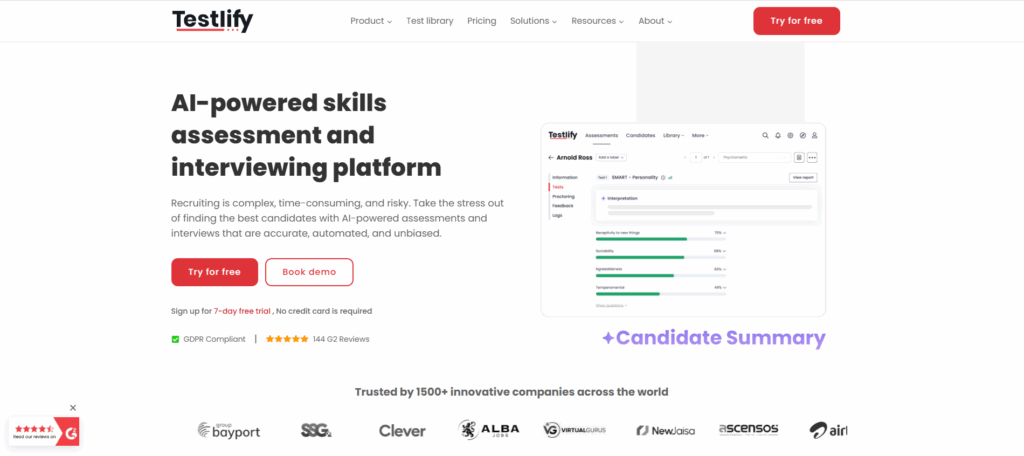
Testlify is an AI-assisted skills assessment and interviewing platform built for hiring rather than for exams. Where ASC's centre of gravity is item banking and psychometric research, Testlify's is the screening loop: build a role-relevant assessment, invite candidates, get a scored shortlist with the evidence attached.
Features
- 25+ question types: single and multiple select, ranking, fill in the blank, short and long answer, coding, typing, file upload, plus live Office-app questions bound to the real products (Google Docs, Sheets and Slides, Microsoft Word, Excel and PowerPoint).
- Vibe coding questions: candidates direct AI tools to reach a working solution instead of writing syntax by hand. It is one of the few honest ways to test how an engineer actually works in 2026, and almost nothing else on this list has an answer to it.
- Scoring you can defend: scoring at question, test and overall level; weights from x0 to x5 per test; two explicit negative-marking modes; percentile benchmarking against other candidates and other reviewers.
- AI checker: classifies an answer as human, AI generated, or mixed, so a strong take-home does not silently become a test of prompt-writing.
- Dual-device proctoring: the candidate's phone becomes a second camera showing both them and their screen. The assessment will not start until mobile monitoring is active. No mainstream competitor ships this.
- AI interviews: one-way async video, two-way conversational AI video, voice, and outbound AI phone interviews, with selectable avatars and voices, attempt and recording limits, automatic multilingual transcripts, and auto-scoring a human can override.
- 100+ ATS integrations: Testlify sits alongside Greenhouse, Lever or Workable as the screening layer and leaves your ATS as the system of record. Teams with no ATS at all can use its built-in job requisitions, application form and simple candidate pipeline instead.
G2 Rating: 4.7
Best for
Lean talent teams and founders who need one tool to cover skills tests, interviews and integrity, without hiring an assessment specialist to run it. It is the closest thing here to a straight swap for ASC on the hiring side, and it goes considerably further on interviewing.
Testlify pricing
Testlify publishes its pricing as a credit-volume selector crossed with a monthly or annual toggle. One credit is consumed per assessment started by a qualified candidate, and credits do not roll over. Annual billing:
- Starter: $139/month billed at $1,668/year. 100 credits/year at $16.68 each, 3 user seats.
- Basic: $279/month billed at $3,348/year. 300 credits at $11.16 each, 5 seats.
- Business: $699/month billed at $8,388/year. 1,000 credits at $8.39 each, 10 seats.
- Premium, Enterprise and Custom: 3,000, 10,000 and 25,000+ credits with 20, 30 and 40 seats. Priced on contact with sales.
Monthly billing carries different credit counts for the same tier names, starting at $198/month for 10 credits. Extra seats are $15 per seat per month on every tier. There is a 7-day free trial with no card, a 30-day money-back guarantee, and pricing locked for 24 months. Worth knowing before you budget: white labeling, SAML SSO and the 100+ ATS integrations are paid add-ons on the self-serve tiers at $2,388/year each, and are included only on Custom.
2. TestGorilla
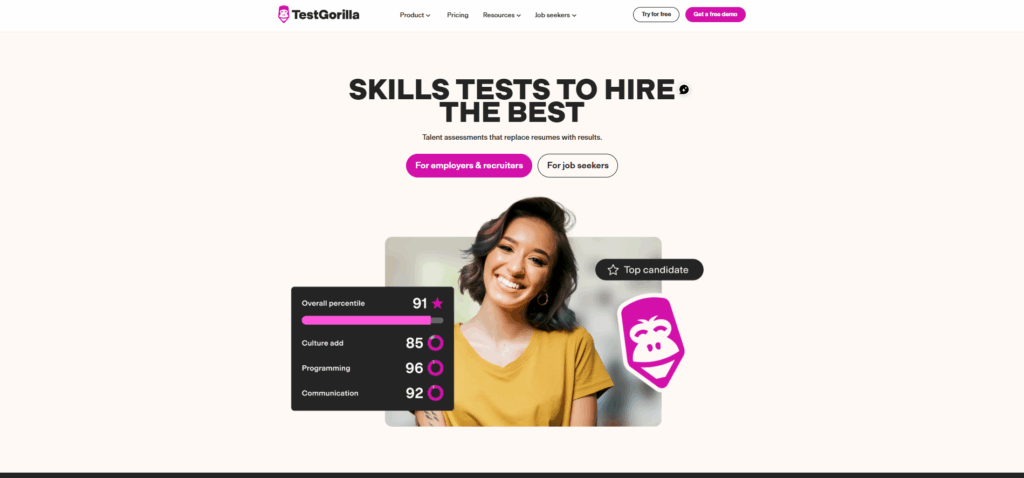
TestGorilla helps teams hire faster with structured assessments and a growing test library. It is built for speed and simplicity, which is exactly right for a first-time buyer and limiting once your process gets specific.
Features
- Pre-built assessments: 300+ tests covering coding, numerical reasoning, cognitive ability, personality and culture add.
- Video questions: open-ended video prompts for soft skills such as communication and customer empathy.
- Bias reduction: anonymous results and standardized scoring to support fairer review.
- Customization: your logo, colours and intro videos, plus control over test order, difficulty and timing.
G2 Rating: 4.5/5
Pricing: A free plan with essential tests and unlimited candidate invites. Starter and Pro plans start at $83/month and $127/month billed annually, varying by company size.
Related resources: TestGorilla alternatives and competitors
3. Adaface
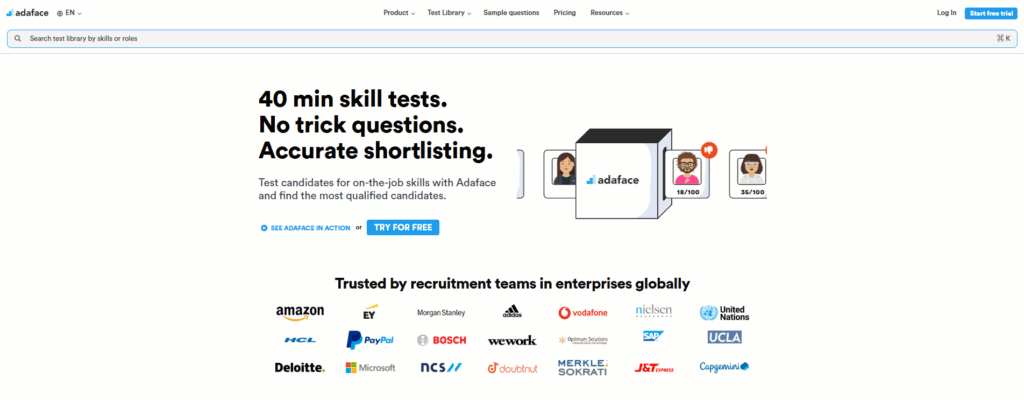
Adaface is the most candidate-friendly platform on this list. It swaps generic multiple-choice tests for adaptive chatbot conversations that assess job-specific knowledge, which tends to lift completion rates.
Features
- Conversational assessments: delivered through "Ada", a chatbot that asks contextual questions like a friendly recruiter, reducing drop-offs.
- Assessment library: 150+ test templates across engineering, finance, support and operations.
- Real-time scoring: candidates are marked pass, borderline or fail so recruiters can filter without manual review.
- Anti-cheating: the question library is built in house, so answers are not sitting on the open web.
G2 Rating: 4.6/5
Pricing: Free trial available. Plans start at $180/year for an individual plan and scale for larger teams.
Related resources: Adaface alternatives and competitors
4. Vervoe
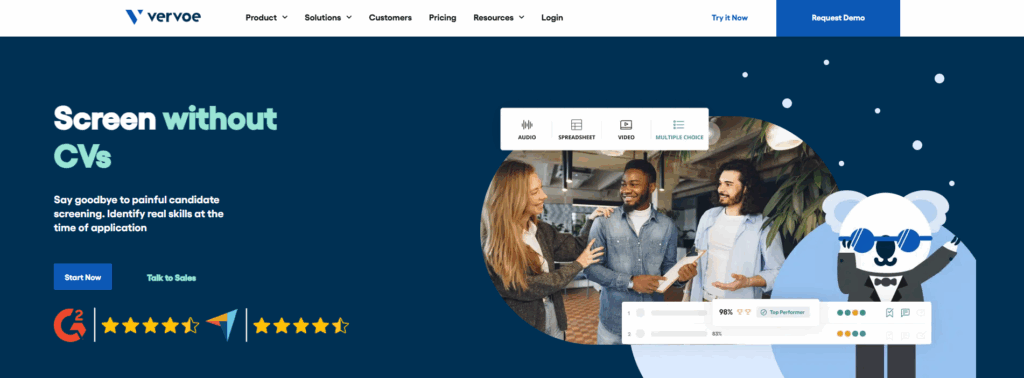
Vervoe is built on the idea that hiring should be about merit rather than resumes. Candidates complete real job tasks, and AI grades and ranks the responses.
Features
- Job simulation tests: 300+ pre-built assessments across support, sales, marketing, technology and operations, each replicating real on-the-job tasks.
- Multi-format testing: text, video, file uploads and spreadsheets.
- AI grading: candidates ranked on accuracy, effort and relevance.
- Team review: several reviewers can rate responses and leave notes in one dashboard.
G2 Rating: 4.6/5
Pricing: Pay-as-you-go, which suits uneven hiring cycles. The entry plan starts at $300 per year for 10 candidates and rises with volume.
Related resources: Vervoe alternatives and competitors
5. Codility
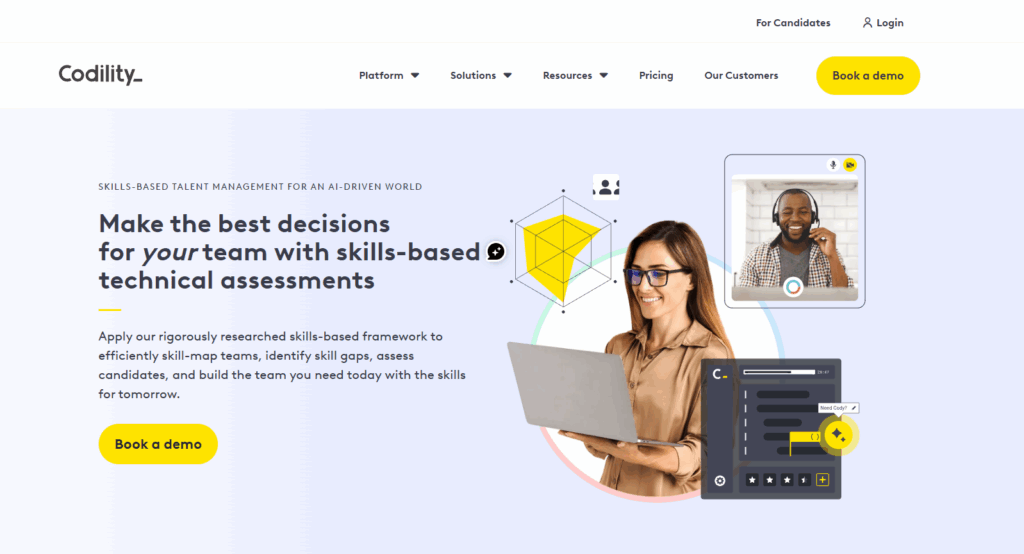
Codility is a coding-focused platform built for large engineering recruitment. If you hire developers in volume and nothing else, it goes deeper than any general assessment tool here.
Features
- Coding task bank: more than 1,100 tasks across 45+ programming languages, from basic algorithms to system design.
- Live technical interviews: a collaborative IDE with syntax highlighting, compiler and test runner.
- Automated scoring: submissions assessed for correctness, efficiency and readability without a manual code review.
- Reporting: candidate reports broken down by task, test cases passed and code quality.
G2 Rating: 4.6/5
Pricing: Three tiers: Starter at $1,200 per year, Scale at $6,000 per year, and a custom enterprise plan.
Related resources: Codility alternatives and competitors
6. Mercer Mettl
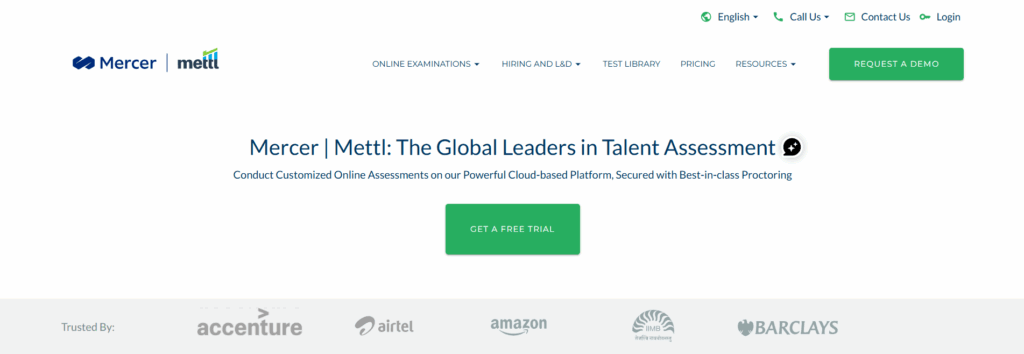
Mercer Mettl is a full assessment suite backed by a global HR firm. It is strong on behavioural and psychometric evaluation, which makes it the closest match on this list to what ASC actually does, and a sensible shortlist entry for regulated hiring, campus recruitment and certification.
Features
- Broad test coverage: 200+ job-specific assessments spanning technical, cognitive, behavioural and psychometric testing.
- Enterprise proctoring: AI face recognition, browser lockdown and live human invigilation.
- Brand personalization: your branding, logos and test domain across the candidate experience.
- Reports and benchmarks: competency scoring, percentile comparisons and hiring recommendations.
G2 Rating: 4.4/5
Pricing: Custom. Costs depend on test count, candidate volume and features, so expect a sales call.
Related resources: Mercer Mettl alternatives and competitors
7. iMocha
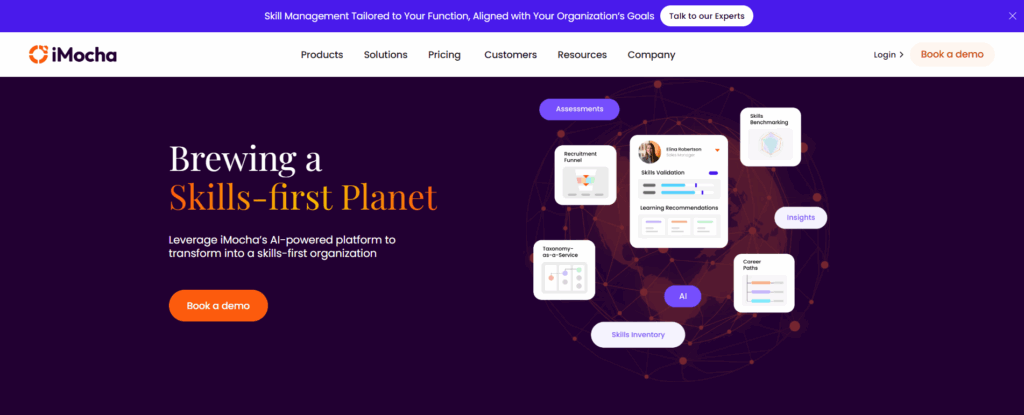
iMocha covers pre-employment testing and internal upskilling from one skills database. Its real differentiator is skills intelligence: mapping what your existing workforce can do, not just who to hire next.
Features
- Large test library: more than 3,000 ready-to-use tests and 30,000+ skills mapped to job roles, including specialised areas such as SAP and cybersecurity.
- Custom test builder: HR teams can combine existing questions or write new ones with flexible scoring logic.
- AI interviewer: conversational AI interviews that add qualitative detail to a score.
- Reporting: performance visibility by domain, skill group and question category.
G2 Rating: 4.4/5
Pricing: 14-day free trial. Plans start at $999/year and scale for larger teams.
Related resources: iMocha alternatives and competitors
8. Hirevue
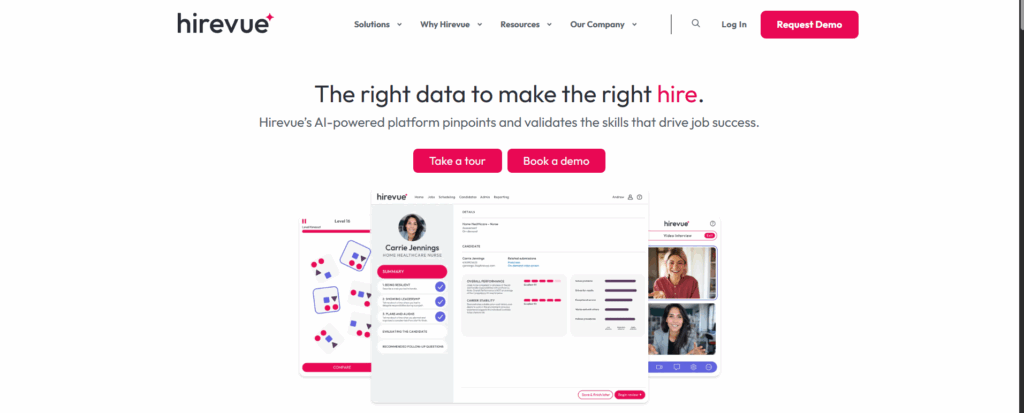
Hirevue handles high-volume hiring through on-demand video interviews, coding challenges and game-based assessments. It is an enterprise buy, and it is priced and implemented like one.
Features
- IO science content library: validated, role-specific interview questions built on industrial-organizational psychology.
- Video interviews: one-way and live formats with structured scoring rubrics.
- Game-based assessments: cognitive games measuring problem-solving in a more engaging format.
- Scheduling and automation: automated interview scheduling, chatbot engagement and ATS integrations.
G2 Rating: 4.1/5
Pricing: Three tiers, none published. You will need to book a demo to get numbers.
Related resources: Hirevue alternatives and competitors
9. TestDome
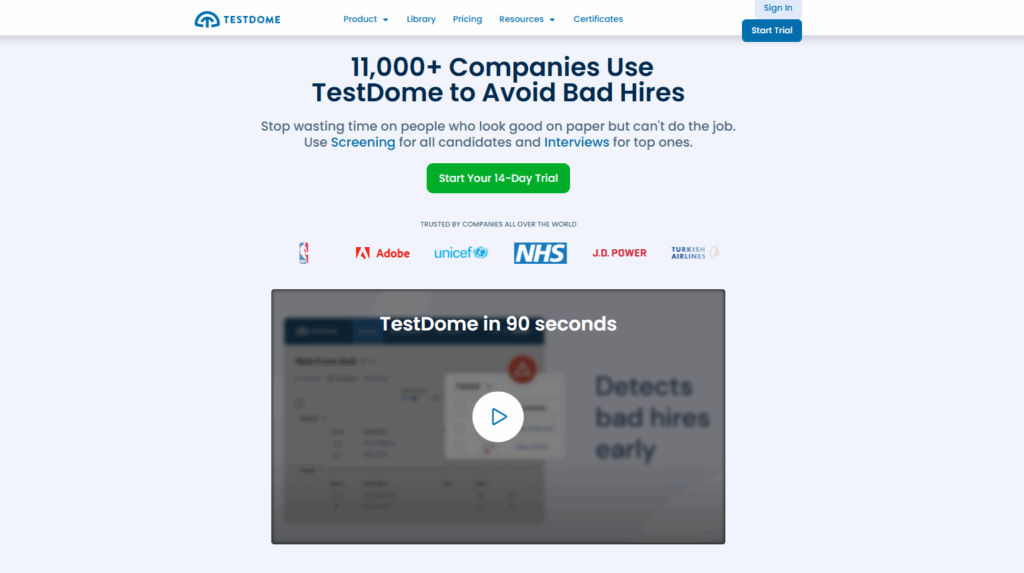
TestDome focuses on work-sample assessments. Rather than trivia, its 150+ pre-made tests ask candidates to do tasks that mirror the actual job, across programming, IT, accounting and customer service.
Features
- Work-sample testing: realistic tasks instead of theoretical questions.
- 150+ pre-built tests: short and designed to filter unqualified applicants quickly.
- Custom questions: build your own tasks or mix them with the library.
- Benchmarking: side-by-side scorecards, percentile rankings and pass/fail indicators.
G2 Rating: 4.5/5
Pricing: Subscription plans are published on TestDome's own site and scale by hiring volume rather than per candidate. Check current tiers directly before you budget.
Related resources: TestDome alternatives and competitors
10. Coderbyte
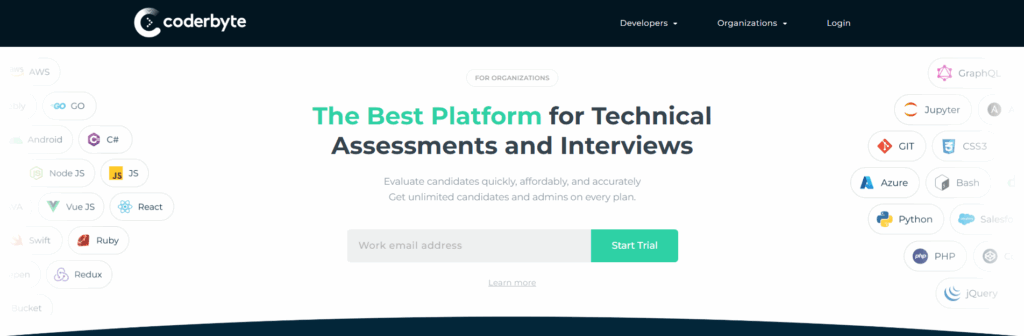
Coderbyte is a technical assessment tool aimed at startups and mid-sized companies hiring developers and data scientists. Unlimited tests on a flat subscription makes budgeting simple when hiring is unpredictable.
Features
- Coding challenges and projects: 1,000+ challenges across 30+ programming languages and 100+ technical skills.
- Multiple question types: multiple-choice, open-ended and SQL query challenges alongside coding.
- Interviewing tools: live video coding with a real-time editor, spreadsheets, Jupyter notebooks and a whiteboard.
- Reporting: structured reports with candidate code, session recordings, skill ratings and benchmarking.
G2 Rating: 4.4/5
Pricing: Subscription-based at roughly $199/month for unlimited candidates and tests, with discounted annual billing.
Related resources: Coderbyte alternatives and competitors
11. HireMojo
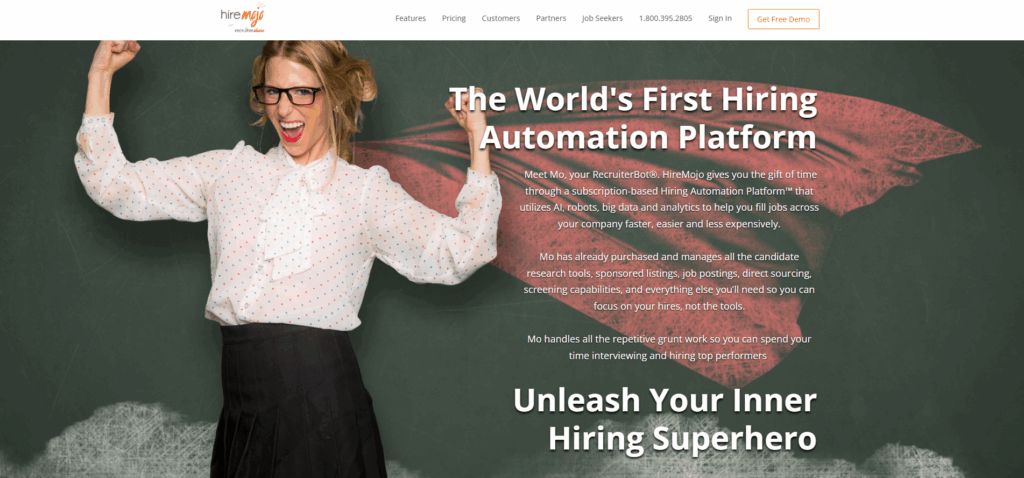
HireMojo is a recruiting automation platform rather than an assessment one. It belongs on this list only if your bottleneck is applicant volume rather than applicant quality, because it solves the opposite half of the problem to ASC.
Features
- Automated job distribution: post to 100+ job boards, career sites and referral networks in one click, with source analytics.
- Pre-screening engine: dynamic questionnaires that score and rank applicants automatically.
- Content library: pre-written job descriptions and interview question templates.
- Candidate tracking: resumes, feedback, scheduling and email in one dashboard.
G2 Rating: 4.5/5
Pricing: Not published. Expect a custom quote based on company size and hiring volume.
Related resources: HireMojo alternatives and competitors
12. HackerEarth
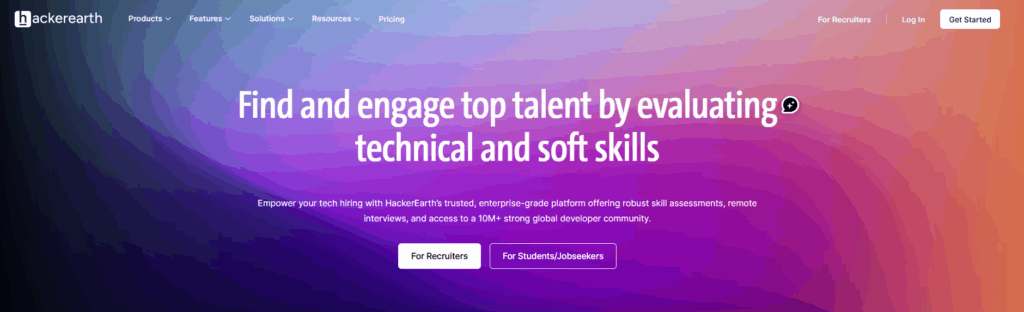
HackerEarth is an enterprise tech hiring platform for large-scale screening and structured developer interviews. Its proctoring is the strongest reason to pick it over a cheaper coding tool.
Features
- Large content library: 25,000+ questions across software development, data science, AI/ML, DevOps and cloud, in multiple-choice, project-based and video formats.
- FaceCode interviews: collaborative coding with a shared editor, question banks and a whiteboard.
- Advanced proctoring: AI webcam monitoring, tab tracking, audio detection and behavioural analysis, with live human proctoring available for high-stakes tests.
- Custom test creation: templates or build from scratch with custom scoring, difficulty and time limits.
G2 Rating: 4.5/5
Pricing: Plans start at $99 per month, with higher tiers for larger teams.
Related resources: HackerEarth alternatives and competitors
13. HackerRank
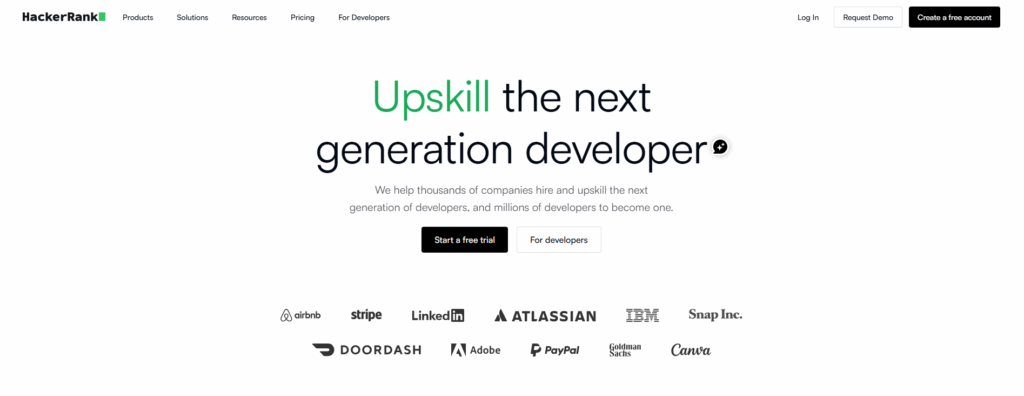
HackerRank is a developer-focused hiring platform used widely in enterprise engineering teams. Candidate familiarity is a genuine advantage: many developers have used it before, so there is less friction explaining the format.
Features
- Large test library: around 7,500 questions across 45+ programming languages, covering frontend, backend, data, security and QA roles.
- Interview workflows: screening, take-home tests and live interviews in one place, with pair programming and system design boards.
- Anti-cheating: webcam recording, copy detection and time analysis.
- Structured scoring: custom rubrics covering code, collaboration and problem-solving.
G2 Rating: 4.5/5
Pricing: Tiered plans starting with a published entry tier, then quote-based plans for larger teams. Confirm the current entry price on their site.
Related resources: HackerRank alternatives and competitors
14. TestInvite
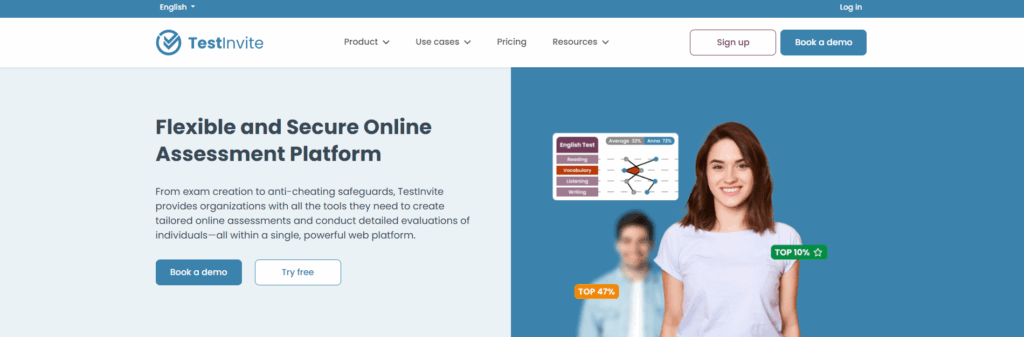
TestInvite is an online exam platform for secure, customizable testing across pre-employment screening, education and professional certification. Of everything here, it is the nearest fit if what you liked about ASC was the exam engine itself.
Features
- Custom test creation: multiple-choice, essays, coding and video responses, with custom scoring logic and timing.
- Talent assessment library: ready-made tests covering problem-solving, communication and role-specific competencies.
- Detailed reports: adjust scoring logic, create metrics, benchmark results and add written interpretations.
- Anti-cheating and proctoring: lockdown browser, AI cheating detection, randomized question banks and video or audio monitoring.
G2 Rating: 4.7/5
Pricing: Starts at $37/month for the entry plan with a limited number of test attempts. Higher tiers add capacity and features, and add-ons raise the price with usage.
Related resources: TestInvite alternatives and competitors
15. eSkill
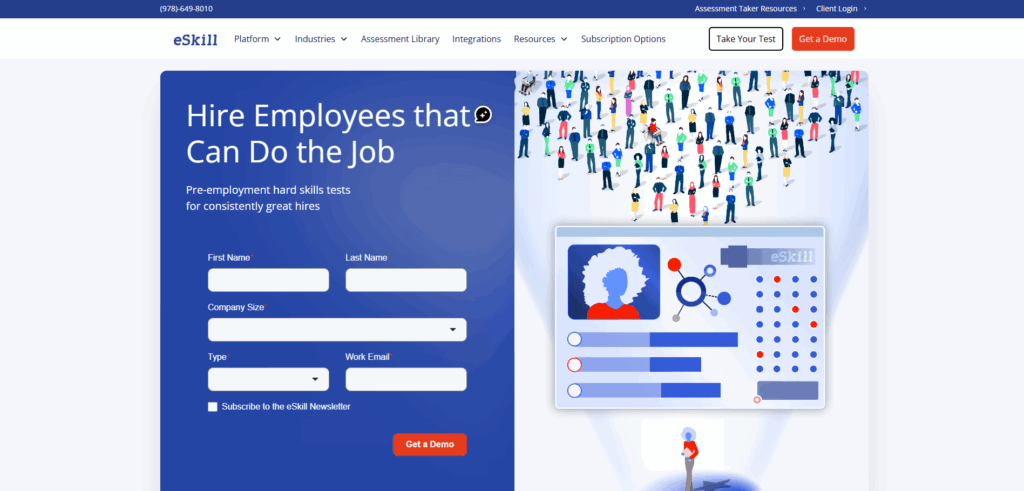
eSkill is a long-established pre-employment testing platform with a wide spread of skills tests, from clerical skills and software proficiency to accounting, legal and call-centre scenarios.
Features
- Large test library: more than 600 ready-to-use assessments, or build custom tests by subject, topic and question.
- Simulations: interactive job simulations that go beyond multiple choice.
- Proctoring: monitors copy-pasting and tab switching, flagging suspicious activity in real time.
- Reporting: candidate reports with overall scores and breakdowns by subject or question.
G2 Rating: 4.5/5
Pricing: Not published. Recruiters need to contact the sales team for a quote.
Related resources: eSkill alternatives and competitors
Which is the best ASC Smarter Assessment alternative?
For hiring, Testlify. It covers the widest span of what a talent team actually does in a week: build a role-relevant assessment from 3,500+ tests and 25+ question types, run a structured AI interview, and get a scored shortlist with proctoring evidence attached. It also supports 100+ ATS integrations and a test library spanning 4,500+ roles.
The honest caveats. If you hire only engineers, a coding-first platform will test them more deeply. If your requirement is certification-grade exam delivery with formal psychometric reporting, that is ASC's home ground and Mercer Mettl or TestInvite are closer swaps than anything else here. And Testlify does not schedule live human interview panels, so if calendar coordination for a five-person panel is your bottleneck, pair it with your scheduling tool.
Pro Tip: before you compare feature grids, run one real role through two shortlisted tools with the same five candidates. You will learn more from the completion rates and the quality of the reviewer report than from any comparison table, this one included. Watch drop-off in particular: a test that takes 90 minutes will quietly cost you your best applicants, who have other offers and less patience.
One more selection criterion that has moved from nice-to-have to mandatory. If you hire in New York City, an automated employment decision tool needs an annual independent bias audit published publicly. Ask any vendor how they support that before you sign, not after. It is also worth putting a number on what poor screening costs: SHRM's benchmarking report puts average cost per hire at $4,129, and that is the bill you pay twice when a hire does not work out.
For a direct feature-by-feature breakdown, read the Testlify vs ASC Smarter Assessment comparison.
Try Testlify on a live role
Start with the role you are hiring for right now. Build the assessment, invite five candidates, and compare the shortlist against the one your current process produced. There is a 7-day free trial with no card required, and a 30-day money-back guarantee if it does not fit. If you would rather see it driven by someone who knows it, book a demo.
Key takeaways
- Match the tool to the job, not the feature count. ASC is an exam and psychometrics platform. If you are screening applicants rather than certifying them, almost any hiring-first tool on this list will fit your workflow better, and the migration cost is mostly rebuilding your question set.
- Multi-signal beats single-score. Structured interviews rank at the top of the validity research, so pair an interview with a job-relevant work sample instead of trusting one test. Practically, that means budgeting for a platform that does both rather than buying two.
- Integrity is now the deciding feature. Generative AI sits on every candidate's desktop, so an unproctored take-home tells you very little. Look for AI-answer detection and identity verification, not just a webcam feed, because a webcam alone does not catch a second screen.
- Published pricing saves weeks. Roughly a third of this list is quote-only. If you are a lean team without procurement support, a published tier lets you decide this month instead of next quarter.
- Specialists still win on depth. For engineering-only hiring, a coding-first platform beats every general tool here, including Testlify. Buy the general platform when you hire across functions, and the specialist when you do not.
- Compliance belongs on the shortlist criteria. New York City already requires an annual independent bias audit for automated hiring tools. Ask how a vendor supports it during evaluation, because retrofitting compliance after rollout is far more expensive than choosing for it.
- Test with real candidates before committing. Completion rate and reviewer-report quality are the two numbers that predict whether a tool survives contact with your team, and neither appears on a pricing page.
Frequently asked questions (FAQs)

Director of Marketing
Akash Patange is the Director of Marketing at Testlify, where he works closely with HR leaders and recruiters to help organizations improve hiring outcomes. He writes about talent assessment, recruitment technology, and data-driven hiring practices.
LinkedInRelated resources
View all
Alternatives
Top 15 Canditech Alternatives and Competitors
Alternatives
Top 15 eSkill Alternatives and Competitors (2026)
Alternatives
Top 15 TestInvite Alternatives and Competitors
Alternatives
Top 15 HackerRank Alternatives and Competitors in 2026
Alternatives
Top 15 HackerEarth Alternatives and Competitors
Alternatives
Top 15 Vervoe Alternatives and Competitors in 2026
Get started.
Hire on proof, not resumes.
Run your first skills-based assessment free — no credit card required.