
Top 15 Codility Alternatives and Competitors
Discover 15 powerful Codility alternatives to streamline your hiring process and assess candidates with confidence.
Technical hiring has become significantly more complex in recent years. Engineering teams are no longer just looking for candidates who can solve algorithmic problems. They want developers who can write production-ready code, collaborate in real-world environments, and demonstrate practical problem-solving skills.
While Codility has earned visibility as a convenient technical skills assessment solution, many organizations are finding Codility restrictive in areas such as pricing flexibility, test customization, non-coding role coverage, and overall candidate experience.
Modern hiring teams increasingly expect:
- Broader role coverage beyond pure coding
- Flexible pricing for seasonal or high-volume hiring
- AI-assisted interviews and insights
- Stronger anti-cheating and proctoring options
- Better candidate experience across geographies
As expectations around skills-based hiring increase, organizations report limitations in Codility’s ability to support these demands, leading them to consider alternative solutions.
In this article, we’ll explore the Top 15 Codility Alternatives and Competitors, comparing their features, G2 ratings, pricing, and core limitations to help you choose the right platform.
 ChatGPT
 Gemini
 Claude
 Grok
Grok Perplexity
Why companies are moving away from Codility
Despite its strengths, Codility presents several challenges for modern hiring teams.
- High entry cost: Codility’s pricing starts at $1,200/year for limited invites, which can be restrictive for startups, fast-scaling teams, or companies with fluctuating hiring volumes.
- Developer-only focus: Codility is optimized almost entirely for coding roles. Teams hiring for data, QA, DevOps, product, or business roles often need additional tools.
- Limited flexibility for custom workflows: While Codility offers solid coding tests, tailoring assessments to company-specific scenarios can feel rigid compared to newer platforms.
- Steep learning curve for admins: Setting up assessments, interpreting reports, and managing integrations can be time-consuming, especially for lean TA teams.
- Annual commitment model: Codility’s annual pricing makes it less appealing for organizations with short-term or project-based hiring needs.
Because of these limitations, many companies are exploring more flexible and comprehensive alternatives. Here’s a quick comparison of the best Codility alternatives before we dive deeper.
Tool Name | Best For | Starting Price | Standout Features | Core Limitations |
|---|---|---|---|---|
Testlify | Enterprises requiring a large library of role-specific tests and conversational AI interviews | Starter plan $198/monthnth | 3,500+ role-specific tests, 25+ custom question types, and AI interviews | Only a 7-day free trial is offered for exploring the platform |
Predictive Index (PI) | HR teams that emphasize cultural, behavioral, and cognitive fit in hiring | Custom quote | Research-backed behavioral and cognitive assessments | No technical assessment tests are available |
The Talent Games | Campus recruiters seeking innovative ways to assess graduate talent | Custom quote | Game-based assessments covering problem-solving and soft skills | Limited use outside campus recruitment |
Talogy | Enterprises focused on psychometric, behavioral, and cognitive assessments for high-stakes hiring | Custom quote | Scientifically validated psychometric tests | Limited technical or coding assessments |
Mercer Mettl | High-volume and campus testing programs | Custom quote | Huge question bank, remote proctoring, and multilingual assessments | No transparent pricing and high minimum commitments |
iMocha | Organizations needing a large skills assessment library with AI proctoring | $1,100/year (250 test attempts) | Patented AI and LogicBox assessments with live coding simulators | Feature-heavy platform with a noticeable learning curve |
HireVue | Large enterprises running high-volume, on-demand video interviews | Enterprise pricing (custom) | On-demand video interviews, game-based assessments, and AI screening | Extremely costly and complex to implement |
TestDome | Teams seeking simple, pay-per-use technical assessments | Pay per candidate | Work-sample tests with a collaborative coding environment | No custom test builder in lower plans and limited analytics |
Coderbyte | Tech recruiters seeking unlimited technical assessments | $199/month | Unlimited candidates, integrated coding IDE, and automated grading | Can be expensive for smaller or low-volume teams |
HireMojo | Companies seeking an AI-driven ATS and sourcing assistant | Custom quote | Automated candidate sourcing, screening, and recruiting analytics | Primarily an ATS rather than a dedicated assessment platform |
HackerEarth | Recruiting teams hiring developers through coding assessments | Growth plan $99/month | Role-based developer assessments and live technical interviews | Limited integrations on Starters |
HackerRank | Organizations running structured coding tests and technical interviews | Starter $198/monthnth | Extensive coding library with an AI-assisted IDE | Expensive for small teams with per-attempt costs |
TestInvite | Businesses requiring secure, customizable online tests | $37/month ($450/year) | Highly flexible test builder with strong anti-cheating controls | Limited users/tests on base plans and a dated interface |
eSkill | Teams hiring for entry-level roles and clerical positions | Custom quote | 600+ assessments with interactive job simulations | Outdated interface and no public pricing |
Canditech | Companies evaluating candidates through realistic job simulations | $150/month | Advanced work-sample simulations with benchmarking analytics | Smaller platform with fewer third-party reviews |

Testlify
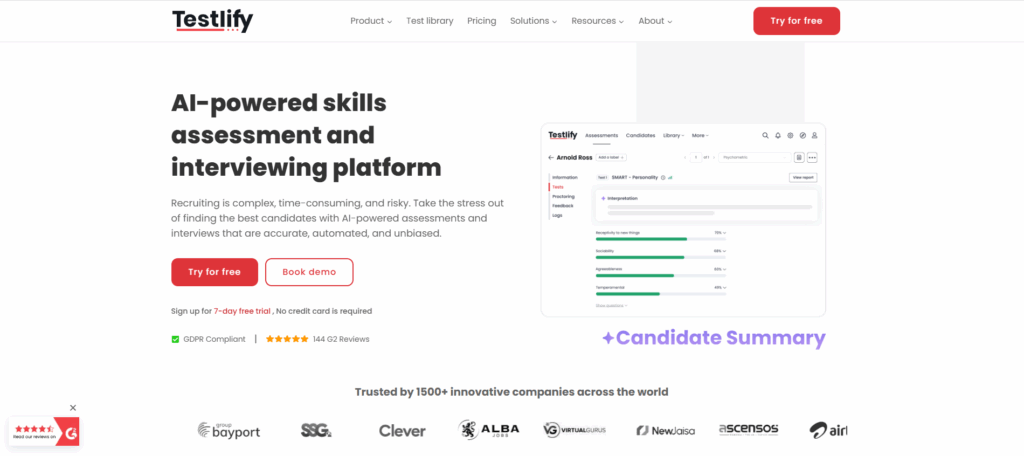
Testlify is a leading AI-powered skills assessment and interviewing platform that offers 3,500+ role-specific tests in 15+ languages, enabling organizations to identify top talent worldwide. The platform also includes over 20 advanced proctoring measures, such as AI-assistance detection and dual-camera proctoring to ensure assessment integrity.
Unlike Codility, which is narrowly focused on coding challenges, Testlify enables organizations to evaluate real job readiness across technical, functional, and behavioral dimensions within a single platform.
Where Codility is a good choice for developer screening, Testlify delivers a broader, more flexible hiring infrastructure that supports engineering, QA, data, DevOps, product, sales, and business roles without forcing teams to stitch together multiple tools for candidate screening.
Features
- Extensive test library: Over 3,500 pre-built tests covering technical, cognitive, and soft skills. Custom tests can also be created.
- Custom question formats: Supports 25+ question types ranging from standard MCQs and essay responses to innovative video AI and voice AI interviewing formats.
- Conversational AI interviews: Simulate on-the-job scenarios across chat, voice, and video formats to provide a realistic candidate experience.
- Psychometric assessments: Supports a wide range of psychometric tests to measure personality traits, behavioral tendencies, and cognitive abilities to help identify culturally aligned and high-potential candidates
- AI insights: Generates concise summaries of candidates’ performance, highlighting strengths and areas for improvement.
- Extensive ATS integrations: Supports over 100 ATS integrations such as Zapier and Zoho Recruit to streamline recruitment workflows.
- Anti-cheating & proctoring: Leverages 18+ anti-cheating and proctoring measures such as dual-camera proctoring, AI assistance detection, live video proctoring, and more to ensure test integrity
Pros
- Wide and flexible test library covering cognitive, technical, soft skills, and role-based assessments
- Supports multilingual role-specific tests for more accurate and inclusive evaluation
- Custom tests can be created, offering flexibility to tailor assessments to specific job requirements.
- Speeds up hiring with conversational AI interviews and detailed analytics
- Robust proctoring features ensure test integrity
Cons
- The wide range of features may require some initial time to explore.
- Proctoring and analytics features require setup time but enhance security and evaluation accuracy.
What customers are saying
Testlify users praise its modern AI features and ease of use. One review notes the “intuitive, user-friendly” interface for both admins and candidates. The pre-made test library and automated grading are often highlighted as time-savers.
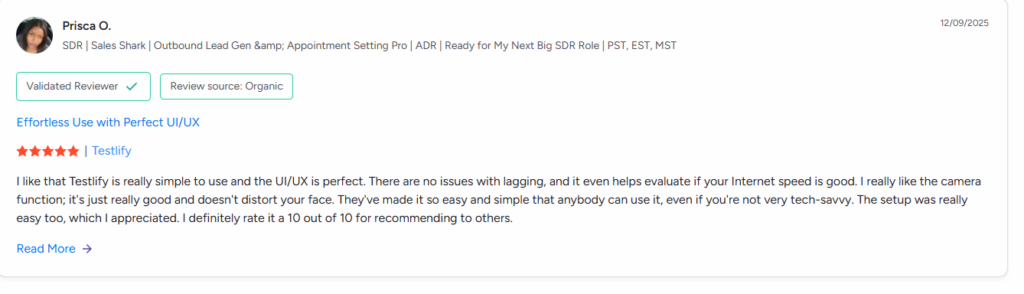
G2 Rating: 4.7 (700+ reviews)
Testlify pricing
Testlify offers flexible pricing plans that scale with your business, providing everything from basic assessments for startups to advanced features for enterprise-level hiring.
- Starter plan: Ideal for small teams and startups, this plan starts at $139/month (billed at $1,663/year) and includes 100 candidate credits at $17 per credit with support for 3 users.
- Starter: Designed for growing businesses, the Starter starts at $279/month (billed at $3,343/year) and includes 300 credits at $11 per credit with support for 5 users.
- Starter: Built for scaling teams, this plan costs $699/month (billed at $4,192/year) and includes 1,000 credits at $8 per credit with 10 users.
- Premium plan: Suited for high-growth organizations, the Premium plan includes 3,000 credits and supports 20 users, with pricing available upon contacting the sales team.
- Enterprise plan: Designed for large enterprises, this plan includes 10,000 credits and supports 30 users, with pricing available upon contacting the sales team.
- Enterprise plus plan: Designed for large-scale hiring programs, this plan includes 25,000 credits and supports up to 40 users, with pricing details available upon contacting the sales team.
- Unlimited plan: For companies seeking unrestricted access, Testlify offers an unlimited plan that includes unlimited candidate credits and full platform functionality, with pricing available on request from the sales team.
Predictive Index (PI)
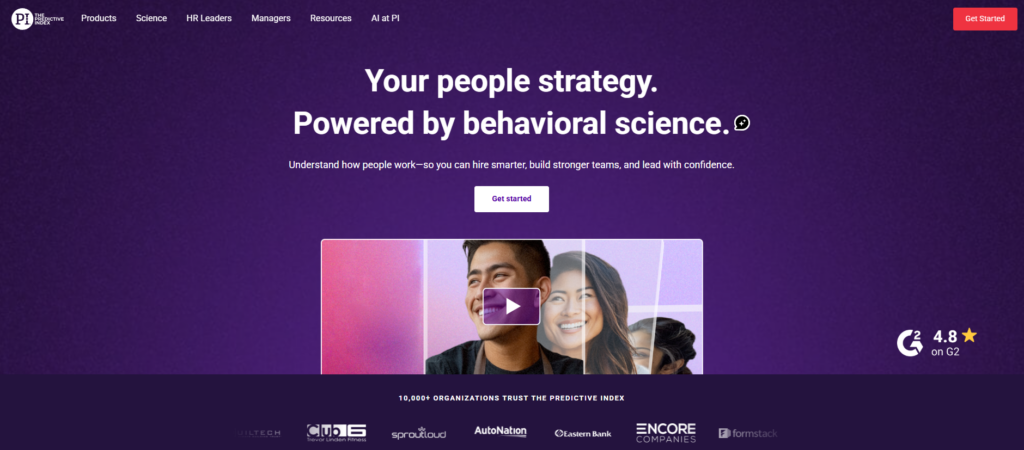
The Predictive Index is a well-established talent optimization and psychometric assessment platform used by enterprises to improve hiring accuracy, employee performance, and team alignment.
Instead of focusing on hard-skill testing, PI specializes in behavioural and cognitive assessments backed by decades of research.
Features
- Behavioral assessment: Measures four core behavioral drives, which include Dominance, Extraversion, Patience, and Formality, providing insights into workplace behavior.
- Cognitive assessment: Evaluates a candidate’s learning agility and problem-solving ability in areas like numerical, verbal, and abstract reasoning.
- Job targeting: Helps hiring teams define ideal behavioral and cognitive profiles for each role, improving job-fit scoring.
- Team discovery tools: Visualize team dynamics, identify strengths, and uncover areas of misalignment.
- Talent optimization platform: Goes beyond hiring to support onboarding, leadership development, employee coaching, and engagement programs.
Pros
- Scientifically validated assessments for evaluating the behavioral traits and cognitive abilities of candidates
- Provides tools for creating detailed role profiles and visualizing team dynamics.
- Extends beyond recruitment into onboarding and coaching, supporting talent optimization.
- Ideal for strategic workforce planning, with a focus on long-term team success.
Cons
- Does not test technical and role-specific skills, focusing mainly on traits and cognitive abilities.
- Implementation can be complex and time-consuming, better suited for experienced analytics teams.
- It may not be cost-effective for smaller organizations with limited budgets.
What customers are saying
Reviews note PI is “highly customizable and valid” for predicting job performance. Customers appreciate how reports highlight candidate strengths/needs.
Drawbacks mentioned include “expensive pricing” and a huge learning curve when it comes to creating assessments.
G2 Rating: 4.7/5 (700+ reviews)
Pricing: Not publicly disclosed; requires contacting the sales team for a custom quote.
The Talent Games
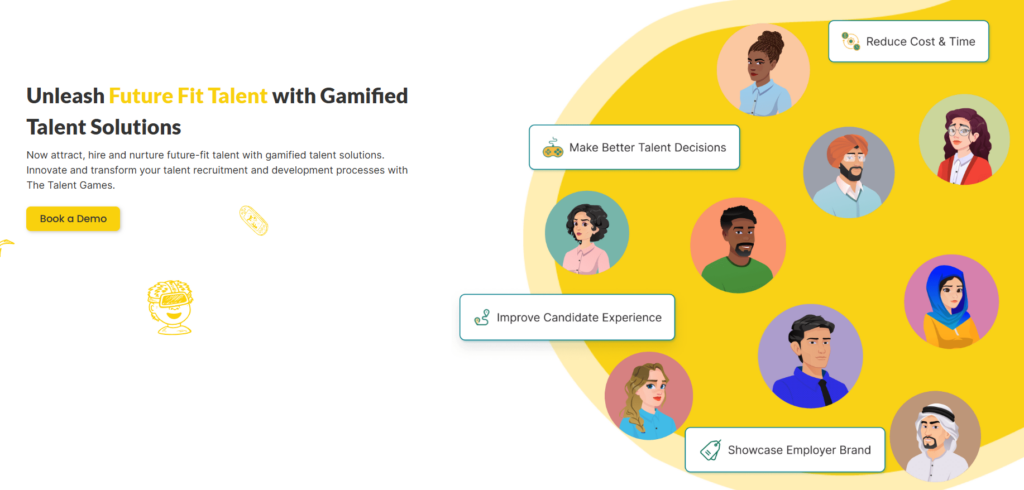
The Talent Games is a gamified talent assessment platform designed to evaluate candidates’ cognitive ability, problem-solving skills, personality traits, and cultural fit through interactive, game-based assessments.
The platform is most commonly used for early-career, graduate, and campus hiring, where candidate engagement and volume screening are critical. It is also adopted by large enterprises looking to modernize employer branding and reduce candidate drop-off during high-volume hiring campaigns.
Features
- Gamified assessments: Interactive games that measure logical reasoning, numerical ability, attention, and problem-solving skills.
- Situational Judgment Tests (SJTs): Realistic work scenarios to evaluate decision-making and behavioral tendencies.
- Role-specific tests: Custom assessments tailored to different job functions and industries.
- Employer branding tools: Gamified experiences that showcase a company’s culture and values.
- Data-driven insights: AI-generated reports that help hiring teams identify high-potential talent quickly.
Pros
- Highly engaging candidate experience, especially effective for Gen Z and early-career talent
- Strong at assessing cognitive potential and behavioral traits at scale
- Reduces candidate fatigue compared to long-form tests or coding challenges
- Useful for high-volume hiring where quick filtering is required
Cons
- Premium pricing with custom quotes, often around five figures, which can be expensive for smaller teams.
- Not suitable for low-volume hiring or one-off assessments, as the pricing model is based on purchasing per game or license.
- Limited applicability for experienced hires or senior engineering roles
- Typically requires pairing with another platform for skills-based or technical assessment
What customers are saying
Users highlight that candidates “love the gamified experience,” and hiring teams find the data “fun and insightful.” Downsides include the steep cost and occasional tech hiccups. (Customer testimonials emphasize candidate engagement and predictive validity of the games.)
G2 Rating: 4.1/5 (5 reviews)
Pricing: Custom pricing based on volume and assessment type.
Talogy
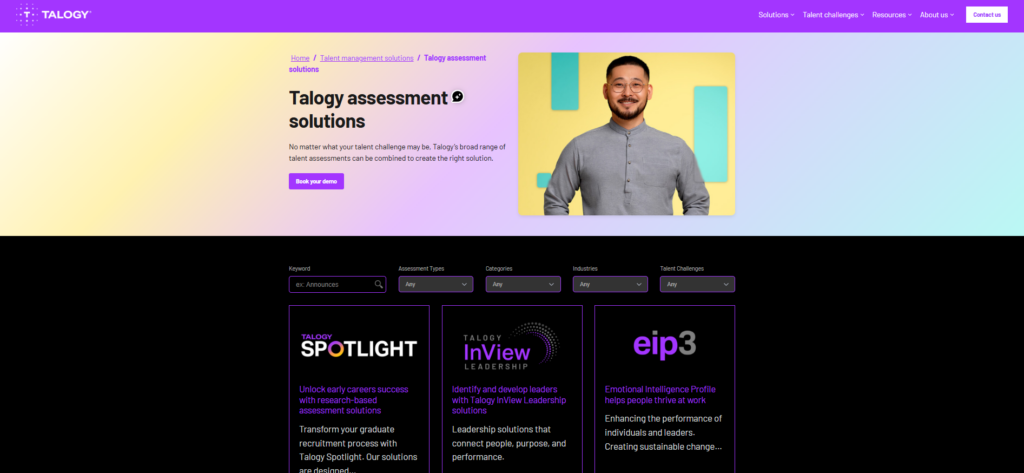
Talogy is a global talent assessment and consulting company that specializes in psychometric testing, behavioral assessments, and hiring science–driven evaluations. Unlike platforms such as Codility that focus heavily on coding challenges and technical execution, Talogy positions itself as a strategic assessment partner, helping organizations improve hiring quality, leadership selection, and workforce potential through validated assessment methodologies.
Talogy is widely used by large enterprises and regulated industries that require scientifically validated assessments, compliance-ready processes, and defensible hiring decisions. Its offerings go beyond hiring and extend into leadership development, workforce planning, and talent optimization.
However, Talogy is not a pure-play coding assessment tool. Organizations hiring for engineering-heavy roles often use Talogy alongside technical testing platforms rather than as a direct replacement for Codility.
Features
- Psychometric assessments: Measures cognitive ability, personality traits, behavioral tendencies, and work styles using research-backed frameworks
- Role-based job profiling: Helps organizations define success profiles by mapping competencies, behaviors, and cognitive requirements to specific roles
- Situational judgment tests (SJTs): Realistic workplace scenarios to evaluate decision-making and behavioral responses
- Leadership and potential assessments: Tools for identifying high-potential talent and future leaders
- Assessment consulting services: Advisory support for validation studies, adverse impact analysis, and compliance requirements
- Enterprise integrations: Integrates with major ATS and HR systems for large-scale hiring programs
Pros
- Strong focus on scientific validity and assessment rigor, making it suitable for high-stakes hiring decisions
- Excellent for evaluating behavioral fit, cognitive ability, and leadership potential
- Well-suited for enterprises that require defensible, compliance-ready hiring processes
- Goes beyond hiring to support leadership development and workforce strategy
Cons
- Does not offer hands-on coding assessments or live technical interviews, limiting its use for developer hiring
- Implementation often requires consulting engagement, which increases cost and setup time
- Less flexible for fast-moving or startup hiring environments
- Pricing is custom and typically aligned with large enterprise budgets
What customers are saying
Public customer feedback on Talogy is limited. While enterprise users often cite the platform’s assessment depth and scientific credibility, there is very little third-party review data available compared to modern SaaS assessment platforms.
G2 rating: Talogy currently has just one review on G2, with an overall rating of 5/5. This small sample size makes it difficult to draw broad conclusions about user satisfaction or usability.
Pricing: Talogy does not publish standard pricing. Costs are custom-quoted based on assessment scope, hiring volume, and consulting requirements, and are typically suited to mid-to-large enterprises.
Mercer Mettl
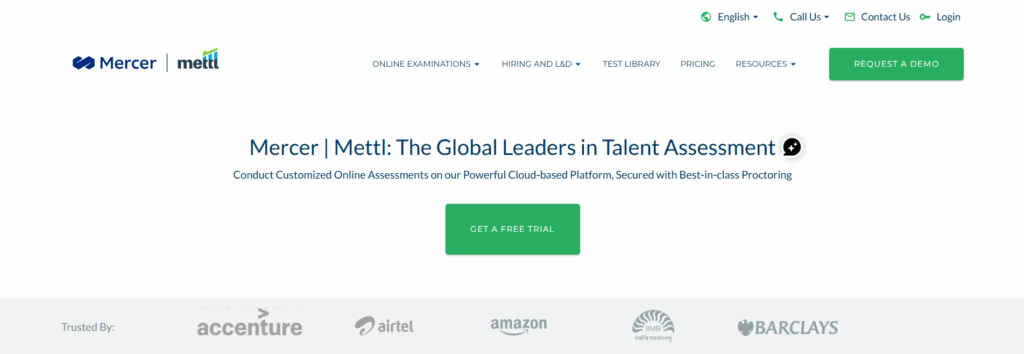
Mercer Mettl is a comprehensive online assessment platform used globally for technical hiring, campus recruitment, high-volume testing, and certification exams.
Unlike Codility, which is primarily focused on developer coding tests, Mercer | Mettl supports a much broader range of assessments, including coding, aptitude, domain knowledge, psychometric testing, and language proficiency.
That said, Mercer | Mettl is often viewed as a heavyweight enterprise solution. While it excels in volume and security, it may feel excessive for teams looking for lightweight, fast-moving technical hiring workflows.
Features
- Wide range of tests: Over 200+ job roles and levels covered, including domain-specific exams and coding tests.
- Anti-cheating and proctoring measures: Provides a robust proctoring toolkit, featuring AI monitoring, lockdown browsers, and human proctoring options.
- Customization and branding: Organizations can have their logo displayed on the test screen, use their own color themes or backgrounds, and host assessments on a custom subdomain.
- Reporting and analytics: Provides detailed competency scores, percentile benchmarks, and hiring recommendations.
Pros
- Very strong for high-volume and campus hiring, especially in regulated or exam-heavy environments
- Robust remote proctoring and test security, suitable for global and distributed hiring
- Wide coverage beyond coding, reducing the need for multiple assessment vendors
- Backed by Mercer, offering credibility, research support, and long-term stability
Cons
- Pricing is custom and often requires a sizable minimum (typically sold in bulk packages).
- The platform can feel feature-heavy and complex, especially for teams focused only on coding assessments
- Less flexibility for rapid test creation compared to modern SaaS-first tools
- Candidate experience may feel more “exam-like” than job-simulated
What customers are saying
Users report that Mettl is “very easy to use” and praise its modular test design and strong customer support. Complaints are few but include requests for more consolidated reporting (e.g., an aggregate Excel report) and the need for a more flexible pricing model for occasional use.
G2 Rating: 4.4/5 (500+ reviews)
Pricing: Pricing is custom-quoted based on assessment volume, proctoring requirements, and role coverage, and typically involves bulk or minimum purchase commitments, making it only suited for mid-to-large enterprises.
iMocha
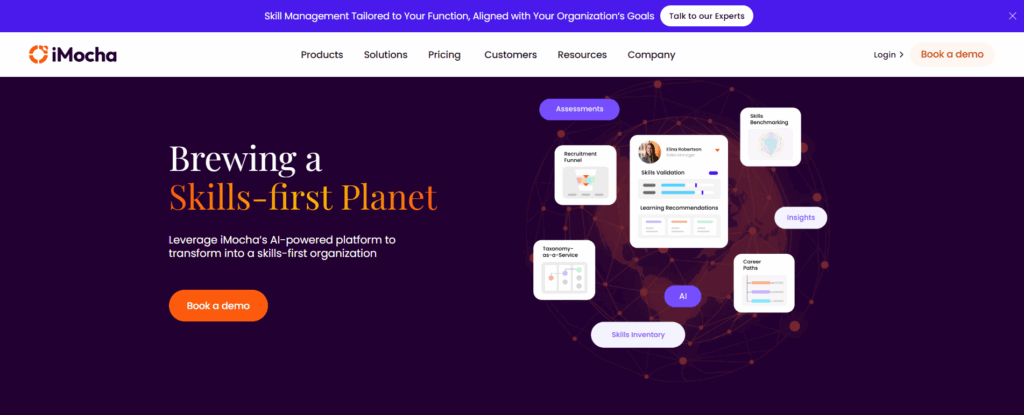
iMocha is an AI-powered skills assessment platform that supports both pre-employment testing and workforce upskilling. iMocha has built a massive skills database and is known for its innovative Skills Intelligence features. Companies use iMocha to test candidates on a variety of skills ranging from coding and IT to finance, language, and more.
Features
- Large test library: Over 3,500+ ready-to-use tests and 30,000+ skills mapped across industries.
- Custom test creation: Build your own tests from scratch or by combining existing questions present on the platform.
- Conversational interviews: Comes with an AI interviewer named Tara who engages in conversations with candidates and auto-generates a report that provides qualitative insights on the candidate’s strengths and areas of improvements.
- AI-powered analytics: Detailed performance reports with benchmarking against industry standards.
Pros
- Huge library (10,000+ skills, including coding, IT, business, and even soft skills).
- Includes AI-driven features (Resume Parser, Code Compare, Smart Test Generator).
- Advanced proctoring options (Live, Record & Review) and plagiarism checks.
- Robust analytics dashboards and integration with LMS/ATS.
Cons
- Even the Starter ($999/year for 100 attempts) is expensive for small teams.
- The interface and feature set can feel overwhelming at first (there’s a learning curve).
- No pure pay-per-use option (must commit to an annual seat-based plan).
What customers are saying
Reviewers rate iMocha highly for its rich feature set. One user calls it “very easy to use” with an “extensive array of features” that streamlined their hiring. Another praises the quality of the question library and the time saved.
Users appreciate the dedicated customer success team and frequent updates. On the other hand, some note minor quibbles like wanting more question types (one review wished for additional variety) and the initial setup being somewhat steep.
But overall, iMocha is seen as feature-rich and reliable.
G2 Rating: 4.4/5 (250+ reviews)
Pricing: 14-day free trial available. Plans start at $1100/year (Starter) and scale up for larger teams.
Hirevue
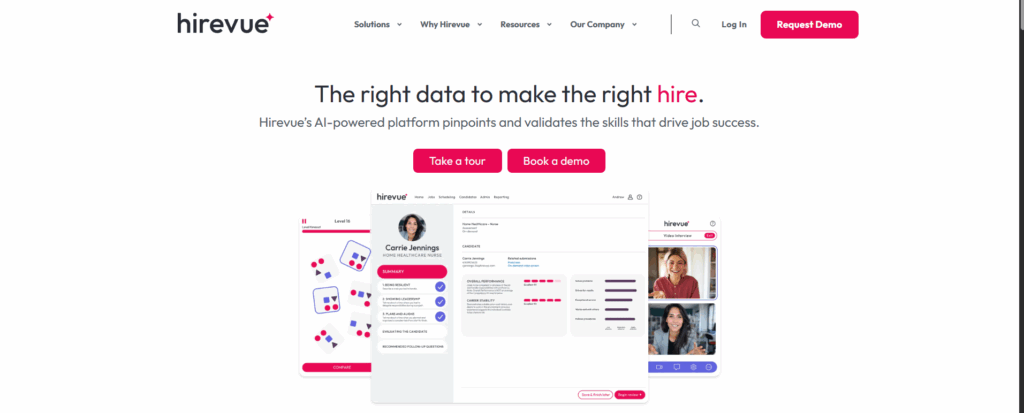
Hirevue is a pioneer in the digital interviewing space that has expanded into assessments. It offers a video interviewing platform combined with game-based and AI-driven assessments. It is used globally by enterprises to streamline high-volume hiring with on-demand video interviews, coding challenges, and even AI-scored games that measure cognitive ability and personality.
Features
- IO Science content library: Access to validated role-specific interview content.
- Video interviews (On-demand & live): One-way and live video interviews with scoring rubrics. AI is used to capture non-verbal cues and evaluate the verbal response content and tone.
- Game-based assessments: AI-driven cognitive games that measure problem-solving, communication, and coding skills.
- Scheduling and Automation: Auto-schedules interviews, engages candidates via chatbots, and integrates with your ATS.
Pros
- Excellent for high-volume hiring and interview automation
- Strong candidate flexibility through asynchronous video interviews
- Helps standardize interviews and reduce interviewer bias at scale
- Robust enterprise integrations and global deployment capabilities
- Particularly effective for early-career, sales, and customer-facing roles
Cons
- Not a deep technical assessment platform; coding tests are limited compared to Codility
- Enterprise pricing makes it cost-prohibitive for SMBs
- Implementation and change management can be complex
- Candidate experience may suffer for technical roles that prefer live problem-solving
What customers are saying
Hirevue users appreciate its ability to scale hiring processes. Reviews highlight the ease of use for scheduling and conducting interviews, noting it’s a “time-saver” since candidates have the option to self-record responses.
On the downside, users do report issues like scheduling limitations (e.g., lack of buffer times, no rescheduling feature) and rare outages
G2 Rating: 4.1/5 (250+ reviews)
Pricing: Hirevue offers three plan tiers, but pricing is not publicly disclosed and requires users to get in touch with the Hirevue team for more details.
TestDome
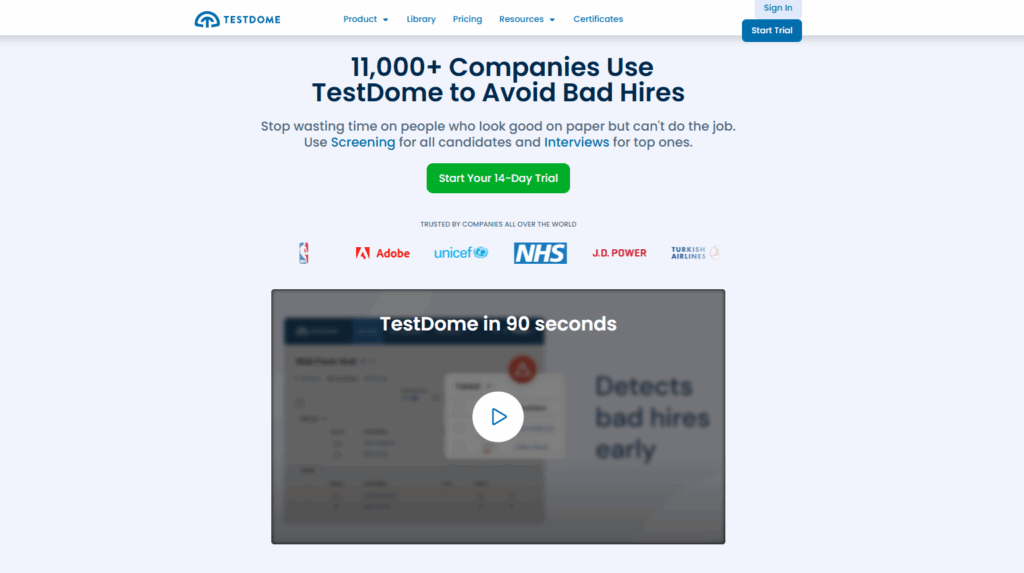
TestDome is a skills testing platform focused on work-sample assessments. It provides over 150 pre-made tests across various domains from programming and IT to accounting, customer service, and more. TestDome’s philosophy is to test applicants with tasks that closely mirror actual job work.
Features
- Work-sample tests: Real-world tasks (e.g., coding, data entry, customer service scenarios).
- Library of 150+ pre-built tests: Covers roles across software development, accounting, customer service, data entry, and more. Tests are short, effective, and designed to filter out unqualified applicants quickly.
- Anti-cheating & proctoring measures: Includes basic proctoring measures such as webcam monitoring and screen recording to deter and detect cheating.
- Benchmarking analytics: Provides side-by-side comparisons of candidates based on test scores.
Pros
- Pay-as-you-go pricing (buy test credits as needed).
- Extensive library of coding, IT, and workplace skills tests (developer, QA, data science, office skills, etc.).
- Easy online setup: turnkey tests plus basic proctoring (timers, webcam).
- Suitable for one-off or irregular hiring.
Cons
- Focuses mostly on English-language tests (no built-in localization).
- The non-technical or soft-skill test library is relatively limited.
- No free plan (the lowest tier is a 5-candidate pack at $100).
What customers are saying
Users find TestDome “very easy to use” with a clean interface. One reviewer noted it makes their recruitment process smoother and more flexible due to features like automated reminders and flexible deadlines. The ability to pay only for what you use is also praised by teams engaging in sporadic hiring.
Common complaints include wishing for more languages (e.g., French) and wanting a few more multiple-choice question options. But overall, TestDome’s simplicity and straightforward pricing are strong positives.
G2 Rating: 4.5/5 (150+ reviews)
Pricing: Pay-per-candidate model. For example, $100 for 5 candidates.
Coderbyte
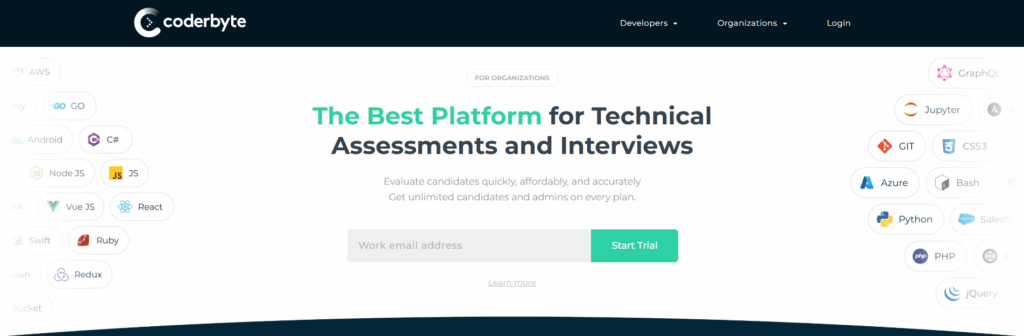
Coderbyte is a technical assessment platform geared towards startups and mid-sized firms for hiring developers and data scientists. It enables unlimited coding tests, technical screening challenges, and even take-home projects on a subscription basis.
Features
- Coding challenges & projects: Massive library of 1,000+ coding challenges, 30+ languages, & 100+ skills.
- Multiple question types: Includes multiple-choice questions, open-ended responses, and SQL queries.
- Built-in interviewing tools: Supports live video coding interviews with collaborative tools including a real-time code editor, spreadsheets, Jupyter Notebooks, and a virtual whiteboard.
- Reporting and analytics: Coderbyte offers a comprehensive reporting and analytics for each coding assessment, which includes several key components such as the candidate’s code, code video recordings, skill ratings and internal benchmarking charts.
Pros
- Straightforward monthly plans ($199/month for the standard plan).
- Built-in code editor and a large library of coding challenges.
- Easy test creation (mix your own questions with templates) and clear candidate reports.
- Facilitates one-on-one live coding interviews through the platform.
Cons
- Exporting results (JSON/CSV) requires a higher-tier plan (extra cost).
- Lacks advanced enterprise features (focus is on coding tasks only).
What customers are saying
Reviewers note that Coderbyte is “much less expensive than alternatives” while providing basic needed functionality. Many appreciate the ease of setup; one said it’s “super easy to configure the assessments” for candidates.
On the downside, one user warned that you can only invite 50 candidates per plan (unexpected until hit), and another mentioned it can be frustrating to pay extra for exporting results. In sum, users like the simplicity and cost-effectiveness, but be mindful of plan limits.
G2 Rating: 4.4/5 (356 reviews)
Pricing: $199/month (unlimited candidates and tests). Annual plans are available at a discount.
Hiremojo
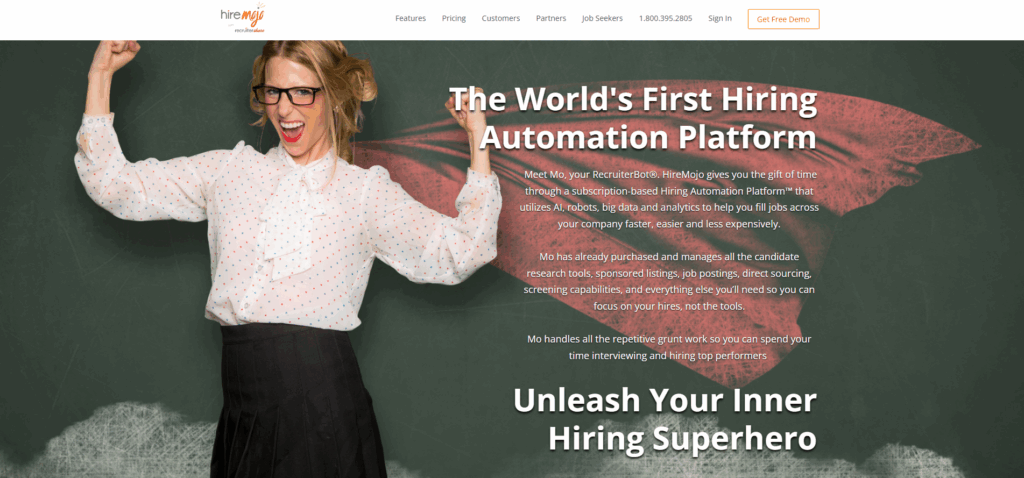
HireMojo is dubbed the industry’s first hiring automation platform. It automates the entire recruitment process from writing job descriptions to posting jobs, pre-screening applicants, scheduling interviews, and more.
Features
- Automated job posting: Distributes job openings across job boards where you’ll find the best candidates.
- Candidate Pre-Screen & Scoring: Automatically pre-screen and rank all applicants. The platform uses a patented online interview process that lets you cut through all of the unqualified resumes to identify top candidates with ease.
- Job and Interview Content Library: Offers ready-to-use templates for creating job descriptions and interview questions, enabling organizations to streamline the hiring process.
- Candidate Management: Easily view candidate resumes, track their status, access notes, schedule interviews, and send ‘No Thank You’ emails to complete the hiring loop.
Pros
- All-in-one recruiting suite: job board distribution, candidate database, automated screening chatbots, and scheduling.
- AI-driven job marketing and resume matching to reduce manual outreach.
- Includes compliance tools (EEO reporting) and background checks.
- Unlimited user seats under flat-price plans.
Cons
- UI and UX feel dated to some users; navigation can be unintuitive.
- Not specialized for technical skill testing (more of an ATS/CRM focus).
- Pricing is flat, which can be inefficient if you have a few hires.
What customers are saying
Hiremojo customers like having multiple tools in one place. One reviewer says it’s a “one-stop shop” for recruiting tasks, automating everything from marketing to interviews. Another highlights the “smart job marketing” and candidate sourcing that saves time.
On the flip side, a user commented that the interface could use a modern redesign. Overall, feedback emphasizes efficiency gains but notes that the platform has more functionality than a simple assessment tool.
G2 Rating: 4.5/5 (4 reviews)
Pricing: Hiremojo does not disclose its pricing publicly. Recruiters need to get in touch with the sales team to get a custom quote
HackerEarth
HackerEarth is an AI-driven tech hiring platform that provides robust tools for screening developers. It supports standardized coding assessments, hackathons, and even remote interviews. Known for its advanced proctoring capabilities and variety of coding challenges, HackerEarth is used by enterprises to identify top tech talent at scale.
Features
- Comprehensive Test Library: Choose from a library of 25,000+ questions across 25+s, including multiple choice, project-based, and data science questions.
- Advanced Proctoring: Features like AI-powered webcam monitoring and plagiarism detection ensure the integrity of assessments.
- Real-Time Interviews (FaceCode): Intelligent live coding interview tool that comes with a collaborative code editor, a built-in question library, HD video chat and a whiteboard.
- Analytics & Skill Reports: Provides detailed skill-based performance reports and AI powered summaries that highlights technical performance and behavioral insights of candidates interviewed.
Pros
- Massive question library (many use HackerEarth’s library of thousands of coding problems).
- Unique features such as FaceCode AI video interview (candidates code live on camera).
- Supports conducting virtual hackathons and competitions.
- Real-time proctoring (IP-based, webcam monitoring) and plagiarism checks.
Cons
- Rigid time limits on tests can be frustrating
- Enterprise-focused pricing means small teams may still pay for surplus features.
What customers are saying
G2 users rate HackerEarth highly for its versatile coding platform. Reviews highlight the ease of creating coding assessments and the support for multiple languages.
However, users express concerns about the strict timers that affect candidate experience (e.g., “time limits can be restrictive for solving complex coding problems”) and occasional minor bugs in test creation.
G2 Rating: 4.5/5 (600+ reviews)
Pricing: HackerEarth offers scalable pricing plans designed to grow with your business. Pricing plans start at $99 per month, with higher-tier plans available to support larger teams and advanced hiring needs
HackerRank
HackerRank is an enterprise-grade developer assessment platform and coding challenge hub that has been on the market for over a decade. It enables companies to create skill-based technical assessments to screen candidates effectively.
HackerRank is popular for early-stage technical screening and standardized developer evaluation at scale. However, HackerRank’s approach remains largely coding-centric and algorithm-focused, which may not fully reflect real-world engineering work for all roles.
Features
- Extensive question bank: HackerRank’s test library is specialized for technical hiring offers a library, featuring over 7500 questions which is mostly comprised of coding challenges across 45+ programming languages languages.
- Screen, interview, and beyond: Coding tests, live pair programming, and interview tools.
- Fair scoring: Leverages multiple proctoring and user signals to ensure each developer has an equal opportunity to demonstrate their skills, while maintaining the integrity of the assessment.
- Enterprise integrations: Supports integrations with ATS and other recruitment tools.
Pros
- Strong brand recognition and familiarity among developers
- Scales well for high-volume technical hiring
- Reliable infrastructure and enterprise-grade integrations
- Useful for standardized screening across global teams
Cons
- It can be expensive (the Starter plan is $198/monthnth, and growth can become costly).
- Known to have a steeper learning curve for advanced use (writing tests often require multiple iterations).
- Limited coverage beyond software engineering roles
- Custom test creation can be time-consuming
- Less emphasis on behavioral, communication, or role-specific evaluation
What customers are saying
Many companies trust HackerRank for its proven track record in tech hiring. (It’s so common that many developers have used it themselves.) Users often mention the sheer breadth of questions as a strength. However, consistent feedback is that building custom questions is time-consuming and that pricing is high for small teams.
G2 reviews also frequently mention its utility in consistent developer screening, but also note that alternatives can be cheaper or simpler to use.
G2 Rating: 4.6/5 (1000+ reviews)
Pricing: Flexible usage-based pricing. Plans start at $198/monthnth for the Starter plan.
TestInvite
TestInvite is a comprehensive online exam and assessment software built to facilitate secure, highly customizable testing for various purposes, including corporate hiring, education, and certification.
Features
- Custom test creation: Provides a highly flexible test builder with a wide variety of custom question types making it ideal for organizations seeking granular control and flexibility in test creation.
- Talent assessment library: Use pre-built tests to assess candidates on essential abilities such as problem-solving, communication, and other role-specific competencies.
- Detailed reports: Enhance candidate reports by modifying scoring logic, deriving new metrics, comparing results against benchmarks or norms, categorizing scores, and adding textual interpretations for different score ranges.
- Anti-cheating and proctoring measures: TestInvite incorporates a comprehensive set of anti-cheating measures, such as lockdown browsers, AI-driven cheating detection, and question randomization, all designed to ensure the integrity of assessments.
Pros
- Strong anti-cheating features (lockdown browser, webcam snapshots, randomized questions).
- Extremely flexible test authoring (multi-step workflows, conditional branching).
- Good support and tutorials, quick response from the vendor.
- Offers live proctoring add-on.
Cons
- Entry plans are very basic (Starter at $37/mo includes only 5 tests and limited teammates)
- To scale beyond 500 credits/year requires upgrading to higher plans.
- Some reviews mention UI translation issues.
What customers are saying
TestInvite users highlight its customer support and ease of use. One reviewer says, “very easy to use” and praises the quick support response. The platform’s data management and reliability are also commended.
On the negative side, a few small-language-institute users mention that the French translation is imperfect and the Starter plan’s test count is limited. But generally, the consensus is that TestInvite is user-friendly and well-supported.
G2 Rating: 4.7/5 (16 reviews)
Pricing: Starts at $37/month (Starter). Pricing increases for more features.
eSkill
eSkill is a long-established pre-employment assessment platform known for its broad library of skills tests and job simulations. Unlike Codility, which is built primarily for evaluating software developers through coding challenges, eSkill is designed to assess a wide range of functional, clerical, technical, and entry-to-mid-level professional skills.
Because of this positioning, eSkill is not a direct replacement for Codility in engineering-heavy hiring. Instead, it serves as a complementary or alternative solution for companies that prioritize broad skills coverage over deep technical coding evaluation.
Features
- Massive test library: Choose from over 600 ready-to-use assessments or create custom tests by selecting subjects, topics, and questions tailored to your job or training needs.
- Simulations: Go beyond multiple-choice questions with eSkill’s interactive job simulation tests that evaluate how candidates perform in real-world job scenarios.
- Anti-cheating and advanced proctoring: Enables organizations maintain the integrity of assessments by monitoring behaviors such as copy-pasting and tab switching, automatically flagging any suspicious activity in real time.
- Reporting and analytics: Access detailed candidate reports, including overall scores and performance breakdowns by subject or question, allowing you to gain insights into each applicant’s strengths and weaknesses.
Pros
- Very strong for non-developer and entry-to-mid-level hiring
- Large variety of practical, job-relevant assessments
- Flexible test customization for role-specific screening
- Useful job simulations that mirror day-to-day tasks
- Reliable option for organizations hiring across many business functions
Cons
- Interface feels dated compared to modern SaaS assessment platforms
- Pricing is not transparent and typically requires sales engagement
- Less emphasis on candidate experience and modern UI/UX
- Fewer pre-built job-specific tests than promised (reviewers sometimes have to build exams from scratch).
What customers are saying
Users emphasize eSkill’s flexibility and breadth. For example, one recruiter says it lets them “find the most useful questions for each department” by customizing tests.
However, some users point out that navigating the test library can be tedious and that they would like more ready-made assessment templates to save time. A few users found the pricing to be expensive for low-volume hiring.
In general, though, eSkill’s customer support and reporting tools are well regarded.
G2 Rating: 4.5/5 (350+ reviews)
Pricing: eSkill does not disclose its pricing publicly. Recruiters need to get in touch with the sales team to get a custom quote
Canditech
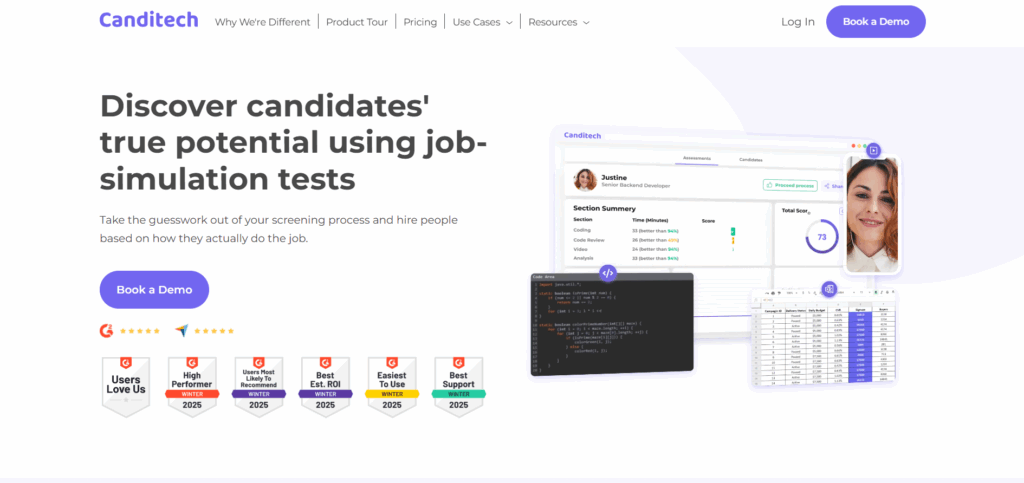
Canditech is a newer entrant that has quickly gained acclaim (even achieving a 5.0 G2 rating). It is a job simulation assessment platform enabling employers to evaluate candidates through realistic work scenarios.
Features
- Custom & expert-built tests: Create your own custom assessments or leverage Canditech’s extensive library of over 500 pre-built tests to design the perfect assessment for your hiring needs
- Job Simulations: Simulations for coding, Excel exercises, open-text responses, and more.
- Automatic scoring: Candidates are automatically ranked based on performance so that you can focus on the applicants with the best chances of success in their future roles, eliminating unconscious human bias.
- Benchmarking analytics: Offers score benchmarking, enabling companies to compare employee performance on various assessments against industry standards or job-specific benchmarks.
Pros
- Supports complex question types (live coding with SQL/Excel scenarios, video responses, collaborative tasks).
- User-friendly test builder: easy for even non-technical users to create rich scenarios.
- Strong focus on data skills (unique SQL coding tests where candidates query a real database).
Cons
- Branding customization is limited (one user wanted more ability to “add flavor” for their brand).
- Reporting could integrate better with internal score rubrics (some users miss embedding custom rating scales)
What customers are saying
Reviews mention how easy it is to create assessments, and it is great for filtering candidates in interview processes.
Criticisms include concerns like exam security and the need for better rubric integration. Overall, Canditech’s emphasis on realistic tests and excellent support gets high marks.
G2 Rating: 5/5 (50+ reviews)
Pricing: Team plan starts at $150/month for 100 candidates
Which is the best Codility alternative?
When considering all of these platforms, Testlify stands out as the top recommended alternative to Codility for both small businesses and large enterprises alike.
Testlify features an extensive test library (over 3,500 tests), AI-powered candidate evaluations, and conversational AI interviews for creating realistic job simulations at scale. It also supports 100+ ATS integrations out of the box.
Whether you’re looking for pre-employment testing tools or a conversational AI powered interview platform for high-volume hiring, Testlify excels at delivering everything you need without overwhelming your budget.
Read our in-depth Testlify vs Codility comparison article to make the best choice for your hiring needs.
Frequently asked questions (FAQs)

Director of Marketing
Akash Patange is the Director of Marketing at Testlify, where he works closely with HR leaders and recruiters to help organizations improve hiring outcomes. He writes about talent assessment, recruitment technology, and data-driven hiring practices.
LinkedInRelated resources
View all
Alternatives
Top 15 Adaface Alternatives and Competitors
Alternatives
Top 15 TestGorilla Alternatives and Competitors
Alternatives
Top 15 The Talent Games Alternatives and Competitors (2026)
Alternatives
Top 15 The TalentMetrix Alternatives and Competitors
Alternatives
Top 15 Equip Alternatives and Competitors
Alternatives
Top 15 Harver Alternatives and Competitors
Get started.
Hire on proof, not resumes.
Run your first skills-based assessment free — no credit card required.