
Top 15 HackerEarth Alternatives and Competitors
Discover 15 powerful HackerEarth alternatives to streamline your hiring process and assess candidates with confidence.
The best HackerEarth alternative is the one that measures the part of the job your coding test cannot see. HackerEarth handles coding tests, live interviews and remote proctoring well. Teams usually leave it when hiring widens past developers, when a coding score stops predicting who actually performs, or when the bill grows faster than the hiring plan.
This guide compares 15 HackerEarth alternatives, what each one is genuinely good at, where it falls short, and how to pick between them without running a three-month bake-off.
 ChatGPT
 Gemini
 Claude
 Grok
Grok Perplexity
TL;DR
- A coding test is a work sample, and work samples carry an operational validity of about .33 against job performance. A structured interview carries .42. So a coding-only stack is leaning on the weaker of the two signals.
- Most teams switch because they need non-developer roles, behavioural signal, or an interview layer, not because the coding engine is broken.
- Testlify fits teams that want one platform for coding plus aptitude, personality and conversational AI interviews. Coding-deep specialists still win on raw algorithmic depth.
- Pricing on this category is mostly quote-based. Only a handful of vendors publish real figures, so budget comparisons need a direct quote from each shortlist.
- Pick on the evidence you need to defend a hire, then check the tool can produce it. Not the other way around.

Why do teams look for HackerEarth alternatives?
Three reasons come up again and again: coverage, cost and the shape of the hiring funnel. HackerEarth is built around developer assessment. The moment a company starts hiring support, sales, finance or operations at the same volume, a coding-first platform becomes one tool among several, and the case for consolidating gets loud.
The market backdrop matters too. Software development job postings still sit 27.5% below their pre-pandemic level, and 71% of the growth between May 2025 and May 2026 came from senior roles. Fewer, more senior openings means each hire carries more weight, and a screening tool that only ranks algorithm scores gives you less to defend a decision with.
That is a hiring slowdown, not a hiring stop. The U.S. Bureau of Labor Statistics still projects 10% employment growth for software developers, QA analysts and testers from 2025 to 2035, with roughly 106,100 openings a year over the decade. So the volume is coming back. The question is whether your screening stack will be ready to judge more than syntax when it does.
Cost is the third driver. Very few vendors in this category publish full pricing, so what looks like a small per-candidate difference can turn into a large annual gap once seats, proctoring and interview modules are added.
How much should a coding test decide?
Less than most hiring teams assume. Work sample tests, which is what a coding challenge is, show an operational validity of .33 against job performance. Structured interviews reach .42, job knowledge tests .40 and cognitive ability .31. No single method gets close to settling the question on its own.
That is the honest argument for switching platforms, and it has nothing to do with feature counts. If a coding score is the only evidence in the file, the decision rests on the weaker half of the available signal.
There is a second reason the coding-only model is aging. In the 2025 Stack Overflow developer survey, 84% of developers use or plan to use AI tools, yet more distrust the accuracy of AI output (46%) than trust it (33%). The skill that separates good engineers now is judgment about when the generated answer is wrong. A timed algorithm puzzle does not test that. A code review task, a debugging exercise or a conversation about a bad suggestion does.
This is what the Testlify AI-Era Capability Framework is built around: evaluate whether candidates can perform in human plus AI workplaces by measuring role skills, problem-solving, communication, judgment, adaptability and responsible AI fluency. AI supports the process. Humans make the decision.
Pro tip: before shortlisting a single vendor, write down the three pieces of evidence you would need to defend your next hire to a skeptical hiring manager. Then check which platforms can actually produce all three. Most shortlists shrink by half.
What should you compare before switching?
Six criteria separate these platforms in practice. Everything else is packaging.
- Role coverage. Developer-only, or the whole org? This is the single biggest fork in the decision.
- Signal types. Coding, cognitive, behavioural, language, work simulation, interview. More independent signals pointing the same way means more confidence in the shortlist.
- Interview layer. Live pair programming, one-way video, or AI-led conversation. Whether it lives in the same tool decides how much stitching you do later.
- Assessment integrity. Identity checks, proctoring depth, AI-assistance detection. Necessary, and easy to over-buy for low-risk roles.
- Reporting a hiring manager will read. Percentiles and skill breakdowns beat a single number every time.
- Pricing model. Per candidate, per seat, or flat subscription. Match it to whether your hiring is steady or spiky.
Quick comparison table
Platform | Strongest at | Best for | Pricing model |
|---|---|---|---|
Testlify | Breadth plus conversational AI interviews | Teams hiring technical and non-technical roles in one place | Published tiers plus custom |
TestGorilla | Broad multi-skill test library | Generalist screening at volume | Free tier plus published paid tiers |
Adaface | Conversational candidate experience | Reducing drop-off on longer assessments | Published tiers |
PMaps | Behavioural and cognitive profiling | Volume hiring where attitude predicts retention | Published tiers plus custom |
Vervoe | AI-graded job simulations | Task-based hiring across mixed roles | Quote based |
Codility | Engineering assessment at scale | Large developer hiring programmes | Published tiers plus custom |
Mercer Mettl | Psychometrics and secure proctoring | Campus, certification and compliance-heavy hiring | Quote based |
iMocha | Skills-intelligence depth | Skills mapping across an existing workforce | Quote based |
HireVue | Video interviewing at enterprise scale | High-volume interview logistics | Quote based |
TestDome | Short, practical work samples | Fast filtering of unqualified applicants | Published tiers |
Coderbyte | Unlimited coding tests on subscription | Startups with unpredictable developer volume | Subscription, confirm with vendor |
HackerRank | Depth of algorithmic content | Engineering orgs that live in coding challenges | Usage based, confirm with vendor |
TestInvite | Granular custom exam building | Certification and highly bespoke testing | Published tiers plus per-candidate rates |
eSkill | Very large ready-made test catalogue | Operational and administrative roles | Quote based |
Canditech | Realistic job simulations | Predicting on-the-job output over test-taking skill | Quote based |
1. Testlify
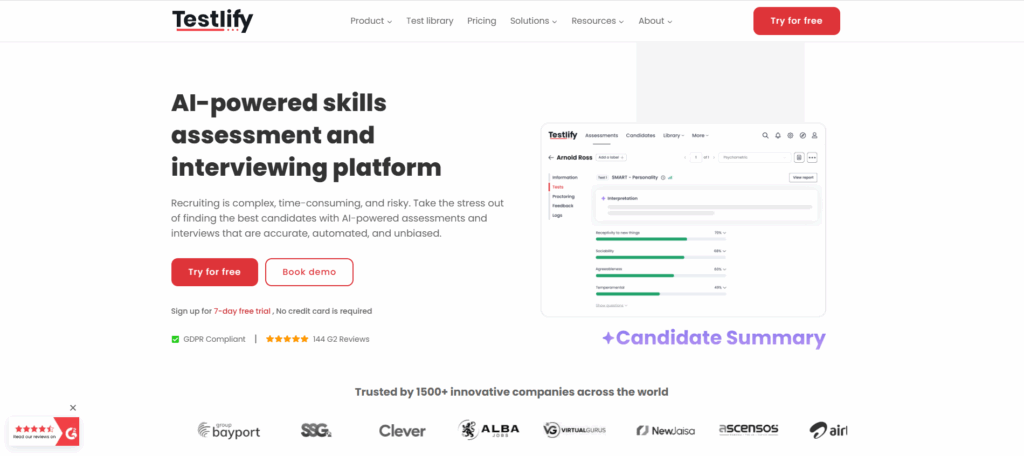
Testlify is an AI-assisted, human-led skills assessment and interviewing platform. It pairs role-specific tests with conversational AI interviews and candidate analytics, and it covers technical and non-technical hiring in the same workflow, which is the specific gap most teams hit with a coding-first tool.
Key features
- Large role-specific test library: coding, cognitive, personality, language and typing assessments in one test library, plus custom tests for niche roles.
- Conversational AI interviews: chat, voice or video job simulations that scale to high-volume funnels without a scheduler in the loop.
- AI candidate summaries: automatic strengths, gaps and fit ratings, with charts and side-by-side comparisons for reviewers.
- Wide ATS coverage: 100+ ATS integrations including Greenhouse, Lever and Workable, so results land in the pipeline automatically.
- Assessment integrity controls: webcam checks, tab-switch detection, question randomisation and lockdown browser, configurable by role risk.
Pros
- One platform for coding, aptitude, behavioural and interview signal, which removes most of the stitching work.
- Published entry pricing, which is rare in this category.
Cons
- Algorithmic depth does not match the coding-only specialists, so competitive-programming shops may want both.
- The breadth takes some setup before the first assessment goes out.
Best for
Teams that hire across engineering and the rest of the business and want one evidence trail behind both.
Pricing
The Standard plan is $139 a month, billed at $1,668 a year, and includes 100 candidate credits (about $16.68 per candidate) and 3 users, with extra seats at $15 per seat per month. Higher volumes and unlimited-credit arrangements are quoted directly. Current figures are on the Testlify pricing page.
2. TestGorilla
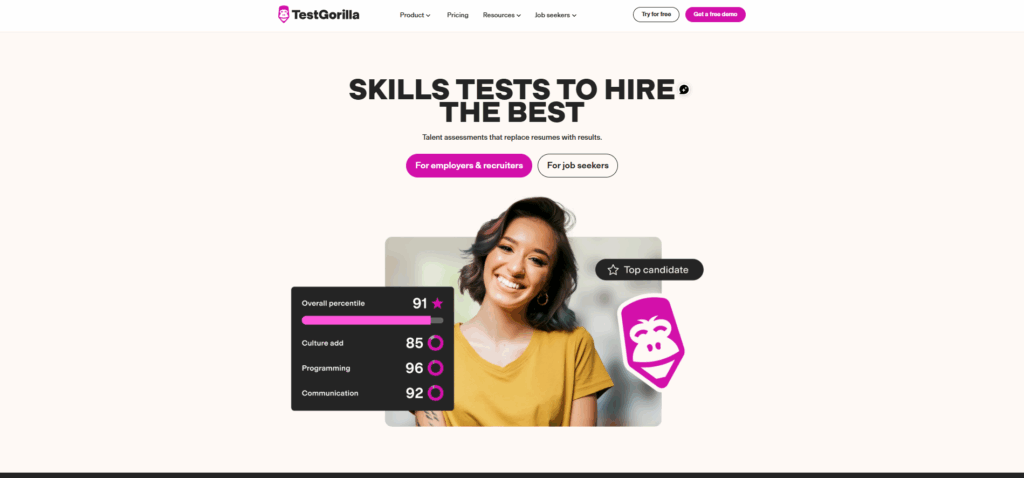
TestGorilla is a general pre-employment testing platform covering technical and soft skills. It is a common first step away from coding-only tools because the library spans most of the roles a mid-sized company hires for.
Key features
- Broad test catalogue: cognitive ability, software skills, language and personality tests, refreshed against job requirements.
- Video questions: capture communication and situational thinking that a written test misses.
- Anonymised scoring: reports designed to reduce the influence of names and backgrounds during shortlisting.
- Custom branding: logos, themes and intro videos, with control over question order and timing.
Pros
- Wide role coverage out of the box, with a usable free tier for a first trial.
- Test quality is consistent across non-technical categories.
Cons
- Coding depth is shallower than dedicated engineering platforms.
- Costs climb once you add seats and higher candidate volumes.
Best for
Generalist screening where most of the hiring is outside engineering.
Pricing
A free plan plus published paid tiers, with larger deployments quoted. Confirm current figures on the vendor pricing page before budgeting. See also our TestGorilla alternatives comparison.
3. Adaface
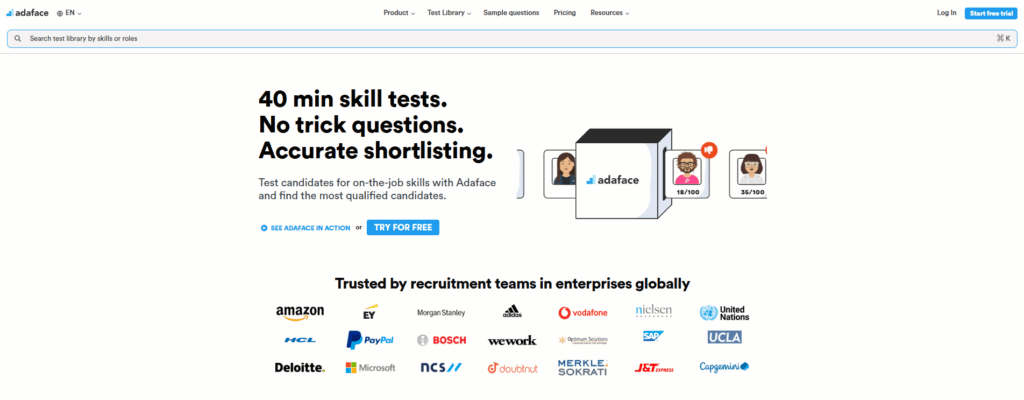
Adaface replaces the standard multiple-choice format with an adaptive chat-driven assessment. The bet is that a conversational format feels less like an exam, so fewer candidates abandon it halfway through.
Key features
- Conversational assessments: a chat interface asks contextual questions in sequence rather than presenting a static test.
- Job-specific templates: ready-made assessments across engineering, finance, support and operations.
- Automatic banding: candidates are sorted into pass, borderline and fail so reviewers can filter immediately.
- Customisation: control over question types, time limits and difficulty on any template.
Pros
- Completion rates hold up better than on long conventional tests.
- Setup is quick, and the templates need little editing.
Cons
- The chat format suits knowledge checks more than long-form build tasks.
- Reporting is lighter than the enterprise-focused platforms.
Best for
Teams losing candidates to assessment drop-off.
Pricing
Adaface publishes tiered plans on its pricing page. Confirm the current tier that matches your volume before committing. See also our Adaface alternatives comparison.
4. PMaps
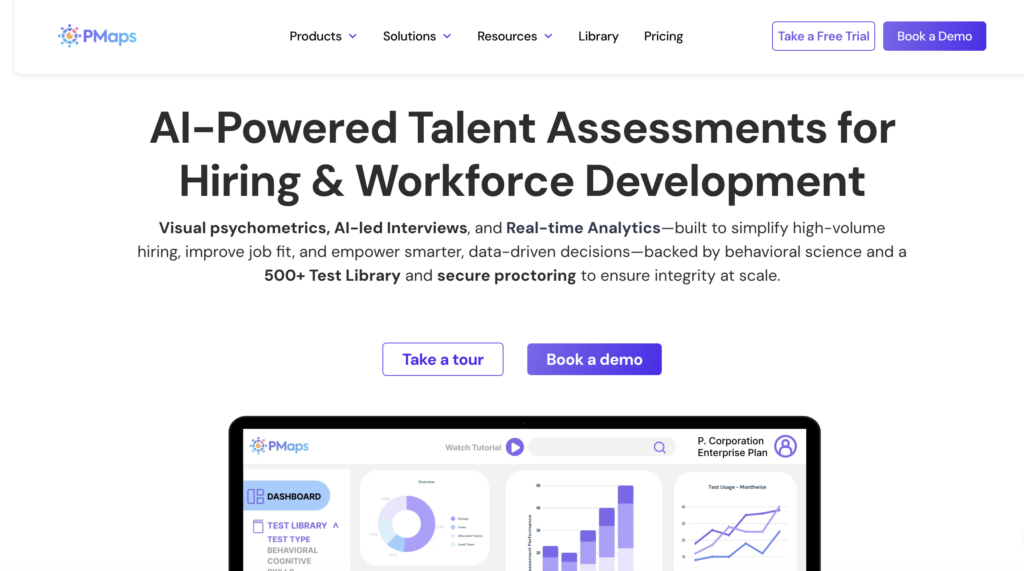
PMaps sits on the psychometric side of the category. Instead of leading with coding, it leads with cognitive ability and behavioural profiling, which makes it a fit for roles where attitude and trainability predict retention better than current skill does.
Key features
- Multi-dimensional assessments: technical, cognitive and behavioural competencies scored together.
- AI voice screening: automated spoken interviews that assess communication and job readiness.
- Role-based library: hundreds of ready-to-deploy job-specific frameworks.
- Proctoring: AI monitoring and fraud detection for remote sittings.
Pros
- Strong behavioural signal for frontline and volume hiring.
- Voice screening covers a gap that text-only tests leave open.
Cons
- Developer assessment is not the strength here.
- Psychometric reports need some interpretation training for hiring managers.
Best for
High-volume hiring where retention, not raw skill, is the problem.
Pricing
Tiered plans are published, with larger programmes quoted. Confirm current figures with the vendor.
5. Vervoe
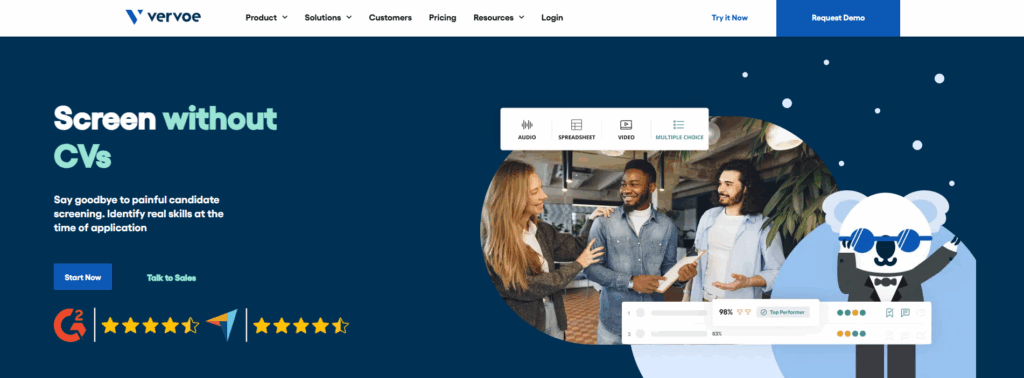
Vervoe is built on the idea that candidates should do the job before they get the job. Assessments are task-based, and AI grades and ranks the responses rather than scoring a fixed answer key.
Key features
- Job simulations: pre-built assessments across support, sales, marketing, tech and operations that mirror real tasks.
- Multi-format answers: text, video, file uploads and spreadsheets in a single assessment.
- AI grading: responses ranked on accuracy and relevance, with the model tuned by your own reviewer feedback.
- Collaborative review: several reviewers rate and comment in one dashboard.
Pros
- Simulation quality is high, and candidates report it as fairer than a quiz.
- Grading improves as reviewers correct it.
Cons
- Open-ended tasks take longer for candidates to complete than a timed test.
- Public pricing detail is thin, so budgeting needs a quote.
Best for
Task-based hiring across mixed technical and non-technical roles.
Pricing
Quote based. The pricing page directs buyers to sales rather than listing figures. See also our Vervoe alternatives comparison.
6. Codility
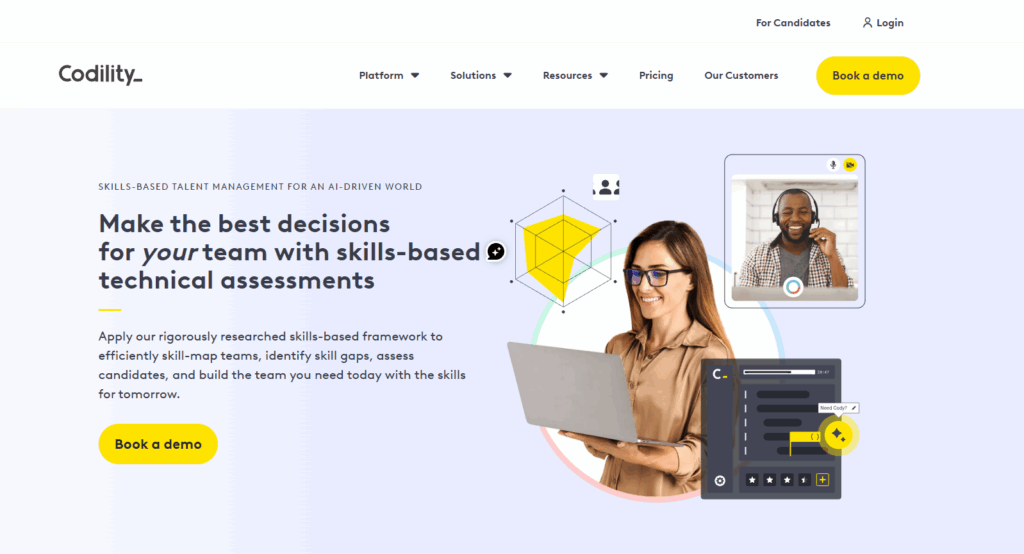
Codility is a direct like-for-like swap for HackerEarth: coding assessment built for large engineering hiring programmes, with a live technical interview layer attached.
Key features
- Deep coding task bank: over a thousand tasks across dozens of languages, from basic algorithms to system design.
- Live technical interviews: a shared IDE with syntax highlighting, compiler and test runner for real-time pair programming.
- Automated scoring: submissions graded on correctness, efficiency and readability, so recruiters get a structured report without a manual code review.
- Task-level analytics: breakdowns by test case passed and code quality.
Pros
- Reliable at scale, with reporting engineers actually trust.
- Published tier pricing, which makes comparison easier.
Cons
- Developer-only, so it does not solve the coverage problem that drives most switches.
- Entry cost is high for small teams.
Best for
Large developer hiring programmes that need depth over breadth.
Pricing
Two published annual tiers plus a custom enterprise option. See also our Codility alternatives comparison.
7. Mercer Mettl
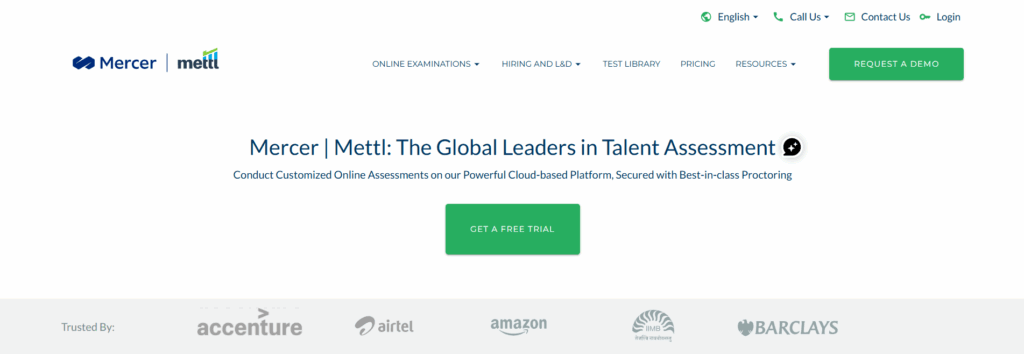
Mercer Mettl runs a full assessment suite with unusually strong psychometric and proctoring depth. It shows up most often in campus recruitment, certification testing and hiring that has to survive an audit.
Key features
- Wide role coverage: assessments spanning hundreds of job roles and levels, including domain exams and coding tests.
- Layered proctoring: AI monitoring, lockdown browsers and human proctoring options.
- White labelling: custom logos, themes and a branded subdomain for the assessment experience.
- Benchmarked reporting: competency scores with percentile benchmarks and hiring recommendations.
Pros
- Proctoring rigour is among the strongest in the category.
- Psychometric research depth suits regulated hiring.
Cons
- Heavier to configure than lightweight tools.
- No public pricing, so evaluation needs sales contact up front.
Best for
Campus, certification and compliance-sensitive hiring.
Pricing
Quote based, priced on tests, candidate volume and features. See also our Mercer Mettl alternatives comparison.
8. iMocha
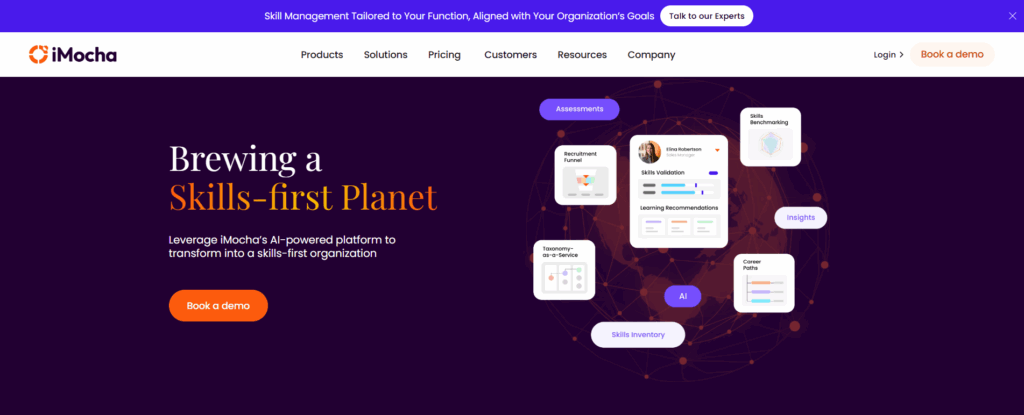
iMocha covers pre-hire testing but has pushed hardest into skills intelligence, which is mapping the skills an existing workforce already has. That makes it a different purchase from a pure screening tool.
Key features
- Very large test library: thousands of ready-to-use tests and tens of thousands of skills mapped to job roles, including niche domains.
- Custom test builder: mix existing questions with new ones and set custom scoring logic.
- AI interviewer: conversational interviews that produce qualitative reports alongside scores.
- Skill-group analytics: performance tracked by domain and question category.
Pros
- Skills taxonomy is deeper than anything else on this list.
- Works for internal mobility, not just hiring.
Cons
- More platform than a team that only needs screening will use.
- Pricing is not published.
Best for
Organisations mapping skills across an existing workforce as well as hiring.
Pricing
Quote based. See also our iMocha alternatives comparison.
9. HireVue
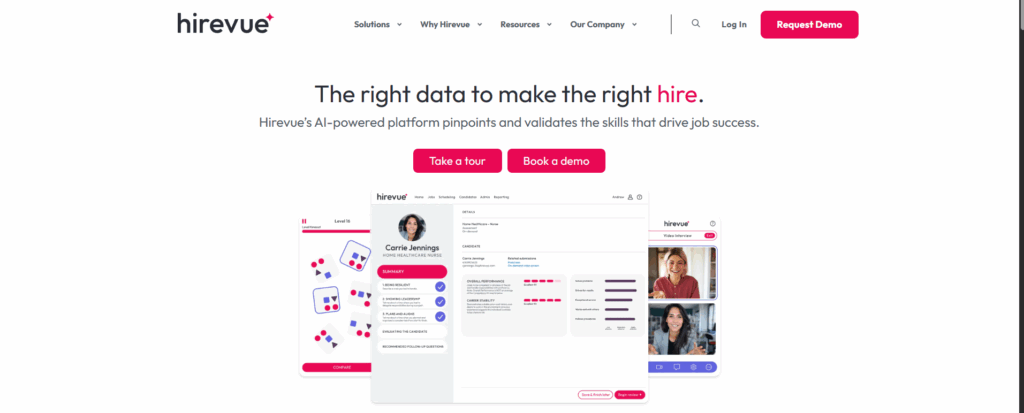
HireVue came from video interviewing and expanded into assessment. Its centre of gravity is still interview logistics at very large scale, which is a different problem from test design.
Key features
- Validated interview content: role-specific structured interview guides built by industrial-organisational psychologists.
- On-demand and live video: one-way and live interviews with scoring rubrics.
- Game-based assessments: cognitive exercises measuring problem-solving and related traits.
- Scheduling automation: interview coordination handled without recruiter back-and-forth.
Pros
- Handles interview volume few platforms can match.
- Structured interview content is research-backed, which matters given structured interviews are the strongest single predictor in the evidence above.
Cons
- Enterprise-weight implementation and cost.
- Skills testing is secondary to the interview layer.
Best for
Enterprises whose bottleneck is interview logistics, not test content.
Pricing
Quote based. See also our HireVue alternatives comparison.
10. TestDome
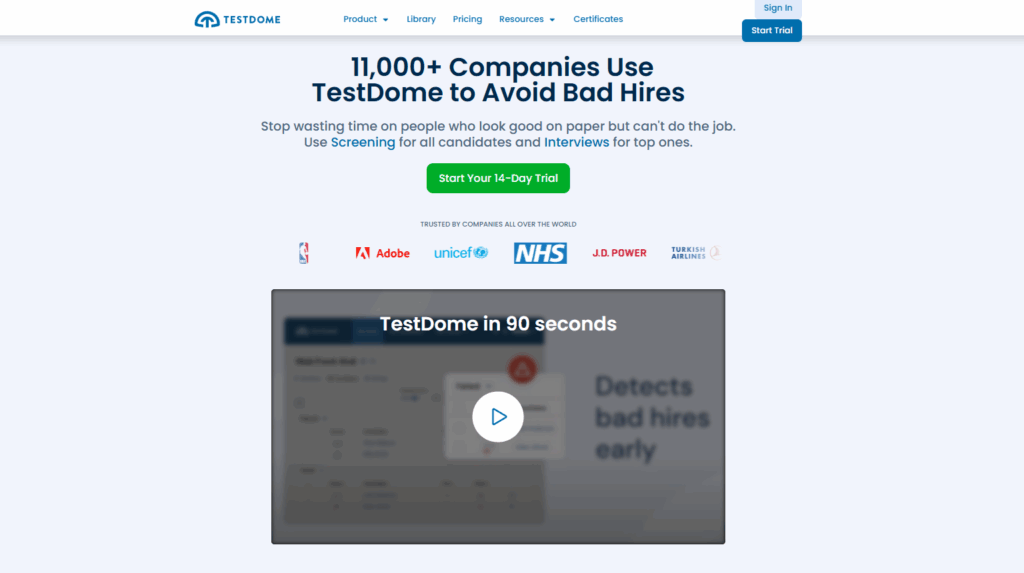
TestDome keeps things deliberately narrow: short, practical work-sample tasks that filter out unqualified applicants fast. It is not trying to be a hiring suite.
Key features
- Work-sample tasks: realistic problems rather than theory questions or timed puzzles.
- Ready-made library: tests across software development, accounting, customer service and data entry.
- Custom questions: build tasks or mix them with the library, covering specific languages, logic, writing or numerical reasoning.
- Benchmarked scorecards: side-by-side comparison with percentile rankings.
Pros
- Fast to deploy, and candidates finish quickly.
- Pricing figures are published, which is uncommon here.
Cons
- No interview layer, so it is one part of a stack rather than a replacement.
- Limited behavioural or cognitive coverage.
Best for
Quickly filtering a large top-of-funnel before anyone spends interview time.
Pricing
Published tiers on the vendor pricing page, with larger volumes quoted. See also our TestDome alternatives comparison.
11. Coderbyte
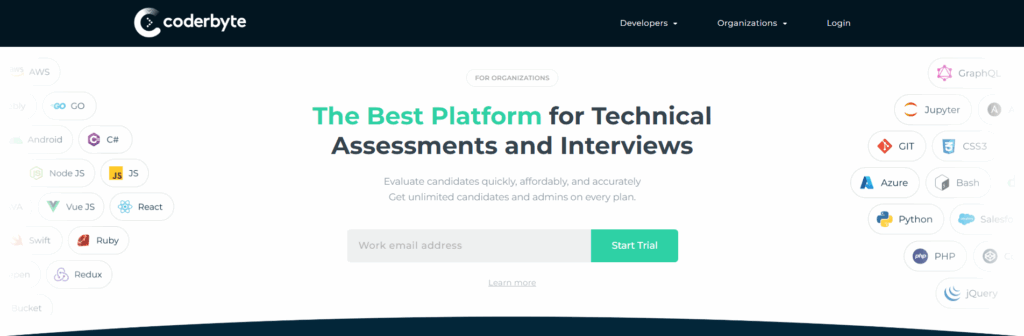
Coderbyte targets startups and mid-sized teams hiring developers and data scientists, with a subscription model built for unpredictable hiring volume.
Key features
- Large challenge library: over a thousand coding challenges across dozens of languages and skills.
- Mixed question types: multiple choice, open-ended responses and SQL queries alongside code.
- Live interview tools: real-time code editor, spreadsheets, Jupyter notebooks and a virtual whiteboard.
- Session playback: candidate code, recordings, skill ratings and internal benchmarking.
Pros
- Subscription model suits lumpy hiring better than per-candidate pricing.
- Take-home projects and live interviews in the same tool.
Cons
- Developer-only coverage.
- Reporting is lighter than the enterprise platforms.
Best for
Startups whose developer hiring comes in bursts.
Pricing
Subscription based. Confirm current figures with the vendor, as the published page moved. See also our Coderbyte alternatives comparison.
12. HackerRank
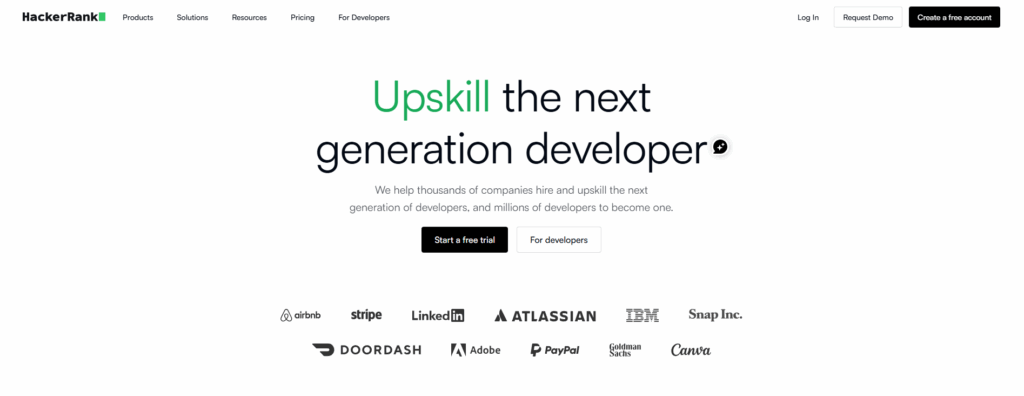
HackerRank is the other veteran in developer assessment and the closest competitor to HackerEarth on content depth. If the reason for switching is coding rigour rather than coverage, this is the obvious comparison.
Key features
- Very large question bank: thousands of coding and technical questions across dozens of languages, including debugging and domain-specific problems.
- Full developer hiring workflow: automated screening, live pair-programming interviews and take-home projects in one place.
- Integrity tooling: plagiarism detection, IP tracking and time-violation alerts.
- ATS integrations: connects to major applicant tracking systems without custom work.
Pros
- Deepest algorithmic content in the category.
- Mature integrations and a familiar candidate experience.
Cons
- Same coverage limit as HackerEarth, so it solves depth, not breadth.
- Pricing is not clearly published.
Best for
Engineering organisations where coding challenges are the core of the process.
Pricing
Usage based. Confirm current figures with the vendor. See also our HackerRank alternatives comparison.
13. TestInvite
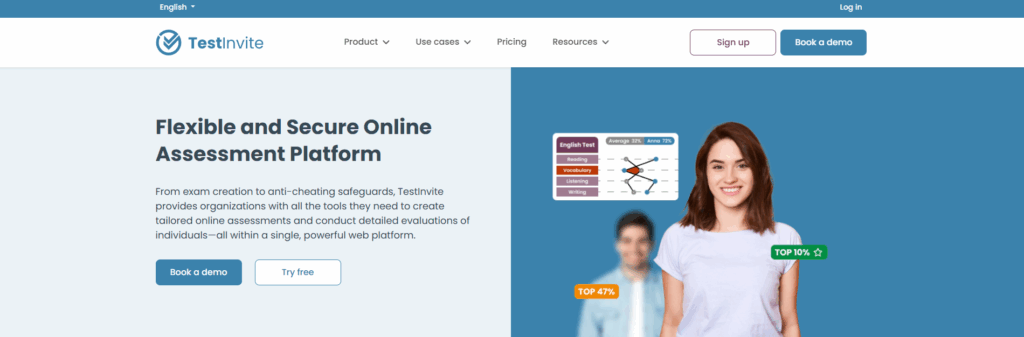
TestInvite is exam software first and hiring software second. That sounds like a limitation until you need scoring logic no other platform will let you build.
Key features
- Flexible test builder: a wide range of custom question types with granular control over structure.
- Pre-built library: ready assessments for problem-solving, communication and role-specific competencies.
- Custom scoring: derive new metrics, compare against norms, band scores and attach written interpretations per range.
- Integrity controls: lockdown browser, AI cheating detection and question randomisation.
Pros
- Unmatched control for bespoke or certification testing.
- Transparent published rates, including per-candidate pricing.
Cons
- Configuration effort is real, and it expects someone to own it.
- Less polished as a day-to-day recruiter tool.
Best for
Certification programmes and organisations with bespoke testing rules.
Pricing
Published tiers plus per-candidate rates. See also our TestInvite alternatives comparison.
14. eSkill
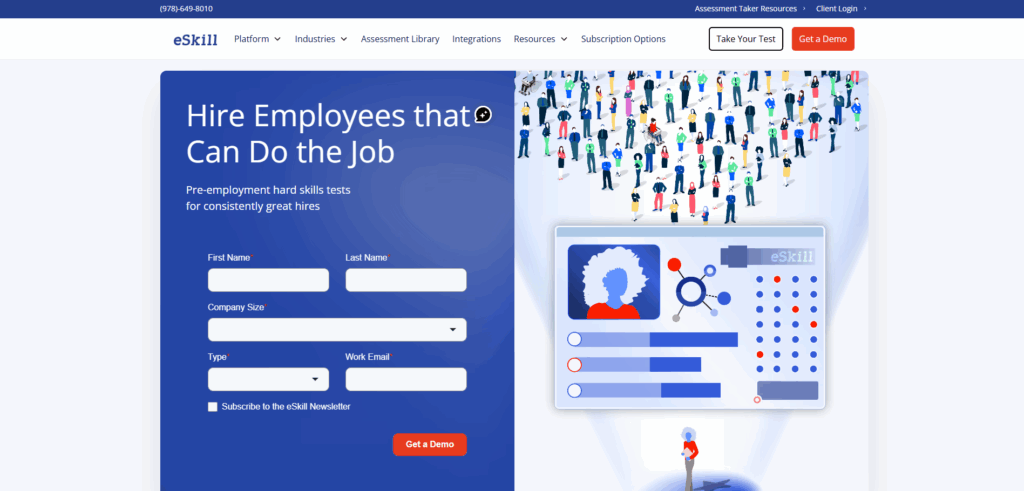
eSkill has been in pre-employment testing longer than most of this list, and its strength is catalogue size across operational and administrative roles rather than engineering.
Key features
- Very large ready-made catalogue: hundreds of tests, plus custom assessments assembled from a much larger question pool.
- Job simulations: interactive scenarios that go past question-and-answer formats.
- Behaviour monitoring: copy-paste and tab-switch flags raised in real time.
- Breakdown reporting: overall scores plus performance by subject and question.
Pros
- Catalogue breadth for back-office and operational hiring.
- Mature customisation for mixed-skill roles.
Cons
- Interface feels dated next to newer tools.
- No published pricing at all.
Best for
Administrative, customer service and operational roles at volume.
Pricing
Quote based. See also our eSkill alternatives comparison.
15. Canditech
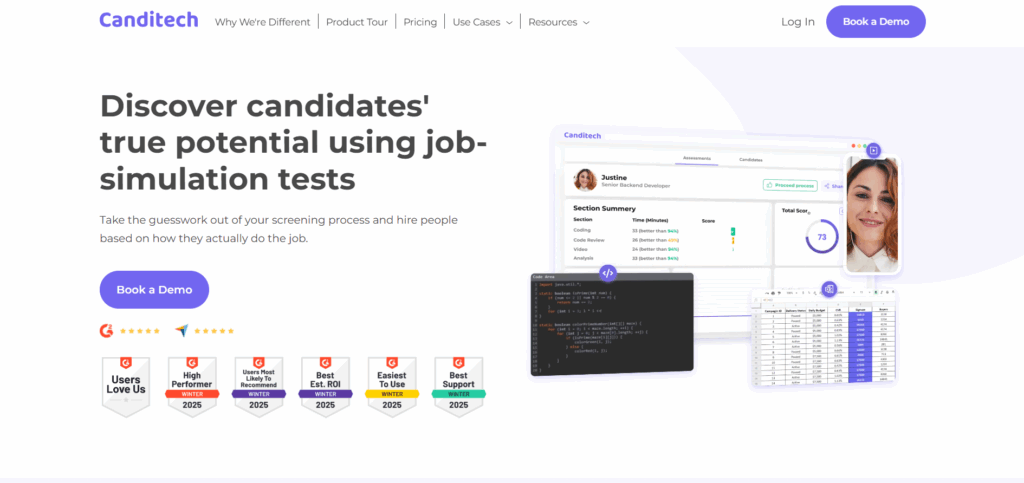
Canditech is the newest name here and the most committed to job simulations. Candidates write code, work a spreadsheet, draft an email or handle a scenario, and the platform scores the output.
Key features
- Expert-built and custom tests: a library of expert-designed assessments alongside a builder for your own.
- Realistic simulations: work-sample tasks drawn from what the role actually does day to day.
- Automatic scoring: candidates graded and ranked against the same objective criteria.
- Benchmarking: results compared against job-specific or industry benchmarks.
Pros
- Simulations map closely to real output, which is the point of a work sample.
- Quick to score for reviewers.
Cons
- Smaller vendor, so integration coverage is narrower.
- Pricing is not published.
Best for
Teams that would rather see output than a score.
Pricing
Quote based. See also our Canditech alternatives comparison.
Which HackerEarth alternative is best?
It depends on which problem sent you looking. If the answer is coding depth, Codility or HackerRank are the closest swaps. If it is candidate experience, Adaface. If it is proctoring rigour, Mercer Mettl. If it is interview volume, HireVue.
For the most common case, a team that has outgrown developer-only assessment and now hires across the business, Testlify is the strongest fit on this list. It covers coding alongside aptitude, personality and conversational AI interviews, connects to 100+ ATS platforms, and publishes its entry pricing instead of routing every question to sales. That combination is what closes the gap the evidence above points at: more than one independent signal behind each decision, not a single score.
Worth being straight about the tradeoff. A platform that covers everything will not out-specialise a coding-only tool on algorithmic depth. If your entire funnel is competitive-programming candidates, buy the specialist. If it is not, breadth wins.
For a direct feature-by-feature view, read the Testlify vs HackerEarth comparison.
Ready to see it against your own roles? Book a demo and walk through a live assessment built for a role you are hiring right now, or browse the test library first.
Key takeaways
- A coding test is one signal, and not the strongest one. Work samples sit at .33 operational validity against job performance while structured interviews reach .42. If the coding score is the only evidence in the file, the decision is resting on the weaker half. Add a second independent signal before the offer, not after a bad hire.
- Coverage, not quality, is what drives most switches. Teams rarely leave a coding platform because the coding is bad. They leave because they now hire support, sales and finance at the same volume and do not want four tools. Decide first whether you are solving depth or breadth, because no platform is best at both.
- Judgment about AI output is now part of the job. With 84% of developers using or planning to use AI tools and more distrusting its accuracy (46%) than trusting it (33%), a timed algorithm puzzle tests progressively less of what the role needs. Code review and debugging tasks test more.
- Assume you will need a quote. Most vendors in this category publish no usable pricing, so a shortlist of three means three sales conversations. Budget the calendar time, and treat published pricing as a genuine point of difference.
- Buy for the evidence you need to defend, then check the tool produces it. Write the three pieces of evidence down before the first demo. Shortlists built this way tend to be half the size and settle much faster.
- Match proctoring depth to role risk. Heavy identity and monitoring controls make sense for certification and regulated hiring. On a low-risk role they add candidate friction and drop-off for very little protection.
Frequently asked questions (FAQs)

Director of Marketing
Akash Patange is the Director of Marketing at Testlify, where he works closely with HR leaders and recruiters to help organizations improve hiring outcomes. He writes about talent assessment, recruitment technology, and data-driven hiring practices.
LinkedInRelated resources
View all
Alternatives
Top 15 Vervoe Alternatives and Competitors in 2026
Alternatives
Top 15 Hiremojo Alternatives and Competitors
Alternatives
Top 15 Coderbyte Alternatives and Competitors
Alternatives
Top 15 TestDome Alternatives and Competitors in 2026
Alternatives
Top 15 Hirevue Alternatives and Competitors
Alternatives
Top 15 iMocha Alternatives and Competitors in 2026
Get started.
Hire on proof, not resumes.
Run your first skills-based assessment free — no credit card required.