
Top 15 Hiremojo Alternatives and Competitors
Discover 15 powerful Hiremojo alternatives to streamline your hiring process and assess candidates with confidence.
The strongest HireMojo alternatives in 2026 are Testlify, Adaface, Vervoe, TestGorilla and Canditech, and the right one depends on whether you need job advertising, skills evidence, or both in one place. HireMojo is a subscription hiring automation platform that pairs job advertising with applicant tracking, so teams usually leave it when they want harder evidence about whether a candidate can actually do the work.
That gap matters more than it used to. Skill gaps are the single biggest barrier to business transformation over 2025 to 2030, named by 63% of employers in the World Economic Forum's skills outlook. Posting a job faster does not fix that. Measuring the skill does.
This guide covers 15 HireMojo alternatives, what each one is genuinely good at, current pricing where it is published, and how to pick between them without running a six-week bake-off.
 ChatGPT
 Gemini
 Claude
 Grok
Grok Perplexity
TL;DR
- HireMojo automates job advertising and applicant tracking. It does not give you validated skills evidence, so most teams that switch are buying evaluation depth, not more automation.
- Testlify is the strongest all-round replacement if you want assessments and AI interviewing in one tool, with 100+ ATS integrations so your existing system stays the system of record.
- Pick a coding-first platform (Codility, HackerRank, HackerEarth, Coderbyte) only if you hire engineers almost exclusively. They are narrow by design.
- Pay-per-candidate pricing (TestDome, Vervoe) beats a subscription when hiring is lumpy. Annual credit plans win when volume is steady.
- Check the anti-cheating model before the test library. A big library with weak proctoring produces confident, unreliable scores.
- Budget for both tools if you have no applicant tracking at all, or choose a platform that ships a simple built-in pipeline.

What is HireMojo?
HireMojo is a subscription-based hiring automation platform that combines job advertising, candidate outreach and applicant tracking in one product. It draws on more than a decade of hiring campaign data to target job ads, handles careers-page hosting and interview scheduling, and prices by quote rather than published tiers. The pitch is fewer manual steps between opening a role and filling it.
Where it stops is evaluation. HireMojo helps you attract and organize applicants. It does not measure whether an applicant can do the job, which is why the alternatives below skew heavily toward assessment and interviewing platforms.
Why do teams look for HireMojo alternatives?
Four reasons come up repeatedly, and only one of them is price.
- No skills evidence. Applicant tracking tells you who applied and when. It does not tell you who can write the SQL query or handle the escalation call.
- Quote-only pricing. HireMojo does not publish tiers, so a small team cannot self-serve or forecast spend without a sales conversation.
- Volume without a filter. US employers made 5.1 million hires against 7.3 million open roles in July 2026, according to the Bureau of Labor Statistics JOLTS release. More applicants reaching a recruiter is only useful if something screens them.
- Cost of a bad screen. SHRM benchmarking puts average cost-per-hire at $4,129. Re-running a search because the first hire could not do the work is the expensive outcome, not the software line item.
How we evaluated these HireMojo alternatives
Each platform below was assessed against the Testlify Multi-Signal Talent Evaluation Model, which holds that one signal is fragile and several pointing the same way create confidence. A resume, a single test score or one interviewer's read is thin evidence on its own. Combining role-relevant assessments, interviews, simulations, references and reviewer feedback is what makes a shortlist defensible.
So the criteria were:
- Evidence breadth. How many independent signals can the tool actually produce, and are they role-relevant rather than generic?
- Assessment integrity. Identity checks, proctoring controls and AI-assistance detection, plus whether flags are treated as evidence for a human or as automatic rejection.
- Workflow fit. Does it integrate with the applicant tracking system you already run, or does it expect to become one?
- Pricing transparency. Published tiers beat "contact sales" for any team under 200 people.
- Reporting depth. Whether a hiring manager can see why a candidate scored the way they did.
Pro tip: run the shortlist against one real, currently open role before you buy. A platform that looks strong on a feature grid can still fall apart on the specific mix of skills you hire for, and a 7-day trial on a live requisition surfaces that in a week instead of a quarter.
Quick comparison of HireMojo alternatives
Tool | Best for | Standout capability | Pricing model |
|---|---|---|---|
Testlify | Teams wanting assessments plus AI interviewing in one platform | Dual-device proctoring and conversational AI interviews | From $139/mo annually |
TestGorilla | General pre-employment testing across mixed roles | Video questions alongside validated tests | Free plan, then from $83/mo |
Adaface | Candidate experience on high-drop-off funnels | Conversational chatbot assessments | From $180/year |
Vervoe | Merit-first hiring on non-technical roles | AI-graded job simulations | Pay-as-you-go from $300/year |
Codility | Large-scale engineering hiring | CodeLive collaborative interviews | From $1,200/year |
Mercer Mettl | Regulated and campus hiring at scale | Psychometric depth plus human proctoring | Custom quote |
iMocha | Skills intelligence beyond hiring | 30,000+ mapped skills | From $999/year |
Hirevue | High-volume enterprise video interviewing | Game-based cognitive assessments | Custom quote |
TestDome | Occasional, lumpy hiring | Work-sample tasks, invites never expire | Pay per candidate invite |
Coderbyte | Startups hiring developers | Take-home projects plus code playback | From about $199/mo |
HackerEarth | Tech hiring events and hackathons | FaceCode live coding interviews | From $99/mo |
HackerRank | Established engineering orgs | 7,500+ question technical library | From about $198/mo |
TestInvite | Certification and exam-style testing | Granular scoring logic and interpretations | From about $37/mo |
eSkill | Blue-collar and administrative roles | 600+ ready tests plus job simulations | Custom quote |
Canditech | Work-sample-led evaluation | Realistic job simulations | From $150/mo |
1. Testlify
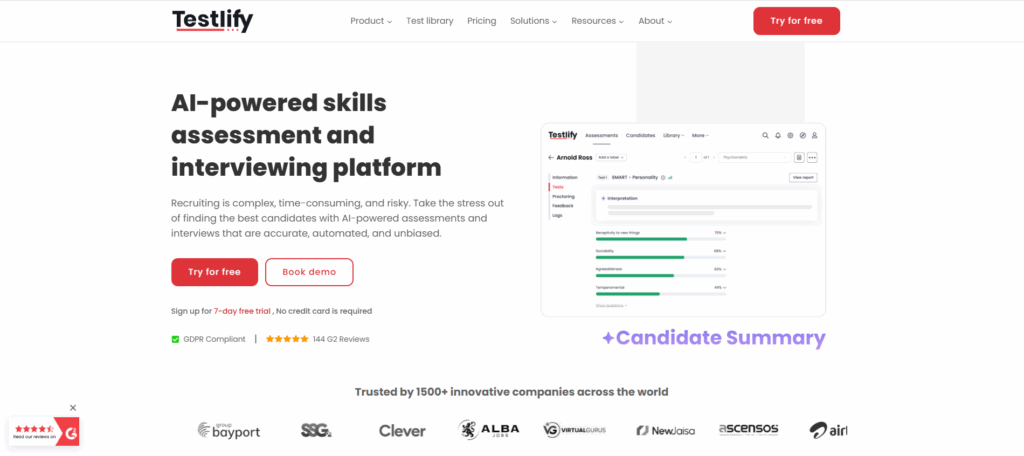
Testlify is an AI-assisted, human-led skills assessment and interviewing platform. It combines role-specific tests, conversational AI interviews and candidate analytics so hiring teams can evaluate technical and non-technical roles from the same shortlist, at the same standard.
For a team leaving HireMojo, the fit is straightforward. If you already run Greenhouse, Workday or Lever, Testlify plugs in as the screening and interviewing layer and your existing system stays the record of truth. If you have no applicant tracking at all, Testlify also ships a simple built-in hiring pipeline: job requisitions, an application form, job-board publishing and an applied to reviewed to shortlisted to rejected flow. It is deliberately basic, aimed at teams that do not want to buy a second product.
Features
- Test library: Over 3,000 ready-to-use tests covering 4,500+ job roles across 50+ industries, spanning coding, cognitive ability, psychometrics, language, software skills, situational judgement and gamified formats.
- Conversational AI interviews: One-way async video, two-way conversational AI video, voice and audio questions, and outbound AI phone interviews. You pick the AI avatar and voice, write custom prompts, and set attempt limits, recording time and preparation time. Transcripts are generated automatically and detect the spoken language.
- AI scoring with human override: AI grades open-ended answers across documents, spreadsheets, source code, images and design files, then produces strengths and improvement summaries. Displaying AI scores to reviewers and including them in the final average are both toggles, so a team can run AI purely advisory. The product's own wording is blunt about it: AI scores and insights are for guidance only.
- Dual-device proctoring: The candidate's phone becomes a second camera showing both the candidate and their screen, and the session will not start until mobile monitoring is active. Alongside it sit 20+ integrity measures across identity, environment, browser lockdown and AI-tool detection, with green, yellow and red flags that prompt a human review rather than auto-rejecting.
- Item-level analytics: Difficulty index, discrimination index and quality-risk flags per question, plus percentile benchmarking and score distributions. This is test-publisher territory that most hiring tools do not expose.
- Vibe coding: Candidates direct AI tools toward a working solution instead of writing syntax by hand, which measures how someone actually builds software in 2026.
- Integrations: 100+ ATS and HRMS integrations, Zapier, webhooks, SAML SSO, SCIM provisioning and real-time SIEM streaming for audit events.
G2 Rating: 4.7
Testlify pricing
Testlify publishes its pricing as a credit-volume selector, where one credit covers one started assessment. Annual billing, which is the cheaper of the two:
Plan | Credits per year | Price | Per credit | Seats |
|---|---|---|---|---|
Starter | 100 | $139/mo, billed $1,668/year | $16.68 | 3 |
Basic | 300 | $279/mo, billed $3,348/year | $11.16 | 5 |
Business | 1,000 | $699/mo, billed $8,388/year | $8.39 | 10 |
Premium | 3,000 | Contact sales | Volume-based | 20 |
Enterprise | 10,000 | Contact sales | Volume-based | 30 |
Custom | 25,000+ | Contact sales | Volume-based | 40 |
Monthly billing runs a different set of numbers for the same tier names, starting at $198/mo for 10 credits. Extra seats are $15 per seat per month on every tier, and credits do not roll over. There is a 7-day free trial with no card required, a 30-day money-back guarantee, pricing locked for 24 months, and a 25% non-profit discount.
Two things to budget for separately: white labeling and the 100+ ATS integrations are each $2,388/year add-ons on the self-serve tiers and are included on Custom. AI phone interviews are metered at $0.18 per minute.
2. TestGorilla
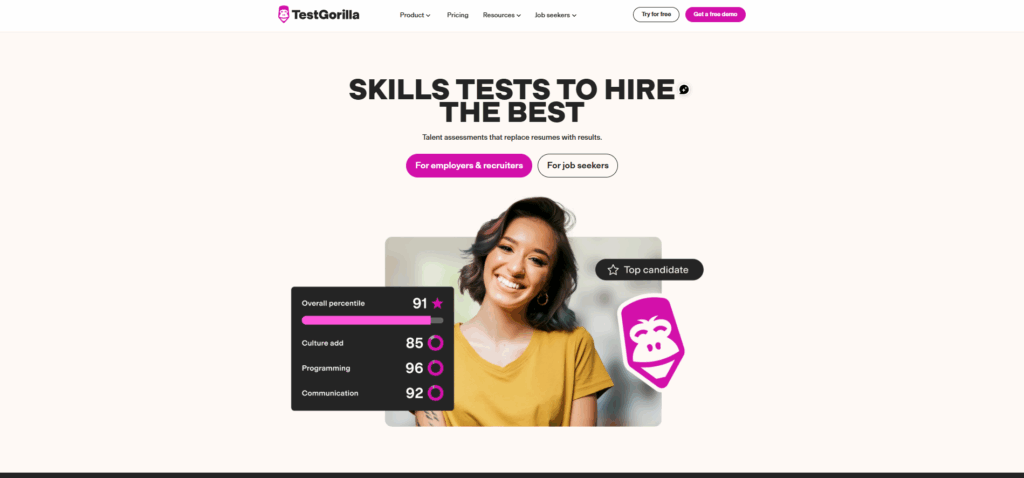
TestGorilla is a pre-employment testing platform offering assessments that cover both technical and soft skills. It is widely adopted across industries and helps improve quality-of-hire by letting companies screen candidates with role-specific tests that reflect real job requirements.
Features
- Test coverage: Choose from 300+ scientifically validated tests including cognitive ability, software skills, language proficiency, and personality traits. Tests are regularly updated and aligned to real job requirements.
- Video questions: Use video questions to capture non-verbal cues and evaluate soft skills such as communication, confidence, and situational thinking.
- Bias mitigation: Reports are anonymized and scored objectively to reduce bias in shortlisting. Cultural fit and personality tests help identify alignment beyond hard skills.
- Custom branding: Employers can brand tests with logos, themes, and custom intro videos. Additional control over question order and timing is also available.
G2 Rating: 4.5/5
Pricing: TestGorilla offers a Free plan with essential tests and unlimited candidate invites. The Starter and Pro plans start at $83/month and $127/month respectively, billed annually, with pricing varying based on company size.
Related resources: Top 15 TestGorilla Alternatives and Competitors
3. Adaface
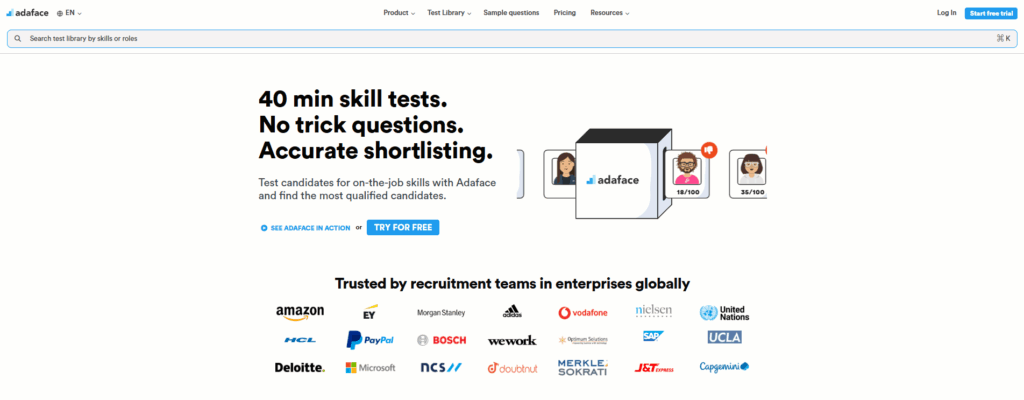
Adaface builds candidate assessments around an AI chatbot called Ada, positioning itself as a candidate-friendly assessment tool with a conversational approach to pre-employment testing. The chatbot simulates a real conversation, which is meant to reduce test anxiety and drop-off.
Features
- Conversational assessments: Rather than using static quizzes, Adaface engages candidates in a chat-style conversation with real-time Q&A. The AI tailors follow-up questions based on candidate responses.
- Job-relevant testing: Every assessment is built around real-world problems that match the role. A backend developer might be asked to debug database queries or optimize API calls.
- Real-time scoring: Candidates are automatically assigned a pass, borderline pass, or fail status. Recruiters can instantly filter candidates and reduce time spent on manual review.
- Customization and templates: Choose from 150+ job-specific assessments or create your own. You can control question types, time limits, and complexity.
G2 Rating: 4.6/5
Pricing: Free trial available. Plans start at $180/year for the Individual plan and scale up for larger teams.
Related resources: Top 15 Adaface Alternatives and Competitors
4. Vervoe
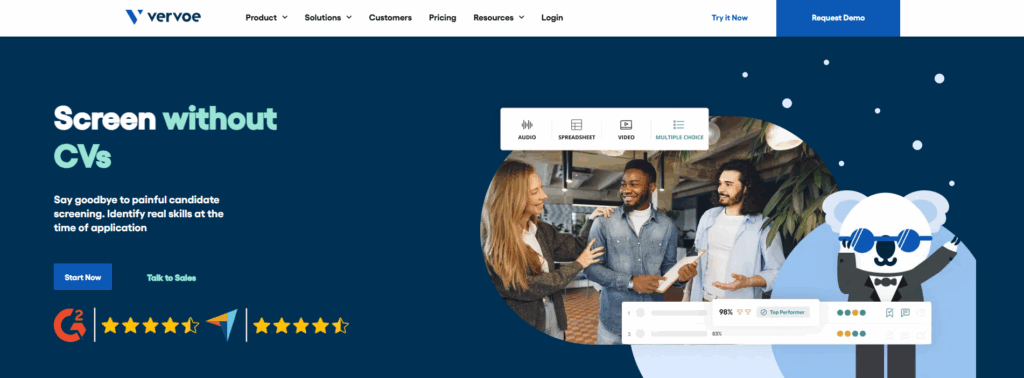
Vervoe sets out to make hiring about merit rather than resumes. It lets employers watch candidates perform job-related tasks and uses AI to grade and rank the responses, covering technical, soft and creative skills through practical exercises.
Features
- Job simulation tests: Choose from over 300 pre-built assessments across customer support, sales, marketing, tech, and operations. Each test mirrors the actual tasks the candidate would perform on the job.
- Multi-format testing: Combine text, video, file uploads, spreadsheets, and more to capture different dimensions of candidate performance.
- AI grading: Vervoe automatically evaluates responses and ranks candidates based on accuracy, effort, and relevance using AI scoring models.
- Team review and collaboration: Multiple team members can rate candidate responses, leave notes, and contribute to final hiring decisions in a unified dashboard.
G2 Rating: 4.6/5
Pricing:Follows a pay-as-you-go model, which suits organizations with uneven hiring cycles or tight cost control. The entry plan starts at $300 per year for 10 candidates, rising as more candidates are added.
Related resources: Top 15 Vervoe Alternatives and Competitors
5. Codility
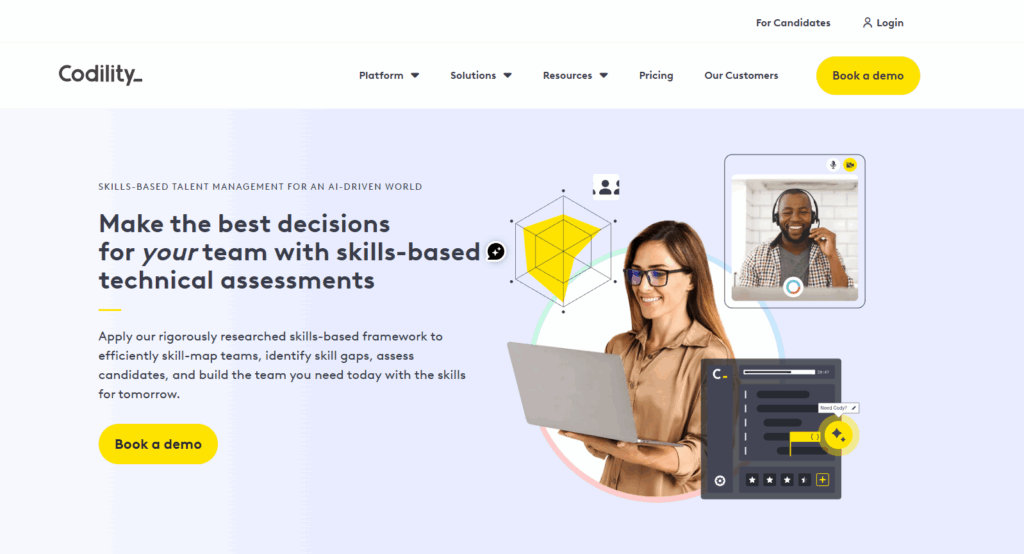
Codility is a coding-focused assessment platform built for large-scale engineering hiring. It evaluates technical candidates through real coding tasks and collaborative technical interviews rather than multiple-choice theory.
Features
- Coding test bank: Choose from 1,100+ coding tasks in 45+ programming languages. Questions range from basic algorithms to complex system design.
- Live technical interviews: The CodeLive interface lets engineers and candidates code together in real time, using a collaborative IDE with syntax highlighting, compiler, and test runner.
- Automated scoring: Submissions are scored on logic, correctness, efficiency, and readability. Recruiters get structured reports without writing code reviews manually.
- Reporting and analytics: Candidate reports break down performance by task, test cases passed, and code quality scores.
G2 Rating: 4.6/5
Pricing: Three structured tiers: Starter at $1,200 per year, Scale at $6,000 per year, and a custom plan for large enterprises.
Related resources: Top 15 Codility Alternatives and Competitors
6. Mercer Mettl
Mercer Mettl is an assessment suite backed by Mercer, and it is strongest in behavioral and psychometric evaluation. Organizations that need rigor and defensibility in hiring tend to shortlist it, and it is widely used in corporate hiring, campus recruitment and certification testing.
Features
- Wide range of tests: Over 200 job roles and levels covered, including domain-specific exams and coding tests.
- Anti-cheating and proctoring measures: A proctoring toolkit featuring AI monitoring, lockdown browsers, and human proctoring options.
- Customization and branding: Organizations can display their logo on the test screen, use their own color themes or backgrounds, and host assessments on a custom subdomain.
- Reporting and analytics: Detailed competency scores, percentile benchmarks, and hiring recommendations.
G2 Rating: 4.4/5
Pricing: Pricing is customized. Organizations need to request a quote, as costs depend on the number of tests, candidates, and features.
Related resources: Top 15 Mercer Mettl Alternatives and Competitors
7. iMocha
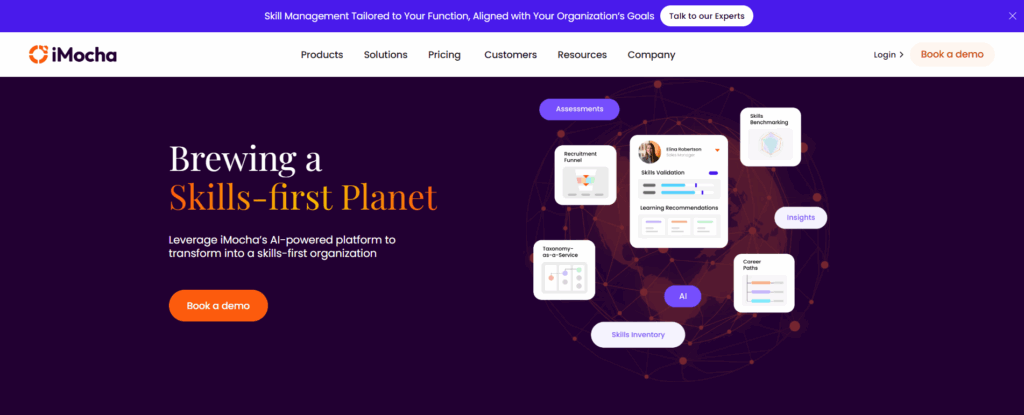
iMocha is an AI-powered skills assessment platform that supports pre-employment testing and workforce upskilling. It has built a large skills database and is known for its skills-intelligence features, with coverage running from coding and IT into finance and language.
Features
- Test library: Over 3,000 ready-to-use tests and 30,000+ skills mapped to industry job roles, including niche domains like SAP, cybersecurity, and financial services.
- Custom test builder: Lets HR teams build tests by mixing existing questions or creating new ones with custom scoring logic.
- AI interviewer "Tara": A virtual assistant that engages candidates through conversational interviews, generating qualitative reports.
- Reporting and analytics: Track candidate performance by domain, skill group, and question category.
G2 Rating: 4.4/5
Pricing: 14-day free trial available. Plans start at $999/year for the Starter tier and scale up for larger teams.
Related resources: Top 15 iMocha Alternatives and Competitors
8. Hirevue
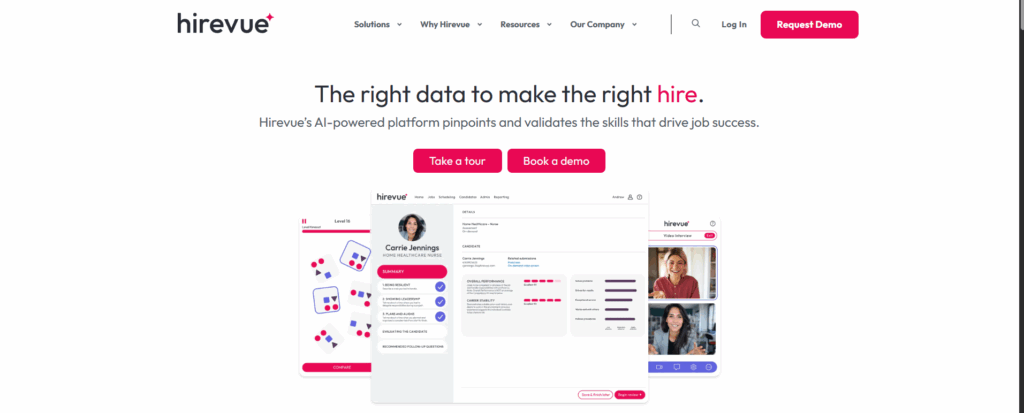
HireVue pioneered digital interviewing and has since expanded into assessments. It pairs a video interviewing platform with game-based and AI-driven assessments, and enterprises use it to run high-volume hiring through on-demand video interviews, coding challenges and AI-scored games.
Features
- IO science content library: Access to validated, role-specific interview content.
- Video interviews, on-demand and live: One-way and live video interviews with scoring rubrics. AI evaluates verbal response content and tone.
- Game-based assessments: AI-driven cognitive games that measure problem-solving, communication, and coding skills.
- Scheduling and automation: Auto-schedules interviews, engages candidates via chatbots, and integrates with your applicant tracking system.
G2 Rating: 4.1/5
Pricing: Three plan tiers, but pricing is not publicly disclosed and requires booking a demo.
Related resources: Top 15 Hirevue Alternatives and Competitors
9. TestDome
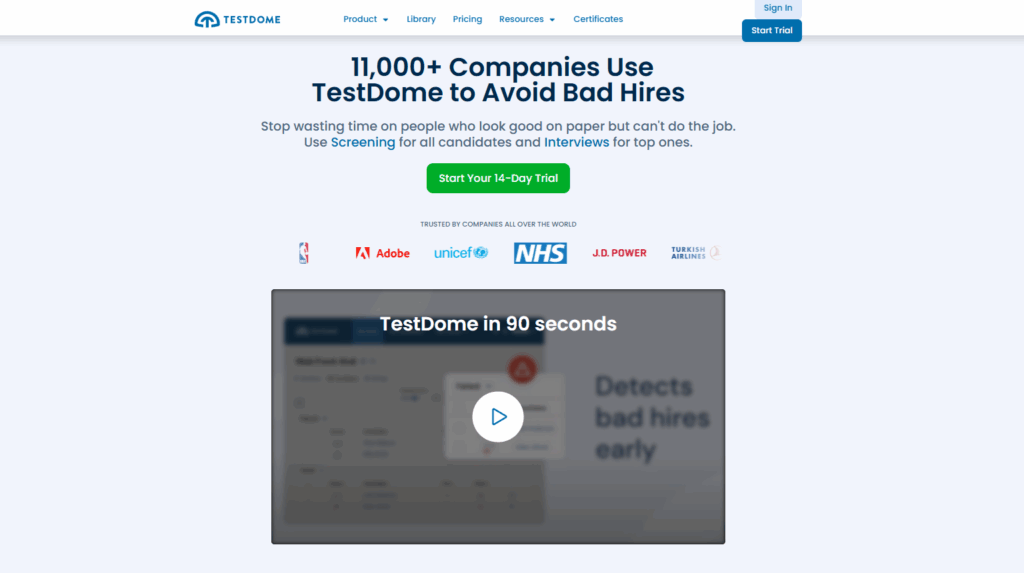
TestDome is a skills assessment platform built around work-sample tests rather than theoretical quizzes. It aims to help recruiters identify capable candidates using realistic tasks, and its pricing model makes it unusually well suited to teams that hire in bursts.
Features
- Work-sample testing:Candidates are evaluated using realistic tasks that mirror what they would actually do on the job.
- Library of 150+ pre-built tests: Covers roles across software development, accounting, customer service, data entry, and more. Tests are short and designed to filter out unqualified applicants quickly.
- Custom question creation: Build your own tasks or mix them with the existing library. You can test specific coding languages, logic, writing, or numerical reasoning.
- Benchmarking and analytics:Compare candidate performance side-by-side with visual scorecards, percentile rankings, and pass/fail indicators.
G2 Rating: 4.5/5
Pricing: TestDome charges per candidate invite rather than by monthly subscription. Invite packs are bought up front, the per-candidate rate falls as pack size rises, and unused invites do not expire. That suits lumpy hiring far better than a fixed monthly plan.
Related resources: Top 15 TestDome Alternatives and Competitors
10. Coderbyte
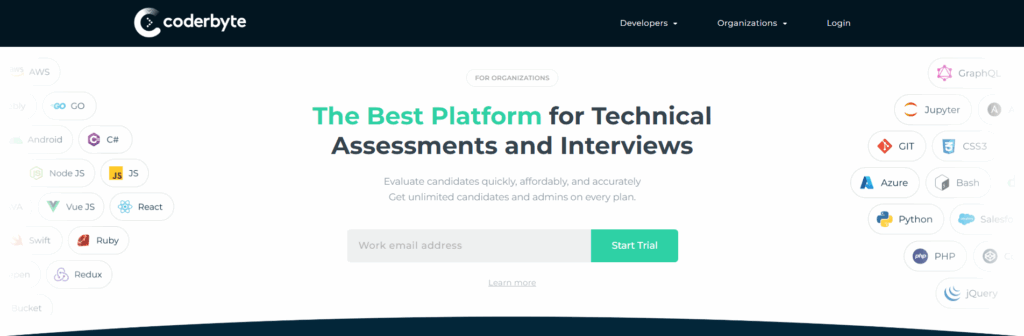
Coderbyte is a technical assessment platform aimed at startups and mid-sized companies hiring developers and data scientists. It supports unlimited coding tests, challenges and take-home project assessments on a subscription basis.
Features
- Coding challenges and projects: A library of over 1,000 coding challenges spanning 30+ programming languages and 100+ technical skill areas, plus full project-based exercises.
- Multiple question types: Multiple-choice, open-ended coding, algorithmic challenges, SQL and database queries, and more.
- Built-in interview tools: Live technical interviews with a real-time collaborative code editor, spreadsheets and Jupyter Notebooks, and a virtual whiteboard for system design.
- Reporting and analytics: Reports include the candidate's code output, code playback recordings of their solution process, automated skill scoring, and benchmarking charts.
G2 Rating: 4.4/5
Pricing: Subscription-based at roughly $199/month for unlimited candidates and tests, with discounted annual plans available.
Related resources: Top 15 Coderbyte Alternatives and Competitors
11. HackerEarth
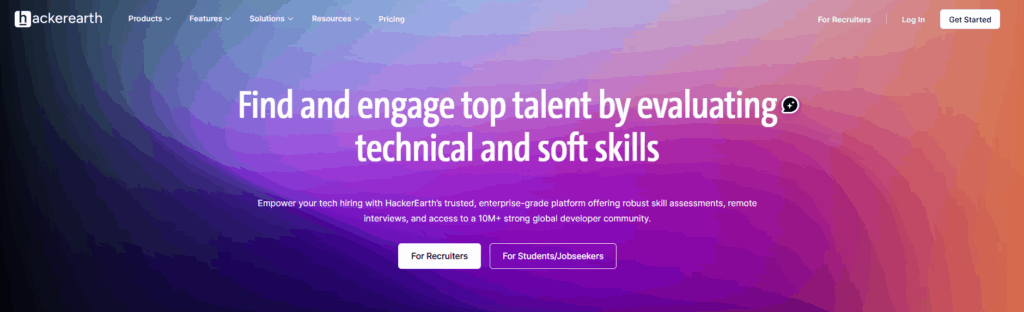
HackerEarth is an AI-driven tech hiring platform for screening developers. It supports standardized coding assessments, hackathons and remote interviews, and enterprises use it to identify technical talent at scale.
Features
- Test library: A library of 25,000+ questions spanning multiple choice, project-based, and data science formats.
- Advanced proctoring: AI-powered webcam monitoring and plagiarism detection help protect assessment integrity.
- Live interviews (FaceCode): A live coding interview tool with a collaborative code editor, built-in question library, HD video chat and a whiteboard.
- Analytics and skill reports: Skill-based performance reports and AI-powered summaries covering technical performance and behavioral insights.
G2 Rating: 4.5/5
Pricing: Plans start at $99 per month, with higher tiers for larger teams and more advanced hiring needs.
Related resources: Top 15 HackerEarth Alternatives and Competitors
12. HackerRank
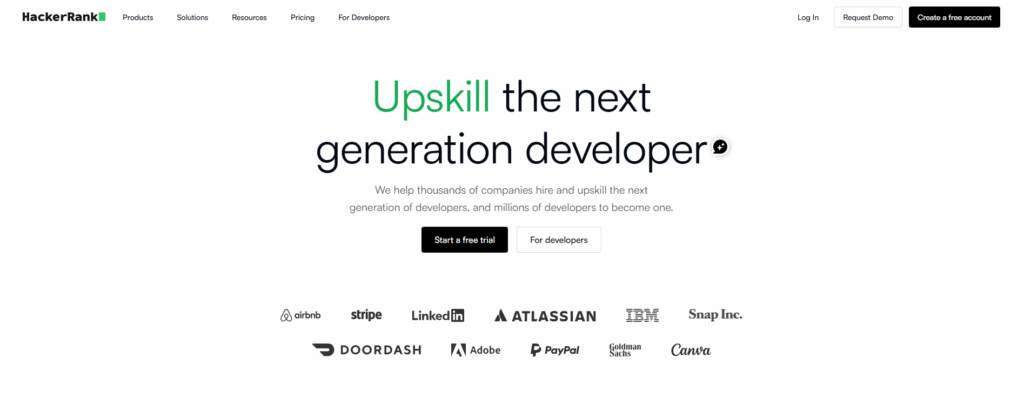
HackerRank is a long-established developer assessment platform and competitive coding hub. Organizations use it to build and run skill-based coding tests and technical interviews, screening developers at scale.
Features
- Coding library: Over 7,500 coding and technical questions across 45+ programming languages, including algorithmic challenges, debugging exercises, and domain-specific problems.
- End-to-end hiring tools: Supports the full developer hiring workflow, from automated screening assessments to live pair-programming interviews and take-home projects.
- Fair and secure assessments: Proctoring and candidate monitoring features including plagiarism detection, IP tracking, and time violation alerts.
- Enterprise integrations: Integrates with major applicant tracking systems and other HR tools, fitting into an existing recruiting stack.
G2 Rating: 4.5/5
Pricing: A usage-based model. The Starter plan begins at roughly $198/month, with higher tiers and enterprise licensing available.
Related resources: Top 15 HackerRank Alternatives and Competitors
13. TestInvite
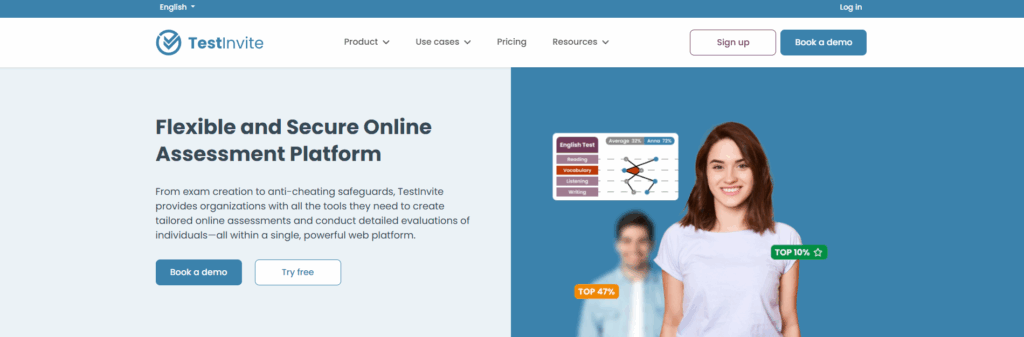
TestInvite is online exam and assessment software built for secure, highly customizable testing across corporate hiring, education and certification. Teams that need granular control over scoring logic tend to end up here.
Features
- Custom test creation: A flexible test builder with a wide variety of custom question types, suited to organizations that want fine control over test design.
- Assessment library: Alongside custom tests, a library of pre-built tests covering problem-solving, communication, and role-specific competencies.
- Advanced reporting: Modify scoring logic, derive new metrics, compare results against benchmarks or norms, categorize scores, and add textual interpretations for score ranges.
- Anti-cheating and proctoring measures: Lockdown browsers, AI-driven cheating detection, and question randomization.
G2 Rating: 4.7/5
Pricing: Starts at around $37 per month for the entry tier. Higher tiers with more features and capacity cost more.
Related resources: Top 15 TestInvite Alternatives and Competitors
14. eSkill
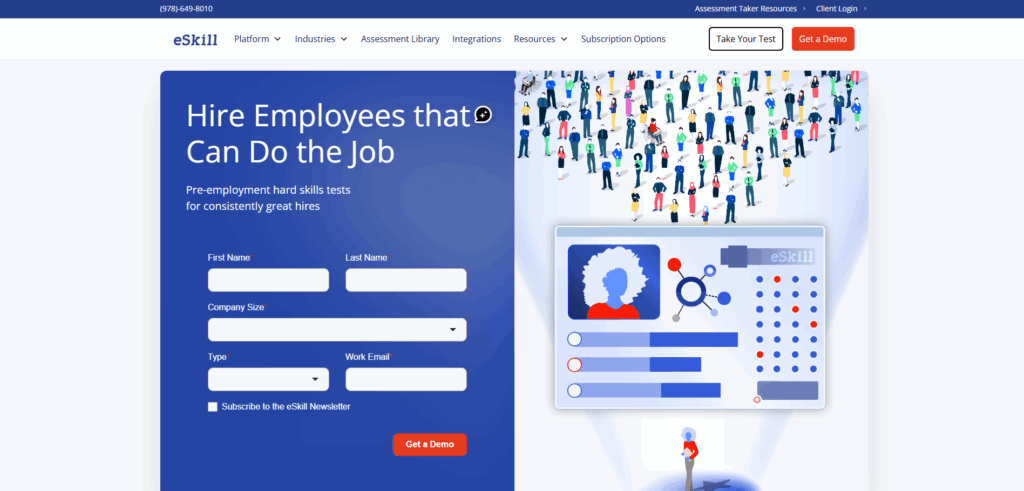
eSkill is a long-established pre-employment testing platform known for the sheer variety of its skills tests. It offers both a large library of ready-made assessments and tools for building custom ones.
Features
- Test library: Over 600 ready-to-use tests. Custom assessments can be built from thousands of questions covering specific subjects, topics, or software tools.
- Job simulations: Interactive simulations that evaluate how candidates perform in real-world job scenarios, going beyond standard question-and-answer formats.
- Anti-cheating and advanced proctoring:Monitors behaviors such as copy-pasting and tab switching, flagging suspicious activity in real time.
- Reporting and analytics: Detailed candidate reports with overall scores and performance breakdowns by subject or question.
G2 Rating: 4.5/5
Pricing: eSkill does not disclose pricing publicly. Recruiters need to contact the sales team for a custom quote.
Related resources: Top 15 eSkill Alternatives and Competitors
15. Canditech
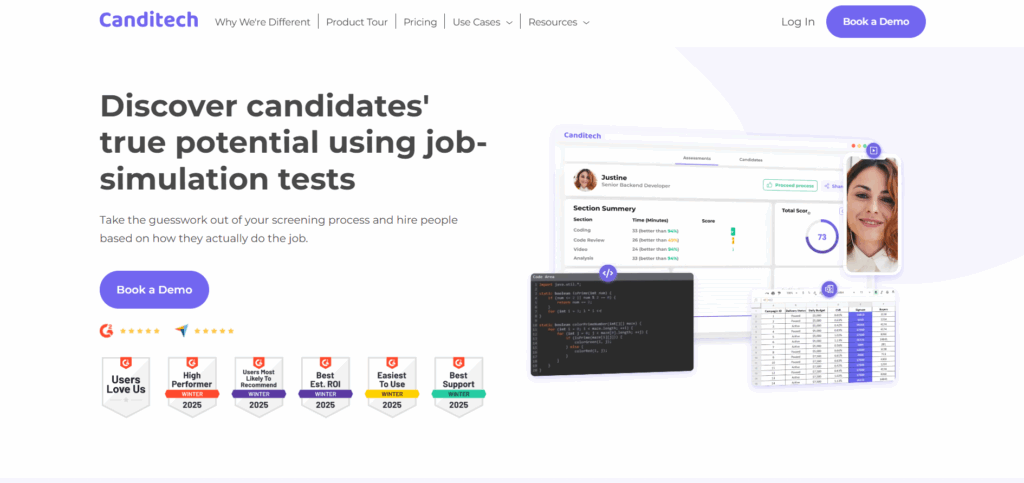
Canditech is a newer entrant in the skills assessment space with a 5.0 rating on G2. It specializes in job simulation assessments, evaluating candidates through realistic work scenarios instead of standard quizzes, which tends to predict on-the-job performance better than a knowledge test.
Features
- Custom and expert-built tests: Build your own assessments or draw on a library of 500+ expert-designed tests.
- Realistic job simulations: Work-sample tasks where candidates might write code, analyze data in a spreadsheet, draft an email response, or handle a mock situation relevant to the job.
- Automated scoring: Grades and ranks candidates on simulation performance, so top performers surface quickly and every candidate is measured against the same criteria.
- Benchmarking analytics: Score benchmarks that compare candidate results against industry standards or predefined job-specific benchmarks.
G2 Rating: 5.0/5
Pricing: The Team plan starts at $150/month for 100 candidates.
Related resources: Top 15 Canditech Alternatives and Competitors
Which is the best HireMojo alternative?
Testlify is the best HireMojo alternative for most teams, because it closes the gap HireMojo leaves open. HireMojo gets applicants in front of you. Testlify tells you which of them can do the work, using an extensive test library, conversational AI interviews and reviewer scoring in one place.
The narrower answer depends on your shape. Hiring engineers almost exclusively? A coding-first platform will go deeper on algorithms than any generalist. Running certification-style exams? TestInvite's scoring logic is built for that. Hiring twice a year? Pay-per-candidate pricing beats a subscription you barely touch.
But most teams leaving HireMojo are hiring across mixed roles, on a real budget, with no appetite for a second procurement cycle. That is where breadth plus 100+ ATS integrations matters more than depth in any single vertical. Your existing applicant tracking system keeps doing its job, and the screening layer gets considerably sharper.
Worth reading next: the in-depth Testlify vs HireMojo comparison.
Start evaluating candidates on evidence
Skills change fast. WEF's Future of Jobs research expects 39% of the skills workers hold today to be disrupted by 2030, which makes a resume an increasingly poor guide to what someone can do next quarter. Testing for the skill closes that gap.
Start a 7-day free trial, no card required, or book a demo and walk through a live requisition with the team.
Key takeaways
- HireMojo and its alternatives solve different problems. HireMojo automates advertising and applicant tracking, while almost every tool on this list measures capability. Knowing which half you are missing prevents buying a second version of what you already own.
- Evidence beats automation on cost. With average cost-per-hire at $4,129, a faster funnel that still lets the wrong hire through costs more than a slower one that does not. Spend the budget where the decision gets made.
- Match the pricing model to your hiring rhythm. Steady, predictable volume rewards annual credit plans. Lumpy or seasonal hiring rewards pay-per-candidate, where unused invites keep their value instead of expiring with the month.
- Coding-first tools are narrow on purpose. They go deeper on algorithms than any generalist platform, and they will not help you hire a sales lead or an operations manager. Buy them for engineering volume, not as a general answer.
- Check integrity before library size. A 3,000-test library with weak proctoring produces scores nobody should act on. Identity checks, browser controls and AI-assistance detection are what make a score usable as evidence.
- Keep the system of record you already trust. If Greenhouse, Workday or Lever runs your pipeline today, pick a screening layer that integrates with it. Replacing working infrastructure to add assessments is an expensive way to solve a screening problem.
- Run a real requisition through the trial. Feature grids flatten out at this tier. One open role, one shortlist, one week tells you more than a month of comparison reading.
Frequently asked questions (FAQs)

Director of Marketing
Akash Patange is the Director of Marketing at Testlify, where he works closely with HR leaders and recruiters to help organizations improve hiring outcomes. He writes about talent assessment, recruitment technology, and data-driven hiring practices.
LinkedInRelated resources
View all
Alternatives
Top 15 Coderbyte Alternatives and Competitors
Alternatives
Top 15 TestDome Alternatives and Competitors in 2026
Alternatives
Top 15 Hirevue Alternatives and Competitors
Alternatives
Top 15 iMocha Alternatives and Competitors in 2026
Alternatives
Top 15 Mercer Mettl Alternatives and Competitors
Alternatives
Top 15 Codility Alternatives and Competitors
Get started.
Hire on proof, not resumes.
Run your first skills-based assessment free — no credit card required.