
AI interviewer vs human interviewer: Who makes better hiring?
AI interviews slash screening time and standardise scoring, while human interviewers uncover nuance and culture fit. This guide shows how blending both cuts time-to-hire without losing the human touch.

The conventional interview process is being redesigned in response to an increasing number of applicants and pressure to cut expenses. A new argument at the centre of this change is whether AI or human interviewers make better hiring decisions.
There is a fundamental query that all recruiters and talent acquisition leads now face: when an AI interviewer and a human interviewer go head-to-head, who makes the better hire?
In this guide, we’ll explore where AI excels, where humans still lead, and how tools like Testlify’s AI Audio Interviews and AI Video Interviews help teams strike the right balance, without sacrificing the human touch.
 ChatGPT
 Gemini
 Claude
 Grok
Grok Perplexity
What is an AI interviewer?
An AI interviewer is a software tool powered by artificial intelligence that runs a structured interview without a live recruiter in the room. It pops the questions, records video or audio answers, and then scores what it hears and sees with natural-language processing and machine-learning models.
To predict a person’s performance in a role, it looks for patterns in word choice, tone, and even microexpressions. These tools can:.
- Run on-demand, 24/7: Candidates log in whenever they’re ready.
- Ask follow-up questions automatically: Adapts to a candidate’s responses on the fly.
- Flag fraud or impersonation: Built-in proctoring checks faces, IDs, and background noise.
In summary, recruiters are given a clean, data-rich shortlist to review while an AI interviewer completes the tedious first round at machine speed.

Where do human interviewers still have the upper hand?
There are some things an AI interviewer simply cannot do, like a human. In real interviews, it’s often the small, unscripted moments that reveal the most about a candidate.
Here’s what they bring to the table that AI can’t replicate (yet):
- Empathy and presence: A human interviewer can smile, offer reassurance, or pause when they sense the candidate is nervous. That kind of emotional awareness helps create a safe space for honest conversation.
- Flexibility in the moment: If an answer feels vague or unclear, a recruiter can rephrase, probe deeper, or change direction based on the flow of conversation.
- Understanding context and nuance: Humans are great at reading between the lines—picking up on tone, hesitations, humour, and non-verbal cues like eye contact or posture that machines might miss or misinterpret.
- Cultural fit judgment: Through real conversation, human interviewers can sense whether someone’s values, energy, and mindset align with the team, not just the job description.
Can AI scale hiring without losing quality?
Yes, when it’s used for the right stage of the funnel and constantly audited. Here’s why:
Volume without the bottleneck
Without overtime or hiring agencies, no human team can match the ability of a single AI interviewer to run hundreds of on-demand video or audio screens throughout a night.
Unilever’s switch to AI interviews freed up 50,000 recruiter hours and cut time-to-hire by up to 90%.
Speed that keeps top talent engaged
Hiring managers often lose great candidates because scheduling drags on. AI removes the calendar shuffle; applicants record answers whenever they’re ready. That trims days or even weeks from the process, directly lowering time-to-hire and cost-per-hire.
Real-time, data-rich shortlists
Recruiters receive a ranked shortlist with transcripts and key phrase highlights instantly, thanks to AI tools. Talent-acquisition teams can jump right into more valuable quality-of-hire discussions rather than sorting through unprocessed video.
But scale isn’t everything.
- AI’s scoring accuracy still depends on good training data
- In roles that rely on soft skills or a nuanced cultural fit, rushing every step through automation can have unintended consequences.
Check Out:Our latest average time to hire calculator
What do candidates think about AI-led interviews?
The majority of applicants appreciate the speed and adaptability of on-demand audio or video screens, but they are still cautious about letting a bot decide their fate.
The good
- Convenience: Candidates can record answers after work or on weekends, eliminating the need for calendar juggling.
- Fairness perception (to a point): According to a Pew study, 47% of respondents believed that AI would treat all applicants more consistently than humans, as it would ask identical questions and use the same scoring rubric.
- Instant feedback: Some platforms share strengths and growth areas within minutes, a capability that human interviewers rarely possess.
The worries
Concern | What the data says | Why it matters |
|---|---|---|
Impersonal feel | Only 37 % of U.S. job seekers trust AI more than humans to make hiring decisions. | A robotic vibe can dent the employer brand, especially for culture-first roles. |
Transparency | Nearly 80 % want to know precisely when and how AI is used in hiring. | Clear disclosure and opt-in language help maintain trust. |
Glitches & access issues | Candidates cite technical hiccups or poor internet connectivity as the top stressors. | Providing low-bandwidth options (such as AI Audio) widens your talent pool. |
When should you combine AI and human interviews in a single funnel?
Not every role needs a fully human process, and not every role should be handed off to a bot.
It makes sense to let AI do the heavy lifting first, then hand off the reins to humans when context, judgment, and rapport are crucial. This is a simple checklist that you can place on your desk:
Scenario | Why AI Goes First | Why a Human Follows Up |
|---|---|---|
High-volume, entry-level roles (retail, support, campus hiring) | Automates hundreds of identical screens overnight, cutting time-to-hire and recruiter fatigue. | Confirms soft skills and genuine enthusiasm in a live call before issuing offers. |
Remote or global talent pools | 24/7 on-demand interviews remove time-zone barriers and reduce scheduling chaos. | A cultural-fit chat ensures that new hires align well with local teams and clients. |
Compliance-sensitive positions (finance, healthcare) | Delivers structured, audit-ready scoring that helps prove fairness in bias audits. | Final human panel verifies ethical judgment, situational awareness, and regulatory knowledge. |
Specialist or senior roles (product managers, sales leaders) | AI pre-screens for essential hard skills and eliminates obvious mismatches. | Deep, two-way discussion explores strategy, leadership style, and stakeholder management. |
Small applicant pools or niche hiring | — | Skip AI; a recruiter’s nuance and relationship-building are faster and more personal. |
Red flags for skipping AI (or using it sparingly):
- Tiny talent pool: If you’re only interviewing a dozen candidates, a human touch from the start is faster.
- Heavily creative roles: Positions reliant on storytelling, design instincts, or improvisation benefit from live dialogue.
- Unreliable internet regions: In areas with low bandwidth, an AI video screen may frustrate applicants; consider falling back to AI Audio or making direct human calls.
How do Testlify’s AI Audio & AI Video Interviews sharpen that hybrid model?
Testlify’s interview tools slot neatly into the “AI-first, human-final” workflow you just mapped out. Here’s precisely how Testlify plugs the biggest gaps recruiters worry about.
Challenge recruiters face | What AI Audio or AI Video does differently |
|---|---|
Bandwidth & time zones | AI Video lets candidates record answers 24/7 |
Patchy internet or low-end devices | Phone-based AI Audio works on any handset and stores the call in the cloud for review. |
Fraud & impersonation | Built-in proctoring checks voice signature, device ID, and background noise; Video mode flags mismatched lip sync or virtual overlays. |
Bias & compliance pressure | Every question, scoring rubric, and outcome is stored and exportable (NYC LL144, EU AI Act). |
Need for human override. | Recruiters can replay, fast-forward, or skip through AI-ranked clips and add their notes before advancing a candidate. |
ATS chaos | One-click export to 100+ ATS and HRIS systems. |
Companies using Testlify’s video interviewing report up to 90% faster hiring cycles and a 65% increase in quality-of-hire scores once recruiters add the human final round.
The human elements remain in the most critical areas of Testlify’s hybrid setup: live panel interviews, salary discussions, and those naturally occurring culture-fit conversations.
Recruiters still review every AI-flagged highlight reel before deciding who moves forward, ensuring a real person signs off on the shortlist.
To ensure that your team begins the day with a clear lineup rather than raw footage, the platform silently automates the tedious first-round tasks.
To put it briefly, Testlify frees up your employees to concentrate on the things that make or break a hire while letting the robots handle the busywork.
How can recruiters coach candidates for AI-based interviews?
To make the process seem transparent rather than enigmatic, begin by outlining exactly what candidates can anticipate.
Give them access to a practice question within the platform and share a one-page preparation guide that covers the fundamentals (quiet space, steady internet, keeping direct eye contact with the camera, and a brief tech test).
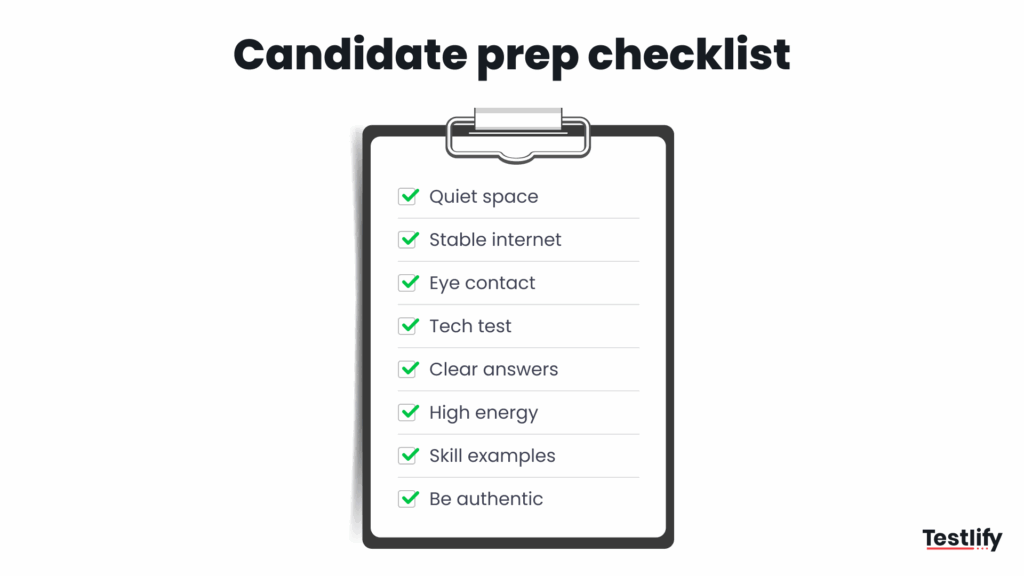
Because the algorithm considers both content and tone, remind them that clarity is more important than speed. Speak in complete sentences, keep your energy levels up, and give examples that are relevant to the essential skills of the position.
Last but not least, emphasize authenticity. While encouraging them to “be themselves” may seem apparent, it keeps them from giving rehearsed responses that AI and later human interviewers can detect.
When properly implemented, this advice enhances the applicant experience, increases completion rates, and provides recruiters with better, more accurate data for the human review stage.
AI interviewer vs human interviewer
The honest answer is “both. AI races through repetitive first-round screens, returning instant, bias-audited data and saving days on the calendar. Humans step in later to read nuance, build rapport, and close offers.
Pair them correctly and you get faster shortlists, fairer scoring, and a stronger final hire.
Hiring Metric | AI Interviewer | Human Interviewer |
|---|---|---|
Speed & scale | Interviews hundreds overnight; slashes time-to-hire | Limited by calendars and time zones |
Consistency/bias control | Same questions, algorithmic scoring, easy bias audit trail | Subject to mood, fatigue, and unconscious bias |
Nuance & culture fit | Detects keywords, tone, and basic facial cues | Reads body language, humor, and team chemistry |
Candidate experience | 24/7 convenience, but it can feel impersonal | Builds trust and rapport, yet slower to schedule |
Cost-per-hire | Low marginal cost once deployed | Higher recruiter hours |
Compliance & data trail | Stores transcripts, scores, and proctoring logs | Notes vary in detail; it’s harder to audit |
Final words
Recruiters can reduce time-to-hire, increase access, and maintain culture by combining the two, letting humans guide the final stage while tools like Testlify’s AI Audio & Video handle the initial process.
The formula is straightforward: humanize what is significant and automate what can be repeated. Ready to hire faster and fairer? Book a quick Testlify demo and see AI-powered audio and video interviews in action.
Frequently asked questions (FAQs)

B2B SaaS Content Writer
Rishav Kumar is a B2B SaaS content writer with 4 years of experience. He loves crafting engaging content. Always exploring fresh ideas, he's passionate about helping businesses grow through impactful writing.
LinkedInRelated resources
View all
HR & recruitment
Why remote companies are leaning on AI interviews for global hiring

HR & recruitment
HR in the higher education industry
HR & recruitment
Why AI powered phone screening is smarter for recruiters
HR & recruitment
How modern HR teams are using visual storytelling to attract top talent
HR & recruitment
How AI interviews work for candidate screening
HR & recruitment
Rethinking talent validation in a skills-based hiring world
Get started.
Hire on proof, not resumes.
Run your first skills-based assessment free — no credit card required.