
5 Creative ways to find blue-collar workers in a competitive market
Struggling to hire a skilled blue-collar worker? Discover 5 creative strategies to find top talent and fill roles faster.

Did you know that the U.S. construction industry alone needs nearly half a million more skilled tradespeople to meet the demand? With such labor shortages, finding the right blue‑collar worker takes more than a generic job post.
With industries competing for skilled labor, employers need fresh strategies to attract and retain top talent. In this guide, we’ll explore some creative and proven ways to connect with qualified candidates and fill blue-collar positions faster.
 ChatGPT
 Gemini
 Claude
 Grok
Grok Perplexity
Key takeaways
- Trade schools and vocational programs are a reliable source for skilled blue-collar workers.
- Social media helps reach qualified candidates quickly when used with targeted ads and real job stories.
- Competitive pay works best when paired with training and skill growth opportunities.
- Community networks and referrals often produce faster hires who stay longer.
- Skill-based hiring tools speed up recruitment and help verify abilities before hiring.

Tap into trade schools and vocational training programs
If you want a reliable pipeline of skilled blue-collar workers, start where the talent is being trained. Vocational-focused community colleges have grown nearly 20% since spring 2020, reaching approximately 871,000 students in spring 2025. That’s a bigger, fresher pool you can access locally.
Many vocational programs feed directly into apprenticeships, and that’s where you’ll find some of the most committed workers. The majority of apprenticeship graduates stay in their field long-term, which means if you build relationships with these programs early, you can secure talent for years.
“Apprenticeship opportunities can create a strong talent pipeline for employers willing to train workers on the job and fuel economic growth that relies on a new generation of skilled tradespeople.” - Randstad USA report on upskilling and talent strategies, 2025
How to turn schools into a hiring channel?
- Partner early: Sign MOUs (Memorandum of Understanding) with nearby trade schools to co-host hiring days and classroom takeovers. Ask instructors to flag top performers each term.
- Offer paid pathways: Run apprenticeships and pre-apprentice internships so students earn while they learn and transition to full-time employment upon graduation.
- Sponsor what matters: Provide tools, PPE, or scholarships in exchange for a first look at graduating cohorts. Schools welcome industry support when enrollment is rising.
- Assess on campus: Bring short, hands-on skills screens to the lab day so candidates can prove their ability on the spot.
Utilize social media platforms.
Social media has become one of the fastest ways to find blue-collar workers where they already spend time. In fact, 86% of job seekers use social media in their job search. This number is even higher among younger tradespeople starting their careers.
What social media strategies work best for hiring?
- Run targeted ads: Facebook’s location and interest filters can help you reach certified welders or licensed electricians in a specific zip code.
- Lead ads with five questions: Ask for years of experience, license/cert, shift availability, commute/readiness, phone. Push qualified leads straight to your ATS via Zapier or native integrations.
- Show the real work: Post short videos of your team on-site, showcasing both the work environment and the people behind it. This will help you to build trust and attract candidates who fit your culture.
- Use employee stories: Highlight career growth stories from your current blue-collar employees. Authentic testimonials resonate far more than generic job ads.
- Join local groups: Many communities have active Facebook and LinkedIn groups where job postings spread quickly among skilled trades.
The goal shouldn’t be to just “post and pray,” but rather to use data-driven targeting and authentic content to reach the right blue-collar talent pool quickly.
Offer competitive pay and skills development.
Pay is still the number one reason a blue-collar worker switches jobs, but it’s not the only one. Skilled tradespeople also look for career growth.
According to a 2024 Pew Research Center survey, about 31% of blue-collar workers say they need more education or training to get ahead.
Offering competitive pay without growth is, therefore, like pouring water into a leaky bucket; you can fill jobs, but you won’t be able to retain them.
How to make your offer stand out?
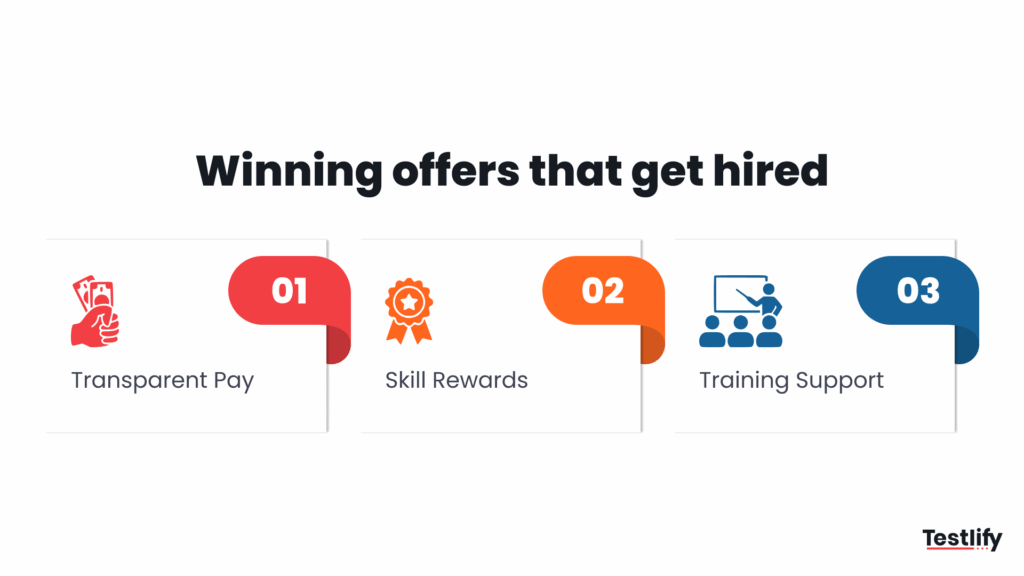
Be upfront about pay:
Posting a clear hourly rate or salary range boosts application rates and filters out mismatched expectations early. Job postings with salary ranges receive 44% to 50% more applications and 30% more views compared to those without salary information.
Reward skill growth
Make skill development a direct part of a worker’s compensation to reward it. Pay increases should be linked to significant accomplishments rather than just tenure, such as obtaining a new trade certification, finishing advanced safety training, or routinely surpassing on-site productivity targets.
When workers see a raise tied to a new skill or certification, they’re more likely to push themselves further. It also shows them you’re serious about helping them grow in their trade, not just getting more work out of them today.
Invest in training
Go beyond the basics by covering the cost of OSHA courses, equipment operation licenses, or specialized trade certifications. Also, make sure employees see where those skills can take them.
Show how a new hire could move from helper to lead hand, then to supervisor, with each step supported by training and a pay bump.
Add in small but meaningful extras like attendance bonuses, tool stipends, or paid safety gear to keep workers motivated and loyal while they grow.
When workers feel they’re being paid fairly and have a path to grow, the turnover rate drops sharply. When training is paired with competitive pay and a learning-first culture, employee retention can jump by 30%-50% compared to pay alone.
Tap into community networks and referral programs.
Some of the best blue-collar hires come from people who already know the work and the workers. You can find qualified and culturally compatible candidates more quickly through employee referrals and community networks.
A LinkedIn study found that referral hires are faster to onboard and stay longer than hires from other sources.
Where to look in your community,
- Local unions and trade associations: They often maintain member lists and can recommend qualified people when projects open up.
- Community centers and vocational nonprofits: Many run job-readiness programs and have graduates eager for hands-on work.
- Veteran transition programs: Skilled trades are a natural fit for many service members entering civilian life.
Use innovative hiring tools for faster, fairer recruitment.
It is evident that if you rely only on job boards or paper applications, you are at risk of losing good candidates to companies that act quicker.
For scheduling interviews, many teams use simple solutions like Google Meet or Zoom. For keeping track of candidates, some rely on Trello or Airtable. These tools keep things organised, but they don’t measure skills. That’s where Testlify comes in.
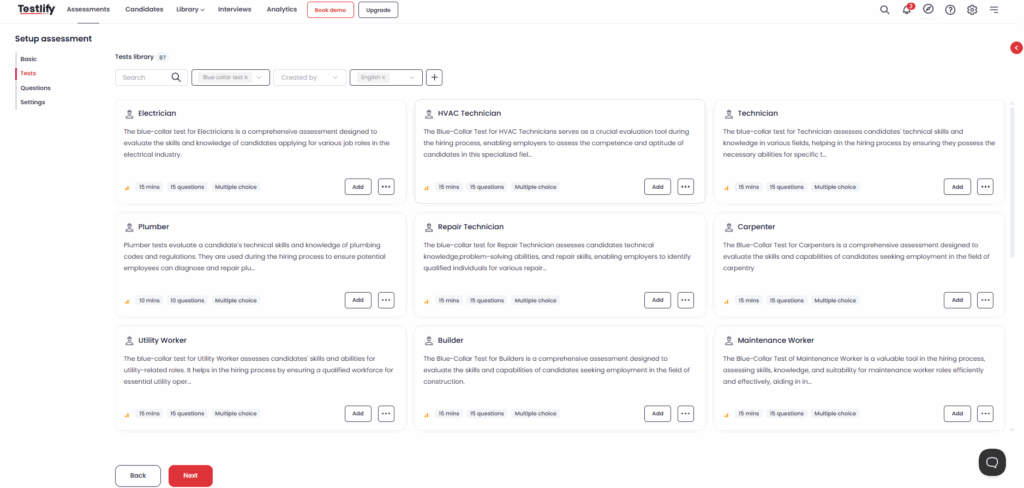
With Testlify, you can screen for the exact abilities a role needs. There are over 3,000 ready-made tests in its test library, from basic safety checks to role-specific skills. You can use the AI Video/Audio interview feature to see how a person explains their work or solves a problem.
Additionally, built-in AI-powered proctoring keeps results honest. The best part is that everything connects with your existing ATS; it supports seamless ATS integration, so you are not stuck copying results between platforms.
For roles where every day of delay costs money, this setup means you can hire faster without gambling on quality.
Turning these ideas into real hires
Use multiple approaches that feed into each other. Build relationships with trade schools, be visible in the places workers already spend their time, offer pay and training worth showing up for, and tap into the networks that your team trusts.
Once you have a steady stream of candidates, the real difference comes from how you screen and select. Talent assessment platforms like Testlify can save time and improve your results.
With ready-made tests, quick video checks, and built-in proctoring, you can be confident that the people you bring in can do the job and stick around. See how Testlify can fit into your next round of hiring and help you find the perfect hire.
Frequently asked questions (FAQs)
Related resources
View all
Hiring Guide
How to use data and analytics to improve recruitment outcomes (in 5 steps)

Hiring Guide
How to build a successful data science team

Hiring Guide
How to build a successful finance management team

Hiring Guide
How to screen candidates for AI developer

Hiring Guide
How to Screen Candidates for VR Developer Positions

Hiring Guide
How to Screen Candidates for AR Developer Positions
Get started.
Hire on proof, not resumes.
Run your first skills-based assessment free — no credit card required.