
Are Personality Tests for Hiring Based on Science or Astrology?
Is astrology true? 152 astrologers were tested and none beat chance. See why horoscopes feel accurate and what hiring teams can learn.

Personality tests are increasingly used in hiring to help employers understand candidates' behavioral traits, working styles and suitability for a role. But how reliable are these assessments? Are they backed by psychological research, or do they make predictions similar to astrology?
The difference matters. While astrology assigns personality traits based on birth charts, scientifically validated personality assessments measure behavioral patterns through structured methods. Let's explore what research says about personality tests for hiring, why horoscopes can feel accurate, and how employers can use evidence-based assessments to make fairer hiring decisions.
 ChatGPT
 Gemini
 Claude
 Grok
 Perplexity
TL;DR
- Astrology isn't scientifically reliable: a 2024 clearer thinking study involving 152 astrologers found that their birth-chart predictions performed no better than random guessing.
- Personality tests and astrology aren't the same: validated personality assessments measure behavioral traits through structured questionnaires, while astrology assigns personality characteristics based on birth dates.
- Horoscopes can feel surprisingly accurate: the barnum effect, confirmation bias and vague descriptions explain why people often see themselves in generalized predictions.
- Personality assessments need validation: employers should use assessments with reliable, measurable results and evidence linking them to relevant workplace behaviors.
- Skills should carry more weight in hiring: personality assessments can provide additional context, but job-related skills tests and structured interviews offer more direct evidence of a candidate's ability.
- Hiring decisions should be evidence-based: every assessment should be relevant to the role, consistently scored and evaluated for potential bias.

Is astrology true?
Astrology is not true as a way to describe personality or predict events. Astrologers have been tested on whether a birth chart reveals anything real about a person, and the results match guessing. Astrology also has no physical mechanism that could explain such effects, so the honest answer to "is astrology real?" is: real as a tradition, not real as a science.
That does not make everyone who reads a horoscope foolish. Most people treat it as entertainment. The problem starts when astrology is used to make decisions about other people, such as who to date, trust or hire.
What does astrology claim?
Astrology claims that the positions of the Sun, Moon and planets at the moment you are born shape your character, relationships and future. Western astrology divides the sky into 12 zodiac signs, and a full birth chart (natal chart) adds the Moon sign, the rising sign and 12 houses.
Most people only know their Sun sign, the sign the Sun appeared in on their birthday. Newspaper and app horoscopes are written for those 12 Sun signs, which means one forecast is meant to fit roughly one in every 12 people on the planet. Professional astrologers say the full chart is far more precise, which is why the fairest tests use full natal charts.
What happened when astrologers were put to the test?
Astrologers who were tested on real birth charts scored no better than chance. In a study published in 2024, the research group Clearer Thinking asked 152 astrologers to match natal charts to 12 real people. For each person, the astrologers saw detailed life information and five charts: the real one and four random decoys.
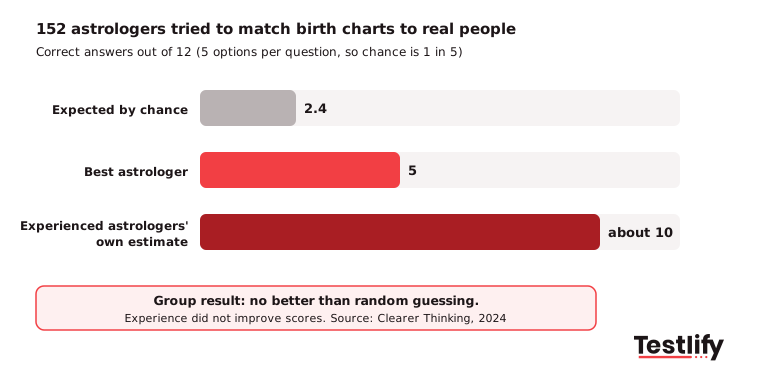
- The chance level: With five options per question, guessing gives an average of 2.4 correct answers out of 12.
- The result: No astrologer scored more than 5 of 12, and the group as a whole was statistically the same as random guessing.
- Experience did not help: The most experienced astrologers expected to get about 10 right. They did no better than beginners.
- Astrologers disagreed with each other: They picked the same chart only 21% to 28% of the time, close to the 20% you would expect by chance.
Astrologers helped design the study and a cash prize was offered for a high score, so the test was set up to give astrology a fair chance. Older tests of astrology, run over several decades, reached the same answer.
Key takeaway: Confidence is not evidence. The astrologers who felt most sure of their skill performed no better than the rest.
Why does astrology feel so accurate?
Astrology feels accurate because human memory and attention are easy to steer. Readings use broad statements that fit almost anyone, people notice the hits and forget the misses, and a forecast can change behavior enough to come true. Together these effects make a random reading feel personal.
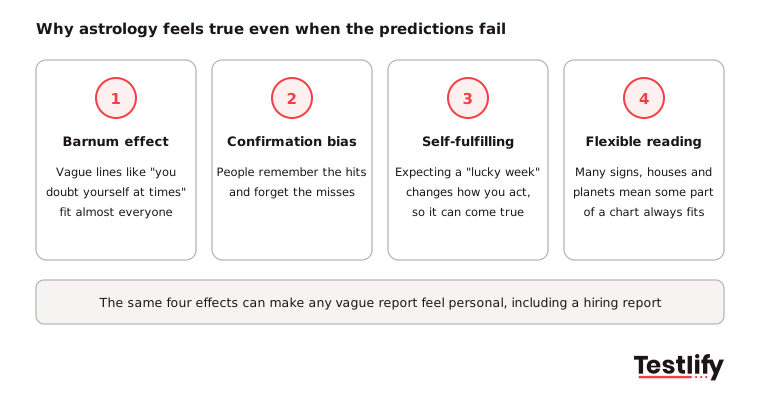
- Barnum effect: The APA Dictionary of Psychology defines it as the tendency to believe that vague predictions or general personality descriptions, "such as those offered by astrology," apply specifically to you. "You can be sociable, but you also need time alone" describes nearly everyone.
- Confirmation bias: A Leo who reads "you love attention" remembers every time that was true and quietly drops the times it was not.
- Self-fulfilling prophecy: A horoscope that promises a good week for new contacts can make you more outgoing, and the good week follows.
- Flexible reading: With 12 signs, 12 houses, 10 planets and many angles between them, there is always some part of the chart that "explains" any outcome after the fact.
None of these effects is unique to astrology. They show up in any report about a person that is vague, flattering or read after the fact, including hiring reports.
How do personality tests for hiring work?
Personality tests for hiring help employers understand how candidates typically think, behave and respond to different workplace situations. They measure traits such as openness, conscientiousness, extraversion, agreeableness and emotional stability to give recruiters additional insight into a candidate's working style.
Unlike astrology, which assigns personality traits based on birth dates, scientifically developed personality assessments use structured questionnaires and established psychological frameworks. However, not every personality test is equally reliable. The quality of an assessment depends on how well it measures the traits it claims to measure and whether those traits are relevant to the job.
Common approaches to personality testing in recruitment include:
- Big five personality assessment: measures five broad personality dimensions: openness, conscientiousness, extraversion, agreeableness and emotional stability.
- DISC assessment: examines four behavioral styles: dominance, influence, steadiness and conscientiousness.
- Situational judgment tests: present candidates with realistic workplace scenarios to understand how they might respond to different situations.
For hiring teams, the goal should not be to find a personality type that fits every role. It should be to understand whether specific behavioral traits are relevant to the responsibilities of the position.
Personality tests should complement skills assessments and structured interviews, not replace them. A candidate's ability to perform the actual job should remain central to the hiring decision.
How is a job-related assessment different from a horoscope?
A job-related assessment differs from a horoscope in what it measures, how it measures it and how the result is used. A horoscope assigns a story based on your birth date. A sound assessment asks every candidate the same questions, scores the answers the same way and ties each score to something the job needs.
Horoscope | Trait questionnaire (Big Five, DISC) | Skills test | |
|---|---|---|---|
Based on | Birth date and time | Your own answers about how you behave | What you actually do on job tasks |
Same input, same result? | Yes, for everyone born that day | Similar results when retaken | Similar results when retaken |
Tied to the job | No | Only when traits are matched to the role | Yes, built from the job's tasks |
Can it be checked against outcomes? | Tests show no link | Yes, against performance and retention data | Yes, against performance data |
Fair use in hiring | Never | As one input, never the only one | Yes, as a core input |
Trait questionnaires are useful when they are treated as one input and read with care. Testlify's guide to interpreting personality tests explains how to read trait scores without over-reading them. Skills tests carry more weight because they show what a candidate can do, not what they say about themselves.
How can hiring teams avoid the Barnum trap?
The barnum effect, also known as the forer effect, is the tendency to believe that vague, general personality descriptions are uniquely accurate for us. For example, a statement like "you work well with others but also value your independence" can sound personal, even though it describes a large number of people.
This becomes a problem in hiring when recruiters rely on personality reports that use broad descriptions without measurable evidence. To avoid the barnum trap, hiring teams should ensure that every candidate insight is specific, job-related, consistently measured and checked for bias.
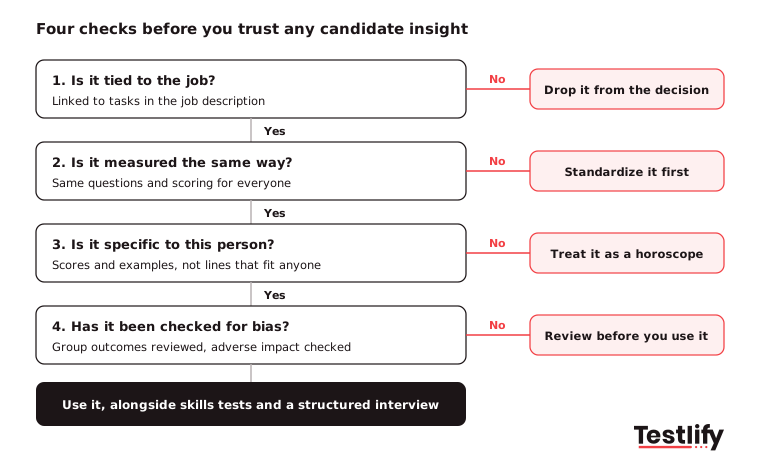
- Start from the job: List the skills and behaviors the role needs before you pick any assessment, then drop anything that does not map to that list.
- Standardize the process: Give every candidate the same tests and a structured interview with fixed questions and a scoring guide.
- Look for specifics: A useful report gives scores, ranges and examples. Lines like "works well with others but values independence" fit nearly anyone.
- Weigh skills first: Use trait results to shape interview questions, not to accept or reject people on their own.
- Check outcomes: Compare scores with later performance and look at pass rates across groups, so you catch a tool that screens out people unfairly.
Pro tip: Before you trust a report, cover the candidate's name and ask a colleague whether it could describe them too. If the answer is yes, it is Barnum text, not evidence.
Ready to hire on evidence instead of star signs?
Testlify helps hiring teams replace gut feel with job-related evidence. The Testlify test library has 3,500+ tests, including role-specific skills tests, cognitive ability tests and personality and culture assessments such as the Big Five (SMART) personality test and the DISC assessment. Every candidate gets the same questions and the same scoring, and the candidate-matching model inside Testlify has completed a third-party NYC bias audit.
Start a 7-day free trial with no credit card, or book a demo to see how it fits your hiring process.
Frequently asked questions (FAQs)

Content Writer
Yashika Khandelwal is a Content Writer with 3+ years of experience creating research-backed content on hiring, talent assessment, and HR technology. She is a registered Organizational Psychologist and subject matter expert who combines behavioral science with practical recruitment insights to produce accurate, evidence-based content.
LinkedInRelated resources
View all
HR & recruitment
Why a personality tests can help you find the best talent
HR & recruitment
Pre-employment personality tests: A must-have tool for hiring

HR & recruitment
Personality tests for hiring are a must-have
HR & recruitment
How can personality tests help you identify training and development needs?
HR & recruitment
Personality tests in hiring: pros, cons, and best uses

HR & recruitment
Do personality tests belong in the workplace?
Get started.
Hire on proof, not resumes.
Run your first skills-based assessment free — no credit card required.