
Talent mobility: Benefits, strategies, and best practices
Discover why talent mobility is crucial for modern businesses. Learn its benefits, strategies, and best practices to build a future-ready, agile workforce.

Why Talent Mobility Is the 2025 Retention Engine
Picture this: your star engineer can learn a new AI-ops stack in three months or learn it somewhere else. LinkedIn now finds that employees who make an internal move have a 75 % chance of staying versus 56 % for those who don’t.
In a labour market where each exit costs 0.5-2× annual salary to replace, mobility isn’t a buzzword; it’s the cheapest insurance policy you’ll ever buy.
Talent mobility aligns skills with business needs, providing people with visible growth paths. The result? Lower churn, faster innovation, and a workforce ready for whatever 2026 throws at you.
 ChatGPT
 Gemini
 Claude
 Grok
Grok Perplexity
What is talent mobility? A game-changer for modern businesses
Talent mobility refers to the movement of employees across roles, departments, or even geographies within an organization. This is done to align their skills with the company’s evolving needs.
Imagine a workplace where employees aren’t stuck in one role for years but instead are given opportunities to explore, grow, and thrive. That is talent mobility in action! Simply put, it’s about finding the right people with the right skills at the right time for the right roles.
This dynamic approach to talent management does more than just fill vacancies; it creates a culture of continuous growth and adaptability. It’s a win-win situation for both parties. Employees gain new skills and experiences, and organizations build resilient, future-ready teams.
Types of talent mobility
- Vertical mobility: Traditional upward movement, like promotions.
- Horizontal mobility: Moving employees across departments or roles at the same level. This is done to expand their skill sets.
- Project-based mobility: Temporary assignments that allow employees to work on cross-functional projects.
- Global mobility: Preparing employees for opportunities across regions or countries.
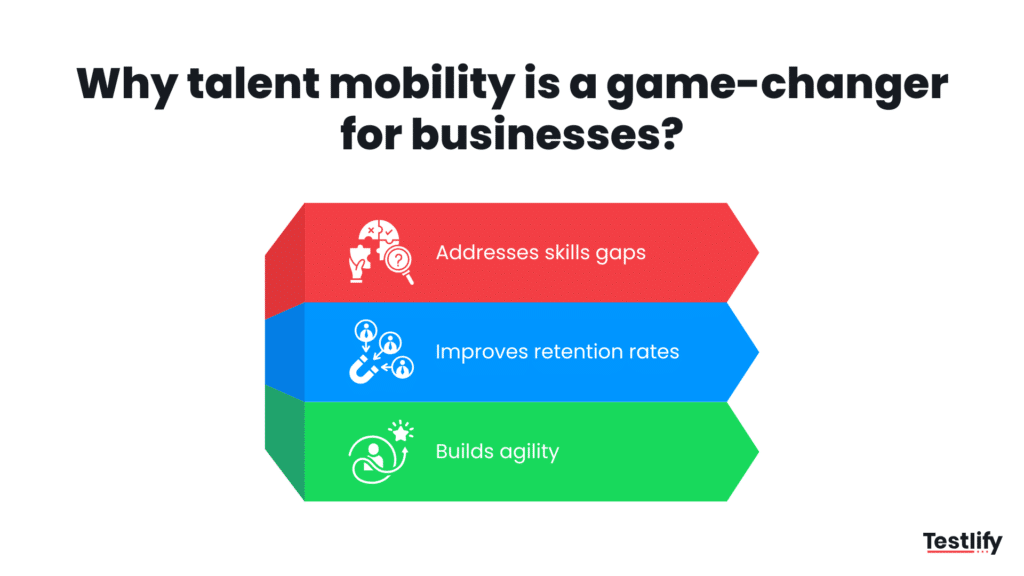
Companies like LinkedIn and Google have already proven that focusing on internal mobility increases employee satisfaction.
In a world where job hopping is the norm, talent mobility provides companies with a competitive edge. It enables companies to retain top performers and cultivate a future-ready workforce.

Why talent mobility matters: Data-backed benefits
In today’s business landscape, organizations need a strategy that goes beyond hiring and focuses on retaining and developing talent. That’s where talent mobility shines. Let’s find out why it matters in today’s business world,
Retention: Keep your best talent longer
We all know that losing skilled employees is expensive and disruptive. According to Gallup, replacing an employee can cost 1.5 to 2 times their annual salary. The good news? Organizations with robust talent mobility programs see a significant drop in turnover rates.
Would you rather spend thousands on recruiting and onboarding new hires or invest in helping your current team grow?
Bridge the skills gap with existing talent
The World Economic Forum predicts that by 2025, 50% of all employees will need reskilling as industries rapidly evolve. Talent mobility allows companies to identify existing employees who can be reskilled or upskilled for critical roles.
Instead of looking outside to fill a gap, imagine the power of redeploying someone who already understands your company’s culture and processes.
Enhance employee experience and satisfaction
Today, employees don’t just want a paycheck; they also wish for purpose and opportunities for growth.
Research indicates that 70% of employees leave their jobs due to a lack of career advancement opportunities. A strong talent mobility program creates visible career paths.
Imagine telling your team, “You don’t need to look elsewhere for growth—we’ve got opportunities for you here.” That’s the kind of message that develops loyalty and motivation.
Save costs while boosting efficiency
Internal movers achieve productivity gains faster and incur lower costs to onboard. Gallup pegs replacement costs at 50%-200 % of salary, making redeployment the clear budget win.
Create an agile workforce for the future
In an unpredictable business landscape, agility is key. Talent mobility ensures that your workforce is adaptable and ready to tackle new challenges.
Whether redeploying team members during an economic downturn or preparing leaders for future roles, a flexible talent pool gives companies a competitive edge.
Attract top talent with a mobility-first culture
A company that champions internal growth becomes an employer of choice. 80% of job seekers say they look for employers who invest in career development. When your organization promotes mobility, it sends a clear message: “We care about your future.”
A thriving talent mobility program is about more than moving employees! By retaining top talent, bridging skills gaps, and promoting a culture of growth, companies position themselves for long-term success.
The numbers don’t lie: Companies with talent mobility programs are better equipped to handle change, retain employees, and grow sustainably. Isn’t it time for your organization to prioritize it, too?
Latest talent-mobility trends to watch in 2025
- Internal hires now fill 39 % of roles, up from 32 % in 2023.
- The World Economic Forum forecasts that 50% of all workers will need reskilling by 2027, making internal redeployment the fastest path to readiness.
- LinkedIn reports a 30% surge in internal moves since 2021, driven by talent market freezes and AI upskilling demands.
The emotional side: Why employees crave mobility
63% of employees cite career development opportunities as a key reason to stay with a company, but many feel stuck and disengaged without visible paths for advancement.
Talent mobility changes this narrative. It offers employees the opportunity to explore new roles, acquire new skills, and expand their horizons. This not only combats the fear of stagnation but also develops a sense of belonging.
Employees feel valued when their potential is recognized and nurtured. When employees see opportunities to grow where they are, they stop looking elsewhere.
By aligning individual aspirations with organizational goals, talent mobility fosters a win-win situation, driving engagement and promoting long-term employee retention.
How Testlify powers internal mobility at scale
- Skills Marketplace in minutes – Testlify’s new Talent-Mobility Suite (2025 release) lets HR publish internal gigs, auto-match employees by validated skill scores, and surface “stretch” roles.
- AI Skill Mapping – Real-time dashboards map current skills against future demand so you can redeploy, not rehire.
- Bias-Check Analytics – The platform’s DEI tracker flags score gaps >4 pts, ensuring fair internal moves (the same engine behind Testlify’s video interview solution).
- One-click reassessment – Re-test employees with role-specific mini-assessments and push results straight to your ATS via 100+ native integrations.
Ready to unlock mobility? Book a 15-minute Testlify demo and see the Suite live.
How to build a winning talent mobility strategy?
Creating a talent mobility strategy involves designing a framework that enables employees to transition seamlessly between positions. Here’s how you can build a plan that works:
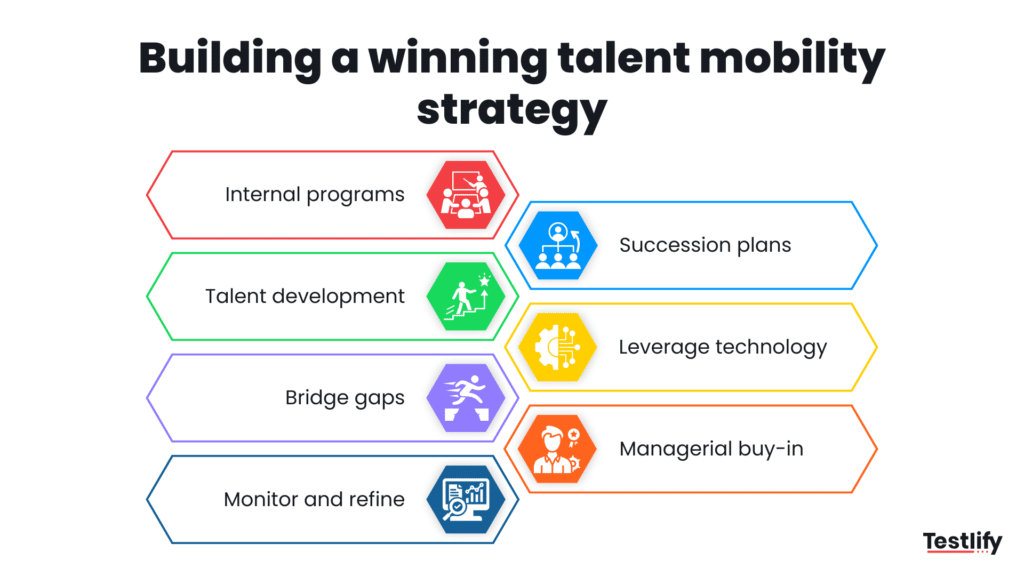
- Develop internal mobility programs – Start by designing structured internal mobility programs that highlight opportunities for team members to explore new roles. Use tools to map current career paths and help employees visualize their growth trajectory. This transparency builds trust and motivation.
- Plan for the future with succession plans – Effective talent mobility requires robust succession plans. Identify high-potential employees and prepare them for leadership roles through career development initiatives and leadership training.
- Focus on talent development and management – Talent mobility thrives in a culture of talent development and talent management. Offer employees opportunities to upskill and reskill through cross-functional projects and certifications.
- Utilize technology for employee experience – Invest in technology platforms that enhance the employee experience by tracking skills, recommending roles, and offering training opportunities. These tools enable the HR team to manage internal and external talent acquisition efficiently.
- Bridge skills gaps with strategic moves – Use talent mobility to address critical skills gaps by redeploying employees to roles where their expertise is needed most. Encourage employees to move across departments or locations to acquire new skills and gain diverse perspectives.
- Build managerial buy-in – Managers can sometimes resist talent mobility for fear of losing their best team members. Address this by aligning incentives with mobility outcomes and creating a shared vision of success.
- Monitor, measure, and refine – Track metrics like retention rates, time-to-fill roles, and employee satisfaction. Use these insights to refine your strategy continually. A winning talent mobility strategy strikes a balance between employee aspirations and business objectives.
Overcoming challenges: Practical solutions for real issues
Implementing and sustaining effective talent mobility programs comes with its own set of challenges. Below are practical solutions to address these real-world issues.
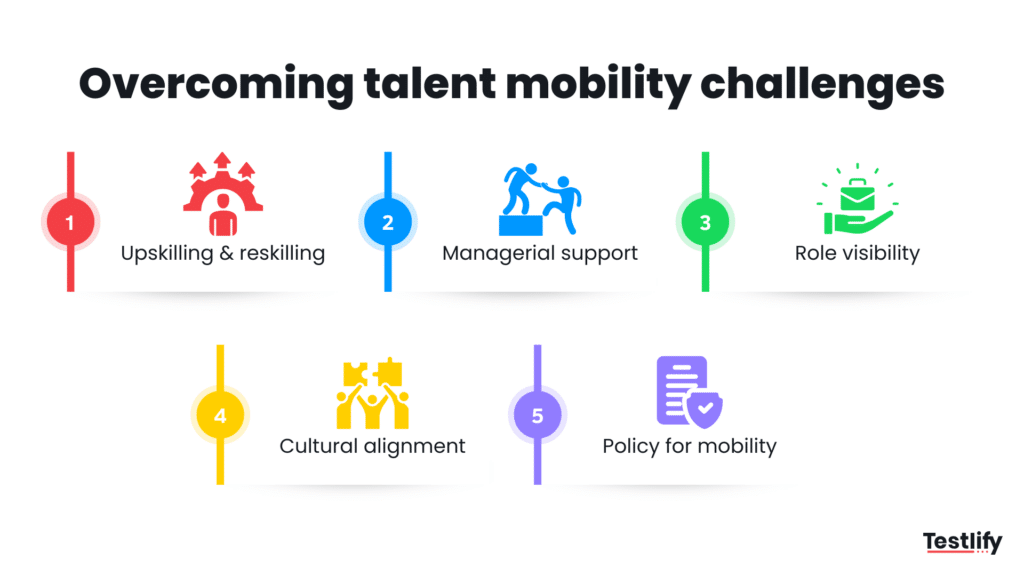
- One of the most significant barriers to talent mobility is the lack of qualified internal candidates for open roles. To overcome this, robust training and development programs that focus on upskilling and reskilling employees should be established.
- Manager resistance or a lack of leadership support can hinder talent mobility initiatives. Clearly articulate the benefits of talent mobility, such as increased employee retention, reduced hiring costs, and enhanced innovation. Provide managers with training and resources to support employee development and facilitate internal moves.
- Employees often miss opportunities due to a lack of visibility into available roles or unclear processes. Create an internal platform where employees can easily access job postings, career paths, and development opportunities.
- Cultural resistance to internal mobility can stifle progress. Highlight success stories of internal mobility through newsletters or town halls to inspire others. Additionally, pair employees with mentors who can guide them through career transitions and skill-building efforts.
- International assignments or cross-functional moves come with logistical and financial challenges. Develop clear policies regarding compensation, relocation support, and performance expectations for mobile employees.
By addressing these challenges with strategic planning, transparent communication, and leadership engagement, organizations can create a thriving culture of talent mobility.
Conclusion: The path forward
In today’s workforce, talent mobility is a necessity. It’s the glue that keeps top talent engaged. It addresses skills gaps and prepares businesses for future challenges.
Talent mobility isn’t just about shifting people into roles—it’s about creating a workplace where employees feel seen, valued, and empowered to grow. Companies with strong internal mobility programs retain employees nearly twice as long as those that don’t.
For organizations, the benefits are undeniable:
- Reduced recruitment costs.
- A pipeline of skilled, future-ready employees.
- A culture that attracts and retains top talent.
However, the true power of talent mobility lies in its ability to create connections. It bridges the gap between individual ambitions and organizational goals.
So, as you plan your next workforce strategy, remember: the best investment is in nurturing the talent you already have.
Frequently asked questions (FAQs)

B2B SaaS Content Writer
Rishav Kumar is a B2B SaaS content writer with 4 years of experience. He loves crafting engaging content. Always exploring fresh ideas, he's passionate about helping businesses grow through impactful writing.
LinkedInRelated resources
View all
HR & recruitment
Deductive vs inductive reasoning: What are they and when to use?

HR & recruitment
Building a Winning Team in the Financial Sector — Essential Recruiting Tips

HR & recruitment
What Is a Percentile Score? Meaning, Calculation, and Use in Hiring

HR & recruitment
What is predictive validity and why do recruiters need it?

HR & recruitment
Employee autonomy: what it is and how to build it

HR & recruitment
What is skills intelligence: Components, benefits and tips
Get started.
Hire on proof, not resumes.
Run your first skills-based assessment free — no credit card required.