
Skills ontology: what it is and how HR leaders use it
Learn how a skills ontology transforms hiring, workforce planning, and upskilling. Discover its benefits, framework, and key differences.

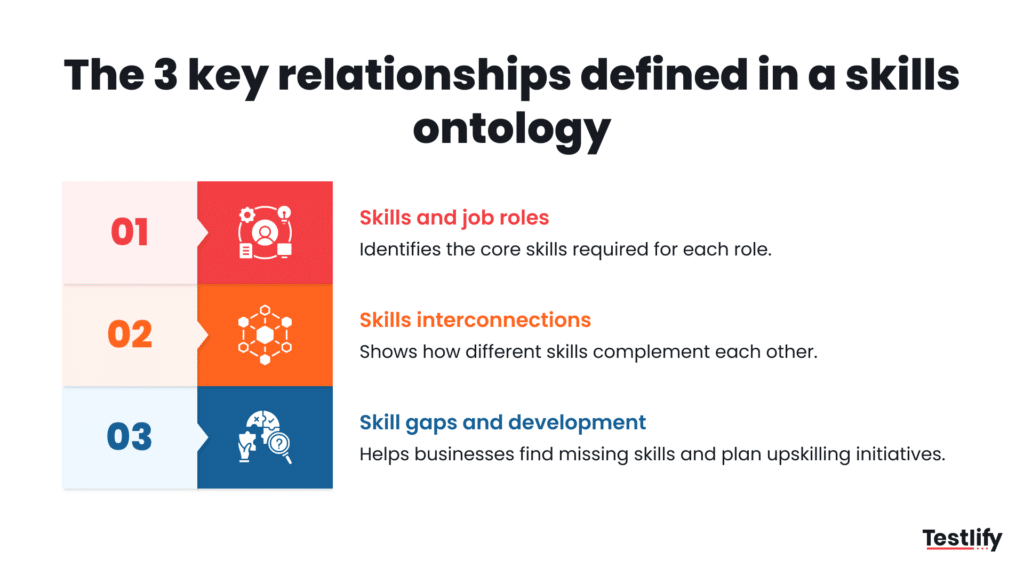
A skills ontology is a structured, machine-readable map of skills, their definitions, proficiency levels, and the relationships between them — connecting skills to job roles, career paths, and learning resources across an entire organization. Unlike a flat skills list or a hierarchical taxonomy, a skills ontology captures how skills relate: which ones are prerequisites, which transfer across roles, and which cluster together into competency profiles.
 ChatGPT
 Gemini
 Claude
 Grok
Grok Perplexity
TL;DR
- 87% of organizations globally already face skill gaps or expect to within the next few years (McKinsey, 2023) — a skills ontology is the structural fix, not a training calendar.
- A skills ontology maps relationships between skills; a taxonomy only lists them hierarchically. The difference determines whether HR can run dynamic workforce planning or just catalog headcount.
- Organizations using skills-based approaches improve talent deployment efficiency by 20-30% (McKinsey) — ontology is the enabling infrastructure that makes skills-based hiring measurable.
- The Testlify Skills Alignment Framework operationalizes skills ontology in four layers: Define, Relate, Assess, and Deploy — turning a data structure into a hiring and mobility engine.
- 60% of HR leaders name building critical skills and competencies their number-one priority (Gartner, 2024), yet only 10-15% of companies have implemented skills-based models at scale (BCG).
- Testlify’s library of 3,500+ tests across 4,500+ job roles maps directly onto a skills ontology structure, validating proficiency claims at the point of hiring with 94% candidate satisfaction.

What is a skills ontology?
A skills ontology is a formal knowledge structure that defines skills, assigns attributes (proficiency levels, synonyms, context), and maps the semantic relationships between them — including prerequisite chains, skill clusters, and role-to-skill dependencies. The term comes from information science, where an “ontology” means a specification of concepts and their interrelations within a domain.
In HR, that domain is workforce capability. A skills ontology enables a machine to reason about skills the way an experienced talent leader would: knowing that a candidate proficient in Python and statistical modeling is likely capable of picking up machine learning, or that a senior account executive’s relationship management skills transfer to customer success leadership. This reasoning is impossible with a flat skills database and unreliable with a static taxonomy.
The World Economic Forum’s Future of Jobs Report 2023 projects that 39% of core job skills will change by 2030. A skills ontology is the only architecture capable of tracking those changes dynamically, updating relationships as new skills emerge and old ones deprecate — without requiring a manual rebuild every 18 months.
How does a skills ontology differ from a skills taxonomy and skills matrix?
HR teams frequently use these three terms interchangeably, but they serve distinct purposes at different levels of sophistication. Using the wrong tool for the job is one of the most common reasons workforce planning initiatives stall. The table below maps the differences across five dimensions.
Dimension | Skills ontology | Skills taxonomy | Skills matrix |
|---|---|---|---|
Structure | Graph: nodes (skills) + typed relationships | Hierarchy: parent-child categories | Grid: employees x skills x proficiency level |
Captures skill relationships | Yes — prerequisites, clusters, transfers | No — categories only | No — assessment only |
Dynamic / self-updating | Yes, with AI/NLP integration | No — manually maintained | No — point-in-time snapshot |
Primary use case | Skills-based hiring, mobility, workforce planning | Job architecture, L&D catalog structure | Team gap analysis, training prioritization |
Complexity to build | High — requires data modeling + governance | Medium — structured but static | Low — spreadsheet-level tool |
AI/automation ready | Yes — machine-readable by design | Partial — requires enrichment | No |
The practical implication: a skills taxonomy tells HR what skills exist in a classification system. A skills ontology tells HR how those skills behave in relation to each other and to specific roles. A skills matrix tells HR who currently has what, at what level. Enterprise talent strategy needs all three, but the ontology is the connective layer that makes the other two actionable at scale.
Why do HR leaders need a skills ontology in 2026?
The business case is not abstract. McKinsey research covering 4.3 million job postings found fewer than half the potential candidates had the high-demand technical skills employers needed — not because the talent did not exist, but because traditional credential-based filtering failed to surface it. Skills ontologies fix this by making skill relationships machine-searchable.
Four concrete pressure points are accelerating adoption in 2026:
Skill volatility is structural, not cyclical
The WEF projects 39% of core skills will be disrupted by 2030. At that rate, job description libraries built on static taxonomies become misleading within 24 months. An ontology-based system flags when a skill node’s adjacency relationships shift — for example, when “prompt engineering” moved from a niche capability adjacent to “NLP research” to a cross-functional skill adjacent to “copywriting,” “data analysis,” and “customer support automation” in under 18 months.
Skills-based hiring has crossed the mainstream threshold
In the U.S., 81% of employers used skills-based hiring in 2024, up from 57% in 2022. Companies using skills-first approaches are 107% more likely to place talent effectively, according to LinkedIn’s 2024 Talent Trends report. But skills-based hiring without a validated ontology underneath it is just resume screening with extra steps — the ontology is what enables systematic, consistent, bias-reduced evaluation across thousands of candidates.
Internal mobility is cheaper than external hiring
The cost to replace an employee ranges from 50% to 200% of annual salary, depending on seniority (SHRM, 2023). Organizations with mature skills ontologies can identify internal candidates for open roles within days rather than weeks, because the system surfaces employees whose skill profiles are structurally adjacent to the target role — even if their current job title would not appear in a keyword search.
AI hiring tools require structured skills data to function accurately
Every major AI-assisted ATS — including tools integrated with Testlify’s 100+ ATS integrations — operates on structured skills data to match, score, and rank candidates. Without an ontology as the underlying data layer, AI matching defaults to keyword frequency, which reproduces historical bias and misses candidates with equivalent-but-differently-named skills. The ontology is the data contract between the AI system and the talent strategy.
Key Takeaway: 60% of HR leaders rank building critical skills as their top priority (Gartner, 2024), yet only 10-15% have operationalized it at scale (BCG). The gap is not ambition — it is architecture. A skills ontology is the architecture.
What are the core components of a skills ontology?
A functional skills ontology for enterprise HR has five structural layers. Each layer adds a dimension of intelligence that a flat list or taxonomy cannot provide.
1. Skill nodes with canonical definitions
Each skill in the ontology is defined as a discrete node with a canonical name, synonyms (so “people management” and “team leadership” resolve to the same node), a definition scoped to professional context, and a domain tag (technical, behavioral, domain-specific, transferable). Without canonical definitions, the same skill appears under 12 different labels across job descriptions, assessment results, and learning records — making aggregation impossible.
2. Typed relationships between skill nodes
Relationships are the core differentiator of an ontology over a taxonomy. The three primary relationship types are: hierarchical (SQL is a subskill of database management), associative (Python and data visualization co-occur in 74% of data analyst job postings), and equivalence (Google Analytics and Adobe Analytics are alternative manifestations of the same underlying “web analytics” competency). These typed relationships power the lateral career path recommendations and adjacent-skill detection that make modern talent mobility engines work.
3. Proficiency levels with behavioral anchors
Each skill node carries a proficiency scale — typically 4 levels (Foundational, Developing, Proficient, Expert) — with behavioral anchors that define observable evidence for each level. Behavioral anchors are what separate an ontology from a label: instead of “Advanced Python,” the ontology specifies “writes production-grade code with testing frameworks, manages package dependencies, and reviews others’ code for correctness.” This is what makes Testlify’s 3,500+ assessments across 4,500+ job roles map directly onto ontology-based job requirements — each test validates a behavioral anchor, not a self-reported level.
4. Role-to-skill mappings with criticality weights
Each job role in the ontology carries a weighted skill profile: required skills (must-have at minimum proficiency level), differentiating skills (separate average from high performers), and adjacent skills (predict future performance ceiling). Criticality weights enable recruiters to prioritize evaluation time — spending 60% of assessment effort on the 3-4 skills that drive 80% of role performance, rather than testing 20 competencies at equal depth.
5. Governance and versioning layer
An ontology without governance degrades into the same inconsistency problem it was built to solve. The governance layer defines who can add or retire skill nodes, how often role-to-skill mappings are reviewed against market data, and how deprecated skills are handled (archived, not deleted, to preserve historical records). LinkedIn Talent Insights and Lightcast (formerly Burning Glass) are the two most-used external data sources for quarterly ontology refresh cycles at enterprise scale.
How does the Testlify Skills Alignment Framework apply skills ontology to hiring?
Most organizations treat skills ontology as an HR systems project. Testlify’s Skills Alignment Framework operationalizes it as a four-layer hiring and talent mobility engine: Define, Relate, Assess, Deploy.
Layer 1: Define
Map every open role to a canonical skill profile drawn from the ontology. Define the 4-6 must-have skills, their required proficiency levels, and the 2-3 differentiating skills that distinguish top-quartile performers in that role. This step replaces the job description as the source of hiring truth — a job description is written for candidates; a skill profile is written for the evaluation system.
Layer 2: Relate
Use the ontology’s relationship graph to expand the candidate pool. A candidate without formal “data visualization” experience but with validated proficiency in “statistical analysis” and “Excel advanced” sits in the adjacency zone — meaning the skill is learnable in 4-6 weeks with high probability. The Relate layer surfaces these candidates rather than filtering them out, addressing the 77% of employers struggling to find skilled workers despite qualified talent existing in the market (ManpowerGroup, 2023).
Layer 3: Assess
Validate skill claims with structured assessments mapped directly to ontology nodes and proficiency anchors. Testlify’s assessment library covers 3,500+ skills across 4,500+ job roles, with each test calibrated to a specific proficiency level within the ontology structure. This closes the gap between claimed skills and validated skills — the single largest source of bad hires in skills-based hiring programs. Organizations that validated skills at this layer saw a 55% reduction in time-to-hire in Testlify deployments.
Layer 4: Deploy
Use validated skill profiles from hiring to feed workforce planning: identifying internal mobility candidates, flagging emerging skill gaps 6-12 months in advance, and building learning pathways based on ontology-defined adjacencies. The Deploy layer is what converts a hiring tool into a workforce intelligence system. At this layer, the 55% time-to-hire reduction compounds into a strategic advantage — because each hire’s validated skill profile immediately enriches the organization’s workforce ontology with real performance data.
Pro Tip: Before building a proprietary skills ontology from scratch, map your 10 highest-volume roles against an established open ontology such as ESCO (European Skills, Competences, Qualifications and Occupations) or O*NET. This gives you a validated starting point with 3,500+ pre-mapped skill relationships, reducing build time by 40-60% for most enterprise HR teams.
How do organizations build a skills ontology step by step?
Building a skills ontology is a data architecture project as much as an HR project. Organizations that treat it as a purely HR exercise typically produce a sophisticated taxonomy that cannot be operationalized in their tech stack. The following sequence is the proven build order for enterprise implementations.
Step 1: Audit existing skill data sources
Inventory every system that holds skill data: ATS, HRIS, LMS, performance management platform, LinkedIn profiles, job descriptions. Most organizations discover skill data is messier than expected — duplicate entries, inconsistent naming conventions, and shadow data across 6-8 systems. Consolidation and deduplication before ontology build prevents structural debt from day one.
Step 2: Define scope and anchor roles
Start with the 10-15 roles that account for the highest hiring volume or the greatest business-critical impact. Building a complete ontology for 500 roles simultaneously fails in 80% of enterprise implementations. Anchor roles provide the relationship graph’s first validated nodes — every subsequent role expansion benefits from the adjacency data generated by the anchor set.
Step 3: Map skill relationships with SME validation
For each anchor role, work with 3-5 high-performing incumbents and their hiring managers to validate the skill relationship map. AI-generated relationship suggestions from tools like LinkedIn Talent Insights or Lightcast provide the first draft; SME review identifies the 15-20% of relationships that are industry-specific or company-specific and would not appear in market data. This hybrid approach cuts SME time by approximately 60% versus building relationships from scratch.
Step 4: Define proficiency anchors for critical skills
For the 20-30 skills that appear most frequently across anchor roles, write 4-level behavioral anchor statements. This is the most time-intensive step — budget 2-4 hours per skill — but it is the step that makes assessment and performance calibration possible. Deloitte’s 2023 Global Human Capital Trends report found that organizations with defined proficiency anchors reduced inter-rater variability in hiring decisions by 34%, directly improving quality-of-hire metrics.
Step 5: Integrate with assessment and ATS layers
An ontology that lives in a spreadsheet or standalone tool delivers limited value. Integration with the ATS enables skills-based job matching; integration with the assessment platform (such as Testlify, which connects to 100+ ATS systems) enables real-time validation of skill claims at the point of application. Integration with the LMS closes the loop by mapping assessed gaps directly to relevant learning paths — the full Testlify Skills Alignment Framework loop.
Step 6: Establish quarterly refresh governance
Assign ontology ownership to a skills architect role (often a senior HR analyst or People Analytics lead) with a quarterly review cadence. Each review should pull three inputs: internal data (which skills are appearing in new hire assessments and performance reviews that are not yet in the ontology), market data (new skills trending in job postings for your industry via LinkedIn or Lightcast), and business data (which skills leadership is prioritizing in the next 12-month product or market expansion roadmap).
What are the most common mistakes organizations make when building a skills ontology?
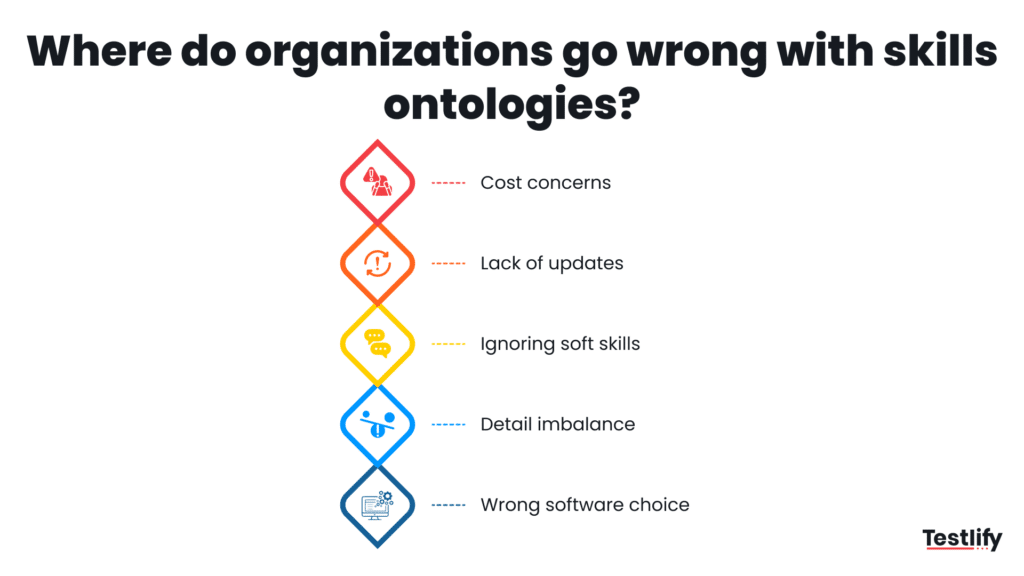
The gap between organizations that successfully operationalize a skills ontology and those that build an expensive documentation project comes down to five recurring failure modes.
Treating it as an HR project instead of a data project
A skills ontology is a knowledge graph. It requires data modeling, schema design, and integration architecture — not just HR policy writing. Organizations that exclude IT and data engineering from the build team produce ontologies that cannot be operationalized in their existing tech stack, limiting them to manual lookups rather than automated matching.
Overbuilding before validating
A common failure pattern: spend 12-18 months building a comprehensive ontology for 400+ roles before testing whether the relationship mappings actually improve hiring outcomes. The 80% of enterprise implementations that stall at the “building” phase share this characteristic. Building for 10-15 anchor roles, running a 90-day pilot with measurable outcomes (time-to-hire, quality-of-hire, offer acceptance rate), then expanding is consistently faster and more durable.
Omitting soft skills from the relationship graph
LinkedIn Talent Trends data shows 89% of hiring failures result from soft skill deficits, not technical gaps. Yet most initial skills ontologies map technical skills in detail and add soft skills as flat labels with no relationship structure. The relationship graph for soft skills is just as important — “conflict resolution” has documented adjacencies to “active listening,” “stakeholder management,” and “cross-functional collaboration” that drive lateral career mobility in leadership tracks.
No validation layer between claimed and assessed skills
A skills ontology built on self-reported or resume-extracted skill data inherits the same accuracy problem as the systems it replaced. The validated layer — assessments calibrated to ontology proficiency anchors — is what converts the ontology from a classification system into a talent intelligence system. Without it, the ontology is sophisticated documentation. With it, it becomes a decision-support engine.
Treating the ontology as a one-time build
Given WEF’s projection that 39% of core skills will change by 2030, an ontology with no refresh governance becomes actively misleading within 24-36 months. The organizations that extract the most value from skills ontologies treat them as living data products with assigned ownership, versioning, and quarterly update cycles — the same way they treat their product roadmap or financial model.
How can a skills ontology improve skills-based hiring outcomes?
Skills-based hiring adopted without ontology infrastructure delivers about 30-40% of its theoretical value. The ontology is what unlocks the remaining 60-70% through three mechanisms that manual or keyword-based approaches cannot replicate.
Structured equivalence detection surfaces candidates whose skills are equivalent to job requirements even when the labels differ. A candidate listing “Salesforce CRM” and “pipeline forecasting” maps to an ontology node for “sales operations” that a keyword search for “HubSpot CRM” would miss entirely. This materially expands the qualified candidate pool without lowering the bar — it raises the accuracy of the match.
Adjacency-based talent identification identifies internal candidates for new roles 6-12 months before the role formally opens, based on the ontology’s relationship graph. Organizations with this capability report 35-45% higher internal mobility rates and significantly lower external hiring costs for roles that could be filled from within.
Bias reduction through structured evaluation replaces subjective “culture fit” assessments with ontology-anchored proficiency validation. When every candidate is evaluated against the same behavioral anchors for the same skill nodes, protected characteristics become structurally irrelevant to the scoring. This is the mechanism behind the finding that skills-based approaches reduced mis-hires for 90% of employers and increased retention for 91% (LinkedIn, 2024). The skills-based hiring framework at Testlify is built on exactly this principle — validated assessment at each ontology node, reducing interview subjectivity.
For organizations running high-volume hiring, the compounding effect is significant. Testlify clients using ontology-aligned assessments across the full talent assessment pipeline report a 55% reduction in time-to-hire and 94% candidate satisfaction — outcomes that are structurally impossible to achieve with resume screening at scale. Connecting this to a structured skills matrix allows HR teams to continuously close the loop between hiring intelligence and workforce planning.
Frequently asked questions (FAQs)

B2B SaaS Content Writer
Rishav Kumar is a B2B SaaS content writer with 4 years of experience. He loves crafting engaging content. Always exploring fresh ideas, he's passionate about helping businesses grow through impactful writing.
LinkedInRelated resources
View all
HR & recruitment
Implicit vs explicit bias: Difference and impact in workplace

HR & recruitment
What is role mapping? Process, benefits

HR & recruitment
What is recruitment planning and how to create a recruitment plan?

HR & recruitment
An HR’s guide to skills taxonomy

HR & recruitment
What is departmentalization: Types, benefits and examples

HR & recruitment
Criterion-Related Validity: A Practical Guide for Hiring (2026)
Get started.
Hire on proof, not resumes.
Run your first skills-based assessment free — no credit card required.