
Internships in Talent Acquisition: A 2026 Strategy Guide
Internships play a key role in talent acquisition strategies, providing hands-on experience. Learn to leverage them for a stronger talent pipeline.
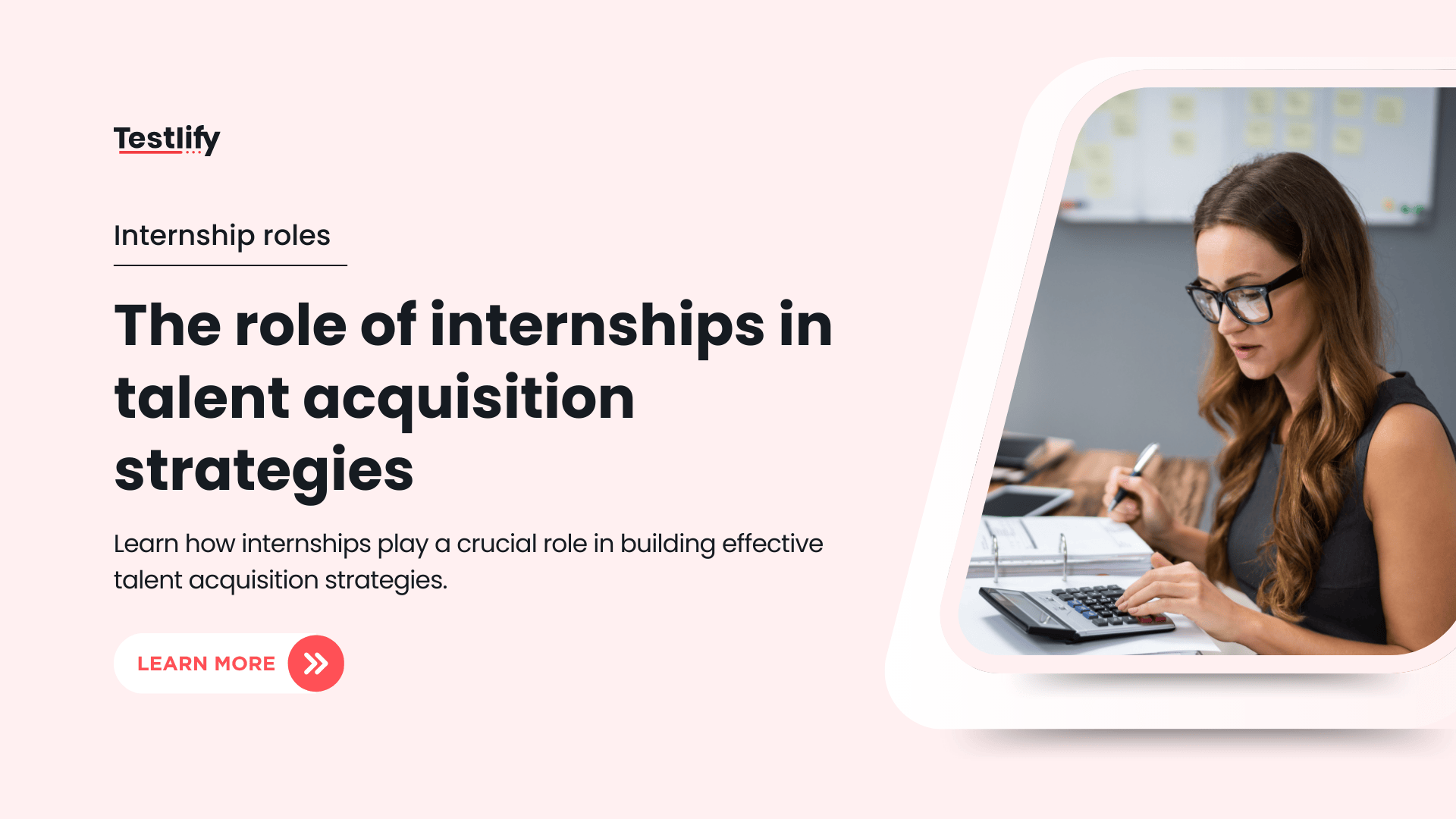
A talent acquisition internship is a paid, fixed-term working period (usually 10 to 12 weeks) that a company uses to watch a candidate do the real job before deciding on a full-time offer. It works as an extended assessment: you see actual output, work habits and team fit instead of interview answers. Run well, most interns convert.
That last part is not a guess. The conversion rate for the 2024-25 intern class hit 63.1%, the highest in five years, according to NACE, and 88.3% of the interns who got an offer took it, up from 82.8% the year before. So the question for most hiring teams is no longer whether internships work. It is whether yours is built to decide well.
 ChatGPT
 Gemini
 Claude
 Grok
Grok Perplexity
TL;DR
- An internship is the only hiring method that shows you weeks of real work before you commit. That is why it beats a resume and a one-hour interview on evidence.
- Conversion is strong right now (63.1% for the 2024-25 class), and most interns who convert are still there a year later, so the payoff shows up in retention as well as fill rate.
- The program is not the hard part. The decision is. Score interns against the same bar, in writing, or conversion turns into a popularity contest.
- If your program is unpaid, check it against the Department of Labor seven-factor test first. Most for-profit internships fail it, which makes the interns employees.
- Internships are a slow lever. They fill next year's roles, not this week's, and they only pay off if you run them season after season.

What is a talent acquisition internship?
A talent acquisition internship is a practical learning opportunity where interns gain hands on experience supporting the recruitment and hiring process. They typically work alongside recruiters and HR teams to source candidates, screen applications, coordinate interviews, maintain candidate records, and support employer branding activities.
The role gives interns exposure to different stages of the hiring process, from identifying potential candidates to helping recruiters evaluate and engage them. Depending on the organization, interns may also learn how to use applicant tracking systems, conduct initial candidate outreach, schedule interviews, and analyze recruitment metrics.
Talent acquisition intern: meaning and scope
A talent acquisition intern is an entry-level, fixed-term member of a recruiting team who supports hiring without owning requisitions.
The duties cluster into four areas:
- Sourcing support: Building candidate lists, conducting Boolean searches, reviewing applications, and identifying candidates who match the requirements of a role.
- Coordination: Scheduling interviews, managing interview logistics, communicating with candidates, and making sure recruiters and hiring managers have everything they need before each interview.
- Data and reporting: Keeping candidate records accurate, updating the applicant tracking system, maintaining recruitment templates, and preparing basic hiring reports.
- Market research: Researching talent pools, identifying where relevant candidates are concentrated, comparing competitor hiring activity, and tracking salary or recruitment trends across the market.
Which talent acquisition test fits intern hiring?
Match the test to what the role genuinely needs, and keep it short enough that early-career candidates finish it. Four types cover most intern programs:
Test type | What it measures | Best for |
|---|---|---|
Role-based skills test | Ability to perform core responsibilities | Technical, finance, design, marketing interns |
Cognitive ability | How fast they learn and solve new problems | Roles with a steep ramp and little prior experience |
Work sample | Quality of real output on a realistic task | Any role where the work product is the job |
Situational judgment | Decisions in realistic workplace situations | Recruiting, client-facing and coordination roles |
For a talent acquisition intern specifically, a situational judgment test plus a short written exercise (draft an outreach note to a passive candidate) predicts more than a cognitive score alone, because the job is mostly judgment and communication under mild time pressure.
What to avoid: a ninety-minute battery for a twelve-week internship. Drop-off is brutal, and the candidates most likely to abandon a long assessment are the ones with other offers. Twenty to thirty minutes is the band where completion stays high and the signal is still real.
For a deeper look at evaluating early-career talent, explore our guide on assessing entry-level candidates.
How do internships build a talent pipeline?
By turning every cohort into a bench you can hire from later, not just a set of candidates for this year's openings. The interns you cannot hire now are the warmest leads you will ever have for next year, and they cost nothing to keep.
Three habits make the difference:
- Pick two or three target schools and stay with them. A career services office that has placed students with you before will pre-screen for you. Rotating schools every year means starting cold every year.
- Score every intern, including the ones you will not hire. A written score is what makes a candidate findable in two years. A vague memory is not.
- Stay in touch after they leave. One honest note at the end of the program and one check-in six months later is enough. Teams that skip this rebuild the pipeline from scratch every season.
This is also where internships do real work on the shape of your pipeline. Judging people on demonstrated work rather than on where they studied widens who can get in, and an internship is skills-based hiring by construction, because the work itself is the evidence.
A steady bench also takes the edge off the recruitment challenges that hit teams who only start looking once a role is already open.
If you are building an internship pipeline, our guide to campus hiring programs covers how to source candidates, while our guide to retaining campus hires explores how to keep them engaged after they join.
Internship hiring vs traditional hiring
Traditional hiring asks you to decide on thin evidence. Internship-led hiring gives you weeks of it. The tradeoff is time: one takes days, the other takes a season.
Factor | Traditional hiring | Internship-led hiring |
|---|---|---|
Evidence of skill | Resume claims plus a short interview | Weeks of real, observed work |
Risk of a bad hire | Higher; the gap shows up after they start | Lower; problems surface during the program |
Culture and team fit | Guessed from interview rapport | Watched day to day |
Time to fill | Weeks | A season, planned ahead |
Onboarding time | Full ramp from day one | Shorter; the hire already knows the ropes |
Pipeline effect | One req, one hire | A bench you can hire from for years |
How do you measure internship ROI?
Track three numbers: conversion rate, quality of hire, and retention. A high conversion rate means little if those hires underperform or leave within a year.
For example, four interns at $6,000 each cost $24,000. If two convert, you have two hires who completed a 12 week evaluation before receiving an offer, while the remaining interns become a scored talent pool for future roles.
Use a simple tracking framework
Track the program at four points:
Stage | Metric | What to track |
|---|---|---|
Recruitment | Cost per intern | Sourcing, assessment, and recruiter costs ÷ interns hired |
Internship | Performance score | Average score against predefined role competencies |
Conversion | Conversion rate | Interns receiving full-time offers ÷ interns who completed the program |
Post conversion | Quality and retention | Performance after 6 and 12 months, plus 12 month retention |
Then compare each cohort with your standard hiring process. If interns convert at a higher rate, perform better, stay longer, or cost less to hire, the program is generating measurable value.
The real ROI comes from reducing hiring risk, not simply filling roles. If the cost of one bad hire exceeds the cost of running the internship, the program can quickly pay for itself.
Internships tend to deliver the most value when hiring decisions depend heavily on practical ability, team fit, and potential, rather than simply filling a high volume of similar entry-level roles.
Where does Testlify fit in?
Testlify fits into the part of internship hiring where you need evidence before deciding who moves forward. An internship gives you weeks of observed performance, but you still need a consistent way to screen candidates before they enter the program and compare them when several candidates appear equally promising.
With Testlify, hiring teams can create or make use of a library of 3500+ role-relevant skills assessments that measure the capabilities an intern needs. The platform also supports conversational AI interviews across chat, voice, and video, giving recruiters another way to evaluate how candidates communicate, reason through workplace situations, and respond to realistic hiring scenarios
You can use Testlify to:
- Screen candidates consistently: Assess applicants against the same role-specific criteria before inviting them into the internship program.
- Measure potential: Evaluate cognitive ability, communication, situational judgment, and other relevant skills even when candidates have limited work history.
- Standardize evaluation: Give recruiters and hiring managers a shared scoring framework instead of relying on interview impressions.
- Build a stronger talent pipeline: Keep assessment results and candidate data organized so strong candidates who are not selected immediately can be considered for future opportunities.
- Support data-backed conversion decisions: Combine assessment performance with internship outcomes to identify which signals actually correlate with successful hires.
Ready to make the conversion call on evidence instead of impressions? Start free or book a demo to see how Testlify scores interns at intake and keeps the offer decision consistent across your cohort.
FAQs

People and Talent Partner
Arushi Shah runs day-to-day talent acquisition and candidate experience at Testlify. She writes on interviewing, structured hiring, and giving candidates a fair, fast process.
LinkedInRelated resources
View all
Hiring Guide
Top 9 people management skills and how to assess them
Hiring Guide
How to create a recruitment dashboard that drive results?

Hiring Guide
7 simple steps to create a hiring process flowchart

Hiring Guide
10 Recruitment challenges and how to solve them

Hiring Guide
Onboarding External Workers: A Practical 2026 HR Guide

Hiring Guide
How to optimize your resume for tech jobs
Get started.
Hire on proof, not resumes.
Run your first skills-based assessment free — no credit card required.