
Understanding Key Responsibility Areas in recruitment
Learn how to define, implement, and measure Key responsibility areas (KRAs) to boost hiring efficiency and performance.

A key responsibility area (KRA) is the part of a job that one person owns the outcome for. Not the tasks. The result. A sales manager's KRA is not "make calls", it is "quarterly revenue". A recruiter's KRA is not "post jobs", it is "roles filled with people who stay".
That distinction sounds small. It is the whole thing. Gallup's Q2 2025 workplace data found that only 47% of employees strongly agree they know what is expected of them at work. Fewer than half. And every one of those people has a job description sitting in a folder somewhere.
TL;DR / Key takeaways
- A KRA in recruitment names the outcome a role is accountable for. A task list names the activity. Confusing the two is why most job descriptions fail to set expectations.
- Keep it to 4 to 6 KRAs per role. More than that and nobody knows what actually matters.
- KRA answers "what am I responsible for". KPI answers "how will we know it worked". You need both, in that order.
- Writing KRAs into the job description before you open a role changes what you screen for, not just what you appraise later.
- KRA responsibility is only useful if you can produce evidence for it at the hiring stage. Otherwise you are just writing better paperwork.
 ChatGPT
 Gemini
 Claude
 Grok
Grok Perplexity
What is a key responsibility area (KRA)?
A key responsibility area is a defined outcome a role is accountable for delivering, usually over a quarter or a year. It describes the result, not the daily activity. Most roles carry 4 to 6 of them. Together they should account for nearly all of why the job exists.
Think of it as the answer to a blunt question: if this person did nothing else all year, what would still have to get done? Whatever survives that question is a KRA. Everything else is a task.
KRA meaning and full form
KRA stands for key responsibility area. You will also see it expanded as key result area, and in practice most HR teams use the two interchangeably. There is a shade of difference worth knowing: "responsibility" leans toward what the person owns, "result" leans toward what gets produced. Testlify keeps a separate glossary entry on key result areas if you want the distinction spelled out.
The abbreviation matters less than the discipline behind it. A team that writes six vague KRAs has gained nothing over a team with no KRAs at all.
Areas of responsibility vs key responsibility areas
People search for "area of responsibility" and "key responsibility area" as if they mean the same thing. They mostly do, with one caveat that trips teams up.
An area of responsibility can be any slice of work someone looks after, including routine upkeep. A key responsibility area is the subset that is critical: the slices where poor performance would genuinely hurt the business. Every KRA is an area of responsibility. Not every area of responsibility deserves to be a KRA.
So when a manager hands you a list of eleven "areas of responsibility" for one role, your job is to ask which four or five carry the weight. The rest belong in the task list.

What is KRA in a job description?
KRA in job description is the section that states what the hire will be measured on rather than what they will spend time doing. It sits above the duties list and usually runs to four or six lines, each naming an outcome, the rough scope, and who else depends on it.
Here is the difference on the page. A typical duties line reads:
Manage the recruitment process for assigned open roles.
The same role, written as a KRA:
Fill assigned engineering roles within 45 days of intake, with at least 70% of hires still in role at 12 months.
The second version tells a candidate what success looks like before they apply. It also tells your interview panel what to probe. Candidates self-select against the first version on job title. They self-select against the second on whether they have actually done it.
Pro tip: write the KRA section first, then write the duties list from it. Teams that go the other way end up with twelve duties and no idea which three matter.
KRA vs KPI: what is the difference?
A KRA in recruitment is the area of accountability. A KPI is the number that tells you how that area is going. KRAs are stable and descriptive, so they change when the role changes. KPIs are numeric and move with targets, seasons, and business cycles. Set the KRA first, then attach one or two KPIs to it.
Dimension | KRA (key responsibility area) | KPI (key performance indicator) |
|---|---|---|
Question it answers | What am I responsible for? | How will we know it worked? |
Form | A named outcome, in words | A number, with a target |
Stability | Changes when the role changes | Changes with each cycle or target |
Typical count per role | 4 to 6 | 1 to 2 per KRA |
Owner | The person in the role | Shared between the person and their manager |
Example, recruiter | Engineering pipeline quality | Offer acceptance rate above 80% |
Where it lives | Job description and appraisal form | Dashboard and review cycle |
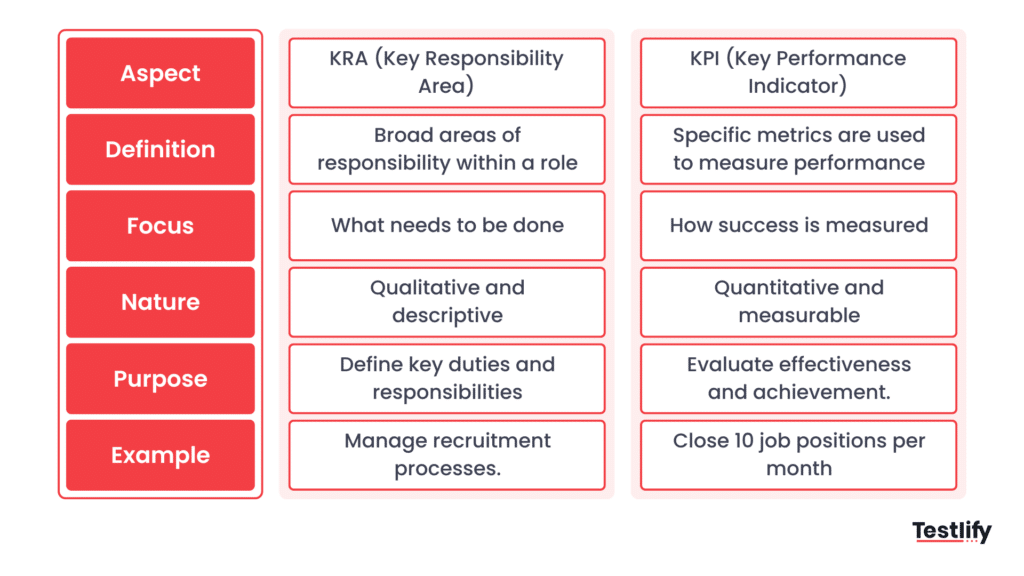
The failure mode is writing a KPI and calling it a KRA. "Reduce time to hire to 28 days" is a KPI. The KRA underneath it is "hiring speed for critical roles". If you skip the KRA and go straight to the number, the number becomes the job, and people optimise the metric instead of the outcome.
What makes a well-defined KRA?
A well-defined KRA roles and responsibility names one outcome, says who owns it, and can be evidenced. If two people could read it and picture different work, it is not done yet. The test is simple: can the person in the role explain, without their manager present, what "good" looks like this quarter?
The parts that have to be there:
- The outcome. One result, stated in plain words. Not a verb list.
- Scope. Which accounts, which roles, which region. Vague scope is how two people end up owning the same KRA and neither does it.
- A measure. At least one KPI attached, even a rough one. Unmeasurable KRAs quietly disappear at review time.
- A timeframe. Quarter or year. Without one, "ongoing" becomes the default and nothing is ever late.
- Dependencies. What the person needs from other teams. This is the part everyone skips, and it is why half of missed KRAs are argued about rather than fixed.
- Weight. Not all five KRAs matter equally. Say so, in percentages, before the review rather than during it.
Weighting is the underrated one. A recruiter with five equally weighted KRAs will drift toward the easiest. A recruiter told that pipeline quality carries 40% and reporting carries 10% knows where to spend a bad week.
How do you write KRAs step by step?
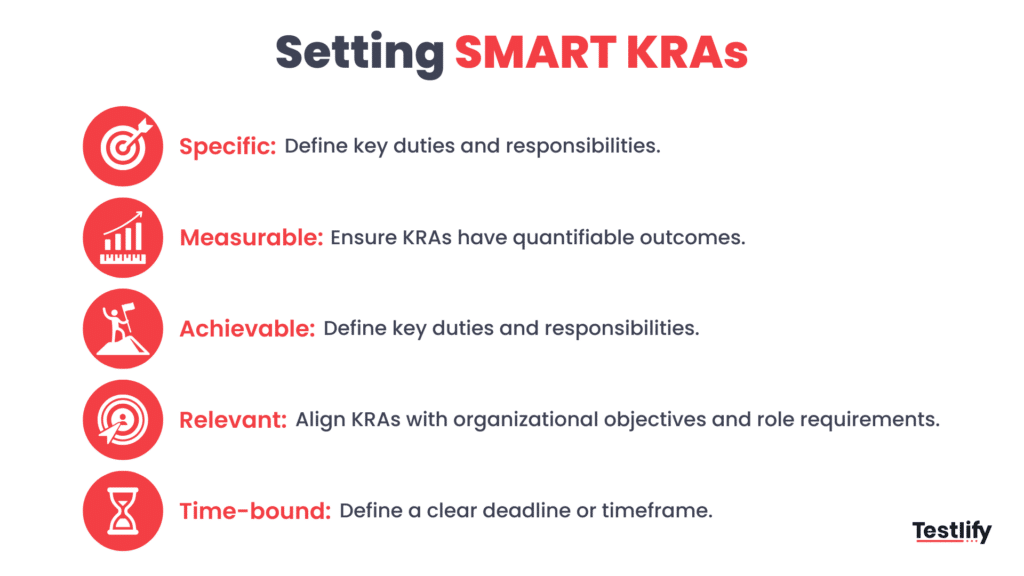
Start from the role's purpose, not the previous job description. Ask what the business would lose if the seat were empty for a quarter, turn each loss into an outcome, cut the list to five, attach a measure and a weight to each, then have the person in the role read it back to you in their own words.
- Write the one-line purpose of the role. If it takes three lines, the role is probably two roles.
- List every outcome the seat is accountable for. Ten to twelve is normal at this stage. Do not filter yet.
- Cut to 4 to 6. Merge overlaps, demote the rest to duties. This is the step teams skip and later regret.
- Attach one or two KPIs to each. If you cannot think of a measure, the KRA is probably a task in disguise.
- Assign weights that add to 100. Forcing the total makes the tradeoffs visible.
- Set the review cadence. Quarterly beats annual. Roles drift faster than review calendars.
- Read it back with the employee. If their summary does not match yours, the wording is at fault, not the person.
One caveat that gets ignored: KRAs go stale. The World Economic Forum's Future of Jobs Report 2025 estimates that 39% of workers' key skills will change by 2030. A KRA written three years ago for a marketing manager who now spends a third of the week on AI tooling is describing a job nobody holds any more. Revisit them when the work changes, not when the calendar says to.
KRA examples by job role
Generic KRA examples are easy to find and mostly useless, because a KRA is only good if it fits how that particular business makes money. Use these as shapes to adapt, not templates to paste.
Sales manager
Quarterly revenue for the assigned territory. Pipeline coverage at three times quota. Ramp time for new reps on the team. Notice that the third one is about other people: a manager's KRAs should include at least one that only exists because they manage.
HR manager
Time to fill for critical roles. Regretted attrition in the first year. Manager capability on performance reviews and feedback. The last one is soft, which is exactly why it needs a measure attached, even a blunt one like completion rate.
Software developer
Delivery of committed roadmap work. Defect rate in production for owned services. Code review turnaround for the team. Engineering KRAs go wrong when they count output (tickets closed) instead of outcome (the service works).
Marketing manager
Qualified pipeline contribution. Brand consistency across owned channels. Campaign payback period. The middle one resists measurement, so most teams drop it, and then wonder why the brand drifts.
Customer support representative
Resolution quality on assigned tickets. First response time within the promised window. Product feedback routed to the right team. That third KRA costs nothing and is the reason support teams are worth listening to.
How do KRAs work in recruitment?
In recruitment, KRAs do two jobs. They tell the hiring team what evidence to collect before an offer, and they give the new hire a scorecard from day one. A role with clear KRAs produces sharper interview questions, because you are no longer probing for general competence, you are checking for a specific outcome the person has delivered before.
This is where most KRA advice stops, and it is the part that actually matters. Writing an outcome into a job description does nothing unless the hiring process can tell who has produced that outcome. Resumes are a weak proxy for it. Van Iddekinge and colleagues, writing in Personnel Psychology in 2019, meta-analysed prehire work experience and found that broad measures like years of experience relate only weakly to later job performance. That is a polite way of saying "eight years in demand generation" tells you very little about whether someone can own a pipeline number.
The Testlify Competency-to-Evidence Matrix is built for this gap. It maps every role to the competencies that matter, then connects each competency to measurable evidence through assessments, simulations, interviews, references, and structured feedback. Applied to KRAs, the mapping runs one step further: each KRA points to the competencies that produce it, and each competency points to the evidence you will actually gather before the offer.
Worked through for one KRA on a demand generation role:
- KRA: qualified pipeline contribution for the enterprise segment.
- Competencies: campaign design, analytical reasoning, written communication with a technical audience.
- Evidence: a marketing analytics assessment, a short written brief scored by two reviewers, and a structured interview question about a campaign that missed its number.
- Decision: the panel compares candidates on the same evidence rather than on how well each one interviewed.
A 500-person SaaS company hiring 20 marketers a year could run this once per role family and reuse it, which is the difference between a hiring process that improves and one that starts over every requisition. It also makes your consistent hiring process defensible: everyone was measured against the same stated outcome.
The same logic holds for engineering. If a KRA for a backend role is "production reliability for owned services", the evidence is a coding assessment plus a debugging exercise, not a longer conversation about past employers. Testlify's test library covers that ground for technical talent and for non-technical roles alike.
What goes wrong with KRAs?
KRAs fail quietly. The document exists, everyone signed it, and nothing changed. Four patterns account for most of it.
The KRA is a task list wearing a costume. "Attend weekly pipeline meetings" is not an outcome. If a KRA can be completed by showing up, rewrite it.
Too many. Eleven KRAs is a way of avoiding the decision about what matters. Five is a decision.
Nobody revisits them. US Bureau of Labor Statistics data puts median employee tenure at 3.9 years as of January 2024, the lowest since 2002, and only 4.8 years even in management and professional occupations. Roles turn over faster than most KRA documents get updated. A KRA written for the last person in the seat is describing a job that no longer exists.
The paperwork gets better and performance does not. This is the uncomfortable one. A review of a century of performance appraisal research by DeNisi and Murphy concluded that improving rating accuracy alone has not reliably improved organizational performance, and that management context matters at least as much as the instrument. That finding is about appraisal systems rather than KRAs specifically, and it should still make you cautious. Better forms are not the lever. What managers do with them is.
So the honest tradeoff: KRAs are worth writing, and they will not fix a team where nobody has an open conversation about performance. They make a good management culture legible. They do not create one. Teams that also invest in transparent communication get far more out of the same document.
Hire against the KRA, not the resume
Once a role's KRAs are written, the next question is who can actually deliver them, and that is a screening problem rather than a paperwork problem. Testlify's role-based assessments let you turn each KRA into evidence you collect before the offer, so the shortlist is scored against the outcome the job description promised. Book a demo to see how the mapping works for a role you are hiring for right now.
FAQs

Content Writer
Yashika Khandelwal is a Content Writer with 3+ years of experience creating research-backed content on hiring, talent assessment, and HR technology. She is a registered Organizational Psychologist and subject matter expert who combines behavioral science with practical recruitment insights to produce accurate, evidence-based content.
LinkedInRelated resources
View all
HR & recruitment
Employee appreciation day 2026: Why it matters (10 ideas)

HR & recruitment
Recruitment Database: Definition, Benefits, Types

HR & recruitment
A complete guide to recruitment advertising in 2026

HR & recruitment
Garden leave meaning: pay, rules, and key benefits

HR & recruitment
SEO for recruitment : The role of AI in talent search

HR & recruitment
What is DEI: Definition, why it matters & tips
Get started.
Hire on proof, not resumes.
Run your first skills-based assessment free — no credit card required.