
Intercultural competence: skills and how to hire for it
Discover how HR professionals can develop intercultural competence to foster inclusion, enhance collaboration, and build diverse workplaces.

Intercultural competence is the ability to work, communicate, and build trust with people from different cultural backgrounds in a way that is both effective and respectful. It is the skill that decides whether a diverse team actually performs or just looks diverse on the org chart. For HR and talent teams hiring across borders, it is no longer an option. It is a core capability you can train for and hire for.
TL;DR
- Intercultural competence is the proven, trainable ability to communicate and collaborate across cultures, made up of attitudes, knowledge, skills, and behavior.
- It is what turns diversity into results. McKinsey found top-quartile ethnically diverse companies are 39% more likely to outperform their peers financially.
- The five skills to look for are cultural awareness, empathy, active listening, adaptability, and conflict resolution.
- You build it with targeted training, cross-cultural projects, inclusive policies, and feedback, not a single workshop.
- You hire for it by mapping the competency to evidence: validated assessments plus structured interviews, never a gut read of culture fit.
 ChatGPT
 Gemini
 Claude
 Grok
Grok Perplexity
What is intercultural competence?
Intercultural competence is the set of attitudes, knowledge, and skills that enable a person to interact effectively and appropriately with people from other cultures. In plain terms, it is knowing that someone may see the world differently than you do, understanding why, and adjusting how you communicate so the work still gets done and nobody feels disrespected.
The keyword is behavior. Plenty of people can name a cultural difference and still handle it badly in the moment. Real intercultural competence shows up in what someone does: how they give feedback, run a meeting, or resolve a disagreement when the other person’s norms are not their own. For HR, that distinction matters because it is the behavior, not the awareness, that you can observe, coach, and assess. It shapes everything from day-to-day communication to talent management and team performance.

Why does intercultural competence matter?
It matters because diversity only pays off when people can actually work across their differences. The research on diverse teams is strong, but every bit of it assumes the team can communicate. Intercultural competence is the hidden variable that decides whether a multicultural team becomes your best asset or your biggest source of friction.
Start with the business case. McKinsey’s 2023 research found that companies in the top quartile for ethnic diversity are 39% more likely to financially outperform those in the bottom quartile, and that gap has widened over the years. But diverse hiring alone does not capture that upside. A team of brilliant people who keep misreading each other will underperform a less diverse team that communicates cleanly.
David Livermore, PhD, president of the Cultural Intelligence Center, argues cultural intelligence has moved from a nice-to-have to a strategic requirement for navigating today’s global, diverse business environment, and the reassuring part is that it’s a learnable skill, not a fixed trait.
Engagement is the other half of the story. Gallup’s State of the Global Workplace put worldwide employee engagement at just 23%, with low engagement and disengagement costing the global economy about 8.8 trillion dollars, roughly 9% of global GDP. People disengage when they feel unseen, and feeling unseen is exactly what happens when managers cannot read or respect cultural differences. Intercultural competence is how you close that gap on a team that spans time zones, first languages, and holidays.
There is also a skills-shift angle HR leaders should not miss. The World Economic Forum’s Future of Jobs report estimates that 44% of workers’ core skills will be disrupted by 2027 and 60% of workers will need retraining. As roles change and teams globalize at the same time, the people who adapt to new tools and new cultures at once are the ones worth hiring and keeping.
What are the components of intercultural competence?
Intercultural competence is easier to build when you break it into its working parts. These six components each show up differently on the job, and each points to a different way to develop and assess it. Awareness without action is the most common failure point, so treat the behavioral components, not just the knowledge ones, as what actually counts.
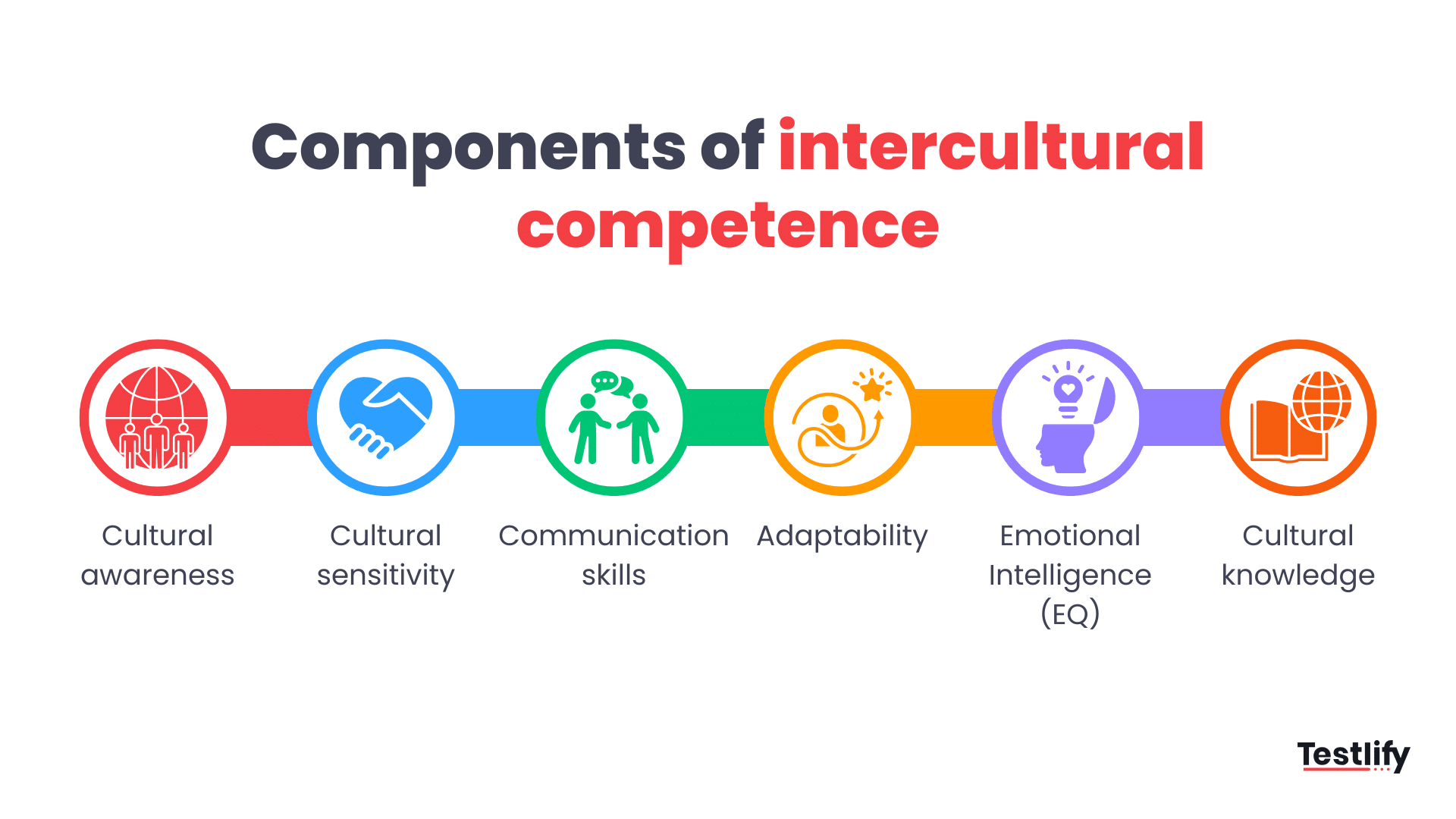
Component | What it looks like | How to build or assess it |
|---|---|---|
Cultural awareness | Recognizing that values, norms, and habits differ across cultures, starting with your own, without assuming your way is the default | Cultural-awareness training, reflective exercises, situational judgment questions |
Cultural sensitivity | Responding to those differences with respect rather than judgment, and reading a situation before reacting to it | Behavioral assessments, structured interview scenarios |
Communication skills | Adjusting how you speak, write, and listen so meaning lands cleanly across languages and communication styles | Cross-cultural communication tests, role simulations |
Adaptability | Changing your approach to fit the cultural context instead of forcing one style on everyone | Cultural adaptability tests, on-the-job observation |
Emotional intelligence (EQ) | Reading the emotion and intent behind a behavior, and managing your own reactions when norms differ from yours | Psychometric and EQ assessments, reviewer feedback |
Cultural knowledge | Understanding your own cultural lens and how specific cultures differ in practice, from feedback norms to how they handle hierarchy | Knowledge-based assessments, cross-cultural projects, mentorship |
Pro Tip: When you write a job description for a global or cross-functional role, name the behavior you want, not the trait. “Adjusts communication style for distributed teams across time zones” is something a candidate can demonstrate and an assessment can measure. “Culturally aware” is not.
Top intercultural competence skills to assess
If the four components are the theory, these five skills are what you actually screen and interview for. They are the observable, trainable behaviors that separate someone who survives on a global team from someone who makes it work.

Cultural awareness
This is the foundation: recognizing that values, norms, and habits differ across cultures, starting with your own. Someone with cultural awareness notices that punctuality, eye contact, or directness carry different meaning in different places, and does not assume their way is the default. It is less about memorizing facts and more about staying curious instead of judgmental.
Empathy
Empathy is the ability to take another person’s perspective and feel why a situation lands the way it does for them. Across cultures, that means reading the reason behind a behavior rather than reacting to the behavior itself. A colleague who goes quiet in a meeting may be deferring to seniority, not disengaging, and an empathetic teammate checks before assuming.
Active listening
In cross-cultural settings, listening means catching context and non-verbal cues, not just words. Active listening helps people confirm what was meant before they respond, which matters most when a second language or an indirect communication style is in play. It is the cheapest way to prevent a small misread from turning into a conflict.
Adaptability
Adaptability is the willingness to change your approach to fit the cultural context instead of forcing one style on everyone. For a manager, that can mean giving direct written feedback to one report and a softer in-person version to another, and being comfortable that there is no single right way to run a diverse team.
Conflict resolution
Disagreements are sharper when values and communication styles differ. Strong conflict resolution across cultures means surfacing the real issue, finding common ground, and addressing the misunderstanding without anyone losing face. Handled well, these moments build trust faster than smooth ones do.
How do you develop intercultural competence?
You develop it by treating it as a skill you can practice, not a personality trait people either have or lack. A single diversity workshop rarely changes behavior. What works is repeated exposure paired with reflection, backed by policies that make inclusion the default. Here is what moves the needle.
- Run focused training, then reinforce it. Cover unconscious bias, communication-style differences, and how to manage across cultures, and revisit the topic so it sticks instead of fading after one session.
- Give people real cross-cultural work. International projects, mentorship pairs, and mixed teams build the skill through practice. Comfort with difference grows from doing, not from a slide deck.
- Build inclusive policies. Flexible holidays for different observances, inclusive language in everyday practices, and clear escalation paths signal that the company expects respect, not just hopes for it.
- Watch for and name bias. Building awareness of unconscious bias helps people catch the assumptions that quietly shape who gets heard, promoted, or interrupted.
- Measure progress. Use engagement surveys, belonging questions, and assessment data to see whether things are improving, then adjust. What you do not measure, you cannot manage.
How do you assess it during hiring?
You assess intercultural competence by mapping the competency to concrete evidence rather than trusting a hiring manager’s instinct about “culture fit,” which is where bias sneaks in. In practice, that means starting with the competency the role needs, then connecting it to measurable evidence from assessments, simulations, interviews, and reviewer feedback before you decide.
In practice, that means combining signals. A cross-cultural communication test shows how a candidate handles communication across cultures. A cultural adaptability test measures how readily they adjust their approach. Pair those scores with structured interview questions about a time they worked across cultural lines, plus reviewer input, and you get a defensible read instead of a gut call. AI can help screen and summarize the evidence, but the hiring decision stays with your team.
Picture a 200-person company opening its first office abroad and hiring 15 people for a cross-border team. Screening finalists with two short culture-and-communication assessments before the first interview surfaces who can genuinely adapt, and saves the panel from spending its limited interview time guessing.
Key takeaways
- What people do matters more than what they know. Intercultural competence shows up in behavior, not awareness. Hire and coach for what you can actually observe, because that is what predicts whether a diverse team performs.
- Diversity only pays off with competence. The 39% outperformance edge McKinsey found for ethnically diverse companies shows up only when people can communicate across cultures. Inclusion is the mechanism that unlocks it, not a nice-to-have.
- You can build it, not just hire it. All six components, from cultural awareness to emotional intelligence, respond to focused training, real cross-cultural projects, and reflection. This is a capability you can develop, not a fixed trait.
- Assess these five skills when you hire. Cultural awareness, empathy, active listening, adaptability, and conflict resolution are the concrete behaviors to test for in interviews and assessments.
- Trade gut-feel for evidence. Replace “culture fit” instinct with validated assessments, structured interviews, and reviewer input, so every hiring decision is fair, repeatable, and defensible.
- Low engagement is your warning sign. With global engagement down to 20%, watch belonging and inclusion data to catch where cross-cultural friction is quietly costing you people.
Frequently asked questions (FAQs)

Content Writer
Yashika Khandelwal is a Content Writer with 3+ years of experience creating research-backed content on hiring, talent assessment, and HR technology. She is a registered Organizational Psychologist and subject matter expert who combines behavioral science with practical recruitment insights to produce accurate, evidence-based content.
LinkedInRelated resources
View all
HR & recruitment
65 key skills-based hiring statistics for 2026

HR & recruitment
Employee poaching: Is it illegal, and how to prevent it

HR & recruitment
7 HR statutory compliance rules you must know

HR & recruitment
Employee Vetting: Steps, Checks, and Best Practices for 2026
HR & recruitment
Transferable Skills: Definition, Meaning & Examples

HR & recruitment
What is a returnship: Benefits and best practices
Get started.
Hire on proof, not resumes.
Run your first skills-based assessment free — no credit card required.