
7 HR statutory compliance rules you must know
Discover the 7 key HR statutory compliance rules every professional must know to ensure a legally sound, fair, and productive workplace in the US and UK.

HR statutory compliance is essential for the success of any organization. It guarantees that legal standards are met, safeguarding the interests of both employers and employees. In the US and UK, compliance goes beyond avoiding penalties; it’s about building a work environment rooted in trust and equity.
This guide breaks down seven key compliance rules every HR professional must master. Let’s clarify the complexities and assist you to build a compliant and flourishing workplace.
 ChatGPT
 Gemini
 Claude
 Grok
Grok Perplexity
What is HR statutory compliance?
HR statutory compliance refers to the legal framework that governs employment and workplace practices. It ensures that businesses adhere to rules and regulations designed to protect employee rights while maintaining organizational accountability.
For instance, the Fair Labor Standards Act (FLSA) of the United States and the Employment Rights Act 1996 in the United Kingdom have created standards for pay, hours of work, and employee classification. Such regulations are important in ensuring transparency and moral conduct in an organization.
In straightforward terms, HR statutory compliance is about adhering to the law to have a balanced and compliant workplace that avoids penalties and reputational risks. Next, discover the seven compliance rules every HR professional needs to master.
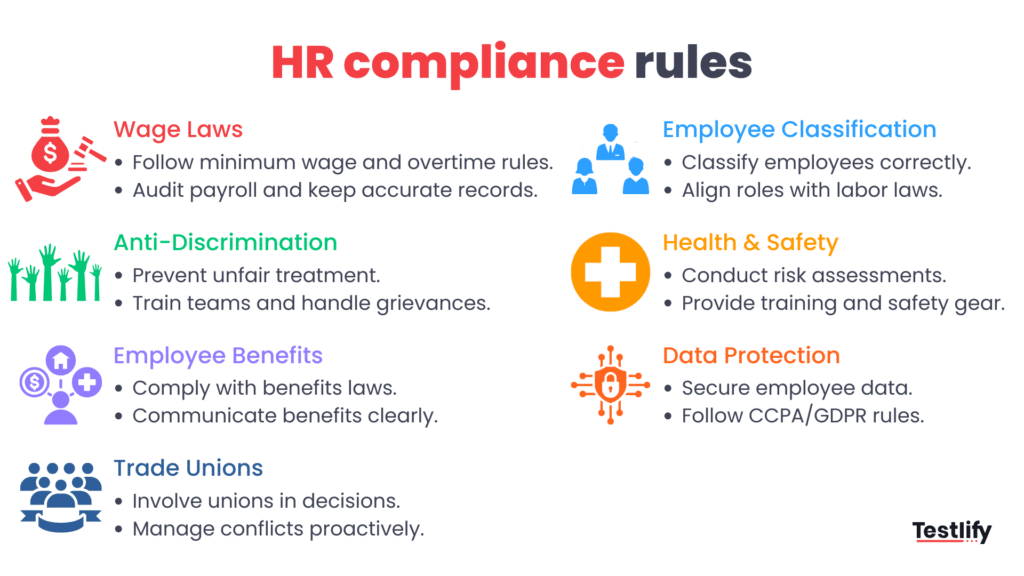

Rule 1: Adherence to wage and hour laws
Compliance with wage and hour laws is very important. This is because to ensure fairness and avoid legal consequences. These laws regulate matters such as minimum wage, overtime pay, and working hours, so that employees are fairly compensated.
The Fair Labor Standards Act (FLSA) sets the federal minimum wage at $7.25 per hour (as of 2023). It also mandates overtime pay for non-exempt employees working over 40 hours a week. Employers must also accurately classify their employees to avoid penalties.
In the UK, the National Minimum Wage Act 1998 requires employers to pay workers aged 23 and above at least £10.42 per hour (2023 rates). Additionally, the Working Time Regulations 1998 limit weekly working hours to 48 unless the employee opts out.
Practical tips for HR
- Conduct regular audits of payroll processes to ensure compliance with labor laws.
- Keep precise records of employee working hours and classifications.
- Stay informed about changes to wage laws.
Compliance with these laws protects your company from lawsuits and builds trust with employees through fair practice.
Rule 2: Accurate employee classification
The correct classification of employees helps them comply with rules and regulations on employment. Incorrectly labeling employees as independent contractors or misclassifying exempt employees may result in huge fines and back-pay liabilities.
FLSA sets specific criteria for classifying employees as exempt or non-exempt, depending on their job duties, salary, and working conditions. Misclassification can lead to overtime pay and benefits violations.
The Employment Rights Act 1996 recognizes three categories of workers in the UK i.e., employees, workers, and self-employed. Each category has its distinct rights in terms of pay, holidays, and termination.
Practical tips for HR
- Review job descriptions regularly to align with actual job responsibilities and legal frameworks.
- Conduct regular audits to ensure employee roles meet classification standards under labor laws.
- Train HR teams to understand that classification errors can have repercussions such as loss of trust from employees and compliance risks.
Accurate classification of employees not only helps avoid legal pitfalls but also strengthens accountability within the organization.
Rule 3: Compliance with anti-discrimination laws
Compliance with anti-discrimination laws is essential for fostering a workplace where all employees feel respected and treated equally. These laws prohibit unfair treatment based on race, gender, religion, disability, or other protected characteristics.
The Civil Rights Act of 1964 prohibits discrimination in employment practices, including hiring, promotions, and compensation. The Equal Employment Opportunity Commission (EEOC) enforces these laws and investigates violations. Under the Americans with Disabilities Act, employers must also accommodate individuals with disabilities.
The Equality Act 2010 in the UK is a consolidation of numerous anti-discrimination laws. It safeguards employees from all forms of unfair treatment in recruitment, promotion, and the workplace.
Practical tips for HR
- Create clear recruitment and workplace behavior rules that promote inclusion.
- Regularize training on anti-discrimination laws for managers and workers.
- Establish a transparent system of grievance redressal for employees to register complaints about discriminatory practices at the workplace.
Rule 4: Ensuring health and safety compliance
It is both a legal and ethical responsibility for employers to maintain safe working conditions. Health and safety regulations are in place to protect employees from potential hazards in the workplace. It basically safeguards their physical and mental health.
The Occupational Safety and Health Administration (OSHA) establishes standards for workplace safety under the Labor Standards Act (FLSA). The employers are required to provide a hazard-free workplace, regular safety audits, and report incidents. To better understand these standards, workers and safety professionals can benefit from taking an OSHA 10 practice test, which helps prepare for the official training. Non-compliance may lead to penalties and reputational damage.
Practical tips for HR
- Regular risk assessment must be conducted in order to identify and mitigate possible hazards.
- Safety policies that meet legal requirements should be developed and implemented.
- Offer safety training to employees and ensure they have access to protective equipment.
Rule 5: Managing employee benefits and social security
Managing employee benefits and social security contributions is crucial for adhering to regulations while also keeping the employees satisfied. Employee benefits are a significant tool for attracting and retaining top talent.
The Federal Insurance Contributions Act, or FICA, requires employers to pay into social security and medicare for qualified employees. Additionally, other benefits that may include health insurance, retirement plans, and paid leave must comply with federal and state labor laws.
A 401(k) is an employer-sponsored retirement savings plan that allows employees to contribute a portion of their salary on a tax-deferred basis. These plans offer various investment options, typically including mutual funds, and may include employer-matching contributions. This provides an opportunity for employees to build long-term financial security.
In the UK, employers are required to provide a workplace pension through the Employees’ Provident Fund scheme and make National Insurance contributions. These benefits are very important for ensuring employees’ financial security.
Practical tips for HR
- Keep precise records of benefit eligibility and contributions to meet legal requirements.
- Regularly assess benefit offerings to ensure they are competitive and meet employee classification standards.
- Clearly communicate benefit information to employees to prevent misunderstandings.
Effective management of employee benefits enhances job satisfaction and ensures that an organization meets its HR statutory compliance obligations.
Rule 6: Upholding data protection and privacy laws
With emerging digital workplaces, it became important to comply with numerous rules and regulations related to data protection. Protecting employee data helps protect private information while establishing trust. It also reduces the company’s legal risks.
In the US, there are different laws that include the California Consumer Privacy Act (CCPA) and the Health Insurance Portability and Accountability Act (HIPAA). These bodies regulate the collection, storage, and use of employee data. Employers should implement secure data handling practices to be in compliance with these legal frameworks.
Additionally, in the UK, the General Data Protection Regulation (GDPR) is a very stiff regulation for processing personal information. The employer should be transparent regarding the storage of data, with proper security measures and consent to data collection. Non-adherence can result in fines of as much as €20 million or 4% of annual turnover.
Practical tips for HR
- Regular compliance audits on data protection must be conducted.
- Implement security measures such as encryption. Limit access to sensitive material.
- Train employees and HR teams on best practices for maintaining privacy in order to minimize unintended violations.
Upholding data protection laws not only ensures HR statutory compliance but also positions your organization as a trustworthy and ethical employer.
Rule 7: Navigating trade union relations and collective bargaining
Navigating the relationship between a trade union and organizational interests can be difficult. Where the intricacies of collective bargaining are understood, the chances of conflict can be transformed into joint opportunities.
What makes trade union relations important?
Having involved trade unions in decision making at the workplace ensures that a collective voice is brought on board to address employees’ concerns. This way, trust is built, and disputes do not escalate into what may become costly legal battles.
A tale of two systems: US and UK
The National Labor Relations Act (NLRA) in the US empowers employees to join trade unions and negotiate for better working conditions and wages. Good faith negotiations is also legally required.
In the UK, the Trade Union and Labor Relations Act requires consultation with unions on matters such as redundancies or changes in working hours. It can provide a structured framework for dialogue.
How can HR lead the way?
- Be proactive: Connect with trade unions before conflicts emerge to cultivate a culture of collaboration.
- Be prepared: Ensure that your HR teams are aware of the legal frameworks governing collective bargaining.
- Think long-term: Utilize negotiations as a means to enhance organizational stability.
Involving trade unions is not just about ticking boxes in terms of compliance-it is about developing partnerships that make your workplace more resilient.
Final thoughts
HR statutory compliance means much more than the elimination of potential penalties. To be accurate, it means the growth of trust, fairness, and accountability. Adhere to the seven rules enumerated below for a workplace which is legally compliant and also empowering for its employees.
Compliance remains a never-ending process. Staying informed and proactive enables your organization to prosper without endangering the rights of its employees and the organization’s reputation.
Take action today – because a compliant workplace is a successful workplace.
Frequently asked questions (FAQs)

B2B SaaS Content Writer
Rishav Kumar is a B2B SaaS content writer with 4 years of experience. He loves crafting engaging content. Always exploring fresh ideas, he's passionate about helping businesses grow through impactful writing.
LinkedInRelated resources
View all
HR & recruitment
Employee Vetting: Steps, Checks, and Best Practices for 2026

HR & recruitment
Transferable Skills: Definition, Meaning & Examples

HR & recruitment
What is a returnship: Benefits and best practices

HR & recruitment
Graduate recruiting: Definition, process, and proven strategies

HR & recruitment
What is balanced scorecard (BSC)? A guide for 2026

HR & recruitment
Top employee selection methods to hire the best talent
Get started.
Hire on proof, not resumes.
Run your first skills-based assessment free — no credit card required.