
How to create a strategic HR roadmap?
Discover how to create an effective HR roadmap to align HR goals with business strategies, boost engagement, and drive organizational success.

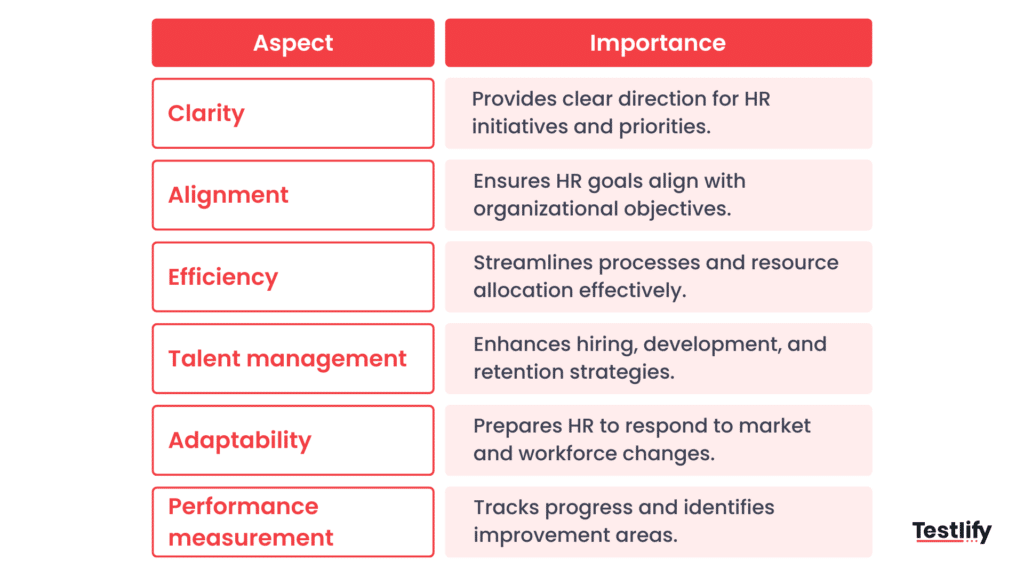
An HR roadmap is a dated plan that shows which people initiatives HR will deliver, in what order, who owns each one, and what each is supposed to change. It turns an HR strategy into commitments the rest of the business can plan around. Strategy says where you are going. The roadmap says when you get there and who is driving.
Some teams call it a human resources roadmap, and plenty of people type HR road map as two words. Same document. What separates a real one from a slide is whether every line has an owner, a date, a budget number, and a way to tell later whether it worked.
Most guides on this topic stop at what to put in the document. That skips the question people actually get stuck on: which roadmap are you being asked for? A CEO asking for an HR roadmap after a funding round wants something very different from a CFO asking for one during a systems consolidation. Get that wrong and you spend a quarter planning the wrong thing.
 ChatGPT
 Gemini
 Claude
 Grok
Grok Perplexity
TL;DR
- An HR roadmap sequences people initiatives against business goals, with owners, dates, budgets, and a measure for each.
- There are five common types, and they are not interchangeable: strategy, transformation, digital transformation, technology, and HRIS. Name which one you are building before you start.
- Build it from the business plan backwards, not from an HR wish list forwards.
- Map the capabilities you need to the evidence that proves you have them before you buy a single system. Tools bought ahead of a capability map become shelfware.
- Only 38 percent of organizations collect data on their own skills gaps, which is why most roadmaps rest on opinion rather than a baseline.
- Review quarterly, rebuild annually. A roadmap nobody has revisited in nine months is a historical document.

What is an HR roadmap?
An HR roadmap is a time-sequenced plan for the people function. It lists the initiatives HR will run over a set horizon, usually 4 to 8 quarters, and attaches an owner, a start and end date, a budget, and a success measure to each. Its job is to make HR work visible and fundable.
The difference between this and an HR strategy is narrower than it sounds but matters in practice. The strategy is the argument: here is what the business needs from its people, and here is our position on how to get it. The roadmap is the schedule that follows. You can have a strategy with no roadmap, and many teams do. You cannot have a useful roadmap without a strategy, because then you are just sequencing tasks nobody agreed were the right ones. If the strategy itself is still missing, start with the steps in strategic HR planning and come back to the schedule afterwards.
Why does an HR roadmap matter in 2026?
Because the work HR is being asked to absorb is growing faster than the function is. The World Economic Forum's Future of Jobs Report 2025 puts it in numbers: employers expect 39 percent of workers' core skills to change by 2030, and 63 percent name skills gaps as the single biggest barrier to transforming their business. That is a workforce planning problem landing on a team that usually has no spare capacity.
The evidence on execution is worse. Gallup's State of the Global Workplace 2026 report found global employee engagement fell to 20 percent in 2025, and manager engagement dropped five points in a single year, from 27 percent to 22 percent. Managers are the delivery mechanism for almost everything on an HR roadmap. If they are the group running out of road, a plan that quietly assumes their spare time is a plan that will slip. It is also why a serious employee engagement plan starts with manager load rather than perks.
Then there is the baseline problem. CIPD research found that only 38 percent of organizations collect data to identify skills gaps inside their own business, and fewer than a third use data to work out what skills they will need next. A roadmap built without that baseline is a list of opinions with dates on it.
Pro tip: Before you write a single initiative, ask your CEO one question: what will be true about this company in 18 months that is not true today? Headcount, market, product, funding. Everything on the roadmap should trace back to one of those answers. Anything that cannot, cut it. You will lose a chunk of your first list. What is left is the part that survives the budget conversation, which is the only list worth publishing.
What are the 5 types of HR roadmaps?
People use the same phrase for five different documents. Naming yours early saves a wasted planning cycle, because the owner, the horizon, and the way you measure success all change depending on which one you are actually building.
Roadmap type | What it plans | Typical horizon | Usual owner | How it fails |
|---|---|---|---|---|
HR strategy roadmap | The whole people agenda: hiring, capability, culture, reward, structure | 12 to 24 months | CHRO or Head of People | Too abstract to schedule or fund |
HR transformation roadmap | Redesign of the HR operating model itself: roles, service delivery, processes | 18 to 36 months | CHRO with the COO or CFO | Treated as a reorg, so process debt survives |
HR digital transformation roadmap | Digitizing the employee lifecycle end to end, including automation and analytics | 24 to 36 months | HR plus IT, jointly | Buys tools before fixing the process underneath |
HR technology roadmap | The HR tool portfolio: what to buy, keep, integrate, retire, and when | 12 to 36 months | HR operations or HRIS lead | Nobody measures whether the tools worked |
HRIS roadmap | One system of record: implementation phases, data migration, module rollout | 6 to 18 months | HRIS lead with a vendor team | Go-live is treated as the finish line |
HR strategy roadmap
This is the broadest of the five and the one most people mean when they say "HR roadmap" without qualifying it. It covers the full people agenda over the next 1 to 2 years and sits directly under the business plan. Its characteristic failure is being written at a level of abstraction nobody can schedule.
"Build a high-performance culture" is a value, not an initiative. Run calibrated performance reviews across all 14 teams by Q3, owned by the People Partner" is an initiative. Most of the translation work here is the same work as putting an HR plan into practice.
HR transformation roadmap
An HR transformation roadmap changes how the HR function itself works: who does what, which services are centralized, what moves to self-service, and which roles change shape. It is the hardest of the five because the people executing the plan are also the subject of it. Budget it longer than you think, and be honest with the team early. A transformation plan that leaks out as a rumor costs you the people you needed to run it.
HR digital transformation roadmap
An HR digital transformation roadmap covers the shift from manual, paper-shaped HR to a connected one: automation, self-service, analytics, and AI applied across recruiting, onboarding, performance, and everything after. It overlaps with the technology roadmap and is often confused with it, but the scope is wider. Technology is what you buy. Digital transformation is what changes about how work gets done, and most of that change is process and habit, not software.
The sequencing rule here is worth arguing about, so here is a position: never digitize a process you have not simplified first. Automating a broken approval chain gives you a faster broken approval chain and a license fee.
HR technology roadmap, or HR tech roadmap
An HR technology roadmap is the narrower plan for the tool portfolio: what you run today, what each system costs, what is being retired, what gets bought next, and how the pieces talk to each other. Most teams start here because it is the most concrete lane, and it is also the lane with the weakest track record.
SHRM research across more than 1,900 HR professionals found that 56% of HR functions do not formally measure whether their AI investments worked, and only 16 percent use return on investment as a measure at all. Just 39 percent had implemented AI in HR in the first place. Read those together, and the picture is a function of buying technology faster than it can prove any of it paid off. A technology roadmap without a measurement column is a purchase order with quarters drawn on it.
HRIS roadmap
An HRIS roadmap is the implementation plan for one thing: the core system of record that holds employee data, payroll inputs, and org structure. It is phase-based rather than initiative-based. Discovery, data cleansing, configuration, parallel run, go-live, then module-by-module rollout.
The trap is treating go-live as the end. The six months after go-live, when adoption either sticks or quietly reverts to spreadsheets, decide whether the money was well spent. Put those months on the roadmap with an owner, or they will not happen.
What goes on an HR roadmap?
Seven things, and a roadmap missing any of them will stall at the first budget review.
- The business goal each initiative serves. Named explicitly in the words the business uses, not translated into HR language.
- The initiative itself. One line, concrete enough that two people would build the same thing from it.
- A single named owner. Not a team. One person whose name goes next to it. Clean role mapping makes this argument shorter.
- Dates and dependencies. Start, finish, and what has to land first. Dependencies are where most roadmaps quietly break.
- A budget number. Including internal time, which is the cost people forget and then run out of.
- The measure. What will be different, and how will you know. One measure per initiative.
- A guardrail. The thing you will not trade away to hit the date, such as candidate experience or legal defensibility.
How do you build an HR roadmap in 6 steps?
The order matters more than the format. Teams that jump straight to buying tools are the ones who end up with software nobody opens.
1. Start from the business plan, not the HR wish list
Get the next 4 to 8 quarters of the business plan in front of you. Headcount targets, new markets, product launches, funding milestones, and cost targets. Every roadmap item has to trace to one of them. If you cannot draw that line in one sentence, the item does not go on this version. A headcount target, for instance, is the input that shapes your talent acquisition strategy for the year.
2. Audit HR activities & duties
Write down where the hours actually go, not where the org chart says they go. Whatever share of the week turns out to be absorbed by administration nobody chose is your real capacity constraint, and it is the most useful single input to step four. Count it in days per month so it can be argued with.
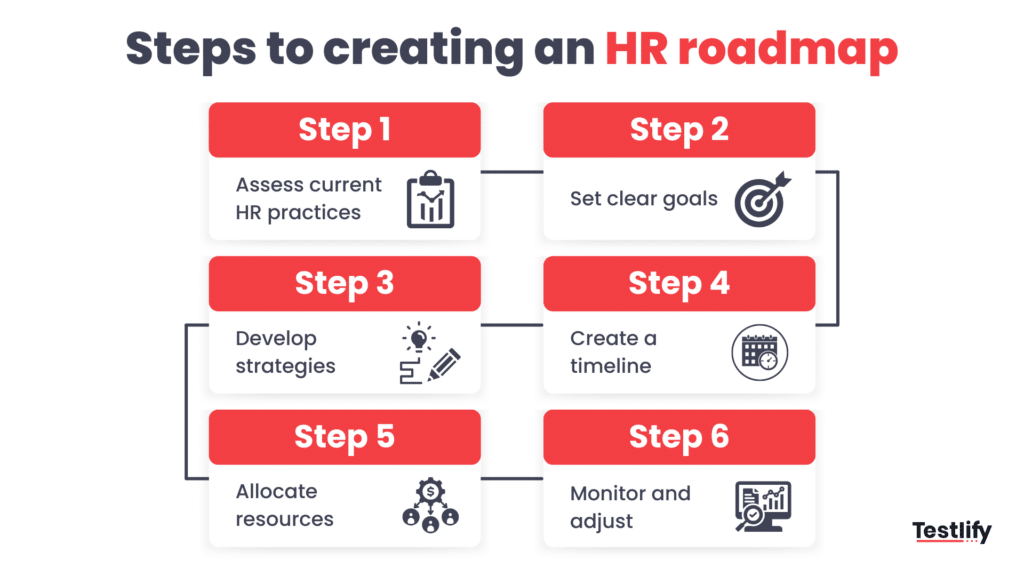
3. Map capabilities to evidence before you buy anything
Decide what capability the business needs, then decide what would count as proof that you have it. The Testlify Competency-to-Evidence Matrix maps every role to the competencies that matter, then connects each competency to measurable evidence through assessments, simulations, interviews, references, and structured feedback. Applied to a roadmap, it stops the usual sequence, which is buying a tool and then working out what question it answers. If you are deciding how granular to get, the split between skills mapping and competency mapping is the choice underneath it.
A worked version: a 150-person company planning to double its engineering team in a year writes down the competencies that actually predict success in its stack, then decides that a scored technical assessment plus a structured panel gives it comparable evidence on every candidate. Only then does it ask what tooling that requires. The capability came first, the purchase second.
4. Sequence against capacity, not ambition
HR functions are small. The US Bureau of Labor Statistics counted about 224,900 human resources manager jobs in 2025, with employment projected to grow 6 percent from 2025 to 2035. Spread across every employer in the country, that is a thin layer of people carrying an expanding brief. Assume no new headcount, lay your initiatives against the capacity you found in step two, and push anything that does not fit into the next window. A roadmap with four parallel workstreams and one person delivering them is fiction.
5. Attach a measure and a review date to every line
One measure per initiative, chosen before the work starts. Time to fill, regretted attrition in the first year, manager satisfaction with shortlist quality, cost per hire, whatever the initiative is actually for. Write the target number down now, because agreeing to it afterwards is how a project gets graded on effort instead of outcome.
6. Publish it where the business can see it
A roadmap in an HR folder is a private to-do list. Put it where the exec team and the managers who will be asked to deliver parts of it can see the same version, with the same dates. The discipline of public dates is most of the value. It also gives you a defensible answer when a new request arrives mid-quarter: here is what it displaces. The recurring work underneath the roadmap belongs somewhere more durable, which is what written HR SOPs are for.
The one-page HR roadmap template
Copy this shape. It fits on one page, which is the point, and it forces every column that gets skipped in a slide deck. The rows below are an illustrative example for a 150-person company that has just raised a funding round, not a real customer plan.
Quarter | Business goal it serves | Initiative | Owner | Measure | Budget |
|---|---|---|---|---|---|
Q1 | Double engineering headcount | Define competencies and scored assessments for 6 engineering roles | Talent lead | All 6 roles live with a scoring rubric | Tooling plus 15 days internal |
Q1 | Protect margin while growing | Baseline current cost per hire and time to fill | People ops | Baseline agreed with finance | 5 days internal |
Q2 | Double engineering headcount | Structured panel training for 12 hiring managers | People partner | Manager rating of shortlist quality up from baseline | Trainer plus 8 days internal |
Q3 | Keep the people you hire | 90-day new hire check-in with a written action loop | People partner | First-year regretted attrition tracked monthly | 10 days internal |
Q4 | Prepare for Series B diligence | Clean core employee data and document the hiring process | HRIS lead | Data audit passes with zero critical gaps | 20 days internal |
What makes HR roadmaps fail?
Four failure modes account for most of it, and three of them are visible on the page before the work ever starts.
No single owner. An initiative owned by "the People team" is owned by nobody. This is the cheapest thing to fix and the most commonly skipped.
No internal time budgeted. Teams cost the software and forget the internal days it takes to configure, migrate, train, and chase adoption. Count those days per person, per quarter. They are usually the larger number.
Technology sequenced before the process. Buying first feels like progress because a purchase has a date attached. It is also how you end up paying a license fee to run an old process slightly faster.
No measurement, so no learning. Covered above, and worth repeating only because it is the one failure that hides. The other three announce themselves within a quarter. This one lets you repeat the same mistake for three years.
The honest caveat: a roadmap is a forecast, and forecasts about people are less reliable than forecasts about revenue. A hiring freeze, an acquisition, or one senior departure can invalidate half of it in a week. That is an argument for quarterly review and a rolling four-quarter horizon, not an argument against planning. The teams that handle disruption best are usually the ones who already knew what they were trading away.
Hire against the roadmap, not around it
Most of what sits on a first HR roadmap eventually comes back to one question: can you tell, before the offer, whether this person can do the job? Testlify is where that part gets evidence behind it, with role-based skills assessments, cognitive and personality tests, coding tests, and AI interviews scored consistently across every candidate, plus integrations with the applicant tracking system you already run so it fits the stack rather than replacing it.
To see how that would sit in your own plan, book a demo and bring the roles on your next two quarters.
Frequently asked questions (FAQs)

Content Writer
Yashika Khandelwal is a Content Writer with 3+ years of experience creating research-backed content on hiring, talent assessment, and HR technology. She is a registered Organizational Psychologist and subject matter expert who combines behavioral science with practical recruitment insights to produce accurate, evidence-based content.
LinkedInRelated resources
View all
HR & recruitment
What is the buddy system in the workplace? Benefits, steps, and 2026 guide

HR & recruitment
10 game-changing HR innovation examples you need to know

HR & recruitment
Upskilling and reskilling differences: Which fits your needs?

HR & recruitment
A recruiter’s guide to Employee Net Promoter Score (eNPS)
HR & recruitment
Spans and Layers: How to Right-Size Your Org Structure
HR & recruitment
Workforce Reduction: Steps, Alternatives, and Best Practices
Get started.
Hire on proof, not resumes.
Run your first skills-based assessment free — no credit card required.