
Customer success manager test: how to evaluate CSM candidates
A practical guide to the customer success manager test: what to measure, sample questions, how to run it and how to read CSM results.

A customer success manager test is a pre-employment assessment that checks whether a candidate can do the real work of a customer success manager (CSM): read account data, keep customers on track to their goals, handle hard conversations and protect renewals. Every applicant gets the same tasks and the same scoring, so you compare skills, not resumes. For TA leaders, recruiters and HR teams, that means less guesswork and fewer wasted interviews. This guide shows what to measure, which questions to ask, how to run the test, how to read the results and how to keep the process fair.
TL;DR / Key Takeaways
- A customer success manager test is a short, scored assessment of the skills CSMs use daily: account health, metrics, communication, problem solving and renewals.
- Use one because retention now drives revenue. Gartner found 73% of chief sales officers are prioritizing growth from existing customers for 2025.
- Test six areas: customer success knowledge, relationship and CRM skills, communication, problem solving, data and metrics, and organization. Senior roles add leadership.
- Match the test to the level, from associate to head of customer success, and keep the first screen between 10 and 40 minutes.
- Use realistic scenarios such as falling usage before a renewal or reading a retention chart. "Just checking in" answers are a red flag.
- Read results skill by skill and set the pass mark from your own first 20 or so candidates, slightly below your strongest interviewees.
- The score is a first filter, not the hire decision. Follow with a short work sample and a structured interview, and have a person review every rejection.
 ChatGPT
 Gemini
 Claude
 Grok
 Perplexity
What is a customer success manager test?
A customer success manager test is a short, structured assessment that measures the skills a CSM uses every day: customer success know-how, communication, problem solving, data reading and account planning. Candidates answer scenario questions and short tasks, and the hiring team gets a scored report for each person.
Most CSM tests take 10 to 40 minutes and sit early in the hiring process, right after applications close. The Testlify customer success manager test is a 10-minute, 8-question test at intermediate level, available in English, French, Dutch, Spanish and German. It covers four areas:
- Customer success: the customer journey from purchase to adoption, and the metrics that fit each stage.
- Communication: clear updates to customers and to sales, product and support teams.
- Excel charts: reading retention and usage charts to spot trends.
- Leadership and management: setting goals and direction for a customer success team.
A test is not a replacement for interviews. A test tells you who has the core skills, so the interview rounds can go deeper with fewer, better candidates.

Why use a customer success manager test to hire CSMs?
A customer success manager test gives you evidence on the skills that drive renewals and expansion before you spend interview hours. Resumes rarely show how someone handles a customer whose usage is falling, and a confident interview can hide weak data skills.
The role carries more revenue weight than it used to. A Gartner survey of 243 chief sales officers and senior sales leaders, run in late 2024, found that 73% are prioritizing growth from existing customers for 2025, and 57% rank account retention and growth as a top-three priority. Gartner's 2025 sales leader survey puts that growth in the hands of the people who own customer relationships.
Screening is also getting harder. According to LinkedIn's January 2025 survey of HR professionals, 73% say less than half of the applications they receive meet all the listed criteria, 64% say finding qualified talent has become harder, and 22% spend 3 to 5 hours a day sifting through applications. A short CSM test cuts that pile down to the people who can show the skills.
A test also brings out abilities a resume hides. A candidate from support or sales may never have held the CSM title but may read a health score better than someone who has. Skills-first screening gives that person a fair shot. For more on the approach, see what skills-based hiring is and why it matters.
What skills should a customer success manager test measure?
A customer success manager test should measure six skill areas: customer success knowledge, relationship and CRM skills, communication, problem solving and strategic thinking, data and metrics, and organization across many accounts. Senior roles add leadership. Each skill needs the right test method, because some show up in multiple-choice answers and some only in a task or a conversation.
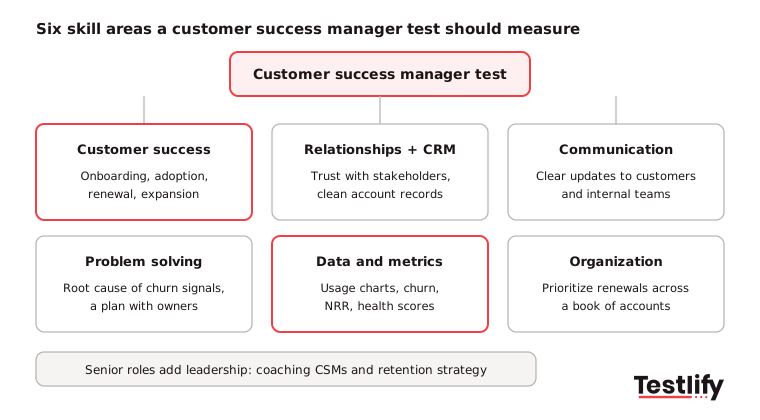
Both of the older Testlify guides on this topic stressed the same core: CRM skills, communication and interpersonal skills, problem solving, and the ability to use customer success metrics and KPIs. Emotional intelligence and teamwork matter too, since a CSM works with sales, support and product every week. Score those through how candidates handle the scenarios, not through a separate personality label.
Pro tip: Take the skills straight from your job description and drop anything the job does not need. The customer success manager job description template is a good starting list.
Which customer success manager test fits each level?
Customer success roles range from associates who handle onboarding to heads of customer success who own retention targets. One test does not fit all of them. Match the test to the level, then add custom questions for your product and customers.
Level | Main focus | Testlify test to start with |
|---|---|---|
Associate or entry level | Customer care, product learning, clear communication | Customer success associate test |
Customer success manager | Account health, metrics, renewals, stakeholder communication | Customer success manager test |
CSM at a SaaS company | Technical understanding, adoption, empathy, project management | Customer success manager (SaaS) test |
Team lead | Coaching CSMs, workload, escalations | Customer success team lead test |
Head of customer success | Retention strategy, forecasting, cross-team planning | Head of customer success test |
The SaaS version is a 10-minute, 10-question test that covers communication, time management, problem solving, technical understanding, empathy, continuous learning, adaptability and project management. Pair the role test with a short cognitive or English test only when the job truly needs it, and keep the total under 40 minutes.
What questions belong in a customer success manager test?
Questions in a customer success manager test should put candidates inside realistic account situations and ask what they would do next. Good questions have one clearly better answer, or a written answer you can score against a short checklist. Here are sample questions you can adapt:
- Declining usage: "A two-year customer's weekly active users fell 30% over two quarters and renewal is in 90 days. What do you do first?" A strong answer checks the data, finds out what changed with the customer, and books a call with the decision maker before discussing renewal.
- Reading a chart: Show a retention chart by signup month and ask which group is at risk and why. A strong answer names the group and links the drop to a likely cause, such as an onboarding change.
- Metrics: "Gross revenue retention is 88% and net revenue retention is 104%. What does that tell you?" A strong answer explains that expansion covers churn, and that churn still needs a fix.
- Pushback on value: "The customer's finance lead says the tool is not worth the price." A strong answer asks which outcomes the customer bought for, shows progress against them, and agrees a plan.
- Feature request: "A key account wants a feature that is not on the roadmap." A strong answer is honest, captures the use case for product, and offers a workaround.
- Prioritization: Give three accounts with different renewal dates, sizes and risks, and ask for the order of work. A strong answer weighs risk and revenue, not just the loudest customer.
- Written follow-up: Ask for a short email after a tense call about an outage. A strong answer owns the issue, gives facts and dates, and avoids jargon.
Watch for red flags too: answers that rely on "just checking in" emails, treat login counts as proof of value, or wait until renewal to raise a risk. For live interview follow-ups, see customer success interview questions.
How do you build and run a customer success manager test?
Building a customer success manager test takes six steps: define success in the role, pick the skills, choose the test and custom questions, set the rules, invite candidates, and plan what happens after the scores come in. Most teams can set this up in an afternoon.
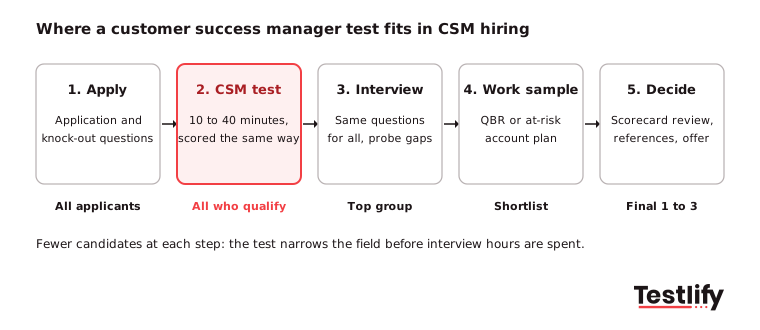
- Define success in the role: Write down what a great CSM delivers in the first 6 to 12 months: renewal rate, expansion, onboarding time or customer health. The test should predict those outcomes.
- Pick 4 to 6 skills: Use the skills table above and your job description. Leave out anything the candidate will learn in onboarding, such as your own product.
- Choose the test and add custom questions: Start from a ready-made CSM test, then add 2 or 3 questions about your customers, such as a short written reply or a one-minute video answer.
- Set fair rules: Keep the test under 40 minutes, give the same instructions and time to everyone, and turn on proctoring so the scores belong to the candidate. See anti-cheating and proctoring.
- Invite from your ATS: Send the test automatically when a candidate reaches the screening stage, and sync scores back. See Testlify integrations.
- Follow with a work sample and structured interview: Invite the top group to one short work sample, such as a quarterly business review or an at-risk account plan, and then to a structured interview.
Practitioner guides from interview platforms such as Yardstick suggest about 60 to 90 minutes per work sample, including preparation and feedback, and no more than two exercises per round. Keep the take-home part small; a three-day case project asks too much of people who already have jobs.
How should you read customer success manager test results?
Customer success manager test results should be read skill by skill, not only as one total score. The total tells you who to move forward; the skill breakdown tells you what to probe in the interview and what support a new hire would need.
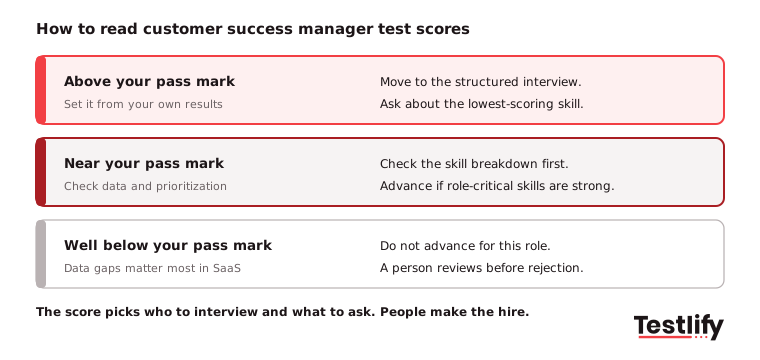
Start with strengths. A high score in customer success knowledge suggests the candidate understands account stages; a high score in data questions suggests they can spot risk early. Then look at weak areas and ask whether they matter for this role. A low data score is a real problem for a CSM who owns a large book of SaaS accounts, and less of one for an onboarding-focused associate.
Use the results in three ways:
- Set a pass mark from your own data: After the first 20 or so candidates, look at where your strongest interviewees scored and set the cut-off a little below that. Avoid a fixed number copied from another company.
- Turn low scores into interview questions: If a candidate scored low on prioritization, ask them to talk through a week with five renewals due.
- Compare like with like: Rank candidates who took the same test, in the same language, with the same time limit.
An interview scorecard with a 1 to 5 scale for each skill keeps later rounds consistent, so the test score and the interview scores add up to one picture.
Key takeaway: A CSM test score is a strong first filter and a guide for the interview, not the final decision. People make the hire.
How do you keep a customer success manager test fair?
A customer success manager test stays fair when every question links to the job, every candidate gets the same conditions, and people can ask for adjustments. Fair tests also hold up better if a hiring decision is ever challenged.
Under US law, an employment test that screens out a protected group must be job-related and consistent with business necessity, and employers must offer reasonable accommodations in how a test is given. EEOC guidance on employment tests sets out these duties.
In practice:
- Base every question on a task in the job description.
- Remove cultural references, idioms and local sports or holiday examples from scenarios.
- Offer extra time or a screen-reader-friendly format on request.
- Offer the test in the candidate's working language where the role allows; Testlify supports 15+ languages.
- Have a person review every rejection that a score alone would trigger.
What mistakes should you avoid with a customer success manager test?
The most common mistakes with a customer success manager test are testing the wrong things or asking too much of candidates. Avoid these:
- Using a generic customer service test: Service tests check ticket handling. CSMs need account planning, metrics and renewal skills too.
- Testing your own product: Candidates cannot know it yet. Test how they learn and explain a product, not what they know about yours.
- Relying only on multiple choice for senior roles: A head of customer success needs a written plan or a case, not just right answers.
- Overlong take-home cases: Long unpaid projects push strong candidates away. Keep tasks short and timed.
- Skipping the data part: A CSM who cannot read a usage chart will spot churn too late.
- Treating the score as the decision: Use it to pick who to interview and what to ask.
How does Testlify help you run a customer success manager test?
Testlify gives hiring teams ready-made customer success tests and the tools to run them at scale. You can start from the CSM test, add your own questions, and invite candidates straight from your ATS.
- Tests for every level: 3,500+ tests, including the customer success associate, manager, SaaS, team lead and head of customer success tests.
- Custom questions: 25+ question types, including written answers, spreadsheet tasks, video answers, and Chat AI and Video AI questions for live-style scenarios. See chat AI interviews.
- AI test builder: paste your CSM job description and get a role-specific assessment with suggested skills and scoring criteria.
- Integrity: 20+ proctoring checks, such as tab and copy-paste tracking, webcam snapshots and AI-assistance detection.
- ATS fit: 100+ ATS and HRIS integrations with two-way sync.
- Fairness proof: a third-party bias audit of Testlify's matching model under NYC Local Law 144. See NYC bias audit.
For the full hiring plan around the test, read how to hire a customer success manager.
Ready to test your next customer success manager?
Try the customer success manager test on your next CSM opening. Start a 7-day free trial of Testlify, no credit card required, or book a demo to see the CSM tests, AI questions and reports on a real role.
FAQ: what else do hiring teams ask about customer success manager tests?

Senior SEO Specialist
Soham is a senior SEO specialist specializing in B2B HR tech. He covers search, answer, and generative engine optimization (SEO/AEO/GEO) for talent acquisition, skills-based hiring, and assessment-driven recruiting audiences.
LinkedInRelated resources
View all
Skill assessment
How to evaluate candidates’ skills with an attention to detail visual test

Skill assessment
How to evaluate candidates’ skills with an adaptability test

Skill assessment
How to evaluate candidates’ skills with a react native test online

Skill assessment
How to evaluate candidates’ skills with a data visualization test

Skill assessment
How to evaluate candidates’ skills with a full stack developer test

Skill assessment
How to evaluate candidates’ skills with a C# assessment
Get started.
Hire on proof, not resumes.
Run your first skills-based assessment free — no credit card required.