
Testlify vs. Hiremojo: Which Skills Assessment Platform is Best for HR Teams?
Testlify vs. Hiremojo: Discover which skills assessment platform best suits your hiring needs
Testlify and HireMojo solve different halves of the same problem. HireMojo automates the top of the funnel: it writes the job post, pushes it across job boards, and ranks applicants from a pre-screen questionnaire. Testlify measures whether those people can actually do the work, through validated tests, work samples, proctored assessments and AI interviews. If the bottleneck is getting enough applicants, HireMojo is pointed at that. If the bottleneck is telling good applicants apart, that is the job Testlify was built for.
That distinction matters more than any feature grid, because the two tools fail in different places. A faster pipeline that still ranks people on what they claim about themselves just delivers bad shortlists sooner.
 ChatGPT
 Gemini
 Claude
 Grok
Grok Perplexity
TL;DR
- HireMojo is a hiring automation platform. It posts jobs to boards, screens applicants with questionnaire-based pre-screen questions, and ranks them automatically.
- Testlify is a skills assessment and interviewing platform, with 3,500+ tests, coding and work-sample questions, 20+ proctoring measures, and AI video, voice and phone interviews.
- The real split is evidence quality. HireMojo scores what a candidate says; Testlify scores what a candidate does.
- Testlify publishes its prices (Starter $139/mo, Basic $279/mo, Business $699/mo on annual billing). HireMojo does not publish pricing at all, so a budget comparison needs a sales call.
- Automated candidate ranking is a regulated activity in a growing number of places, and that pushes the choice toward tools that keep a human in the decision.
- Teams that already run an applicant tracking system usually keep it and add Testlify as the screening layer. Teams with no ATS can use Testlify's built-in hiring pipeline instead.

What is Testlify?
Testlify is a pre-hire skills assessment and interviewing platform. It gives hiring teams a library of 3,500+ ready-made tests across 4,500+ roles and 50+ industries, plus AI interviews, anti-cheating controls, and candidate reports that show how someone performed rather than what they wrote on a resume.
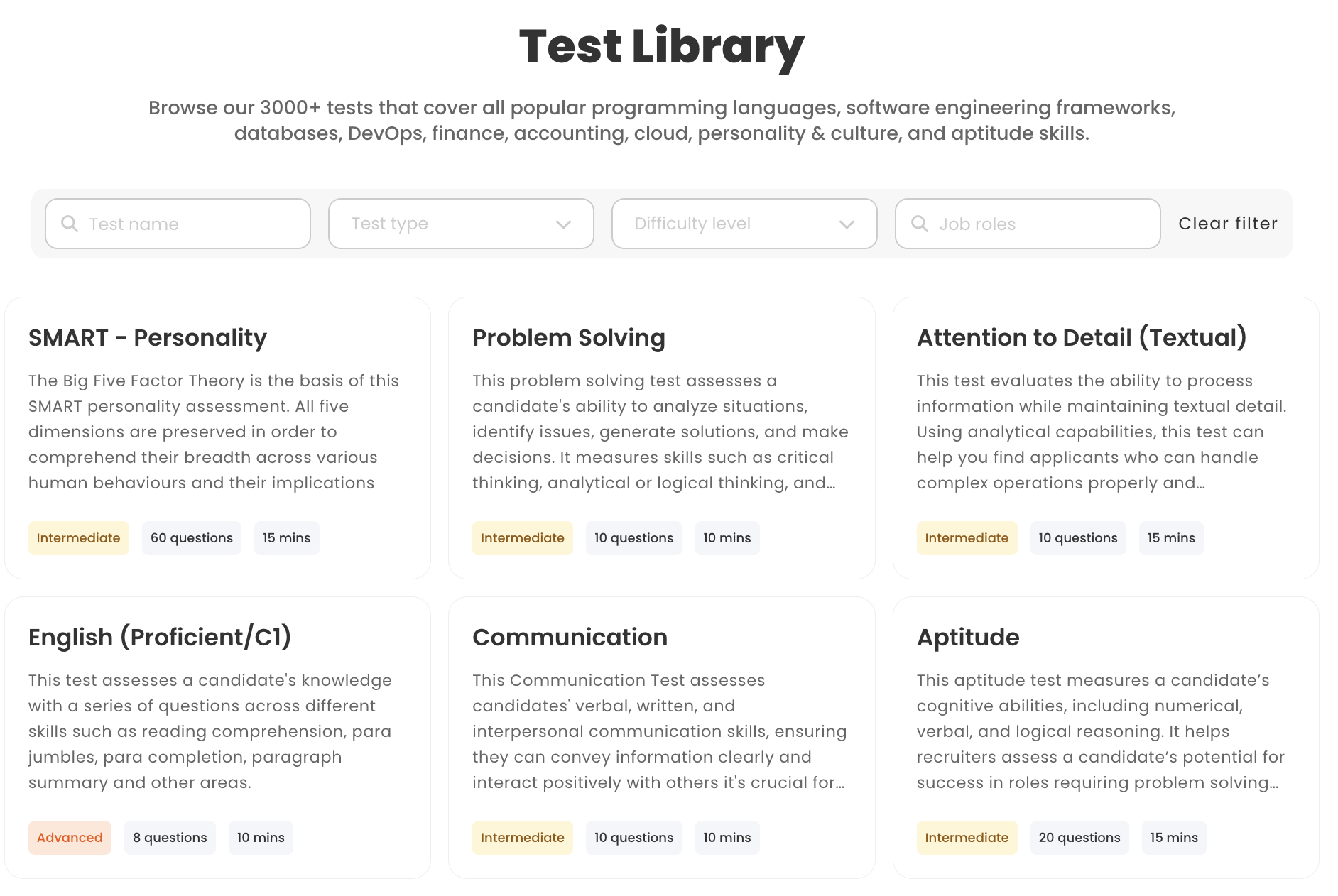
The test library covers cognitive ability, personality and culture, situational judgement, language, typing, software skills, and programming across 45+ languages. Question types run past the usual multiple choice: coding assessments with an embedded VS Code editor and up to 20 test cases, live tasks in Google Docs, Sheets, Slides, Microsoft Word, Excel and PowerPoint, file uploads, and vibe coding, where candidates direct AI tools to reach a working solution instead of writing syntax by hand. That last one is worth noticing. Most assessment tools still test as though AI does not exist in the job.
Scoring runs at three levels (question, test and overall), and admins choose between score-based weighting and manual weights from x0 to x5. Recruiters see percentile ranks, benchmarks against other candidates, and item-level statistics like difficulty and discrimination index, the kind of psychometric detail usually reserved for test publishers.
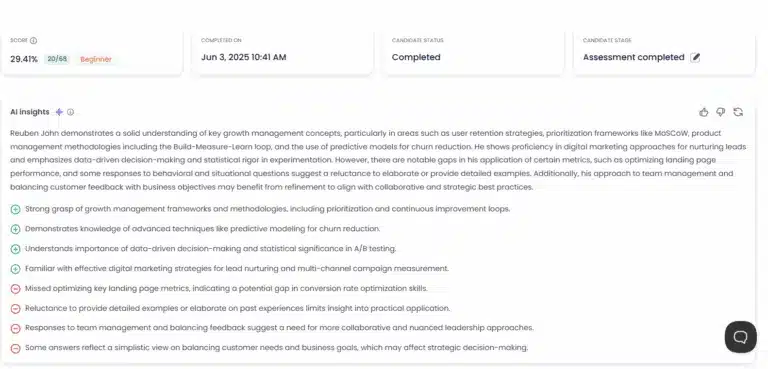
AI runs through the product, but it is deliberately advisory. The platform ships the disclaimer "AI scores and insights are for guidance only. Use human judgment for final decisions", and both "Display AI scores to the reviewer" and "Include AI score in the final average" are toggles a customer can switch off. That design choice is what makes the output defensible.
What is HireMojo?
HireMojo is a subscription hiring automation platform built around "Mo, your RecruiterBot". It handles job description writing, job distribution, applicant pre-screening and candidate ranking, and covers applicant tracking functions, so a small team can run a req end to end without a dedicated recruiter.
Its strongest pieces are at the sourcing end. Smart Job Posting spreads a role across major boards including LinkedIn, Indeed, Glassdoor, Monster and CareerBuilder, with 16 boards represented on the vendor site. A content library of 50,000+ pre-written job descriptions and interview question templates means nobody starts from a blank page. Its Cloud Recruiting service adds sourcing reach on top.
Screening works through what HireMojo calls a patented online interview system. Candidates answer pre-screen questions drawn from a question database, covering multiple-choice, behavioural and skills-based items, and the platform scores and ranks them automatically so recruiters read the top of the list first.
That is genuinely useful when a posting pulls 400 applicants. But a self-reported questionnaire attached to a job ad is a screening filter, not a measurement of skill. Nobody writes code in it, nobody builds a spreadsheet in it, and nothing stops a candidate from looking up the answers.
How this comparison was put together
This page is published by Testlify, so it is worth saying how the two columns were filled. Every Testlify claim below comes from the shipping product: the assessment builder, the proctoring settings and the pricing page, not from a sales deck. Where something is in beta or not yet released, it is left out rather than counted.
HireMojo's side is drawn from its own site and its public product descriptions, in September 2026. Where HireMojo does not publish something (pricing is the main one), this page says so instead of guessing or repeating a third-party figure the vendor has not confirmed. Features are compared on what each tool is built to do, which is why the table below gives HireMojo the sourcing rows and Testlify the evaluation rows rather than scoring both on one list that happens to favour us.
Testlify vs. HireMojo: quick comparison
Capability | Testlify | HireMojo |
|---|---|---|
Primary job | Measure skills and interview candidates | Automate job posting, screening and tracking |
Test library | 3,500+ tests, 180,000+ validated questions, 4,500+ roles | Pre-screen question database (multiple choice, behavioural, skills-based) |
Question types | 25+, including coding, typing, Office and Google Workspace tasks, work samples | Questionnaire formats |
Interviews | One-way video, two-way conversational AI video, voice, and outbound AI phone | Automated interview scheduling and questionnaire-based interviews |
Anti-cheating | 20+ measures, including dual-device proctoring and AI-use detection | Not a published capability |
Job posting to boards | Job-board publishing from the built-in pipeline | Core strength, 16 boards, predictive posting |
Job description library | AI generates assessments from a job description | 50,000+ pre-written descriptions |
Pricing transparency | Published tiers on the pricing page | Quote only, contact sales |
Best for | Deciding who can do the job | Filling the top of the funnel fast |
How do the two platforms screen candidates?
HireMojo screens by asking. Candidates answer pre-screen questions and an algorithm ranks the responses. Testlify screens by testing: candidates complete role-relevant work under controlled conditions, and the score reflects performance on that work rather than self-description. Both narrow a pile of applicants. Only one produces evidence.
The research on this is not ambiguous. A 2022 reanalysis of selection-method validity in the Journal of Applied Psychology revised many long-standing estimates downward, and it still placed structured interviews among the strongest predictors of job performance while placing years of education and general years of experience among the weaker ones. The methods that predict well are the structured, job-relevant ones. Credential and self-report signals sit at the bottom, and a pre-screen questionnaire is closer to the bottom than the top.
There is a compliance edge to this too, and it is the part most buyers miss. Under the federal Uniform Guidelines on Employee Selection Procedures, any procedure used as a basis for an employment decision counts as a selection procedure, including a scored questionnaire. If it screens people out, it can be challenged, and the employer is the one who has to defend it. An automated ranking nobody can explain is a weak thing to defend.
Pro tip: before buying either tool, ask the vendor what a rejected candidate's record looks like six months later. If the answer is a score with no underlying work product, the hiring decision has no audit trail.
Which platform has the stronger test library?
Testlify, and not by a small margin. It carries 3,500+ tests built from 180,000+ validated questions, mapped to 4,500+ roles across 50+ industries. HireMojo's equivalent is a question database used to assemble pre-screen questionnaires. These are different categories of thing, not different sizes of the same thing.
The ready-made test library spans blue collar, cognitive ability, engineering, language, personality and culture, programming, psychometric, role-specific skills, situational judgement, software skills, simulation and gamified categories, each at three difficulty levels. Teams can also build their own: question banks with fixed or variable question counts, per-question timers, shuffled options, nested skill tagging, and real-time translation into a candidate's preferred language.
The honest caveat is that a big library is only useful if someone maps it properly. Buying 3,500 tests and then sending every candidate the same generic aptitude test wastes the whole advantage. The Testlify Multi-Signal Talent Evaluation Model is the method that avoids that: combine several role-relevant signals (an assessment, an interview, a work sample, a reference, reviewer feedback) rather than leaning on any single score. One signal is fragile. Several pointing the same way is a decision you can stand behind.
How do they compare on interviews?
Testlify runs interviews as a product surface; HireMojo runs them as workflow automation. Testlify supports one-way asynchronous video, two-way conversational AI video, voice and audio questions, and outbound AI phone interviews billed at $0.18 per minute, with 150+ interview templates. HireMojo focuses on getting interviews scheduled and questionnaires answered.
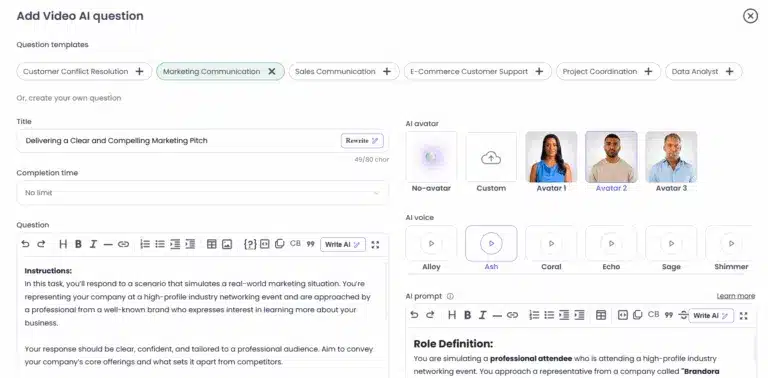
The configuration is where the difference shows. An AI interviewer in Testlify has a selectable avatar, a named voice, a persona, custom prompts and supplied context. Recruiters set the number of attempts (including no limit), recording time, completion time, and preparation time before auto-start recording. Transcripts are automatic and multilingual, with the AI detecting the spoken language on recordings of at least 30 seconds. Reviewers can watch, download the video or audio, replay the screen, regenerate the interview report, and override any AI score.
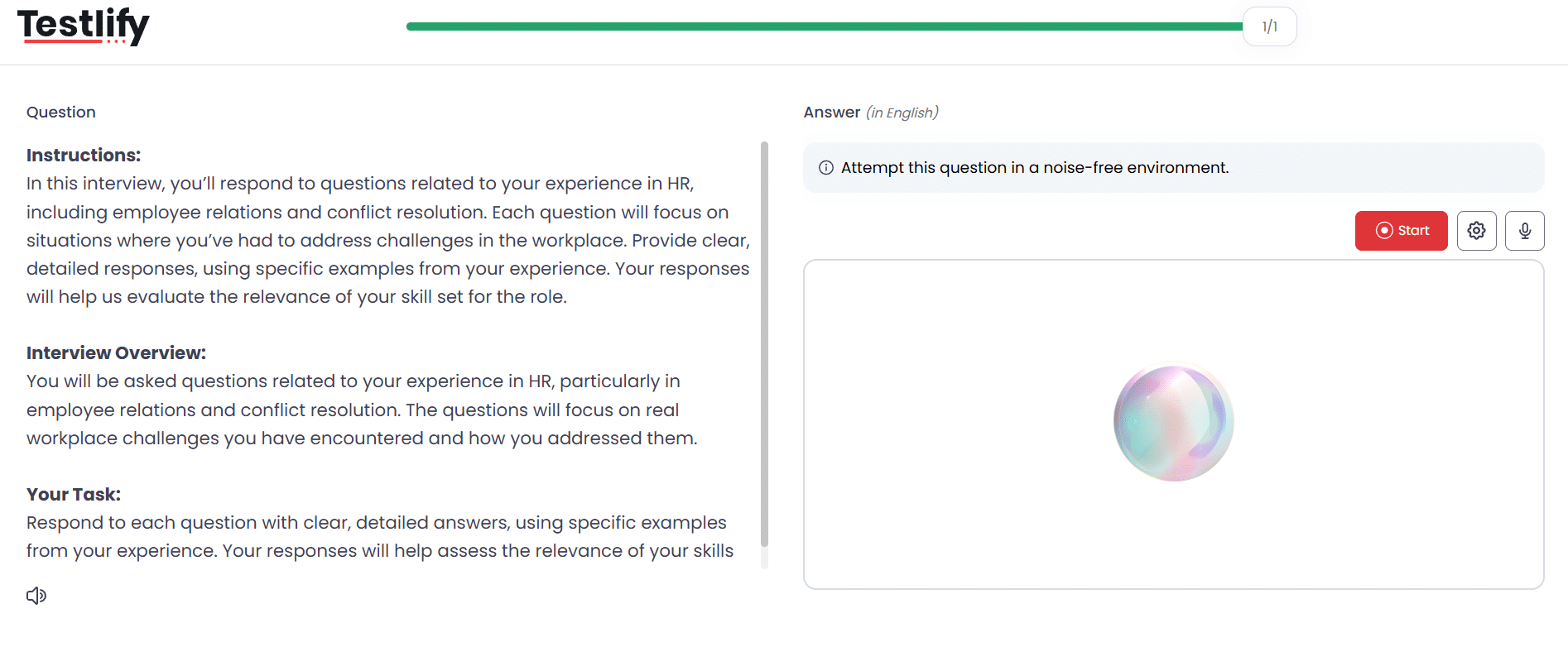
During a live AI voice interview the candidate sees "You're muted while the AI is speaking", which tells you it is real turn-taking rather than a recorded prompt with a timer. Candidates get a device check and a practice recording first, with a note that "No one else can see this, and it's not saved anywhere".
One boundary, stated plainly: Testlify does not schedule live human interview panels. If the requirement is calendar coordination across four interviewers, that stays with your ATS or scheduling tool.
What about anti-cheating and proctoring?
This is the widest gap between the two. Testlify ships 20+ integrity measures across three presets (Standard, Strict and Custom). HireMojo does not publish proctoring as a capability, which is consistent with its positioning: a pre-screen questionnaire has little to protect.
The proctoring controls cover full-screen enforcement, tab-switch detection, face detection and single-presence checks, photo ID verification with face matching, periodic webcam snapshots, copy-paste tracking, multi-monitor restriction, AI-tool and browser-extension detection, IP and location checks, and session recording.
The one worth singling out is dual-device proctoring. The candidate's phone becomes a second camera positioned to capture both them and their laptop screen, and it is a hard gate: "You will not be able to start the assessment until mobile monitoring is active." Most assessment tools have no answer to someone reading from a second screen.
What matters just as much is what happens with a flag. Testlify reports three states, and the wording is deliberately cautious. Yellow reads "Some behavior during the session wasn't ideal. A quick manual review is recommended." Auto-termination exists but is a separate, opt-in setting with a threshold the recruiter picks. Flags are evidence for a human, not an automatic rejection. Face verification data is deleted after 30 days and candidates can withdraw consent at any time.
How do they handle your ATS?
Most buyers already run an applicant tracking system and do not want a second one. Testlify integrates with 100+ ATS platforms and leaves that system as the record of truth, sitting in the middle as the screening and interviewing layer. Candidates can auto-advance to the next ATS stage when they clear a cut-off score.
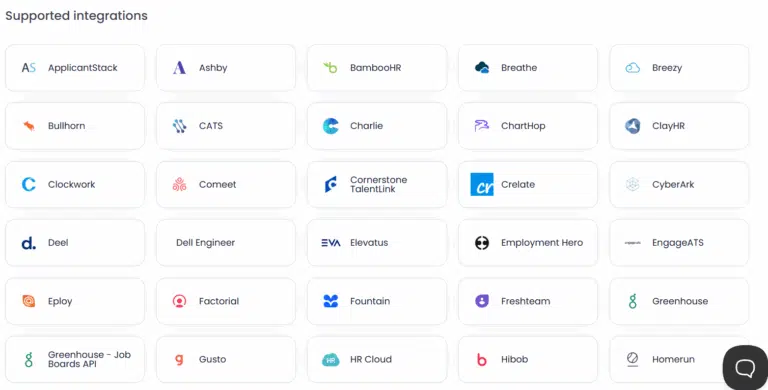
Worth being precise about the commercial detail, because vendor pages usually are not: on Testlify's self-serve tiers the 100+ ATS integrations are a paid add-on at $2,388 a year, included on the Custom plan. White labelling is priced the same way, and SAML SSO and 2FA are also add-ons. Budget for those separately if they matter.
For teams with no ATS at all, Testlify also ships a simple built-in hiring pipeline: job requisitions, a candidate application form, job-board publishing, a public job listing, and an applied to reviewed to shortlisted to rejected flow. It is deliberately basic, and it is not a substitute for a dedicated system of record at enterprise scale. HireMojo is the stronger option if applicant tracking and job distribution are the actual product you are shopping for, since that is its centre of gravity rather than an add-on.
Testlify does not replace your ATS, and it is not trying to.
How much does each platform cost?
Testlify publishes its prices. HireMojo does not: its pricing is quote-only through its sales team, so any budget comparison starts with a call. Third-party directories quote HireMojo starting figures that the vendor's own site does not confirm, so treat those numbers carefully.
Testlify's tiers on annual billing, from the current pricing page:
Tier | Credits per year | Price | Per credit | Seats |
|---|---|---|---|---|
Starter | 100 | $139/mo, billed $1,668/year | $16.68 | 3 |
Basic | 300 | $279/mo, billed $3,348/year | $11.16 | 5 |
Business | 1,000 | $699/mo, billed $8,388/year | $8.39 | 10 |
Premium | 3,000 | Contact sales | Volume-based | 20 |
Enterprise | 10,000 | Contact sales | Volume-based | 30 |
One credit covers one started assessment by a qualified candidate, and credits do not roll over. Extra seats run $15 per seat per month. There is a 7-day free trial with no card, a 30-day money-back guarantee, prices locked for 24 months, and a 25% non-profit discount. Some items are metered rather than bundled: AI phone interviews at $0.18 per minute, a system check at $0.25, face verification at $0.50 per attempt, and a higher proctoring tier at $5 per attempt.
The buying question is not which tool is cheaper. It is which cost you are trying to remove. Federal jobs data counted 5.1 million hires against 7.3 million job openings in July 2026, so most teams are not short of applicants. They are short of confidence about which ones can do the work.
Which platform should you choose?
Choose HireMojo if the painful part of hiring is getting the job in front of enough people and keeping the admin under control. Choose Testlify if applicants arrive but shortlists are unreliable, interviews feel like guesswork, or a rejected candidate could reasonably ask why. Some teams end up running both.
Company size moves this decision more than most buyers expect. A 30-person firm hiring six people a year does not need predictive job distribution across 16 boards; it needs to know that the two finalists can actually do the work. A 900-person company hiring continuously already has an ATS and a sourcing stack, and what it lacks is defensible evidence at the screening stage.
Regulation is tightening around exactly this. The EU's Artificial Intelligence Act classifies AI systems used to recruit, screen, filter or evaluate job candidates as high-risk, with obligations phasing in over time. That is not legal advice, and no product design is a safe harbour, but the direction is clear enough to plan around: automated ranking that no human reviews is the pattern under scrutiny, and a tool that keeps scoring advisory and overridable is the easier one to live with.
Hire on evidence, not guesswork
The fastest way to see the difference is to run one real role through an assessment and compare the shortlist you get against the one your current process produced. Start with the 7-day free trial, or book a demo and have someone walk through the assessment setup for a role you are hiring right now. If you want the wider market view first, the list of HireMojo alternatives covers the other tools in this category.
Key takeaways
- The two tools sit at different stages, so "better" depends on your bottleneck. HireMojo works on applicant volume and admin; Testlify works on decision quality. Diagnose which one is actually costing you hires before comparing feature lists, because buying the wrong half solves nothing.
- Self-reported answers and demonstrated skill are not the same evidence. A pre-screen questionnaire records what a candidate claims; an assessment records what they produced. When a hiring decision is questioned later, only one of those leaves something to point at.
- Structured, job-relevant methods predict performance better than credentials. The 2022 validity reanalysis puts structured interviews among the strongest predictors and years of education and experience among the weakest, which is a direct argument for testing skills rather than filtering resumes.
- Automated ranking carries obligations that fall on the employer, not the vendor. A scored questionnaire is a selection procedure under the Uniform Guidelines, and screening AI is high-risk under the EU AI Act. Keep a human able to see and override the score.
- Published pricing is itself a buying signal. Testlify's tiers, credit costs and add-on prices are visible before a sales call; HireMojo's are not. Budget for Testlify's add-ons separately, since ATS integrations and white labelling are $2,388 a year each on the self-serve tiers.
- Keep the ATS you trust. Most teams should add assessment as a screening layer through one of the 100+ integrations rather than replacing a working system. The built-in pipeline is there for teams that genuinely have nothing, and it is basic by design.
- Proctoring only matters if you act on it properly. Dual-device monitoring and AI-use detection close the gaps that make remote testing arguable, but flags are evidence for a human review, not grounds for automatic rejection.
FAQs

Director of Marketing
Akash Patange is the Director of Marketing at Testlify, where he works closely with HR leaders and recruiters to help organizations improve hiring outcomes. He writes about talent assessment, recruitment technology, and data-driven hiring practices.
LinkedInRelated resources
View all
Competitor Comparisons
Testlify vs. Coderbyte: Which Skills Assessment Platform is Best for HR Teams?
Competitor Comparisons
Testlify vs TestDome: Skills Assessment Platforms Compared
Competitor Comparisons
Testlify vs. Hirevue: Which Skills Assessment Platform is Best for HR Teams?
Competitor Comparisons
Testlify vs. iMocha: Which Skills Assessment Platform is Best for HR Teams?
Competitor Comparisons
Testlify vs. Mercer Mettl: Which Platform is Best for HR Teams?
Competitor Comparisons
Testlify vs. Codility: Which Platform is Best for HR Teams?
Get started.
Hire on proof, not resumes.
Run your first skills-based assessment free — no credit card required.