
What is cultural alignment and why is important in 2026?
Learn what cultural alignment is and why it’s crucial for business success. Discover how it drives growth, engagement, and performance in workplaces.

Cultural alignment is the match between the values a company says it holds and the way people actually behave when nobody is watching. When those two line up, decisions get faster and arguments get shorter. When they drift apart, you end up with a nice set of values on a wall and a different, unwritten set of rules that people follow in practice.
Most companies are closer to the second version than they think. Gallup found that only 20% of US employees strongly agree they feel connected to their organization's culture, which means roughly 8 in 10 are working inside something they don't recognize as theirs. That gap is what this page is about: how to spot it, how to measure it, and what actually closes it.
TL;DR
- Cultural alignment is about lived behavior, not stated values. The test is what happens in a tense meeting, not what the careers page says.
- There are two separate problems hiding under one phrase: whether your current people experience the culture you claim, and whether your next hires will reinforce or dilute it. They need different fixes.
- Measure it with three things together: an anonymous survey, a read of what your systems actually reward, and evidence from your hiring process. Any one on its own will mislead you.
- The most common failure is not disagreement; it's a promotion and pay system that quietly rewards the opposite of the stated values.
- Alignment work turns into sameness screening unless you score what a candidate adds on purpose. That's the trap worth watching.
 ChatGPT
 Gemini
 Claude
 Grok
Grok Perplexity
What is cultural alignment?
Cultural alignment is the degree to which an organization's stated values, its everyday norms, and the behavior its systems reward all point in the same direction. A company is aligned when a new hire can predict how a decision will be made before anyone explains it. It is misaligned when people need a second, private map to get work done.
The word gets used for two different things, and keeping them apart saves a lot of wasted effort:
- Internal alignment: do the people already here experience the culture you describe? This is a measurement problem, and a survey answers most of it.
- Hiring alignment: will the people you are about to hire reinforce that culture or quietly erode it? This is a process problem, and no survey will answer it.
Confusing the two is why so many culture programs stall. A company runs an engagement survey, sees a weak score on the values question, and responds with a values relaunch. The score doesn't move, because the thing breaking alignment was never the wording. It was the organizational culture people learned by watching who got promoted.

Why is cultural alignment important?
Because it changes how much friction every other decision carries. Aligned teams spend less time relitigating what matters, which shows up as speed, lower attrition, and fewer expensive hiring mistakes. The research on this is unusually consistent for a soft topic.
In a survey of 1,348 North American executives published in the Journal of Financial Economics, 92% said improving their corporate culture would raise their firm's value, and 84% said their own culture needed improvement. Read those two numbers together. Almost everyone running a company believes culture is worth money, and almost everyone believes theirs is not where it should be.
The retention side is just as blunt. SHRM's global culture research, covering more than 11,000 employees across 15 countries, found that people who rate their workplace culture as good or excellent are 83% less likely to be actively job hunting than people who rate it poor or terrible. Culture is not the only reason people leave, and pay still tops that list at 58% of global responses. But it is the reason that costs nothing to fix badly and a lot to ignore.
Here is the part the research does not say, and it matters: none of these numbers mean a strong culture makes a weak strategy work. Alignment makes a chosen direction easier to execute. It does not choose the direction.
What does a culturally aligned team look like?
A culturally aligned team is one where people make consistent decisions without checking first. You can see it in small, boring moments rather than in enthusiasm scores.
Signal | Aligned | Misaligned |
|---|---|---|
A junior person spots a problem | Raises it in the room, same day | Mentions it privately, weeks later |
Two teams disagree on priority | Resolved by the stated principle | Resolved by whoever is more senior |
Someone misses a commitment | Named early, fixed, no drama | Discovered at the deadline |
A new hire's first month | Predicts decisions by week three | Still learning the real rules at month six |
Promotion decisions | Explainable against the values | Explainable only by tenure or visibility |
Notice that none of those are about agreement. Culturally aligned people argue plenty. What they share is a common answer to "how do we decide here", which is why the arguments end.
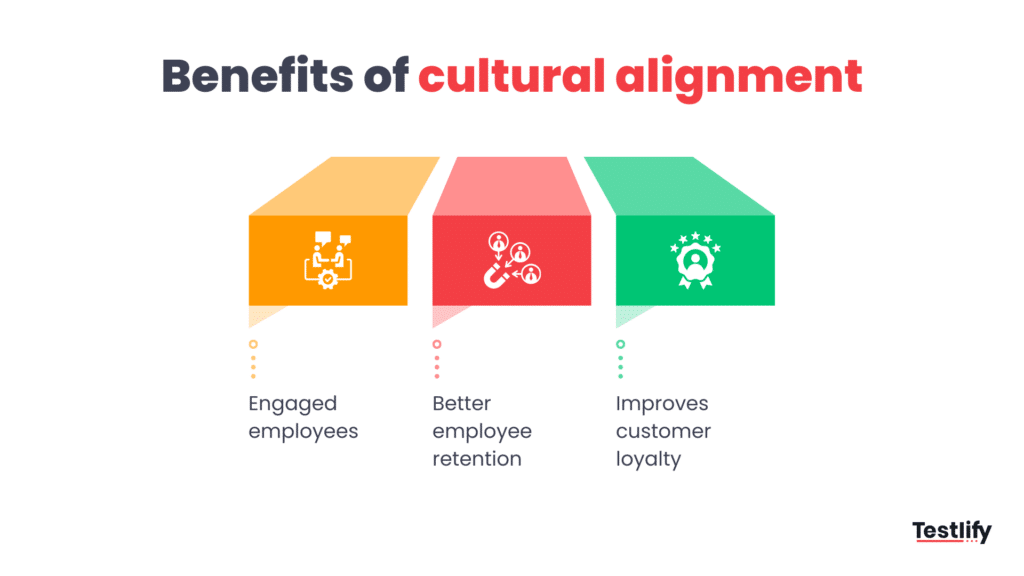
That shared decision-making approach delivers tangible benefits, from stronger collaboration and improved customer loyalty to better employee engagement and retention, as the image below highlights.
What causes cultural misalignment?
A poorly worded values statement rarely causes cultural misalignment. In practice, cultural misalignment usually stems from four areas, roughly in order of how often they are the real cause.
- Incentives that contradict the stated values. A company says collaboration, then pays and promotes on individual numbers. People are not confused; they are responding correctly to the real signal.
- Growth outrunning the transfer of norms. Culture passes person to person. Past about 50 people, it stops traveling by osmosis, and nobody notices the handoff broke until two teams are running different rules.
- A senior exception. One leader who visibly operates outside the values teaches more about the real culture than any handbook. This is the hardest one to fix and the most damaging to leave.
- Hiring for the wrong signal. Screening on gut-feel "fit" fills the company with people who interview comfortably, which is not the same thing as people who work the way you claim to work.
Gallup's numbers show how thin the practice is: 24% of employees say leadership is committed to the organization's cultural values, and only 20% say the same about their own coworkers. Both are low. Leaders scoring higher than peers is not a comfort either, because it means values are getting announced more than they are practiced.
Culture-strategy alignment: where the two meet
Culture-strategy alignment means the behavior your culture rewards is the behavior your strategy requires. Strategy picks the destination. Culture decides how the company travels, and whether it arrives with the same people it started with.
The practical version is a two-column exercise, and it takes about an hour. On the left, write the three things your strategy needs people to do more of this year. On the right, write what your promotion criteria, your bonus structure, and your meeting calendar currently reward. Where a row disagrees, you have found a culture-strategy gap, and you have found it without a consultant.
A worked example
A 120-person services firm decides to move upmarket, which needs people to turn down small deals and spend longer on fewer accounts. The right-hand column says sales bonuses pay per closed deal, and the weekly meeting celebrates deal count. The strategy is new, the reward system is three years old, and the reward system wins every time.
Pro tip: run the two-column exercise before you touch a survey. Half the misalignment most companies find is visible in their own compensation plan, and fixing an incentive is faster than changing a belief.
Organizational culture alignment across teams
Organizational culture alignment is the version of this problem that appears once you have more than one team. Each team develops local norms, which is healthy, until the local norms start contradicting each other at the seams where work hands over.
The seams are where to look: engineering handing to support, sales handing to delivery, recruiting handing to the hiring manager. Ask each side of a handoff the same question, separately, about what "done" means. If the two answers differ, the gap is not a communication issue. The two teams are optimizing for different things, and someone upstream set it up that way.
One caveat worth stating plainly, because the ranking advice on this topic usually skips it: you do not want every team to be identical. A support team that behaves exactly like a sales team is badly run. The goal is shared decision principles with local variation in how work gets done, not uniformity.
How do you measure cultural alignment?
You measure cultural alignment by comparing three independent reads: what people say anonymously, what your systems reward, and what your hiring process actually selects for. One source on its own is easy to fool.
Method | What it tells you | Where it stops working |
|---|---|---|
Anonymous values survey | Whether people recognise the stated culture | Tells you the score, not the cause; useless if response rates are low or trust is already gone |
Incentive and promotion audit | What behavior the company really pays for | Needs honest access to comp and promotion data, which is often the blocker |
Exit and regret-attrition review | Which misalignments cost you your best people | Lagging by months; exit interviews under-report the real reason |
Structured behavioral interviews | Whether candidates work the way you claim to work | Only as good as the scoring consistency behind it |
Values or work-style assessment | A consistent pre-interview read on every candidate | Qualitative by design; never a pass or fail number |
On frequency: once a year is too slow to catch a drift and monthly turns into survey fatigue. Twice a year, with the incentive audit attached to whichever one lands near planning, is the cadence that holds up at most sizes.
4 Factors contributing to cultural alignment
Cultural alignment determines how well an employee’s values, behaviours, and working style fit with an organization. While skills and experience matter, these four factors play a major role in creating a workforce that works well together.
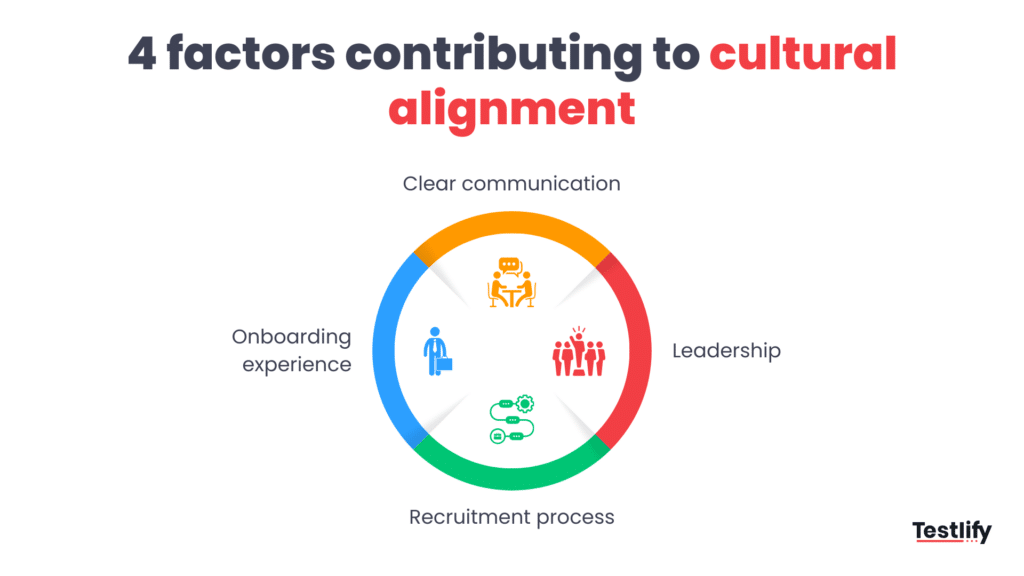
1. Clear communication
Companies that communicate their values, expectations, and feedback openly make it easier for employees to understand and align with the workplace culture.
Communication should also work both ways. Employees should feel comfortable sharing ideas, raising concerns, and asking questions without fear of being ignored or penalized.
2. Leadership
When leaders consistently demonstrate the behaviours they expect from their teams, those behaviours are more likely to become part of the company culture.
Strong leadership also creates consistency. Employees are more likely to feel culturally aligned when managers make decisions fairly, encourage collaboration, recognize contributions, and hold themselves accountable.
3. Recruitment process
Cultural alignment starts before an employee joins the organization. The recruitment process should evaluate not only whether candidates have the required skills but also whether their values, behaviours, and expectations align with the company.
Recruiters can assess this through behavioural interview questions, situational questions, and skills assessments. At the same time, organizations should give candidates an honest view of their culture so they can decide whether the workplace is right for them.
4. Onboarding experience
The onboarding experience helps new employees understand how the organization operates beyond what is written in the employee handbook. It is an opportunity to introduce company values, workplace expectations, communication styles, and team dynamics from day one.
A structured onboarding process can help employees feel connected and confident in their new roles. It also gives organizations an early opportunity to reinforce the behaviours and values that shape their culture.
Which cultural alignment solutions actually hold up?
Plenty of things get sold as cultural alignment solutions. They are not interchangeable, and each has a point where it stops helping.
Solution | Best for | Honest limit |
|---|---|---|
Values rewrite or relaunch | A genuinely vague or outdated set of values | Changes nothing if the incentives stay as they are |
Engagement survey platform | Tracking sentiment over time at scale | Measures how people feel, not what the company rewards |
Recognition programs | Reinforcing behavior that already exists | Amplifies the current culture, including the parts you wanted to change |
Manager training | Teams where the gap is skill, not intent | Fails against an incentive structure pulling the other way |
Pre-hire values and work-style assessment | Keeping the hiring intake consistent as you grow | Qualitative evidence for a human decision, not a score to rank by |
Incentive and promotion redesign | The most common root cause | Slowest to agree internally, which is why it gets skipped |
If a vendor sells you one of these as the answer to cultural alignment, the honest version is that it is one of the three measurements you need. Our bet, after looking at where these programs stall, is that the incentive redesign in the last row does more than the other five combined, and it gets attempted last.
Culture fit vs culture add: The bias trap
Culture fit asks whether a candidate matches how the team already works. Culture add asks what the candidate brings that the team is currently missing. Run alignment work on fit alone and you will build a company of people who think alike, which feels aligned right up until the market changes.
The mechanism is not malice; it is convenience. "Fit" is the easiest judgment to make and the hardest to defend, because it is mostly a read on familiarity. That is also why it is a reliable route to hiring bias patterns that nobody intended: interviewers rate the candidate they would enjoy a coffee with, then describe it as values alignment.
The fix is unglamorous. Define the behaviors (stage 1 above), score every candidate against the same behaviors, and give "what does this person add that we lack" its own line in the debrief rather than leaving it as a tiebreak. If add never changes a decision, it is not being scored; it is being mentioned.
Start closing your culture gap
Run the two-column incentive exercise this week, then decide whether your hiring process is reinforcing the culture you want or quietly editing it. If you want to see what a consistent, evidence-based read on candidate work style looks like before the first interview, book a demo and see how Testlify can help you make more informed hiring decisions.
Frequently Asked Questions (FAQs)

Human Resources Lead
Snehi Parmar leads People at Testlify, owning hiring, culture, performance, and retention for a 90-person team. She writes on practical HR strategy and building people processes that scale.
Related resources
View all
Workplace culture
How Toxic Company Culture Drives Employee Attrition

Workplace culture
5 most pressing issues in the workplace (with solutions)

Workplace culture
5 methods to improve team dynamics and employee behaviors

Workplace culture
How to bridge the generation gap in employee communications

Workplace culture
Bridging communication gaps in workplace disputes

Workplace culture
Workplace Communication: How to Build Team Harmony
Get started.
Hire on proof, not resumes.
Run your first skills-based assessment free — no credit card required.