
Building a global interview infrastructure
Build a scalable, fair, and data-driven global interview process. Discover how Testlify powers enterprise hiring across borders.

“By the end of 2025, 70% of the global workforce will be working remotely at least five days a month.” — Gartner, Future of Work Trends 2025.
With all that’s happening in the evolving work landscape today, the shift towards remote and hybrid models is no longer a fad but a fundamental transformation.
As companies go global, the challenge isn’t just finding talent; it’s also about evaluating and seamlessly integrating that talent across geographical locations.
“I am convinced that nothing we do is more important than hiring and developing people. At the end of the day, you bet on people, not on strategies.” — Lawrence Bossidy, former CEO of Honeywell.
This quote underscores the critical importance of building a robust global interview infrastructure. It’s not merely about conducting interviews but setting a standardized, scalable, and fair system that transcends geographical boundaries.
Let’s explore what a true global interview infrastructure looks like, the challenges enterprises face, and how platforms like Testlify are reshaping global hiring.
 ChatGPT
 Gemini
 Claude
 Grok
Grok Perplexity
What makes up a global interview infrastructure?
A proper global interview infrastructure is a strategic system of integrated technologies, workflows, and protocols that support enterprise-wide hiring across regions and roles.
Below are the core components that form the foundation:
- Structured interview frameworks
- AI-powered assessment tools
- Multilingual & inclusive capabilities
- Proctoring, security & compliance layers
- Analytics & insights

What challenges do enterprises face in building a global interview infrastructure?
Global hiring introduces complexities that don’t exist in local or regional recruitment. From timezone clashes and compliance issues to inconsistent evaluation methods, enterprise teams often struggle to build an interview system that scales without sacrificing quality or fairness.
Fragmented tech stack
Large organizations tend to employ a collection of separate tools: one for video calls, another for assessments, and spreadsheets for feedback.
This fragmentation results in fractured workflows, lost data, and inconsistent candidate experiences. A lack of a centralized system leads to delays and miscommunication.
Interview inconsistency across regions
With no standardized interview style, scoring standards, or evaluator training, candidates are judged differently depending on the recruiter or location.
The challenge here is that bias creeps in, and hiring turns subjective instead of skill-based.
Time zone and scheduling chaos
Coordinating interviews across multiple time zones wastes time and slows down decision-making. It mostly happens when multiple rounds or panel interviews are involved.
This sums up that delays in scheduling are equal to slower time-to-hire and the risk of losing top candidates.
Limited language and accessibility support
Most tools are English-first and not designed for multilingual or accessibility-conscious environments. These disadvantages affect non-native speakers and differently abled candidates.
Lack of compliance and security readiness
Managing candidate data worldwide involves coping with regional regulations such as GDPR (EU), CCPA (US), or PDPA (APAC).
Only a few recruitment tools are designed with global compliance in place. One security breach or compliance error could cost millions and cause reputational damage.
Incomplete or delayed hiring insights
Manual assessments, dispersed feedback, and a lack of analytics make it difficult for HR leaders to monitor performance or enhance the interview process over time.
No visibility is equal to no optimization. Enterprises need data to make better and faster hiring decisions.
How does Testlify solve global interview infrastructure challenges?
Enterprises need systems that can scale and standardize their global hiring operations.
That’s where Testlify stands out. It offers a purpose-built infrastructure that aligns with complex hiring needs and ensures consistency and fairness across every region and role.
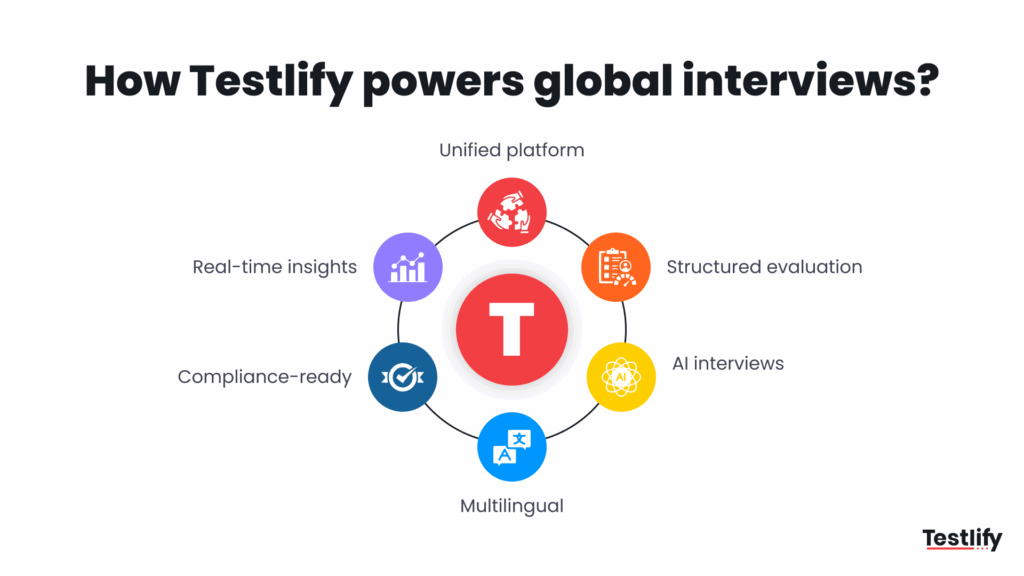
Unlike traditional setups that rely on scattered platforms, Testlify unifies assessments, interviews, proctoring, analytics, and integrations into one seamless ecosystem.
With structured assessments and role-specific benchmarks, enterprises can eliminate subjective evaluations and establish a consistent interview process across geographies.
Testlify’s AI-powered video interview feature ensures that every candidate can interact asynchronously with an AI avatar regardless of their timezone.
Conversely, hiring teams receive transcribed answers, real-time video recordings, and AI-generated insights covering grammar, fluency, and clarity.
Inclusivity is built into the product to support 12+ languages, accessible candidate interfaces, and flexibility for location-agnostic assessments help global teams assess candidates fairly.
More importantly, Testlify ensures complete compliance with regional regulations, including GDPR, and provides enterprise-grade security (SOC2, ISO standards).
What truly sets Testlify apart is its real-time analytics. From pass rates and drop-offs to benchmark comparisons, talent teams get complete visibility into what’s working and where hiring bottlenecks exist.
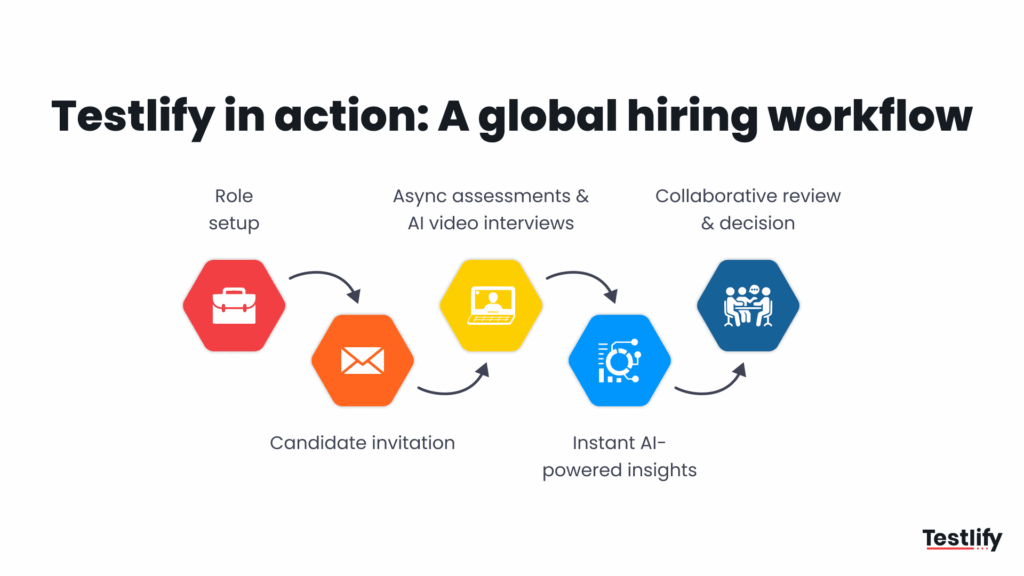
What a real global interview workflow looks like with Testlify
With Testlify, the entire hiring flow becomes streamlined. It starts with defining the role in Testlify’s system. Once the recruiter inputs the job title, they can access a rich library of over 3000 pre-built assessments.
Interestingly, recruiters can create custom assessments using various question types, ranging from skill-based MCQs to asynchronous video questions, chat simulations, and open-ended responses.
Next comes candidate engagement. Recruiters can send bulk invitations, personalize test links, and offer flexible assessment windows.
Candidates receive clear instructions, can take tests in their preferred language, and interact with AI avatars during video interviews without having to sync schedules with recruiters.
Once the test is completed, recruiters can access an auto-generated results dashboard. Every candidate’s performance is scored, transcribed (in case of video), and analyzed with AI-backed insights covering fluency, comprehension, accuracy, and job relevance.
No back-and-forth follow-ups. No lost feedback loops. Just instant clarity, accessible from anywhere.
Feedback from different hiring managers can be shared, tracked, and compared through a unified dashboard. The entire journey is consolidated, from screening to shortlisting.
What enterprises should look for in a global interview infrastructure
For global hiring to run smoothly, enterprises need more than interview scheduling tools or basic video calls.
If you’re evaluating your current setup or looking to upgrade, here’s what your global interview infrastructure should include:
- A platform that allows interviews to happen across time zones, asynchronously or live, without creating bottlenecks. This is non-negotiable for enterprise teams operating across regions.
- Your infrastructure must support structured, role-specific assessments, with question types ranging from MCQs to video, open-ended, and simulated environments. It should also allow for standardized scoring criteria to reduce evaluator bias.
- Enterprises should prioritize tools with multilingual capabilities, candidate-friendly UX, and inclusive features such as flexible scheduling, voice options, and accessibility support.
- Integration with your ATS, HRIS, and collaboration tools is essential to streamlining operations.
- Global hiring requires enterprise-grade compliance. Your platform should offer GDPR readiness, SOC2 and ISO certifications, configurable data policies, and strong identity security features.
When these elements come together, you can build a global-ready hiring engine.
Final thoughts
Hiring across borders demands more effort. Even the best hiring teams lose great candidates without a reliable interview infrastructure.
Testlify brings it all together. From async video interviews to real-time insights and multilingual support, it simplifies global hiring without cutting corners. In a world where talent is everywhere, your infrastructure should be too.
Frequently asked questions (FAQs)

B2B SaaS Content Writer
Rishav Kumar is a B2B SaaS content writer with 4 years of experience. He loves crafting engaging content. Always exploring fresh ideas, he's passionate about helping businesses grow through impactful writing.
LinkedInRelated resources
View all
HR & recruitment
Breaking hiring silos: Aligning TA with L&D and DEI

HR & recruitment
How to build a recruitment center of excellence (CoE)?

HR & recruitment
Seasonal and project-based hiring: Playbook for volume flexibility

HR & recruitment
Why Employer Value Proposition (EVP) is your talent magnet in 2026?

HR & recruitment
eSIM for HR and Global Talent Mobility: 6 Ways eSIM Transforms HR Management

HR & recruitment
How to evaluate professional certifications for recruiting success
Get started.
Hire on proof, not resumes.
Run your first skills-based assessment free — no credit card required.