
Talent acquisition trends for 2026: 10 shifts to plan for
Ten talent acquisition trends for 2026, from AI agents and skills-first hiring to candidate fraud and AI laws, and how TA teams can act.

Talent acquisition trends are the shifts in how organizations find, assess and hire people, driven by technology, the labor market, candidate expectations and regulation. In 2026 the biggest changes come from AI moving into everyday recruiting work, a move from resumes to proven skills, and new pressure to show that hiring is both fair and accurate.
TL;DR / Key Takeaways
- The biggest 2026 shifts: AI in daily recruiting, skills-based hiring, candidate fraud, quality of hire as the main metric and tighter AI laws.
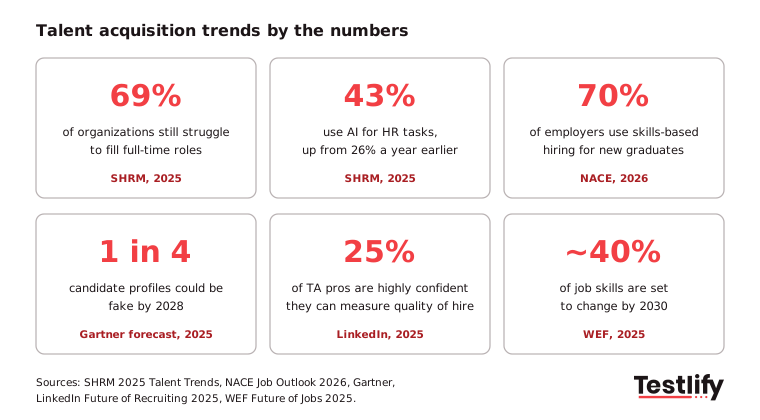
- Hiring stays hard: SHRM's 2025 Talent Trends survey found 69% of organizations still struggle to recruit for full-time roles.
- AI use for HR tasks rose from 26% in 2024 to 43% in 2025, per SHRM. Keep a person reviewing every rejection.
- Fraud is real: 6% of candidates in Gartner's 2025 survey admitted to interview fraud. Add identity checks and proctoring to remote steps.
- 89% of TA professionals expect quality of hire to matter more, yet only 25% are highly confident they can measure it (LinkedIn).
- NYC Local Law 144 requires bias audits and candidate notice, and the EU AI Act's employment rules start December 2, 2027.
- Pick two or three trends, pilot them on one role family for a quarter, measure against quality of hire and scale what works.
 ChatGPT
 Gemini
 Claude
 Grok
 Perplexity
What are the top talent acquisition trends for 2026?
The top talent acquisition trends for 2026 are AI built into daily recruiting work, skills-based hiring, rising candidate fraud, quality of hire as the main success metric, tighter AI hiring rules, candidate experience as a deciding factor, internal mobility, flexible work models, fair-process DEI and a more strategic, leaner TA function.
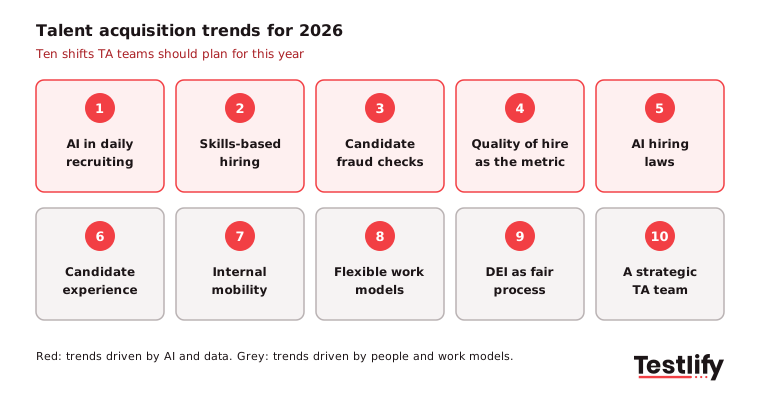
Trend | What changed | What to do this year |
|---|---|---|
AI in daily recruiting | Pilots became everyday tools and agents | Pick two workflows to automate, keep a person on every decision |
Skills-based hiring | Degrees and resumes count for less | Test the skills each role needs before the interview |
Candidate fraud | AI-written applications and proxy interviews | Add identity and integrity checks to remote steps |
Quality of hire | Speed alone no longer proves success | Track performance and retention of new hires |
AI hiring laws | NYC rules in force, EU rules on the way | Keep bias audits, notices and human review on file |
Candidate experience | Candidates compare your process with others | Fix response times and explain how AI is used |
Internal mobility | Skills gaps are filled from inside first | Assess employees for open roles before you advertise |
Flexible work models | Hybrid, remote and contract work mix | Hire for the work model, not just the job title |
DEI as fair process | Focus moved from targets to consistent methods | Use the same questions and criteria for every candidate |
A strategic TA team | Fewer recruiters, bigger scope | Build data, AI and advisory skills in the team |

What is changing in the hiring market in 2026?
The hiring market in 2026 is still hard for employers even though hiring has slowed in many sectors. Fewer roles are open, yet the right people remain scarce because the skills each job needs keep changing. TA teams are being asked to hire with fewer recruiters, higher application volumes and more scrutiny on every decision.
SHRM's 2025 Talent Trends survey of 2,040 HR professionals found that 69% of organizations still struggle to recruit for full-time roles. The most common problems were too few applicants, competition from other employers and candidates who stop replying. The same survey found that 28% of organizations now require new skills for full-time roles and 47% are updating existing roles to include them.
The World Economic Forum's Future of Jobs Report 2025 expects 170 million new jobs and 92 million displaced jobs by 2030, with nearly 40% of the skills needed on the job set to change. Of the employers surveyed, 63% named skills gaps as the main barrier to growth. For TA teams, the job is less about filling seats fast and more about finding people who can do work that is still being defined.
How is AI changing talent acquisition?
AI is changing talent acquisition by moving from small experiments into the everyday work of sourcing, screening, scheduling, interviewing and reporting. Recruiters now use it to parse resumes, match skills to roles, run first-round interviews, draft outreach and summarize candidates, while people keep the final say on who moves forward.
The shift is visible in the data. The LinkedIn Future of Recruiting 2025 report found that 37% of organizations are now integrating or experimenting with generative AI in hiring, up from 27% a year earlier. Teams that use it save about 20% of their work week, and 26% of them put that time into skills assessment. SHRM's survey found that AI use for HR tasks rose from 26% in 2024 to 43% in 2025.
Three changes stand out in 2026:
- AI agents run whole steps: Korn Ferry's TA Trends 2026 survey of about 1,600 talent leaders found that 84% plan to use AI in the coming year and 52% plan to add autonomous AI agents to their teams. Agents now handle tasks such as screening, scheduling and follow-ups end to end. Our guide to agentic AI in recruitment covers how they work.
- Chatbots answer candidate questions: Virtual assistants on career sites answer common questions about how to apply, application status, benefits, pay and roles, so recruiters spend less time on the same queries.
- Connected tools replace separate systems: AI screening, assessments and interviews now sync with the ATS and HRMS, so data is not retyped between tools. Read more on using an HRMS to assess and hire.
Automation also brings risk. Screening tools can repeat bias found in past data, and they can reject good candidates for reasons nobody can explain. Most teams now use a human-in-the-loop approach: AI scores and ranks, and a recruiter or hiring manager reviews every rejection. An AI resume screener with an explainable match score makes that review faster.
Pro tip: Before you add an AI tool, write down which decision it supports and who checks its output. A tool with no named reviewer tends to become the decision maker by default.
Why is skills-based hiring replacing resume screening?
Skills-based hiring is replacing resume screening because degrees, job titles and years of experience are weak signals of whether someone can do the job today. Testing the skills a role needs, through work samples, simulations, coding tasks or cognitive tests, gives every applicant the same chance to show what they can do.
Employer data shows the shift is now mainstream. NACE's Job Outlook 2026 research found that 70% of employers use skills-based hiring for new graduates, up from 65% a year earlier. LinkedIn found that companies running the most skills-based searches are 12% more likely to make a quality hire, and 93% of TA professionals say accurately assessing skills is crucial to quality of hire.
Skills-based hiring also widens the talent pool. Candidates without a degree, career changers and people from non-traditional backgrounds get a fair look when the first filter is a skills test rather than a keyword match on a resume. The approach is most common in technology, finance, customer service and other roles where practical ability matters more than credentials. See Testlify's skills-based hiring data for more on adoption.
Why is candidate fraud a growing hiring risk?
Candidate fraud is a growing hiring risk because generative AI makes it easy to produce polished resumes, answer interview questions in real time and even fake a voice or face on a video call. Remote hiring removes the in-person checks that used to catch impostors, so fraud now reaches final rounds.
Gartner's 2025 candidate survey found that 6% of 3,000 job candidates admitted to interview fraud, either posing as someone else or having someone else pose as them. About 4 in 10 candidates said they use AI during applications. Gartner predicts that by 2028, 1 in 4 candidate profiles worldwide could be fake. Fake candidates are a security risk as well as a bad hire, since some seek access to company systems.
TA teams are responding with integrity checks built into the process rather than added at the end:
- Identity verification at the assessment or interview stage, with photo ID and face matching for remote roles.
- Proctoring during skills tests: webcam snapshots, tab and copy-paste tracking, and AI assistance detection. Testlify's anti-cheating and proctoring includes 20+ proctoring checks.
- Work samples and live tasks that are hard to fake, followed by a short live conversation about the answers.
Why is quality of hire becoming the main metric?
Quality of hire is becoming the main TA metric because time to fill and cost per hire show how fast and cheap hiring is, not whether the people hired perform and stay. Leaders now want proof that the process selects people who succeed, and AI makes it possible to link hiring data with performance.
LinkedIn found that 89% of TA professionals expect measuring quality of hire to become more important, yet only 25% are highly confident they can measure it today. The most common measures are job performance ratings (66%), new hire retention (60%) and hiring manager satisfaction (44%). Read our guide on how to improve quality of hire for practical steps.
Recruitment analytics now tracks the whole funnel rather than single numbers:
Metric | What it tells you | Why it matters in 2026 |
|---|---|---|
Source of hire | Which channels bring hires | Moves budget to channels that produce quality, not volume |
Time to fill | Days from opening to accepted offer | Top candidates leave the market fast |
Interview to offer ratio | How well screening filters candidates | A high ratio means interviews are wasted |
Cost per hire | Spend per hire | Shows the return on AI and automation |
Quality of hire | Performance and retention of new hires | The outcome that proves the process works |
Onboarding success | Ramp-up time and early exits | Flags mismatches the screening missed |
Candidate satisfaction | How candidates rate the process | Predicts offer acceptance and referrals |
Predictive analytics goes one step further. Using data from the ATS, HRMS, assessments and past hires, teams can estimate which candidates are likely to succeed and stay in high-turnover roles. Computers do not make the final choice, but they help recruiters focus. The quality of hire calculator is a simple place to start.
How are AI hiring laws changing talent acquisition?
AI hiring laws are changing talent acquisition by making employers explain, audit and supervise the automated tools they use to screen and rank people. Rules that started in single cities now reach whole regions, and they put the duty on the employer, not only the vendor.
In New York City, Local Law 144 has been enforced since July 5, 2023. Employers may not use an automated employment decision tool unless it has had a bias audit within one year of use, a summary of the results is public, and candidates are told about the tool in advance. Testlify published a third-party NYC bias audit of its matching model in June 2023.
In the European Union, the AI Act treats AI used in recruitment, promotion and termination as high risk. EU lawmakers agreed in 2026 to move the start date for these employment rules to December 2, 2027, according to summaries from Sidley and other law firms, but the obligations themselves remain. Teams hiring in the EU should use the extra time to document how their tools work, test them for bias and keep a person in charge of decisions.
Key takeaway: Treat every AI screening step as something you may need to explain to a candidate or a regulator. Keep the audit, the notice and the name of the person who reviews the result.
How are candidate experience and employer brand changing?
Candidate experience is changing because candidates now treat applying like buying: they compare processes, read reviews and drop out when a company is slow, silent or unclear. A poor process costs offers and harms the employer brand, while a clear, respectful one wins candidates who have other options.
Trust is the new pressure point. Gartner found that only about a quarter of candidates (26%) trust AI to evaluate them fairly. Employers that explain where AI is used, what it measures and how a person reviews the result give candidates a reason to stay in the process.
The basics still matter most. The "vanishing recruiter" problem, where a recruiter stops replying after an interview, is still one of the biggest complaints. Empathy, quick updates, feedback loops and candidate satisfaction surveys help close that gap. Many teams now use automated status updates and chatbots so that no candidate waits weeks without news.
Employer branding has moved onto social channels. SHRM found that social media is now the most used recruiting strategy, at 55% of organizations. Employee stories, short videos and role-specific challenges reach candidates who never visit a careers page. Read more on employer branding in talent acquisition.
Why are internal mobility and upskilling back on the agenda?
Internal mobility and upskilling are back on the agenda because filling a skills gap from inside is often faster, cheaper and less risky than hiring. Current employees already know the business, and moving them into new roles keeps their knowledge in the company while lowering hiring costs and turnover.
The pressure comes from skills change. The World Economic Forum's Future of Jobs Report 2025 found that 77% of employers plan to upskill their workforce, and SHRM found that over a third of organizations train existing employees for hard-to-fill roles.
Internal hiring works best when it is run like external hiring: open roles are visible to everyone, employees are assessed on the same skills as outside candidates, and managers do not block moves. Many companies now use internal talent marketplaces that suggest roles, projects, training and mentors based on each employee's skills and goals. Testlify supports internal mobility by assessing employees for new roles.
How are remote, hybrid and flexible work changing hiring?
Remote, hybrid and flexible work are changing hiring by widening where companies can find people and changing what they need to test. A role that can be done from anywhere draws a national or global pool, while office mandates shrink the pool and push some candidates away.
SHRM found that organizations offering flexible work report less trouble recruiting (22%) than those that do not (29%). Korn Ferry's research found that nearly three quarters of employees want a hybrid or remote option. Virtual recruiting and onboarding, which started as a stopgap, are now normal: interviews, assessments and first-week training happen online for most office roles.
Flexibility also covers the type of contract. Many organizations mix full-time staff with contractors, freelancers and temporary workers to add capacity or bring in specialist skills when demand changes. Remote and flexible roles call for different skills, such as self-management, clear written communication and working across time zones, so teams add behavioral and role-play assessments to judge them.
What is happening to DEI in recruiting?
DEI in recruiting is moving from public targets to fair, consistent process. Many US employers have reworded or scaled back formal DEI programs since 2025, but the practices that make hiring fair, such as structured interviews, the same criteria for every candidate and skills-first screening, remain standard.
Fair process is also good hiring practice. Teams now use anonymized resume review, inclusive job description wording, diverse interview panels and funnel analytics that show where different groups drop out. These steps reduce bias, widen the pool and make each decision easier to defend. Our guide on diversity and inclusion in talent acquisition covers the practices in detail.
How is the role of the talent acquisition team changing?
The role of the talent acquisition team is changing from filling requisitions to advising the business on where talent comes from, what skills it needs and how to hire it well. TA leaders now plan workforce needs with finance and operations, map skills gaps and run the AI and data behind hiring.
Korn Ferry found that 83% of talent leaders have some influence with the C-suite, yet 59% still feel left out of strategic business decisions. Korn Ferry also found that 73% of TA leaders name critical thinking and problem solving as the skill they need most. LinkedIn reported that employers were 54 times more likely to list relationship development as a required recruiter skill than a year before.
Teams are also leaner. Many TA functions now cover more roles with the same or fewer recruiters while application volumes grow, which is one reason burnout and admin overload are common complaints. Entry-level hiring has shrunk in some sectors as AI absorbs routine work, which risks weakening the future leadership pipeline. When you hire the people who will lead this change, check that candidates can apply current talent acquisition trends in a TA manager role rather than only describe them.
How should talent acquisition teams prepare for 2026?
Talent acquisition teams should prepare for 2026 by choosing the two or three trends that affect their hiring most, running small pilots, measuring the results against quality of hire and scaling only what works. Trying to act on every trend at once spreads a lean team too thin.
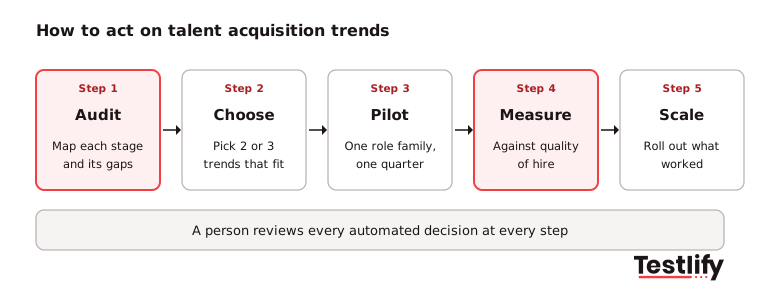
- Audit your process: Map each stage from job post to offer, and note where time is lost, where candidates drop out and where decisions rest on gut feel.
- Choose two or three trends: A team hiring at volume may start with AI screening and fraud checks. A team hiring specialists may start with skills tests and internal mobility.
- Run a pilot: Test the change on one role family for one quarter, with a named owner and a person reviewing every automated decision.
- Measure against quality of hire: Compare performance, retention and hiring manager satisfaction with the old process, not only speed.
- Scale what works: Roll it out, update your candidate notices and audits, and drop what did not help.
The best recruiting strategy for 2026 is tech-enabled, people-focused, data-informed, inclusive, flexible and connected. Platforms can do much of the work. Testlify, for example, offers more than 3,500 skills tests, AI interviews by video, voice and chat, and connects with 100+ ATS and HRIS tools through its integrations.
When you add or replace a recruiter, a talent acquisition assessment checks the sourcing, screening and stakeholder skills the role now needs. For the bigger picture, see our guide to building a talent acquisition strategy, or try Testlify free to run a skills-first pilot.
Frequently asked questions about talent acquisition trends

Wordpress Developer
Yash Patel is a Wordpress and SEO Specialist at Testlify with 3+ years of experience in technical SEO, on-page optimization, and content strategy. He works on improving Testlify's organic presence and produces content focused on hiring, talent assessment, and HR technology.
LinkedInRelated resources
View all
HR & recruitment
Legal considerations in recruitment compliance tips for 2026

HR & recruitment
Creating a positive candidate experience

HR & recruitment
7 Candidate Sourcing Strategies That Work in 2026

HR & recruitment
How to build an employer brand: 9 steps for hiring teams

HR & recruitment
12 recruitment skills to look for and how to test them

HR & recruitment
What is the purpose of capturing screenshots while testing?
Get started.
Hire on proof, not resumes.
Run your first skills-based assessment free — no credit card required.