
Are T-shaped skills the future of hiring? Here’s why
Discover why T-shaped skills are transforming hiring trends. Learn their importance, benefits, and how they drive collaboration and innovation in the workplace.

Do you know that 70% of employers face difficulty finding candidates who can work across teams while excelling in their core expertise? The era, driven by innovation and cross-functional teamwork, no longer accepts traditional skill sets. That’s where T-shaped skills come into play.
It is a revolutionary concept that combines deep specialization with versatile, broad knowledge. Organizations are now hunting for those professionals who can wear multiple hats. Would you rather hire someone confined to one skill or a professional who bridges gaps and drives collaboration?
This means that T-shaped professionals are a game-changer in the hiring process. But will these skills help build future-proof teams? Read on to know why these skills emerge as the gold recruitment standard. How does it address critical business challenges, and why ignoring it could leave your company behind?
 ChatGPT
 Gemini
 Claude
 Grok
Grok Perplexity
What are T-shaped skills?
In a world where hybrid roles and interdisciplinary collaboration are the norm, T-shaped skills have become a buzzword in talent management. But what exactly are they?
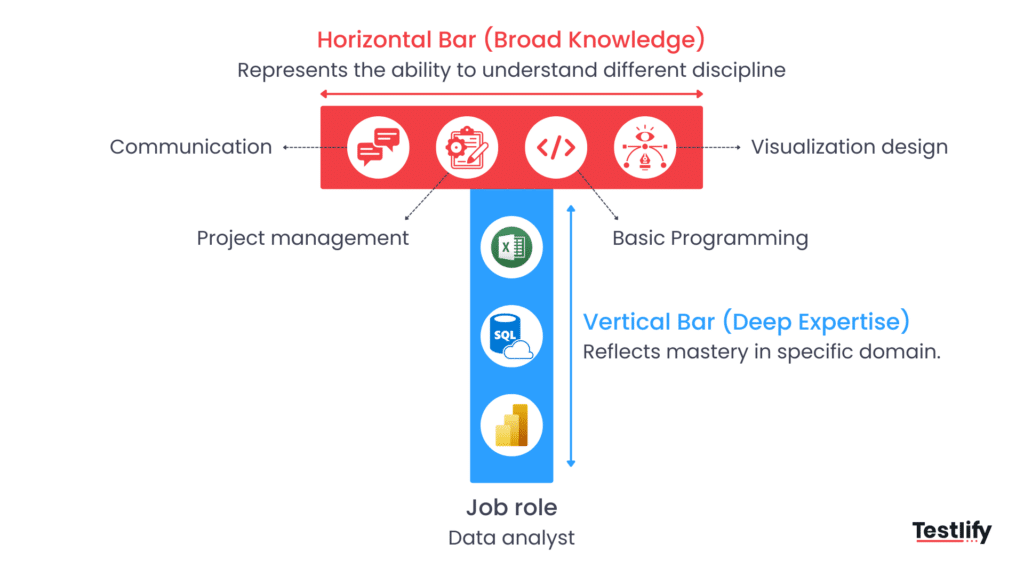
T-shaped skills represent a balance between deep expertise in one specific area (the vertical bar of the “T”) and a broad understanding of multiple areas (the horizontal bar). Let’s understand more broadly!
- The vertical bar: In simple words, the vertical bar represents a candidate’s deep expertise in a particular field. In short, it represents an individual’s specialization. For example, a software developer with advanced coding skills in Python or Java represents this vertical strength.
- Horizontal Bar: This reflects a person’s ability to work across disciplines. Basically, it shows how an individual utilizes knowledge in areas outside their specialization, such as project management, communication, or design thinking.
Examples of T-shaped professionals
- A marketer who specializes in SEO (vertical bar) but also understands content creation, social media, and analytics (horizontal bar).
- An engineer with deep expertise in electrical systems (vertical bar) and a working knowledge of mechanical processes and team collaboration (horizontal bar).
T-shaped skills are more than a trendy term. Tim Brown, the CEO of IDEO, popularized the term to highlight the importance of having specialists who can think like generalists. In the following sections, we’ll explore why these skills are crucial for shaping the future of hiring.

Difference between T-shaped, N-shaped, and M-shaped skills
While T-shaped skill combine depth in one area with broad knowledge across others, N-shaped and M-shaped skills take a slightly different approach, catering to unique professional demands.
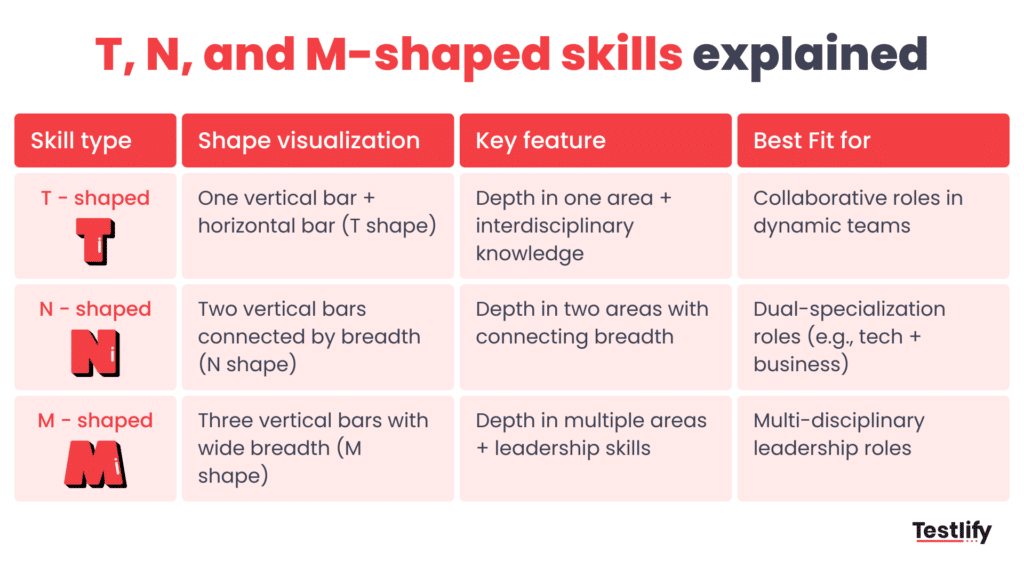
T-shaped skills
- Structure: Depth in one area (vertical bar) and broad interdisciplinary knowledge (horizontal bar).
- Ideal for: Collaborative environments where cross-functional teamwork is crucial.
- Example: A software developer specializing in Python who also understands project management and UX design.
N-shaped skills
- Structure: Depth in two specific areas with a connecting breadth.
- Ideal for: Roles requiring dual specialization, such as combining technical and business skills.
- Example: A product manager proficient in marketing and software development.
M-shaped skills
- Structure: Depth in multiple areas with exceptional breadth and collaborative ability.
- Ideal for: Leadership positions or roles requiring multi-disciplinary expertise.
- Example: A senior leader with expertise in operations, marketing, and technology.
Each skill model caters to different roles: T-shaped skills drive collaboration, N-shaped skills address dual-specialization needs, and M-shaped skills support multi-disciplinary leadership. In the context of hiring, T-shaped skills often emerge as the most versatile.
Why are T-shaped skills important in hiring?
Nowadays, hiring professionals with T-shaped skills has become a strategic priority. Below are some points highlighting why they’re critical for building high-performing teams.
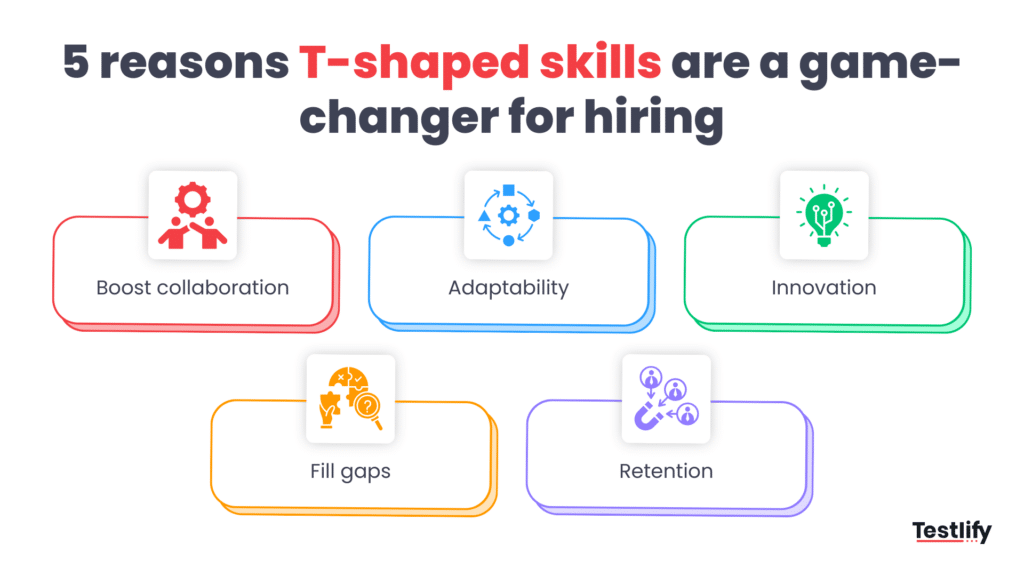
1. Collaboration across teams
T-shaped professionals do exceptionally well with interdisciplinary collaboration. The broad knowledge of T-shaped professionals facilitates smooth communication. Additionally, helps bridge the gap between departmental colleagues for effective teamwork.
For example, a marketing specialist with technical knowledge can work smoothly with a software development team on digital campaigns.
2. Adaptability to change
The modern workplace requires employees to pivot across different roles and tasks. T-shaped skill-set make the professional adaptable. They can engage with challenges from multiple areas of expertise while keeping their feet grounded in their speciality. LinkedIn reports that 92% of talent professionals believe adaptability is critical for today’s workforce.
3. Driving innovation
Innovations usually happen at the intersection of disciplines. Professionals with T-shaped skills use their diverse knowledge base to think creatively, solve problems, and introduce fresh ideas. For example, a data analyst who understands design principles can improve how data insights are visualized.
4. Filling skill gaps
T-shaped professionals help address skill shortages within teams by covering multiple knowledge areas. This makes them invaluable in lean or agile organizations that rely on versatility.
5. Improving employee retention
Investing in individuals who hold T-shaped skills contributes to long-term growth. These professionals are more likely to evolve with the company. This can naturally reduce the turnover rates. Employers can easily identify T-shaped skills during interviews by asking about candidates’ cross-functional experiences.
This is an era where collaboration, innovation, and adaptability define success. T-shaped skills are no longer optional—they’re essential. Companies that prioritize hiring professionals with T-shaped skills can position themselves for long-term success.
How T-shaped skills drive business success?
Professionals with T-shaped skills are not just experts in their fields but also collaborators and problem-solvers. They bridge the knowledge gaps between teams to work seamlessly and tear down silos that usually stall progress.
Moreover, T-shaped employees become habituated to handling changes, which makes businesses more agile and resilient. Companies should focus on cross-functional training and development programs to harness the power of T-shaped skills.
In short, organizations that invest in T-shaped skills are not just preparing for the future but building it.
Challenges of hiring for T-shaped skills
T-shaped skills are the most desired across industries. However, finding and recruiting candidates embodying this unique blend of depth and breadth is not simple.
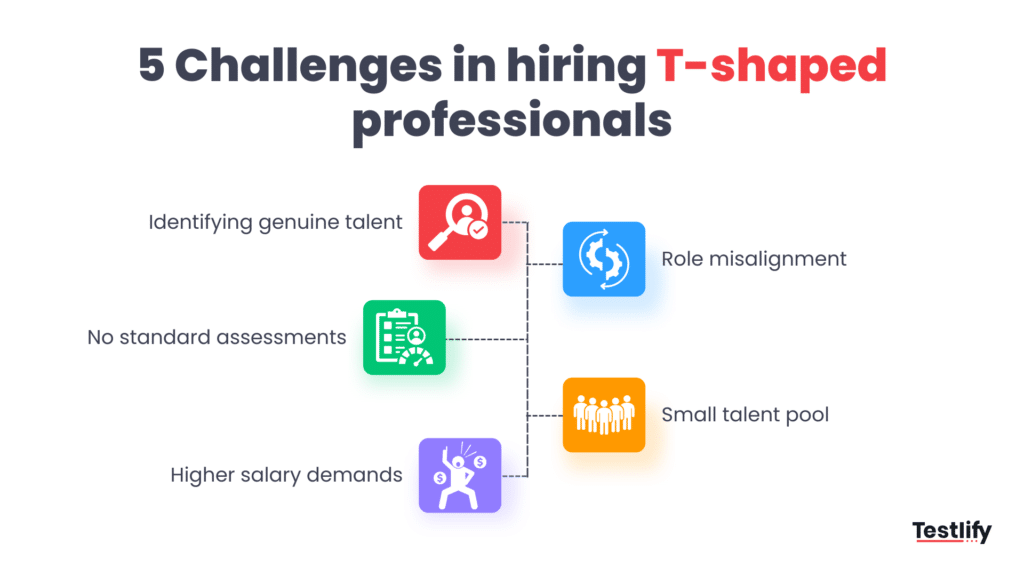
You might face a lot of challenges while chasing these kinds of individuals. Below are some of the biggest challenges recruiters face:
- Difficulty in identifying true T-shaped candidates – It’s tough to distinguish genuine T-shaped individuals from generalists during interviews.
- Misalignment between roles and skills – Not all roles need T-shaped skills, leading to mismatched hiring expectations.
- Lack of standardized assessment tools – Lack of standardized tests makes evaluating T-shaped skills subjective.
- Limited talent pool – The demand for T-shaped professionals exceeds the available supply.
- Higher compensation expectations – T-shaped candidates often expect higher compensation for their versatility.
How to overcome the challenges?
To overcome these challenges, recruiters can:
- Use skill assessment platforms like Testlify to evaluate both depth and breadth of expertise.
- Develop clear job descriptions that align with the need for T-shaped skills.
- Offer cross-functional training programs to nurture T-shaped talent internally.
Can T-shaped professionals be the managers of the future?
Absolutely. T-shaped professionals bring a unique balance of deep expertise and broad knowledge, making them ideal future managers. Their ability to collaborate across teams, solve problems holistically, and adapt to change equips them to lead in dynamic environments.
They naturally foster innovation by connecting ideas across disciplines and inspire teams with empathy and inclusivity. With proper mentoring and leadership training, T-shaped professionals can evolve into managers who drive collaboration, adaptability, and creativity—qualities essential for navigating the complexities of the modern workplace.
Why organizations should groom T-shaped leaders?
While T-shaped skills already make professionals stand out, organizations can nurture these employees into future-ready managers through mentoring, leadership training, and cross-functional exposure. With these investments, businesses can build a leadership pipeline that’s collaborative, adaptable, and innovative.
T-shaped professionals aren’t just the managers of tomorrow—they’re the leaders businesses need to thrive in a rapidly changing world.
Final thoughts
So, are T-shaped skills the future of hiring? The answer is a resounding yes. As workplaces grow more collaborative and complex, the demand for professionals combining deep expertise with broad knowledge is skyrocketing.
While hiring for these skills comes with challenges, the payoff is undeniable. T-shaped professionals transform teams, drive creativity, and bridge critical skill gaps. Companies that prioritize T-shaped skills in their hiring strategies are positioning themselves for long-term success.
The future of hiring is here, and it’s shaped like a “T.” Will your organization embrace it?
Frequently asked questions (FAQs)

B2B SaaS Content Writer
Rishav Kumar is a B2B SaaS content writer with 4 years of experience. He loves crafting engaging content. Always exploring fresh ideas, he's passionate about helping businesses grow through impactful writing.
LinkedInRelated resources
View all
HR & recruitment
Beyond clinical skills: using AI to assess soft skills in healthcare hiring

HR & recruitment
How to conduct a skills audit?

HR & recruitment
What is regretted attrition and how to reduce it?

HR & recruitment
16 HR skills every professional need
HR & recruitment
5 Essential HR goals and objectives for a thriving 2026

HR & recruitment
101 guide to using the 9-box matrix
Get started.
Hire on proof, not resumes.
Run your first skills-based assessment free — no credit card required.