
What is recruitment planning and how to create a recruitment plan?
Learn how to create a successful recruitment plan to streamline hiring, attract top talent, and improve efficiency. A must-read guide!

Recruitment planning is a crucial aspect of human resources management. It involves outlining strategies, processes, and procedures that help attract, hire, and retain the best talent for your organization.
According to SHRM, 77% of organizations reported difficulties recruiting for full-time regular positions, indicating a persistent challenge in talent acquisition. Hence, you must understand the significance of having a structured approach to recruitment, ensuring that you meet both short-term and long-term organizational goals.
In this blog, we’ll talk about everything you should know about recruitment planning.
 ChatGPT
 Gemini
 Claude
 Grok
Grok Perplexity
What is recruitment planning?
Recruitment planning is the process of developing a systematic approach to hiring employees. It involves forecasting hiring needs, creating a strategy to meet them, and identifying the best sources for potential candidates. The goal is to ensure that your organization has the right talent at the right time to meet business objectives.
Effective recruitment planning also involves considering the organizational culture, job requirements, and how to attract candidates who align with your company’s technical and cultural aspects.

The basics of recruiting plans
A well-constructed recruitment plan provides clarity and direction for the HR team. It outlines the specific actions that need to be taken, the resources required, and how to measure success. Below are the essential components of a recruitment plan.
1. Hiring needs
The first step in any recruitment plan is understanding your hiring needs. This includes identifying the positions that need to be filled, the skills required, and the timing of these hires. Analyzing the company’s current and future growth, as well as considering employee turnover and internal mobility, helps determine these needs.
2. Job descriptions
Clear and comprehensive job descriptions are the foundation of your recruitment strategy. A job description outlines the expectations of the role and the qualifications required. This helps attract candidates who align with the company’s needs and values.
3. Recruitment channels
Recruitment channels are the platforms and methods used to find potential candidates. Choosing the right channels is critical, as it ensures your job openings are seen by the right talent.
4. Budgeting and resources
Recruitment can be an expensive and time-consuming, so it’s essential to set a budget and allocate resources effectively. This includes costs for advertising positions, hiring temporary staff, paying recruitment agencies, and investing in technology.
5. Timeline
Recruitment timelines are essential to ensure that the hiring process moves smoothly. A clear timeline sets expectations for when key stages of the recruitment process should be completed. This includes creating job postings, shortlisting candidates, conducting interviews, and making job offers.
6. Onboarding
Strategic recruitment planning does not end at the offer letter. A structured 30/60/90 day onboarding plan is part of the recruitment strategy, ensuring new hires reach productivity faster and feel supported from day one.
Why is a recruitment plan important?
A well-thought-out recruitment plan offers several benefits, not just for HR but for the entire organization. Below, we dive into why recruitment planning is essential for success.
1. Aligned goals
A recruitment plan ensures that HR efforts are aligned with the company’s strategic goals. By understanding the broader organizational objectives, HR can focus on hiring the talent needed to help the company grow and thrive.
2. Efficient resource allocation
Recruitment can be costly, both in terms of time and money. A recruitment plan ensures that resources are allocated efficiently by prioritizing the most important hiring needs and selecting the best recruitment channels. This prevents unnecessary spending on ineffective strategies and helps HR teams work within budget constraints.
3. Improved candidate experience
A structured recruitment plan helps streamline the hiring process, ensuring candidates are treated fairly and professionally. A positive candidate experience reflects well on the company and can make a significant difference in whether top talent accepts a job offer.
Research consistently shows that 72% of recruiting leaders believe employer branding has a significant effect on recruitment outcomes, and organizations with a deliberate approach to candidate experience attract stronger applicants and convert offers at higher rates.
4. Reduced turnover
When the right person is hired for the right role, the likelihood of turnover decreases. A recruitment plan helps ensure that candidates possess the skills, qualifications, and cultural fit needed for long-term success within the organization.
5. Adaptation to market conditions
Labor markets are constantly evolving. A recruitment plan allows organizations to stay adaptable in response to changes in labor laws, industry trends, and shifts in candidate behavior. It helps organizations anticipate hiring challenges and make necessary adjustments to stay competitive.
6. It reduces the cost of a bad hire
A bad hire is one of the most expensive things that can happen to an organization. SHRM estimates that replacing a mis-hire costs the equivalent of six to nine months of that employee's salary, and for senior or specialized roles the figure climbs significantly higher. A strategic recruitment plan reduces this risk by defining success profiles clearly before sourcing begins, using structured, validated assessments to evaluate job-relevant competency rather than relying on interviews alone, applying consistent criteria across all candidates to reduce bias-driven decisions, and ensuring role requirements are grounded in real business needs.
7. It protects productivity through smarter hiring
Every day a critical role sits vacant is a day of lost output and increased pressure on existing team members. At an estimated $500 per day in lost productivity per unfilled role, the cost adds up fast for organizations managing multiple open positions simultaneously. Building talent pipelines before roles open, automating early-stage screening, and streamlining interview processes all reduce time-to-fill. Organizations using AI-enabled recruitment tools report 31% faster hiring times on average.
8. It drives diversity, equity, and inclusion
McKinsey research has consistently shown that organizations in the top quartile for ethnic and gender diversity outperform their peers on profitability, but diversity does not happen by accident. A strategic recruitment plan builds DEI into the process by diversifying sourcing channels beyond the traditional pipelines that tend to reproduce existing workforce demographics, using standardized assessments that evaluate candidates on job-relevant criteria rather than subjective impressions, auditing screening and interview processes regularly for potential bias, and setting measurable diversity hiring goals that are tracked alongside other kpis.
How to implement successful recruitment planning and forecasting?
Recruitment forecasting involves predicting future hiring needs based on various internal and external factors. It is a crucial component of recruitment planning because it allows HR teams to proactively address talent shortages, skills gaps, and workforce changes.
1. Understanding the business’s strategic objectives
Forecasting recruitment needs start with a deep understanding of the company’s strategic objectives. HR professionals must align their recruitment strategies with the organization’s growth plans. By understanding the company’s direction, HR can forecast the roles that will become critical to achieving business goals.
2. Assessing the current workforce
Recruitment forecasting begins with a thorough assessment of the current workforce. HR professionals need to analyze the existing talent pool to identify gaps and predict future needs. This involves looking at turnover rates, retirement projections, internal mobility patterns, and current employee skill sets. For example, if a department has high turnover rates or a few employees nearing retirement, HR can plan to replace those positions before they become vacant.
Analyzing the current workforce also helps identify internal talent that may be ready for promotion or lateral movement into new roles. This allows HR to develop succession plans and leverage existing employees for future growth, thus reducing the need for external recruitment.
3. Predicting future business growth and trends
External factors, such as industry trends and economic conditions, are significant in recruitment forecasting. For example, if a particular industry is expected to grow rapidly, there may be a higher demand for specific skills, such as those related to data science, artificial intelligence, or renewable energy. Recruitment forecasting helps HR anticipate these changes and start recruiting ahead of time to fill skills gaps.
Additionally, forecasting allows HR teams to stay aware of labor market trends. For example, if there is a shortage of qualified professionals in a particular field, HR can take proactive steps, such as offering competitive salaries or focusing on candidate development programs to attract top talent.
4. Conducting skills gap analysis
A critical part of recruitment forecasting is conducting a skills gap analysis. This involves assessing the current workforce to identify areas where the company may lack expertise. For example, if a company is focusing on digital transformation, but its employees lack digital marketing expertise, HR will need to plan for hiring or training employees with these skills.
A skills gap analysis also helps HR prioritize hiring efforts and determine whether it is more cost-effective to hire externally or develop talent internally through training and development programs.
5. Creating a talent pipeline
Recruitment forecasting helps build a proactive talent pipeline. By predicting future hiring needs and understanding the skills required, HR can develop a pool of qualified candidates in advance. This pipeline ensures that the organization is prepared to fill positions quickly when the need arises rather than scrambling to find candidates at the last minute.
A well-managed talent pipeline also allows HR to develop relationships with potential candidates long before roles become available. This can lead to faster recruitment cycles and better-qualified hires.
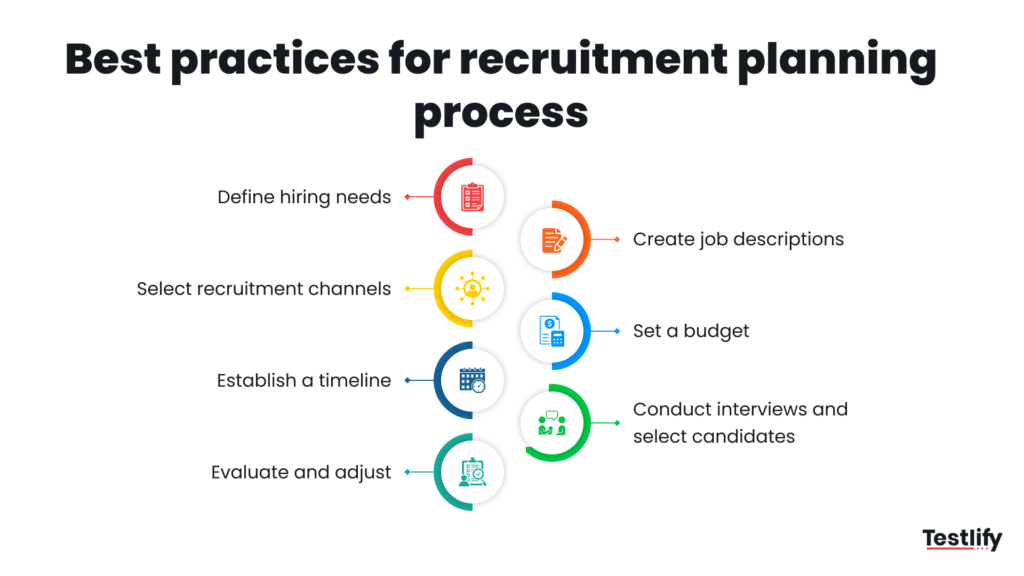
7 steps for recruitment planning process
The recruitment planning process is a systematic approach to ensure that HR efforts are well-organized and effective. A step-by-step recruitment plan provides structure, reduces uncertainty, and improves decision-making. Below are the stages of the recruitment planning process.
1. Define hiring needs
The first step in the recruitment planning process is to define hiring needs. This involves working closely with department heads and managers to understand the company’s staffing requirements. Are there roles that need to be filled urgently, or does the hiring need to be done in a longer term? Understanding the company’s immediate and future needs ensures that HR can prioritize recruitment efforts effectively.
2. Create job descriptions
Once the hiring needs have been identified, HR needs to create detailed and accurate job descriptions for each role. Job descriptions are the foundation of recruitment as they outline the qualifications, responsibilities, and expectations for the position. A well-crafted job description helps attract candidates who possess the right skills and are a good cultural fit for the company.
The job description should also reflect the company’s values, culture, and mission. A compelling job description can be a powerful tool for attracting top candidates who align with the organization’s ethos.
Pro tip: Get relevant job descriptions in just one click with Testlify’s AI job description generator.
3. Select recruitment channels
Once the job descriptions are ready, HR must select the appropriate recruitment channels to reach potential candidates. Different roles may require different strategies, so selecting the right platform is key. For example, technical roles may require posting on specialized job boards or leveraging recruitment agencies, while marketing roles may be best filled through social media or referrals.
It’s important to use a mix of recruitment channels to ensure a diverse pool of candidates. This may include job boards, social media, internal recruitment, and employee referrals. Each channel should be evaluated for its effectiveness based on the type of position and the quality of candidates it generates.
4. Set a budget
Recruitment efforts often come with costs, so setting a budget is an essential part of the process. HR needs to estimate how much it will cost to fill the position, including advertising costs, recruitment agency fees, technology costs (such as ATS), and the time spent by hiring managers and interviewers. Having a clear budget helps HR allocate resources wisely and avoid overspending on ineffective methods.
5. Establish a timeline
Setting a timeline for recruitment ensures that the process remains on track. HR needs to create a timeline for each stage of the recruitment process, from posting the job to making the final offer. This timeline should align with the company’s business goals, ensuring critical positions are filled quickly without compromising quality.
A timeline also helps manage expectations for both the HR team and candidates, ensuring that everyone involved understands when decisions will be made.
6. Conduct interviews and select candidates
Once applications have been received and shortlisted, it’s time to conduct interviews. The interview process should be structured and consistent to ensure that all candidates are evaluated fairly. The goal is to assess not only the candidate’s skills and qualifications but also their fit within the company culture.
7. Evaluate and adjust
After each recruitment cycle, it’s important to evaluate the success of the process. This includes tracking metrics like time-to-hire, cost-per-hire, and candidate quality. By evaluating each stage of the recruitment process, HR can identify areas for improvement and adjust future strategies accordingly.
How to create a successful recruiting plan
Creating a successful recruitment plan is essential for attracting top talent, optimizing resources, and ensuring long-term success. Below are the key steps to develop a successful recruiting plan.
1. Set clear objectives
The first step in creating a successful recruiting plan is to define your objectives. Are you trying to fill specific roles quickly? Do you want to diversify your talent pool? Do you need to hire for future growth? Setting clear goals will help you focus your efforts and ensure that the recruitment plan aligns with your business needs.
2. Understand your talent pool
Understanding where your ideal candidates are located, what motivates them, and where they spend their time is critical to attracting the right talent. Conducting research into your target talent pool allows you to select the most effective recruitment channels, whether that’s LinkedIn, industry-specific job boards, or social media platforms.
3. Leverage technology
Technology can significantly streamline the recruitment process. Utilizing recruitment software, like Applicant Tracking Systems (ATS), allows you to automate tasks such as resume screening, job posting, and interview scheduling. Automation saves time and improves the efficiency of the recruitment process.
4. Build a strong employer brand
A strong employer brand is crucial for attracting top talent. Your company’s values, culture, and benefits should be clearly communicated through job postings, your website, and social media channels. Candidates are more likely to apply to a company that showcases a positive work environment and strong employee support.
5. Collaborate with hiring managers
Collaboration between HR and hiring managers is essential to ensure that the recruitment plan meets the specific needs of each department. Regular communication with hiring managers helps define job requirements, expectations, and candidate profiles.
6. Monitor and adjust
Finally, a successful recruiting plan requires ongoing monitoring. Regularly assess the effectiveness of your recruitment strategies by tracking key performance indicators (KPIs). Adjust your approach to address any challenges or capitalize on new opportunities.
What are the benefits of a recruitment plan?
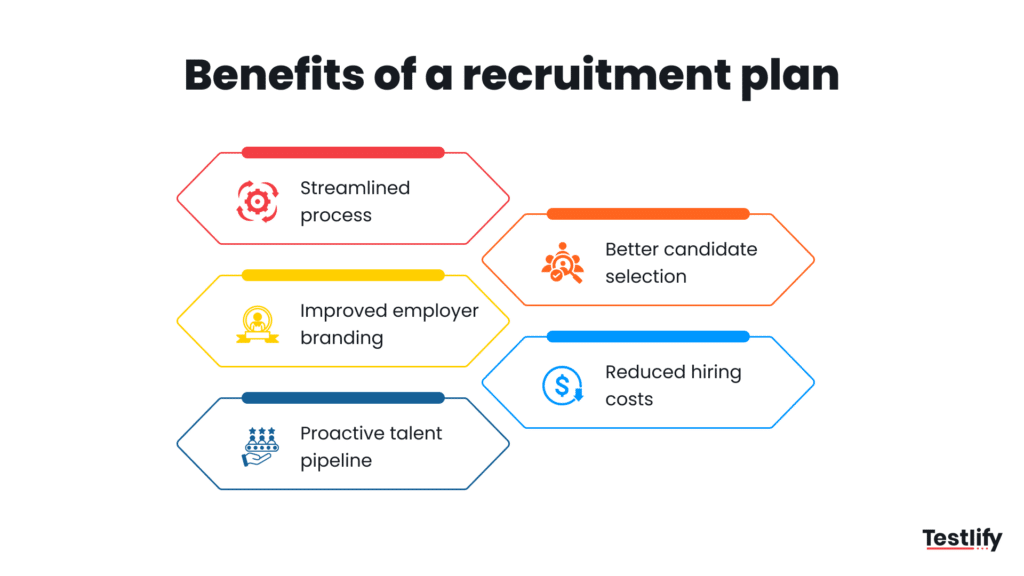
A well-designed recruitment plan brings several significant benefits to the organization:
1. Streamlined process
A recruitment plan makes the hiring process more organized and efficient. It provides structure and clarity, ensuring that HR and hiring managers follow the same procedures. This reduces the time spent on redundant activities and enables faster hiring without compromising on quality.
2. Better candidate selection
A recruitment plan helps HR focus on hiring candidates who are a good fit for the company’s needs and culture. By clearly defining job requirements and aligning recruitment efforts with business goals, HR can ensure that they attract the most qualified candidates.
3. Improved employer branding
A professional and efficient recruitment process enhances the company’s employer brand. Candidates who have a positive experience are more likely to speak highly of the organization, even if they are not hired.
4. Reduced hiring costs
With a recruitment plan in place, HR can avoid unnecessary spending by prioritizing the most effective recruitment channels and optimizing resources. This reduces hiring costs and helps stay within budget.
5. Proactive talent pipeline
A recruitment plan helps build a pipeline of qualified candidates, ensuring that the organization is always prepared to fill roles quickly. This proactive approach minimizes delays in hiring and helps maintain business continuity.
Key recruitment KPIs to track
A recruitment plan without measurement is just a document. These are the metrics that tell you whether your plan is working:
- Time-to-fill: the number of days between a role opening and an accepted offer. The SHRM benchmark average is 44 days. Monitoring this by role type and department reveals where your process has bottlenecks.
- Cost-per-hire: total recruitment spend divided by the number of hires made. The US average sits around $4,700, with significant variation by role level and industry.
- Quality-of-hire: arguably the most important metric and the hardest to measure. Track new hire performance ratings, time-to-productivity, manager satisfaction scores, and first-year retention to build a composite picture of hiring quality.
- Offer acceptance rate: a low offer acceptance rate is a signal worth investigating. It may point to compensation misalignment, a weak candidate experience, or a recruiting process that takes too long and loses candidates to faster-moving competitors.
- Source effectiveness: track which sourcing channels produce the candidates who are actually hired and who perform well after joining, so budget is not wasted on high-volume, low-quality channels.
- Diversity hiring metrics: monitor the demographic composition of your applicant pool, your shortlists, and your final hires. If diversity drops off significantly between stages, that is a signal to investigate your screening and evaluation process.
- First-year retention rate: the proportion of new hires who remain with the organization after 12 months. A consistently low rate is often a recruitment problem masquerading as a retention problem.
Common mistakes that undermine recruitment plans
Even well-intentioned plans fail when these mistakes creep in:
- Treating the plan as a static document: Business conditions change, talent markets shift, and what worked last year may not work this year.
- Excluding hiring managers from the process: When hiring managers are not aligned on role requirements, candidate profiles, and process expectations, the plan breaks down at the interview stage.
- Over-indexing on speed at the expense of quality: Pressure to fill roles quickly is real, but hiring in a hurry produces bad hires, which are far more expensive than a longer vacancy.
- Ignoring the candidate experience: A poor recruitment experience becomes employer brand damage that makes future hiring harder.
- Failing to close the loop on post-hire data: If hiring decisions are never connected to post-hire outcomes, the process cannot improve. Build feedback loops between hiring managers and the recruitment team into the plan.
Conclusion
Effective recruitment planning is essential for any HR professional looking to attract the right talent and drive organizational success. By following a systematic approach to defining recruitment objectives, creating detailed job descriptions, setting a realistic budget, selecting the right recruitment methods, and ensuring a smooth onboarding process, you can make more informed hiring decisions and build a strong, talented team.
The key to success in recruitment planning is staying organized, maintaining clear communication, and adapting your strategy as the company evolves. With the right planning, you can ensure that your recruitment efforts contribute directly to your organization’s growth and long-term success.
Frequently asked questions (faqs)

Content Writer
Yashika Khandelwal is a Content Writer with 3+ years of experience creating research-backed content on hiring, talent assessment, and HR technology. She is a registered Organizational Psychologist and subject matter expert who combines behavioral science with practical recruitment insights to produce accurate, evidence-based content.
LinkedInRelated resources
View all
HR & recruitment
An HR’s guide to skills taxonomy

HR & recruitment
What is departmentalization: Types, benefits and examples

HR & recruitment
Criterion-Related Validity: A Practical Guide for Hiring (2026)

HR & recruitment
How can employers assess candidates’ clerical skills?

HR & recruitment
Types of interviews: A complete HR guide

HR & recruitment
Job characteristics model 101: A complete guide
Get started.
Hire on proof, not resumes.
Run your first skills-based assessment free — no credit card required.