
What is Personally Identifiable Information (PII) and how’s it protected?
Learn how HR can protect employee PII, maintain privacy, and ensure compliance with best practices for large organizations.

HR professionals handle mountains of personal data daily, from resumes and employment applications to benefits forms and background checks. This data often contains personally identifiable information (PII), which is highly sensitive and, if mishandled, can lead to legal trouble, reputational damage, or financial loss.
This guide is designed to help HR teams in large organizations understand PII, the legal framework around it, and best practices for keeping employee data safe. Whether you’re refining your hiring process, conducting assessments, or managing employee records, understanding PII is critical for compliance and trust.
 ChatGPT
 Gemini
 Claude
 Grok
Grok Perplexity
What is Personally Identifiable Information (PII)?
PII refers to any information that can identify an individual, either directly or indirectly. Think of it as any data point that connects to a specific person.
Examples of PII
- Full name
- Social Security number (SSN)
- Date of birth
- Home address or phone number
- Employee ID
- Bank account or payroll information
- Email addresses
- Government-issued IDs (passport, driver’s license)
Even seemingly harmless information, like a job title, combined with other details, can become PII. In HR, understanding these nuances is essential because small pieces of data can be aggregated to identify someone.

Why is PII important for HR?
HR departments are custodians of sensitive employee information. Mishandling PII can have severe consequences:
- Legal penalties: Violations of privacy laws like GDPR, CCPA, or HIPAA can result in fines running into millions.
- Employee trust: Employees expect their personal data to be handled securely. A breach can erode confidence in your organization.
- Operational impact: Data breaches may disrupt hiring processes, payroll, and internal communications.
Even routine HR tasks, such as onboarding or pre-employment assessments, involve collecting and storing PII. Therefore, awareness is key.
What is Personally Identifiable Information Privacy laws?
The Personally Identifiable Information Privacy laws are a legal framework that sets rules for how organizations must handle personal data. It defines what counts as PII, outlines responsibilities for its protection, and specifies penalties for mishandling it.
For HR teams, this means:
- Collecting only necessary information from employees or candidates.
- Using the data strictly for legitimate business purposes, like payroll, benefits, or hiring decisions.
- Ensuring secure storage, restricted access, and proper disposal when no longer needed.
While specific laws can vary by state or country, the core principle is the same: organizations must respect and safeguard the privacy of individuals’ personal data.
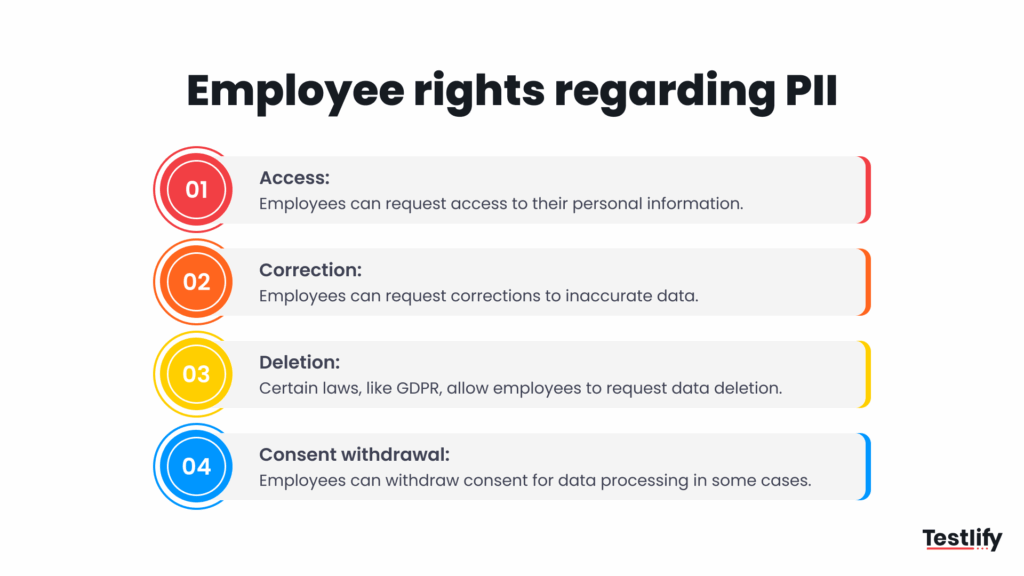
Organizations must comply with various data protection regulations depending on their location and the nature of the information. HR teams, especially in large enterprises, should be familiar with the following:
United States
- HIPAA (Health Insurance Portability and Accountability Act): Protects health-related information, particularly relevant for employee health benefits.
- GLBA (Gramm-Leach-Bliley Act): Covers financial information, which may come into play if HR handles payroll or retirement accounts.
- State laws: Many states, like California (CCPA) or New York (SHIELD Act), have their own regulations governing PII.
International
- GDPR (General Data Protection Regulation): Applicable if your organization handles data of EU citizens. GDPR has strict rules on data collection, storage, and consent.
- Other regional laws: Countries like Canada, Australia, and India have their own privacy regulations. Large organizations operating globally need a compliance strategy across regions.
Types of PII
PII can be grouped into two main categories: sensitive and non-sensitive. Understanding the distinction helps HR teams prioritize protection measures and handle employee and candidate data appropriately throughout recruitment, onboarding, and employment management processes.
Sensitive PII
Sensitive PII includes information that, if exposed, could lead to identity theft or discrimination. Examples:
- Social Security numbers
- Passport numbers
- Financial information
- Medical records
- Biometrics (fingerprints, facial recognition)
HR must exercise extreme caution when handling sensitive PII.
Non-Sensitive PII
Non-sensitive PII might not cause immediate harm if exposed but still requires careful handling. Examples:
- Name and job title
- Work email address
- Company ID
While non-sensitive PII may seem harmless, when combined with other data, it can become sensitive.
How HR Collects PII?
HR collects PII at multiple stages of the employee lifecycle. Some key touchpoints include:
Recruitment and hiring
- Job applications and resumes
- Background checks
- Pre-employment assessments
- Interview notes
Onboarding
- Employment contracts
- Tax forms (e.g., W-4 in the US)
- Benefits enrollment forms
- Direct deposit information
Employment management
- Performance reviews
- Attendance and timekeeping records
- Health and leave records
- Disciplinary actions
Offboarding
- Exit interviews
- Final payroll information
- Benefits termination
Each stage requires careful handling to ensure PII remains confidential and secure.
How is PII protected?
Protecting PII is both a legal obligation and a business necessity. Here are key ways HR teams can ensure PII is secure:
Limit data collection
Collect only the information that is necessary for the task at hand. Avoid storing sensitive personal details if they are not required for recruitment, payroll, or employee management. Limiting data reduces the risk of breaches and simplifies compliance with privacy regulations.
Secure storage
Store digital PII using encrypted solutions and restrict access to authorized HR personnel only. Physical files should be kept in locked cabinets, ensuring sensitive data is protected from unauthorized access or accidental exposure, both in daily operations and long-term storage.
- Use encrypted digital storage solutions.
- Limit access to authorized HR personnel only.
- Secure physical files with lockable cabinets.
Access control
Implement role-based access controls so that employees can only view or handle PII relevant to their specific job duties. Limiting access reduces the chance of internal breaches, accidental exposure, or misuse of sensitive employee or candidate information.
Data minimization and retention
Keep personal data only as long as legally or operationally necessary. Regularly review stored information and securely delete outdated or unnecessary records to reduce risk, maintain compliance, and ensure that only relevant and current PII is retained.
- Keep data only as long as legally or operationally required.
- Regularly review and securely delete outdated records.
Employee consent and awareness
Clearly inform employees and candidates about how their data will be collected, stored, and used. Obtaining explicit consent not only ensures compliance with privacy laws but also builds trust by showing respect for their personal information.
Training HR staff
Regularly train HR personnel to recognize potential threats such as phishing, social engineering, and other attacks targeting PII. Awareness and preparedness among staff strengthen organizational security and reduce the likelihood of accidental or intentional data breaches.
Vendor management
Many HR processes involve third-party vendors, such as assessment platforms or payroll providers. Ensure all vendors adhere to strict PII protection standards, have secure systems, and are contractually obligated to comply with relevant privacy laws, reducing risk when handling sensitive employee information.
Common PII risks for HR
HR departments face several risks if PII is mishandled:
Data breaches
Cyberattacks on HR systems can expose sensitive employee and candidate information, including Social Security numbers, payroll data, and medical records. Breaches can result in identity theft, regulatory penalties, and reputational damage for the organization.
Insider threats
Employees with access to sensitive data may intentionally or accidentally misuse it. Disgruntled or careless staff can leak confidential information, highlighting the need for strict access controls and monitoring within HR operations.
Phishing and social engineering
HR personnel are common targets for phishing emails, fake requests, and social engineering attacks designed to steal login credentials or PII. Training staff to recognize suspicious activity is essential to prevent unauthorized access.
Compliance violations
Failing to follow local, state, or international privacy laws can result in heavy fines, lawsuits, and reputational damage. HR teams must stay up-to-date on regulations like GDPR, CCPA, and HIPAA to maintain compliance.
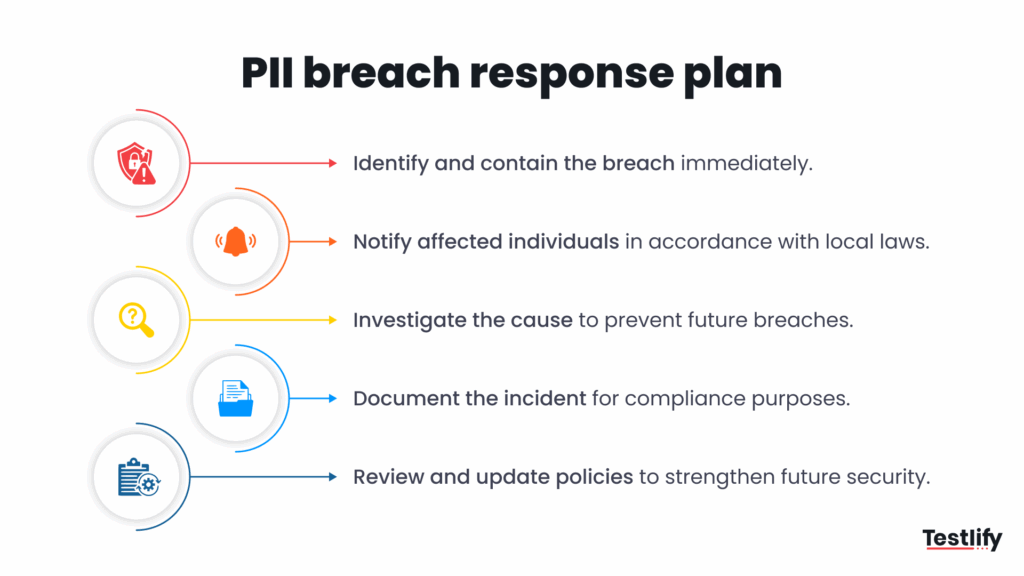
Effective risk mitigation requires combining secure technology, robust processes, and regular staff training. By implementing access controls, encryption, monitoring, and awareness programs, HR departments can significantly reduce the likelihood of PII breaches or misuse.
How technology can help in protecting PII?
Technology solutions are increasingly used to secure, manage, and streamline HR data, including PII.
Pre-hire assessment platforms
Platforms like Testlify securely store candidate assessment and evaluation data. This allows HR teams to make informed hiring decisions while ensuring that sensitive personal information is protected from unauthorized access or breaches.
HRIS and payroll systems
Modern Human Resource Information Systems (HRIS) and payroll systems encrypt sensitive employee data, control access, and provide secure storage. These systems reduce the risk of internal or external data exposure while maintaining operational efficiency.
Data loss prevention (DLP) tools
DLP tools monitor the use of sensitive data across HR systems, preventing accidental or malicious leaks. They help detect potential threats, enforce data policies, and ensure that confidential information does not leave secure channels.
Automated compliance checks
Some technology platforms offer automated compliance monitoring, helping HR ensure that data collection, storage, and processing meet regulations such as GDPR or CCPA. This reduces legal risk and streamlines privacy management for large organizations.
PII compliance checklist for HR
Here’s a brief checklist HR teams can follow to ensure proper PII management:
Task | Action points |
|---|---|
Data inventory | Identify all PII collected, stored, and processed |
Access control | Restrict PII access to authorized personnel |
Storage security | Encrypt digital data, lock physical files |
Vendor compliance | Ensure third-party vendors protect PII |
Employee consent | Obtain and document explicit consent |
Retention policy | Regularly review and delete outdated data |
Training | Conduct periodic training on data privacy |
Breach response | Have a clear, actionable breach plan |
Final thoughts
HR professionals are guardians of one of the most valuable assets in any organization: personal data. Understanding PII, implementing robust policies, and leveraging secure technology are essential steps toward compliance and operational excellence.
While platforms like Testlify provide secure ways to manage candidate data during hiring, the broader responsibility of protecting PII rests with HR. A combination of awareness, process, and technology ensures that organizations not only meet legal requirements but also foster a culture of trust and transparency among employees and candidates.
By following the guidance outlined in this blog, HR teams in large organizations can confidently navigate the complex world of PII management and create safer, more efficient processes for everyone involved.
Key takeaways
- PII is any data that can identify an individual, directly or indirectly.
- Mishandling PII can lead to legal, financial, and reputational consequences.
- HR processes, from recruitment to offboarding, collect and store sensitive information.
- Adopting secure technology, clear policies, and staff training are essential.
- Pre-hire assessment tools like Testlify can streamline hiring while keeping candidate data secure.
- Compliance with regional, national, and international privacy laws is non-negotiable.
By taking a proactive approach, HR teams can protect sensitive information, maintain trust, and mitigate risks across the employee lifecycle.
Frequently asked questions (FAQs)

Content Writer
Yashika Khandelwal is a Content Writer with 3+ years of experience creating research-backed content on hiring, talent assessment, and HR technology. She is a registered Organizational Psychologist and subject matter expert who combines behavioral science with practical recruitment insights to produce accurate, evidence-based content.
LinkedInRelated resources
View all
Skill assessment
What skills-based hiring data shows beyond the US and UK
HR & recruitment
AI across all stages of the hiring process in 2026

AI in recruitment
Best practices for hiring data analysts using assessments?
Candidate assessment
What tools support voice responses for language proficiency testing?
Candidate assessment
How do ATS-integrated assessments streamline hiring workflows?
Candidate assessment
How to assess financial modeling and accounting skills pre-hire?
Get started.
Hire on proof, not resumes.
Run your first skills-based assessment free — no credit card required.