
Top 15 Thrive Alternatives and Competitors
Discover 15 powerful Thrive alternatives to streamline your hiring process and assess candidates with confidence.
The best Thrive alternatives are skills-assessment platforms that publish their pricing, let you start without a sales call, and give you more than one signal on a candidate. Testlify, TestInvite, Adaface and Coderbyte all fit that description. Which one wins depends on what you hire for and how much you hire.
First, a warning that costs people an afternoon. Four different products are called Thrive, and search engines mix them freely. This page is about Thrive by Thrivetech, the UK psychometrics and skills-assessment company. If you meant the realistic-job-preview vendor, our ThriveMap alternatives roundup is the one you want.
 ChatGPT
 Gemini
 Claude
 Grok
Grok Perplexity
TL;DR
- Thrive by Thrivetech is a psychometrics-first assessment platform with a huge job-mapped library and per-candidate pricing that starts around 7 pounds. Its strength is behavioural science, not self-serve software.
- Teams usually leave for one of four reasons: they want published prices, faster setup, deeper anti-cheating controls, or AI interviewing built into the same tool as the tests.
- Testlify is the closest all-round replacement, with a published price ladder, 3,500-plus tests, conversational AI interviews and dual-device proctoring.
- If you hire engineers almost exclusively, a coding-first platform will serve you better than a general assessment suite.
- Check how each vendor handles AI-assisted candidates before you sign. Gartner expects one in four candidate profiles to be fake by 2028, and that changes what a test needs to prove.

Which Thrive do you actually mean?
Four products share the name, and the search results for "Thrive alternatives" mix all four. Sorting this out first saves you from evaluating performance-review software when you wanted a skills test.
- Thrive (Thrivetech): UK talent-assessment and psychometrics platform. Job-specific cognitive, personality, culture and skills assessments, plus voice-based behavioural interviewing. This is the one this page compares.
- ThriveMap: realistic job previews and day-in-the-life simulations for entry-level, high-volume hiring. Different buyer, different problem.
- Thrive TRM: a talent-relationship manager for executive search firms. Closer to a CRM than an assessment tool.
- Thrive (learning): a learning experience platform. Shows up in "Thrive alternatives" lists next to Lattice and Culture Amp, which is how buyers end up on the wrong page.
Pro tip: before you shortlist anything, open the vendor's own pricing page and check whether the product is sold per candidate, per seat or per year. That single detail predicts more about fit than any feature grid, because it tells you whether the tool was built for steady hiring or for one big annual intake.
What is Thrive used for in hiring?
Thrive by Thrivetech sells assessments mapped to more than 200,000 specific jobs, covering cognitive ability, personality, culture fit and practical skills. Candidates get benchmarked against a large comparison pool, and managers get interview questions generated from the results. The company also runs a pre-assessed candidate pool you can search, and it charges per candidate rather than per seat.
That model works well for a company that runs occasional, high-consideration hiring and wants psychometric rigour behind each decision. It works less well for a team that hires steadily, wants to self-serve, or needs coding tests and video interviews in the same tool.
Why do teams look for a Thrive alternative?
Four reasons come up again and again, and none of them is that Thrive is bad at what it does.
- Pricing you can read without a call. Per-candidate quoting is fine until you need to forecast a year of hiring. Buyers increasingly want a list price and a trial.
- One tool instead of three. Psychometrics in one place, coding tests in another and video interviews in a third is three logins and three invoices.
- Anti-cheating that holds up in 2026. Gartner's HR Symposium research puts fake candidate profiles at one in four by 2028, with 6 percent of 3,000 candidates surveyed admitting to some form of interview fraud. A personality questionnaire cannot tell you who actually sat the test.
- The skills keep moving. Employers expect 39 percent of key job skills to change by 2030, according to the Future of Jobs Report 2025. A library that updates slowly ages badly.
The stakes are real money. Replacing one employee costs between one-half and two times their annual salary, on Gallup's turnover cost analysis, and that is described as the conservative end.
How were these Thrive alternatives picked?
Every tool below had to clear four bars: a real assessment library rather than a survey builder, published or at least stated pricing, integration with the systems a hiring team already runs, and some defence against AI-assisted candidates. Beyond that, the ranking follows how well each tool covers multiple kinds of evidence.
That last point is the Testlify Multi-Signal Talent Evaluation Model in practice: one signal is fragile, several independent signals are not. A resume, one test score or one polished interview each fail on their own. Skills evidence plus work-sample evidence plus interview evidence plus reviewer feedback, pointing the same way, is a decision you can defend. The research backs the shape of that argument. Sackett and colleagues' 2022 reanalysis of selection validity in the Journal of Applied Psychology places structured interviews among the strongest predictors of job performance, and years of education and general experience among the weakest. The exact coefficients are still argued over in print. The ranking is not.
Thrive alternatives compared
Prices below are each vendor's own published entry point at the time of writing and they change often, so confirm the current list price before you commit.
Tool | Best for | Entry pricing | G2 rating |
|---|---|---|---|
Testlify | All-round assessment plus AI interviewing | $139/mo billed annually | 4.7 |
TestGorilla | Fast, simple multi-test screening | Free plan, then $83/mo | 4.5 |
Adaface | Candidate-friendly chat assessments | From $180/year | 4.6 |
Vervoe | Job simulations graded by AI | From $300/year | 4.6 |
Codility | Large-scale engineering recruitment | $1,200/year | 4.6 |
Mercer Mettl | Psychometrics with heavy proctoring | Quote only | 4.4 |
iMocha | Skills intelligence and upskilling | From $999/year | 4.4 |
Hirevue | High-volume video interviewing | Quote only | 4.1 |
TestDome | Work-sample tests for practical roles | Published on request | 4.5 |
Coderbyte | Developer hiring on a subscription | About $199/mo | 4.4 |
HireMojo | Recruiting automation and job posting | Quote only | 4.5 |
HackerEarth | Enterprise tech screening at volume | From $99/mo | 4.5 |
HackerRank | Developer assessment and interviews | From $198/mo | 4.5 |
TestInvite | Secure exams and certification | From $37/mo | 4.7 |
eSkill | Clerical, software and call-centre roles | Quote only | 4.5 |
1. Testlify
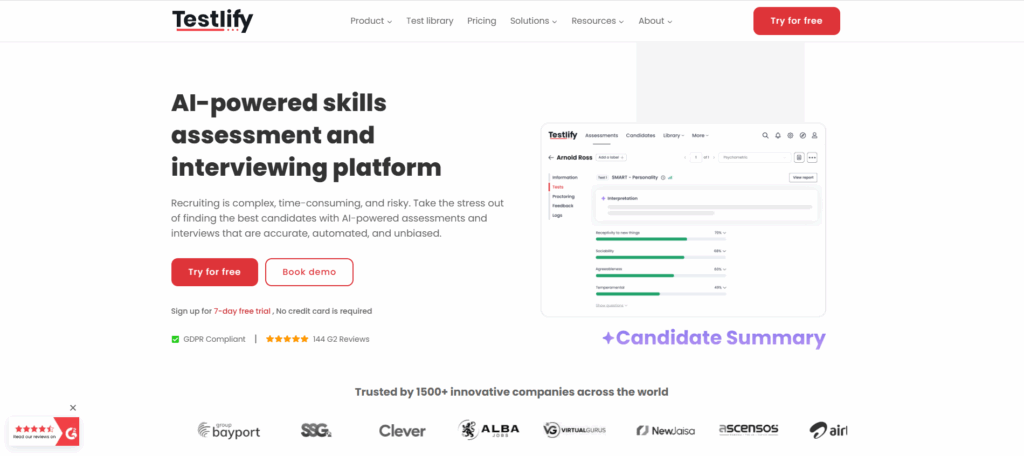
Testlify is an AI-powered skills assessment and interviewing platform built so that a hiring decision rests on evidence rather than a resume. It is the closest single-tool replacement for Thrive, because it covers the psychometric ground Thrive is strong on and then adds coding tests, work samples and conversational AI interviews in the same account.
Key features
- Test library: more than 3,500 ready-made tests across 4,500 roles and 50 industries, spanning cognitive ability, personality and culture, situational judgement, software skills, simulations and coding.
- 25 question types: including live Google Docs, Sheets, Slides, Word, Excel and PowerPoint tasks, plus vibe coding, where candidates direct AI tools to a working solution instead of typing syntax.
- AI interviews: one-way video, two-way conversational AI video, voice and outbound AI phone interviews, with selectable avatars and voices, custom prompts, attempt limits, automatic multilingual transcripts and auto-scoring a human can override.
- Dual-device proctoring: the candidate's phone becomes a second camera watching both them and their screen, and the session will not start until it is live. Almost nobody else in this list does that.
- Item-level psychometrics: difficulty index, discrimination index and quality-risk flags per question, so you can tell a hard question from a broken one.
- Integrations: 100-plus ATS integrations including Greenhouse, Lever and Workable, plus a simple built-in hiring pipeline for teams that do not run an ATS yet.
G2 rating: 4.7
Best for: teams under a few hundred people that want psychometrics, skills tests and interviews in one place, with a price they can read up front.
Testlify pricing
Testlify sells credits, one per assessment a qualified candidate starts, across a published plan ladder. Billed annually:
- Starter: $139/month, billed $1,668/year, 100 credits at $16.68 each, 3 seats.
- Basic: $279/month, billed $3,348/year, 300 credits at $11.16 each, 5 seats.
- Business: $699/month, billed $8,388/year, 1,000 credits at $8.39 each, 10 seats.
- Premium, Enterprise and Custom: 3,000, 10,000 and 25,000-plus credits, priced by volume through sales.
Monthly billing is a separate set of numbers for the same tier names. Extra seats are $15 each per month, AI phone interviews are billed at $0.18 per minute, and there is a 7-day free trial, a 30-day money-back guarantee and a 25 percent non-profit discount. Be aware that ATS integrations, white labelling and SSO are $2,388-a-year add-ons on the self-serve tiers rather than included, unless you are on a Custom plan.
2. TestGorilla
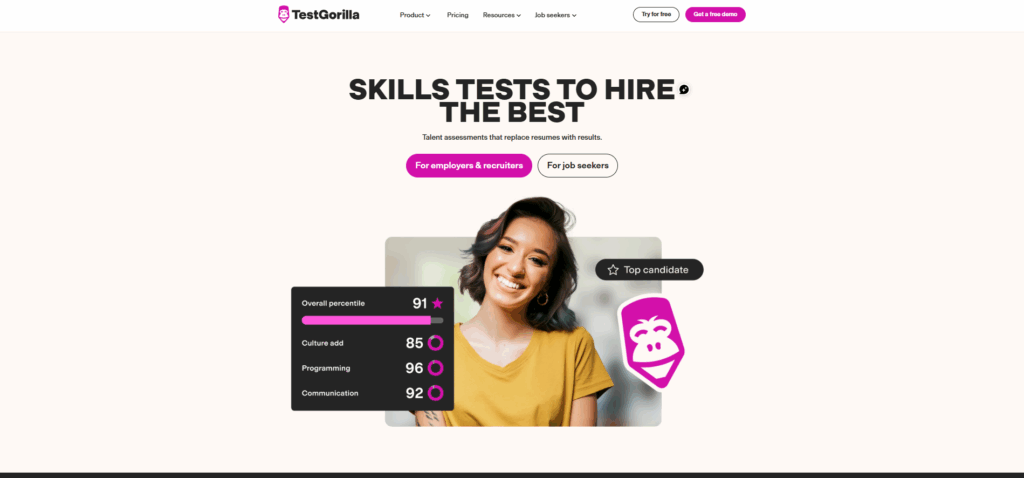
TestGorilla is built around speed and simplicity. You stack four or five short tests into one assessment, send it out, and read a ranked list. Teams that want structure without a long configuration project tend to land here.
Key features
- Pre-built assessments: 300-plus tests covering coding, numerical reasoning, cognitive ability, personality and culture add.
- Video questions: open-ended prompts for communication, persuasion and customer empathy.
- Bias controls: anonymous results and standardised scoring formats.
- Branding: your logo, colours and intro videos, with control over test order, difficulty and timing.
G2 rating: 4.5
Best for: small teams that want to be running a structured screen by tomorrow morning.
Pricing: a free plan with core tests and unlimited candidate invites, then Starter and Pro from $83 and $127 per month billed annually, varying by company size.
3. Adaface
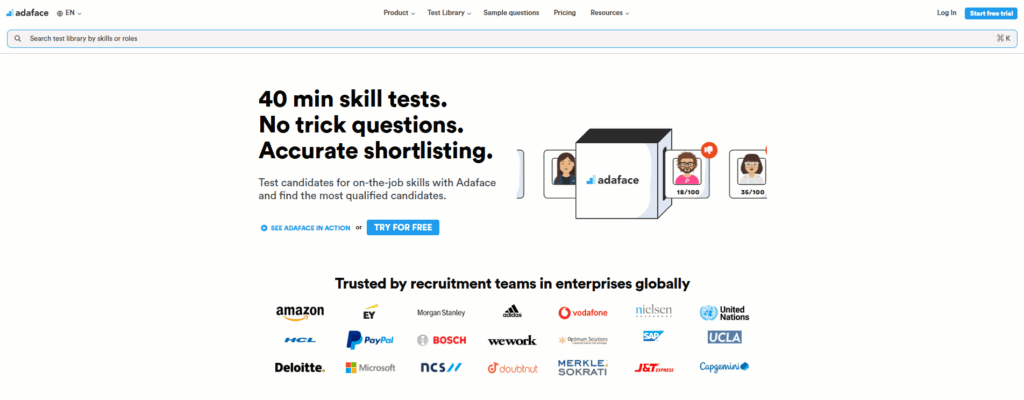
Adaface replaces the multiple-choice grid with a chat. Its assessments run as a conversation with a bot called Ada, which asks contextual, role-specific questions. Completion rates are the pitch, and for roles where candidates have options, that matters more than most feature comparisons admit.
Key features
- Conversational assessments: recruiter-style questioning that keeps candidates engaged and cuts drop-off.
- Template library: more than 150 pre-built tests for engineering, finance, support and operations roles.
- Real-time scoring: automatic pass, borderline and fail grouping so you can filter before anyone reads a transcript.
- Question integrity: questions are written in-house and never published, and the team re-checks monthly whether current AI tools can solve them.
G2 rating: 4.6
Best for: teams hiring in competitive markets where candidate experience decides who finishes the test.
Pricing: free trial available, with plans from $180 per year for individual use and scaling for larger teams.
4. Vervoe
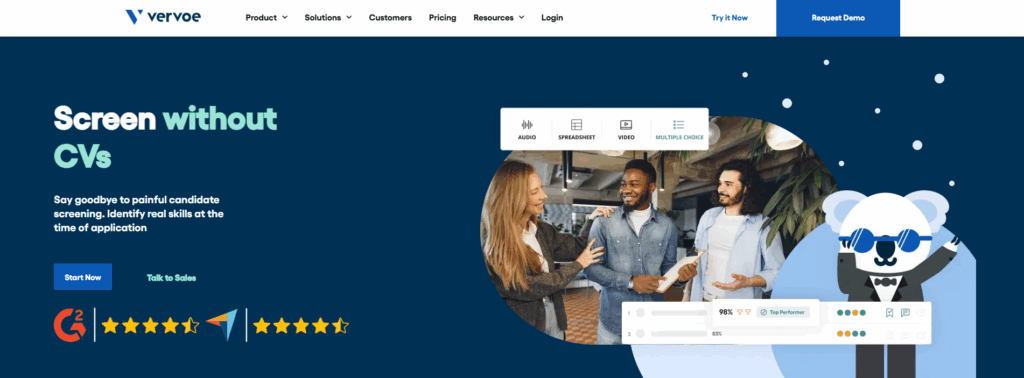
Vervoe's whole argument is merit over resumes. Candidates do the job rather than describe it, and AI grades and ranks what they produce. The assessments lean on practical exercises across customer support, sales, marketing, technology and operations.
Key features
- Job simulations: 300-plus pre-built tests modelled on real on-the-job tasks.
- Multi-format answers: text, video, file uploads and spreadsheets in one assessment.
- AI grading: responses scored and ranked on accuracy, effort and relevance.
- Team review: several reviewers score and comment in one shared dashboard.
G2 rating: 4.6
Best for: roles where output is easy to judge and a multiple-choice test tells you nothing useful.
Pricing: pay as you go, which suits uneven hiring cycles. The entry plan starts around $300 per year for 10 candidates and rises with volume.
5. Codility
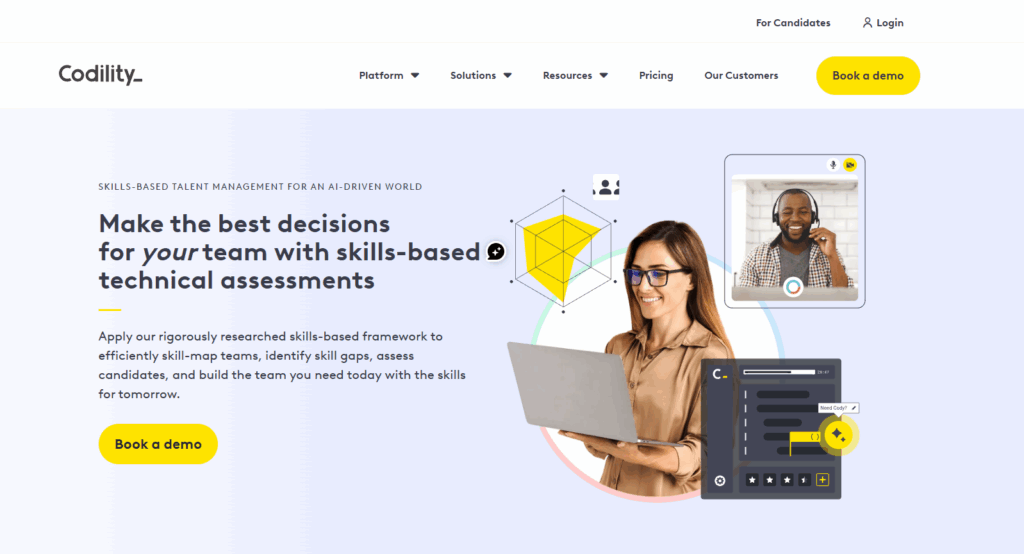
Codility is engineering recruitment at scale. It screens with on-the-job coding challenges and then hosts the collaborative technical interview in the same place, which keeps the pipeline in one system rather than three.
Key features
- Coding task bank: more than 1,100 tasks across 45-plus programming languages, from basic algorithms to system design.
- Live technical interviews: real-time pair coding in Codility's own editor with a compiler and test runner.
- Automated scoring: submissions judged on correctness, efficiency and readability without a manual code review.
- Reporting: per-task breakdowns, test cases passed and code-quality scores.
G2 rating: 4.6
Best for: engineering organisations running structured technical hiring all year.
Pricing: three tiers, with Starter at $1,200 per year, Scale at $6,000 per year and a custom enterprise plan.
6. Mercer Mettl
Mercer Mettl is the closest match to Thrive's own centre of gravity: research-based behavioural and psychometric evaluation, backed by a large consultancy, with proctoring built for exams as much as for hiring. Campus recruitment and professional certification are where it shows up most.
Key features
- Test coverage: 200-plus job-specific assessments across technical, cognitive, behavioural and psychometric domains, all customisable.
- Enterprise proctoring: AI face recognition, browser lockdown and live human invigilation.
- Branding: your logos and a dedicated test domain for a consistent candidate experience.
- Reporting: competency scoring, percentile comparisons and hiring recommendations mapped to your own frameworks.
G2 rating: 4.4
Best for: large organisations running campus intakes or certification programmes.
Pricing: quote only, based on test volume, candidate numbers and features.
7. iMocha
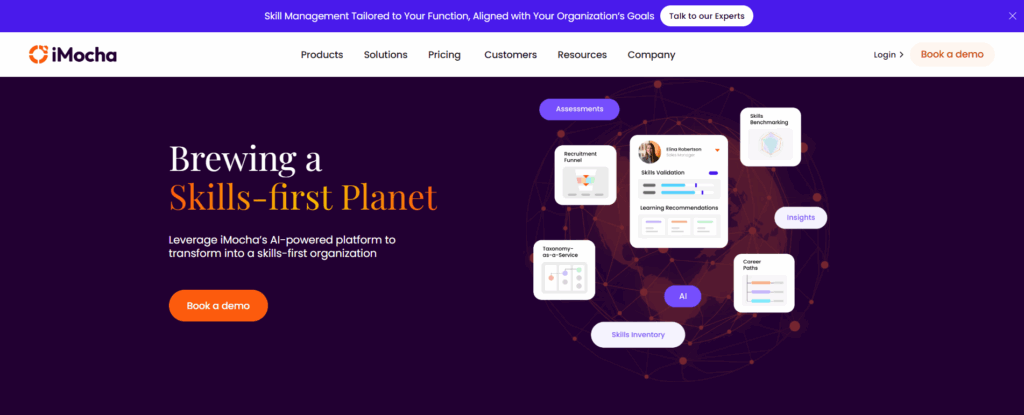
iMocha reaches past hiring into workforce planning. It maps skills across an existing workforce as well as a candidate pool, which makes it a fit for companies whose real problem is knowing what their people can already do.
Key features
- Test library: more than 3,000 ready-to-use tests and 30,000-plus mapped skills, including SAP, cybersecurity and financial services.
- Custom test builder: mix existing questions with new ones under flexible scoring logic.
- AI interviewer: a virtual interviewer that runs adaptive, chat-based conversations rather than fixed questions.
- Reporting: performance broken down by domain, skill group and question category.
G2 rating: 4.4
Best for: companies running skills inventories and internal mobility alongside hiring.
Pricing: 14-day free trial, with plans from $999 per year and scaling for larger teams.
8. Hirevue
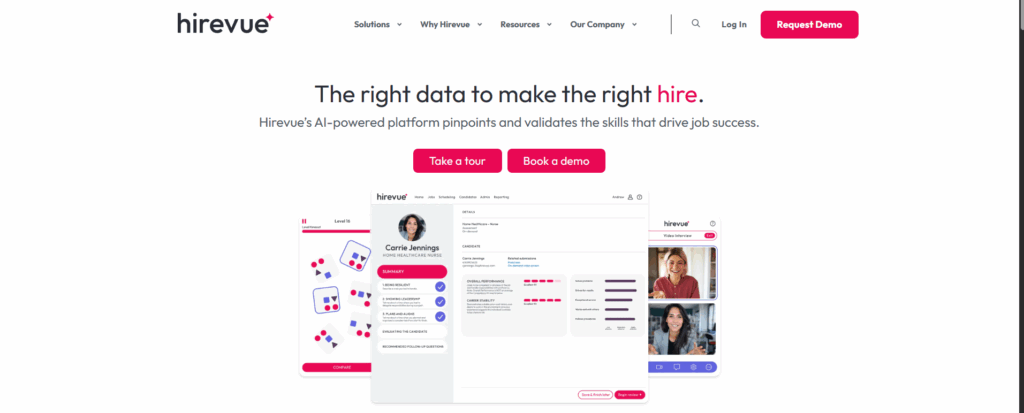
Hirevue is built for hiring hundreds of people at once. On-demand video interviews, coding challenges and game-based assessments feed a structured scoring process, and the scheduling automation around it is the part high-volume teams actually buy.
Key features
- Validated question library: role-specific interview questions developed from industrial-organisational psychology.
- Video interviews: one-way and live formats with structured scoring rubrics.
- Game-based assessments: cognitive games measuring problem-solving and communication.
- Automation: interview scheduling, chatbot candidate engagement and ATS integrations.
G2 rating: 4.1
Best for: enterprise teams hiring at seasonal volume where scheduling is the bottleneck.
Pricing: three tiers, none published. A demo booking is required to get numbers.
9. TestDome
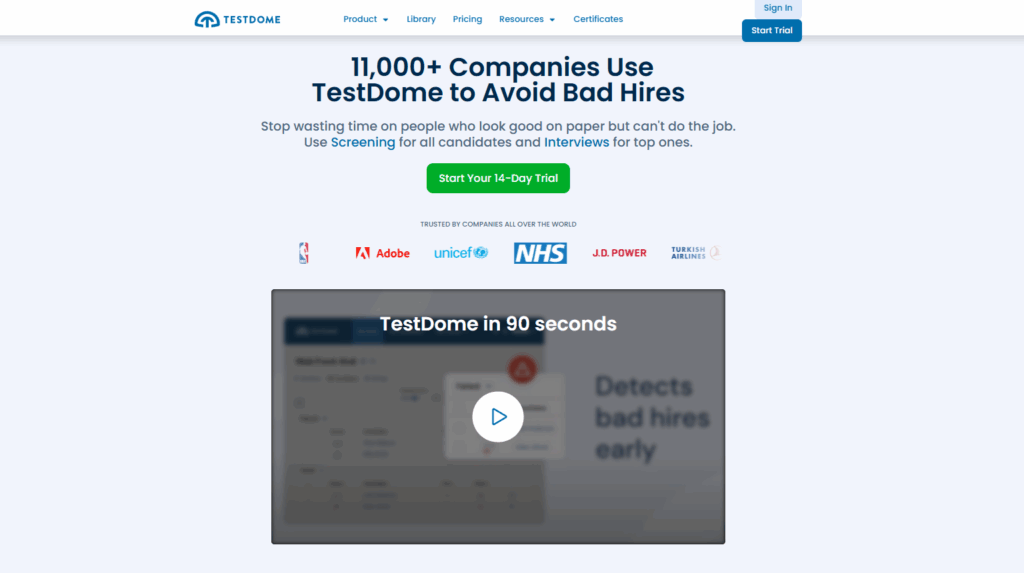
TestDome sticks to work samples. Rather than trivia, its tests ask candidates to do a scaled-down version of the actual task, across programming, IT, accounting and customer service. Tests are short by design, which is the point when you are filtering a large top of funnel.
Key features
- Work-sample testing: realistic tasks that mirror day-to-day responsibilities.
- Test library: more than 150 pre-built tests across development, accounting, customer service and data entry.
- Custom questions: build your own tasks or blend them with the library.
- Benchmarking: visual scorecards, percentile rankings and clear pass or fail indicators.
G2 rating: 4.5
Best for: teams filtering a big applicant pool down to a workable shortlist.
Pricing: subscription-based, published on TestDome's own pricing page. The figure previously shown here belonged to a different vendor and has been removed rather than guessed at.
10. Coderbyte
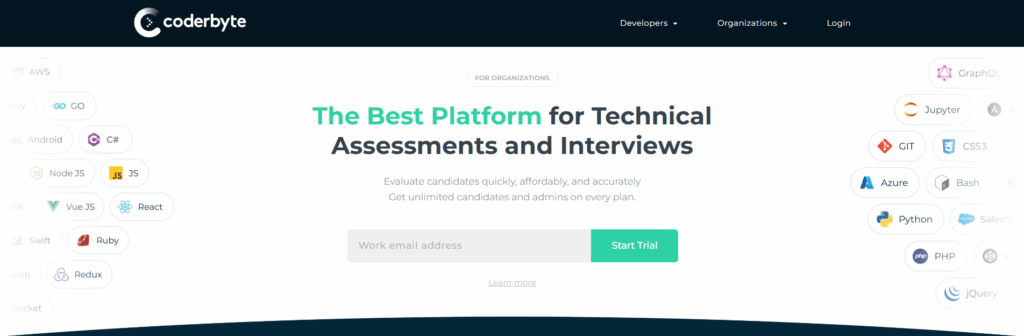
Coderbyte serves startups and mid-sized companies hiring developers and data scientists. The subscription model, with unlimited tests rather than per-candidate charges, is what pulls growing teams across from per-seat vendors.
Key features
- Challenge library: 1,000-plus coding challenges across 30-plus languages and over 100 technical skills, plus full project exercises.
- Mixed question types: coding tasks, multiple choice, open written answers and SQL queries.
- Interview tools: live technical interviews with video, a shared code editor, Jupyter notebook and spreadsheet support and a whiteboard.
- Reporting: code submissions, replayable session recordings, automated scorecards and benchmarking charts.
G2 rating: 4.4
Best for: growing engineering teams that want predictable costs rather than per-candidate billing.
Pricing: subscription-based at roughly $199 per month for unlimited candidates and tests, with discounted annual billing.
11. HireMojo
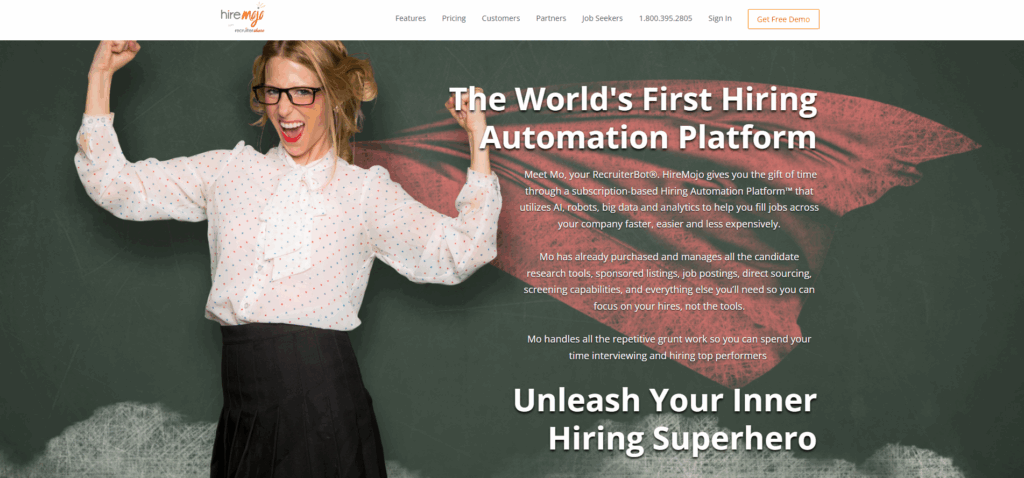
HireMojo is not really an assessment tool, which is exactly why it belongs on this list for some readers. If your bottleneck is getting enough applicants rather than sorting them, a platform that pushes jobs to 100-plus boards and pre-screens the replies solves the problem you actually have.
Key features
- Automated job posting: distribution across many job boards and sourcing channels without manual effort.
- Pre-screen and scoring: a patented online interview process that ranks applicants against your own questions.
- Content library: ready-made job descriptions and interview questions you can adapt.
- Candidate management: resumes, pipeline stages, notes, scheduling and automated candidate emails.
G2 rating: 4.5
Best for: teams whose problem is applicant volume, not applicant quality.
Pricing: not published. Quotes are tailored to company size, hiring volume and features.
12. HackerEarth
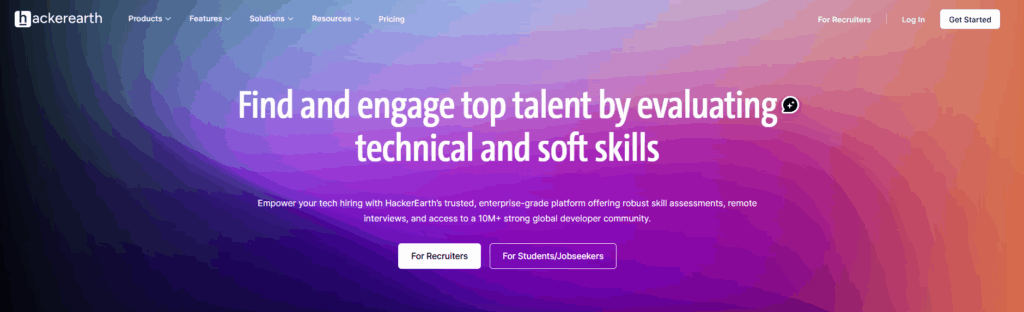
HackerEarth handles enterprise tech screening at volume, with unusually broad coverage of specialist engineering roles and proctoring designed for hiring events where thousands sit the same test at once.
Key features
- Content library: 25,000-plus questions across software development, data science, AI and machine learning, DevOps and cloud.
- FaceCode interviews: collaborative coding interviews with a shared editor, question banks and a virtual whiteboard.
- Advanced proctoring: AI webcam monitoring, tab tracking, audio detection and behavioural analysis, with live human proctoring for high-stakes tests.
- Custom tests: templates or from scratch, with your own scoring logic, difficulty levels and time limits.
G2 rating: 4.5
Best for: large tech organisations running hackathons and campus hiring drives.
Pricing: plans from $99 per month, with higher tiers for larger teams.
13. HackerRank
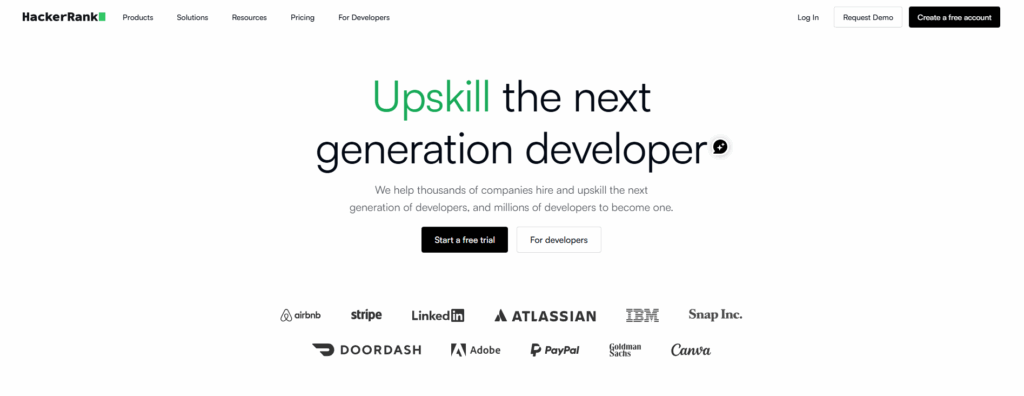
HackerRank is the name most engineering leaders already know, and familiarity counts: candidates have usually seen the interface before, which removes one source of test anxiety from the process.
Key features
- Question library: around 7,500 curated questions across 45-plus programming languages, covering frontend, backend, data, security and QA.
- Interview workflows: screening, take-home tests and live interviews in one platform, with pair programming and system-design boards.
- Anti-cheating: webcam recording, copy detection and time analysis.
- Structured scoring: custom rubrics covering coding ability, collaboration and problem-solving.
G2 rating: 4.5
Best for: engineering teams that want a standard their candidates already recognise.
Pricing: from $198 per month for the starter plan.
14. TestInvite
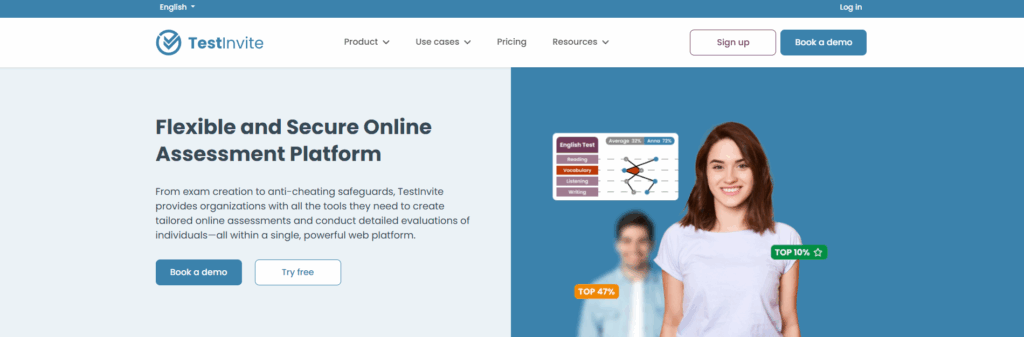
TestInvite is the option for people who need control over every detail of the exam. Question design, scoring logic, timing and proctoring are all configurable to a degree the simpler tools deliberately avoid, which is why certification bodies and universities use it alongside employers.
Key features
- Custom test creation: multiple choice, essays, coding and video responses, with your own scoring logic and timing.
- Assessment library: pre-built tests for problem-solving, communication and role-specific competencies.
- Detailed reports: full control over scoring, metrics, benchmarks and score categories, with written interpretations.
- Proctoring: lockdown browser, AI cheating detection, randomised question banks and video or audio monitoring.
G2 rating: 4.7
Best for: certification, licensing and any assessment that has to stand up to a challenge.
Pricing: from $37 per month for the Starter plan with a capped number of attempts, rising with usage and add-ons.
15. eSkill
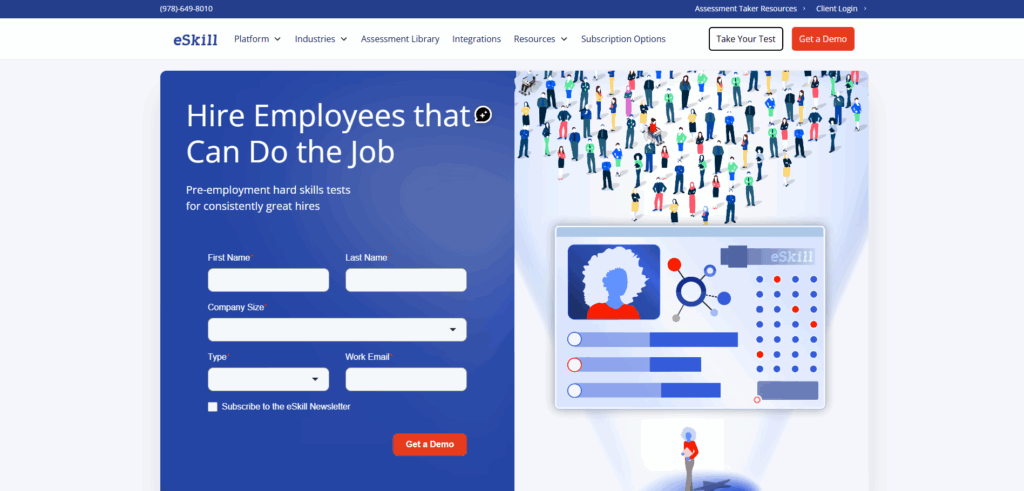
eSkill covers the operational middle of a business that flashier tools skip: clerical work, software proficiency, literacy and numeracy, accounting, legal and call-centre scenarios. Its simulations put candidates into the actual task rather than asking about it.
Key features
- Test library: more than 600 ready-to-use tests, plus custom assessments built from thousands of questions by subject, topic or software tool.
- Job simulations: interactive scenarios such as a customer service call, a data entry task or an IT troubleshooting exercise.
- Proctoring: monitoring for copy-paste, excessive window switching and irregular response patterns, flagged in real time.
- Analytics: candidate reports broken down by subject area and question type.
G2 rating: 4.5
Best for: operations, finance and support teams hiring for measurable desk-based skills.
Pricing: quote only, arranged with their sales team.
Which is the best Thrive alternative?
Testlify, for most teams replacing Thrive. It covers the same psychometric and skills ground, adds coding tests, work samples and conversational AI interviews in one account, and publishes what it costs so you can plan a year of hiring without a discovery call.
The honest exceptions are worth stating. If you hire engineers and almost nobody else, a coding-first platform will beat a general suite. If you run campus intakes for thousands of students, the enterprise proctoring vendors were built for that scale. If your problem is that not enough people apply, an assessment tool will not fix it. And if you liked Thrive precisely because a behavioural scientist is standing behind the norms, keep that in your evaluation criteria rather than trading it away for feature count. For a closer look at the two side by side, there is a head-to-head Testlify and Thrive breakdown, and a wider roundup of talent assessment tools if you want to widen the shortlist.
Start with one role, not the whole process
Pick a single open role, build one assessment for it, and run your next ten candidates through it alongside your current process. Two weeks later you will know whether the scores predicted who you actually wanted to interview. That is a smaller commitment than a platform migration and a much better test than a feature grid. Start free on Testlify, or book a walkthrough and bring the role you are struggling to fill.
Key takeaways
- Check which Thrive you mean before anything else. Four products share the name across assessment, realistic job previews, executive-search CRM and learning. Evaluating the wrong category is the most common way this search wastes a week, and it is free to avoid.
- Pricing model predicts fit better than feature count. Per-candidate pricing suits occasional, high-consideration hiring; credit or subscription pricing suits steady hiring. Work out which pattern you have before you compare anything else, because the wrong model turns a good tool into an unpredictable invoice.
- One signal is fragile. A resume, a single test score or one strong interview each fail on their own. Advance candidates when several independent signals agree, which is what the Testlify Multi-Signal Talent Evaluation Model is for and what the selection-validity research supports.
- Anti-cheating is now a selection criterion, not a nice-to-have. With fake candidate profiles heading toward one in four by 2028, ask every vendor how they verify that the person scoring well is the person who will do the job, and what evidence a recruiter actually sees.
- Match the tool to the role you hire most. Coding-first platforms win for engineering-only teams, exam platforms win for certification, and general assessment suites win when you hire across functions. Buying the wrong specialism is expensive to unwind.
- The cost of getting it wrong is measurable. Replacing one employee runs between one-half and two times their salary on Gallup's conservative estimate, which is the budget any assessment platform is competing against.
FAQs

Director of Marketing
Akash Patange is the Director of Marketing at Testlify, where he works closely with HR leaders and recruiters to help organizations improve hiring outcomes. He writes about talent assessment, recruitment technology, and data-driven hiring practices.
LinkedInRelated resources
View all
Alternatives
Top 15 Total Testing Alternatives and Competitors
Alternatives
Top 15 ThriveMap Alternatives and Competitors
Alternatives
Top 15 UbiAptitude Alternatives and Competitors
Alternatives
Top 15 Zapilio Alternatives and Competitors
Alternatives
Top 15 TalentClick Alternatives and Competitors
Alternatives
Top 15 ASC Smarter Assessment Alternatives and Competitors in 2026
Get started.
Hire on proof, not resumes.
Run your first skills-based assessment free — no credit card required.