
Top 15 Total Testing Alternatives and Competitors
Discover 15 powerful Total Testing alternatives to streamline your hiring process and assess candidates with confidence.
The best Total Testing alternatives in 2026 are Testlify, TestGorilla, Adaface, Vervoe and Mercer Mettl, and which one wins depends less on test-library size than on three things: whether you need interviewing as well as testing, whether your first-stage test has to be proctored, and whether you pay per test or per candidate. That last one moves the bill more than anything else on this page.
Total Testing has sold web-based employment testing since 2002, and it is still a solid catalogue for clerical, software-skills and behavioral screening. But it charges per completed test, its first-stage test is unproctored by design, and it does not do video or AI interviewing. Teams that outgrow one of those three limits are the ones searching for a replacement.
Below are 15 platforms worth shortlisting, what each is actually good at, and a table you can scan in about a minute.
 ChatGPT
 Gemini
 Claude
 Grok
Grok Perplexity
TL;DR
- Total Testing is a validated test catalogue, not a hiring platform. If you only need clerical, Microsoft Office or personality screening, it still does that job well.
- The pricing unit matters more than the sticker price. Per completed test punishes multi-test batteries; per candidate does not.
- If your shortlist involves video or AI interviews, remote proctoring, or item-level reporting, you are shopping outside Total Testing's scope, not comparing like for like.
- Testlify is the closest replacement for teams that want tests plus interviews plus proctoring in one tool, with 3,500+ tests and published pricing.
- Coding-heavy teams should look at the developer-first platforms instead; a general skills catalogue will not test what they need.
- Ask every vendor on this list the same three compliance questions before you sign anything. They are in the section near the end.

What is Total Testing, and who is it for?
Total Testing is a web-based employment testing company founded in 2002 that sells validated skills and behavioral assessments to employers and staffing firms. Its own site describes a catalogue of 800+ validated skills and behavioral assessments, roughly 50,000 tests administered a year, and more than 3,500 unique clients over the past three years.
The catalogue leans clerical and operational: Microsoft Office proficiency, typing and data entry, accounting, industrial and safety, plus personality and behavioral instruments. A Build Your Own Test option assembles a custom battery from over 200 pre-validated scales. Results land in a dashboard called TotalView, and score reports are emailed to the administrator as soon as a candidate finishes.
Pricing works two ways. Pay-As-You-Go bills $30 per completed test with no contract and no charge for tests nobody takes. Pre-Pay buys tokens in blocks of 25 or more, the tokens never expire, and the rate drops with volume, down to roughly $12 per test in the 1,000 to 2,500 range. ATS integration is listed under the Pre-Pay account rather than the pay-as-you-go one.
One design choice shapes everything else: Total Testing uses two-stage testing. The first test is unproctored and taken wherever the candidate likes. If the score matters, the employer runs a shorter proctored confirmation test at their own place of business. That is a defensible model for local hourly hiring. It is a poor fit if your candidates are remote and you needed the first score to be trustworthy.
Why teams look for a Total Testing alternative
Four reasons come up repeatedly, and only one of them is price.
No interviewing. Total Testing tests. It does not run one-way video interviews, conversational AI interviews or phone screens, so anything past the test score happens in a different tool.
Unproctored first stage. Remote-first teams cannot easily run a supervised confirmation test at an office nobody visits. That matters more each year: Gartner predicted in January 2025 that by 2028 one in four candidate profiles worldwide will be fake. An identity check after the fact is not the same as one during the test.
Per-test billing. A three-test battery costs three times a single test. Screen 60 candidates on three tests each and that is 180 completed tests, or about $5,400 at the pay-as-you-go rate, before anyone reaches an interview.
Emailed scorecards. A PDF in your inbox tells you what a candidate scored. It does not tell you whether the question was any good, how the candidate ranked against everyone else who sat it, or which items nobody could answer.
There is also a slower reason. Skill requirements keep moving: the World Economic Forum's Future of Jobs Report 2025 found employers expect 39% of workers' key skills to change by 2030. A catalogue that ages well for typing speed ages badly for anything touching AI tooling.
How do Total Testing competitors compare on test quality?
Test quality is not library size. It is whether the test predicts performance, and whether the way you combine scores is consistent. Two pieces of research are worth knowing before a demo.
The first is Sackett and colleagues' 2022 re-analysis in the Journal of Applied Psychology, which recalculated operational validity estimates for common selection methods and revised several long-quoted figures downward. Structured interviews, job-knowledge tests and work samples held up best. Unstructured conversation did not.
The second is Kuncel and colleagues' 2013 meta-analysis in the same journal, which compared mechanical and judgment-based ways of combining candidate data. Combining scores by a consistent formula beat expert judgment applied by eye, and it was not close.
Read together, they point at a practical rule: more signals, combined the same way every time, beat one score interpreted by whoever happens to read it. That is the idea behind the Testlify Multi-Signal Talent Evaluation Model, which combines assessment results, interviews, simulations, references and reviewer feedback into one comparable view instead of resting a decision on a single number. Any vendor on this list should be able to explain how its scores combine. Several cannot.
Pro tip: ask each vendor for the difficulty and discrimination index on a test you care about. A question that 95% of candidates answer correctly is not screening anyone, and a vendor who cannot show you that statistic probably is not measuring it.
How we evaluated these tools
Every platform below was assessed against the same seven criteria, weighted for a team replacing a test-only catalogue rather than buying its first assessment tool:
- Test-library depth and question types. How many roles are covered, and can you build what is missing?
- Interviewing. One-way video, live, AI-led, phone, or none at all.
- Proctoring model. Automated, live human, record-and-review, or unproctored.
- Reporting. A score, or per-question analytics and benchmarking.
- ATS integration. Native connectors, and on which plan.
- Pricing unit. Per test, per candidate, per seat, or unlimited.
- Compliance evidence. Validation documentation, adverse-impact reporting, audit support.
A note on what is not here: per-vendor G2 scores and exact list prices were removed from this page because they could not be verified against a primary source at the time of writing, and one of them was wrong (the previous version quoted Coderbyte's price inside the TestDome section). Pricing models are described instead. Check the vendor's own pricing page before you budget.
Quick comparison table
Platform | Category | Standout capability | Pricing model | Best for |
|---|---|---|---|---|
Total Testing | Skills catalogue | Two-stage supervised confirmation testing | Per completed test | Local hourly and clerical hiring |
Testlify | Assessment and interviewing | Dual-device proctoring plus AI interviews | Per candidate credit | Teams replacing tests plus interviews |
TestGorilla | Skills assessment | Large validated test library | Per candidate subscription | Structured multi-test screening |
Adaface | Skills assessment | Chat-style conversational tests | Per candidate subscription | Reducing candidate drop-off |
Vervoe | Skills assessment | AI-graded job simulations | Per candidate, tiered | Work-sample-first hiring |
Codility | Technical assessment | Live collaborative coding interviews | Annual subscription | Large engineering intakes |
Mercer Mettl | Psychometrics | Live human invigilation | Quote only | Campus and certification testing |
iMocha | Skills intelligence | Skills taxonomy and gap analysis | Annual subscription | Internal mobility and upskilling |
HireVue | Video interviewing | Structured on-demand video plus games | Quote only | High-volume enterprise hiring |
TestDome | Work-sample testing | Short task-based screening tests | Subscription | Fast first-pass filtering |
Coderbyte | Technical assessment | Unlimited coding tests and projects | Flat subscription | Startups hiring developers |
TalentClick | Behavioral and safety | Safety and risk-behavior profiles | Flat unlimited-use plan | Industrial and driver roles |
HackerEarth | Technical assessment | Deep proctoring on coding tests | Monthly subscription | Enterprise developer screening |
HackerRank | Technical assessment | Screening plus live interview in one | Monthly subscription | Engineering teams at scale |
TestInvite | Exam software | Granular exam and scoring control | Tiered subscription | Certification and high-stakes exams |
eSkill | Skills catalogue | Job simulations plus custom batteries | Quote only | Direct Total Testing swap |
1. Testlify
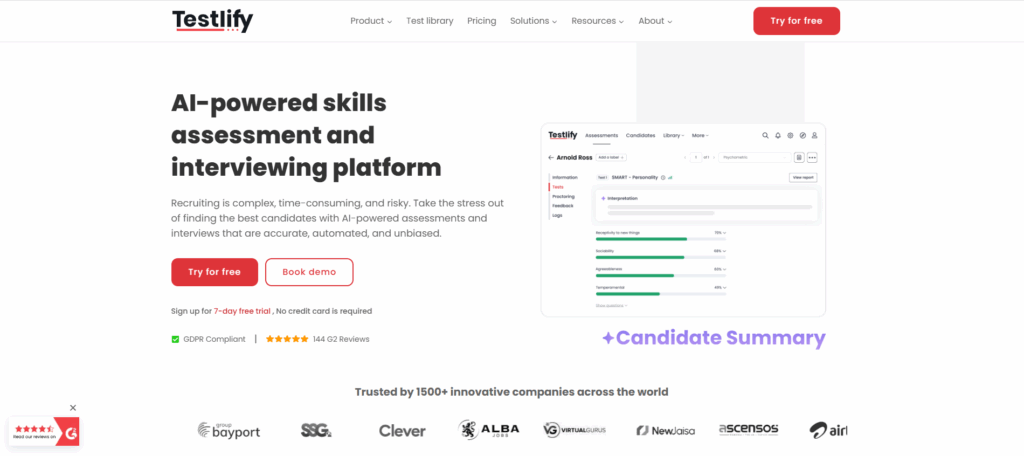
Testlify is an AI-assisted, human-led assessment and interviewing platform. It is the closest thing on this list to a like-for-like Total Testing replacement, because it covers the test catalogue and everything that normally happens after the test in the same tool.
Key features
- 3,500+ tests, 25+ question types. The test library spans cognitive, personality, role-specific, coding and language testing across 4,500+ roles. Question types include live Microsoft Excel, Word, PowerPoint and Google Workspace tasks, and vibe-coding questions where candidates direct AI tools to a working solution rather than typing syntax.
- Interviews in four formats. One-way async video, two-way conversational AI video, voice, and outbound AI phone interviews billed at $0.18 a minute. You pick the AI avatar and voice, write the prompts, cap attempts and recording time, and get multilingual transcripts. AI scoring is advisory by default and a human can override it.
- Dual-device proctoring. The candidate's phone becomes a second camera pointed at both their face and their screen, and the assessment will not start until it is connected. Three presets (Standard, Strict, Custom) cover the rest: tab-switch detection, ID face-match, multi-monitor restriction and AI-tool detection.
- Item-level psychometrics. Difficulty index, discrimination index, quality-risk flags, answer distribution and percentile benchmarking per question, not just a candidate score.
- 100+ ATS integrations. The integration catalogue covers Greenhouse, Lever, Workday and the rest, sold as a $2,388 a year add-on below the Custom tier. Teams with no ATS get a simple built-in hiring pipeline instead: job requisitions, an application form, job-board publishing and applied through shortlisted stages.
Pricing
Published on the Testlify pricing page, billed annually. One credit covers one started assessment, however many tests are inside it.
- Starter: $139 a month, billed $1,668 a year. 100 credits, 3 seats.
- Basic: $279 a month, billed $3,348 a year. 300 credits, 5 seats.
- Business: $699 a month, billed $8,388 a year. 1,000 credits, 10 seats.
- Premium, Enterprise and Custom: 3,000, 10,000 and 25,000+ credits, priced by sales.
There is a 7-day free trial with no card, a 30-day money-back guarantee, a 24-month price lock and a 25% non-profit discount. Extra seats are $15 each a month.
Here is the pricing-unit difference in numbers. Screen 60 candidates on a three-test battery: that is 180 completed tests at Total Testing's $30 pay-as-you-go rate, roughly $5,400. On Testlify the same work is 60 credits, which sits inside the $1,668 Starter plan. The honest catch runs the other way too: Total Testing charges nothing for a test nobody takes, while a Testlify credit is spent the moment a candidate starts. If half your invitees ghost you, that gap narrows.
Best for
Teams under a few hundred employees that want testing, interviewing and proctoring in one place with pricing they can read off a page.
2. TestGorilla
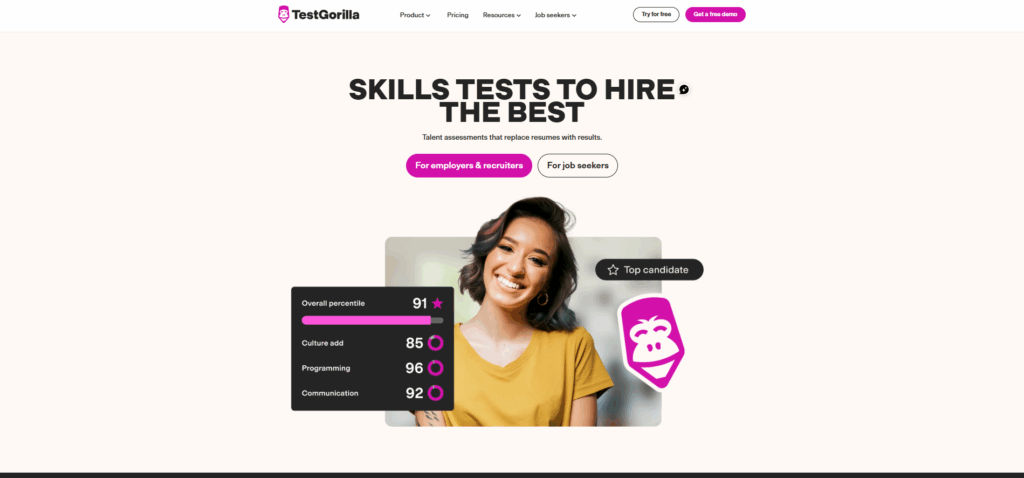
TestGorilla is a skills assessment platform built around structured, multi-test assessments. It is the most direct catalogue-to-catalogue swap for Total Testing, with a broader modern test range and a per-candidate subscription instead of per-test billing.
Key features
- A validated library covering coding, cognitive ability, numerical reasoning, personality and culture add-on tests.
- Open-ended one-way video prompts for communication and customer-facing roles.
- Anonymised results and standardised scoring to reduce reviewer bias.
- Branding controls over test order, difficulty and timing.
Best for
Teams that want a like-for-like test catalogue with a modern candidate experience and predictable per-candidate cost.
3. Adaface
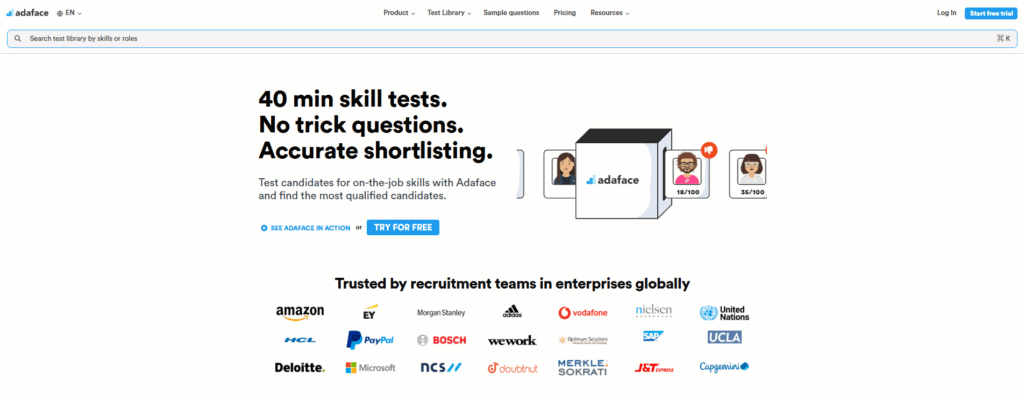
Adaface replaces the multiple-choice format with a chat-style assessment, which is its whole pitch: candidates who would abandon a 40-minute quiz will often finish a conversation.
Key features
- Conversational assessments run by a chatbot that asks contextual follow-ups.
- Pre-built test templates across engineering, finance, support and operations roles.
- Automatic pass, borderline and fail banding to cut manual review.
- In-house authored questions that are not publicly indexed, re-checked against common AI tools.
Best for
Teams losing candidates at the assessment step, especially in competitive technical markets.
4. Vervoe
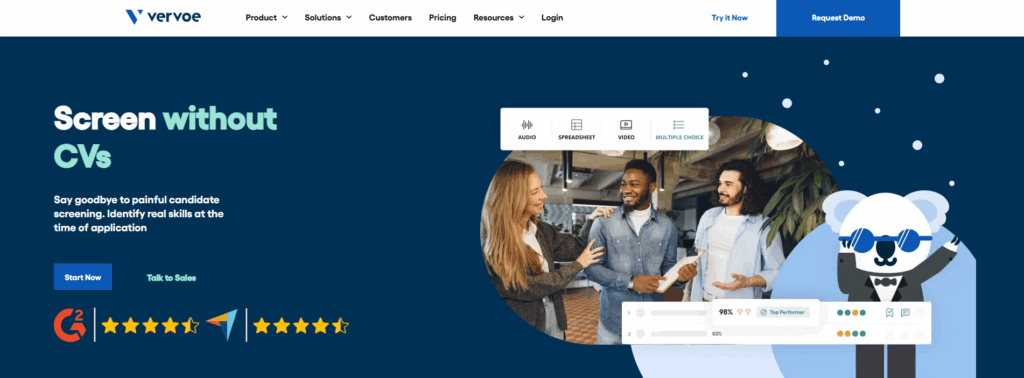
Vervoe is built on job simulations rather than knowledge questions. Candidates do a version of the work and the AI grades and ranks the output, which suits roles where the resume tells you almost nothing.
Key features
- Pre-built simulations across customer support, sales, marketing, technology and operations.
- Mixed response formats including text, video, file upload and spreadsheets.
- AI grading that ranks candidates on accuracy, effort and relevance.
- Shared review workspace so several people score the same responses.
Best for
Skills-first hiring where you want to see the work, not a score for knowing about the work.
5. Codility
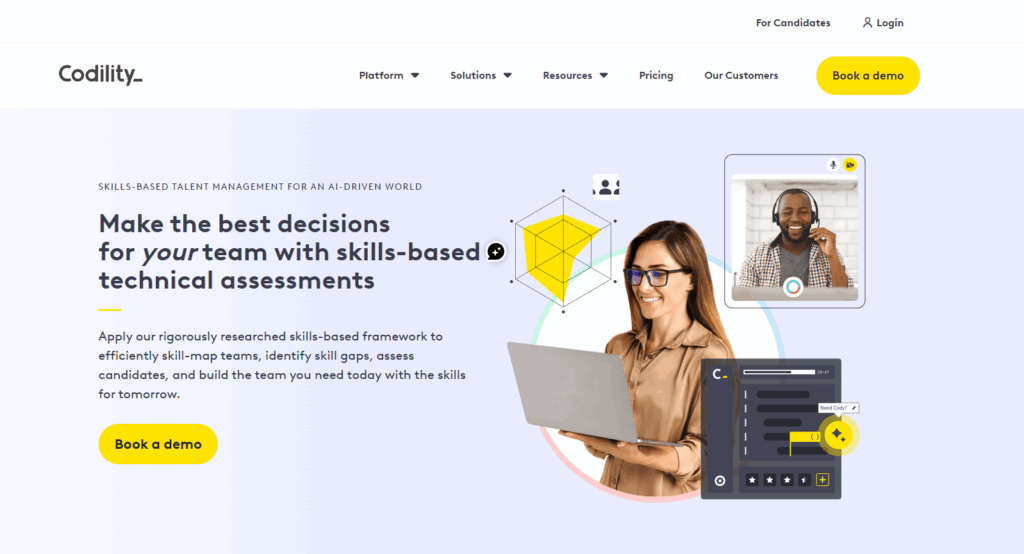
Codility is a coding assessment platform for large engineering intakes. It is not a Total Testing replacement in any general sense; it is what you buy if the roles you cannot fill are all technical.
Key features
- A large task bank spanning 45+ programming languages, from basic algorithms to system design.
- Live collaborative coding interviews in a browser IDE with a compiler and test runner.
- Automated scoring on correctness, efficiency and readability.
- Task-level reports showing test cases passed and code-quality scores.
Best for
Engineering teams running structured technical screens at volume.
6. Mercer Mettl
Mercer Mettl is a psychometric and behavioral assessment platform with unusually heavy proctoring. Of everything here it is the closest in spirit to Total Testing's supervised second stage, except the supervision happens remotely.
Key features
- Job-specific assessments across technical, cognitive, behavioral and psychometric domains.
- Proctoring with face recognition, browser lockdown and live human invigilation.
- Branded test experience on a dedicated test domain.
- Competency-based scoring with percentile comparisons.
Best for
Campus recruitment, certification programmes and any test where a disputed result is expensive.
7. iMocha
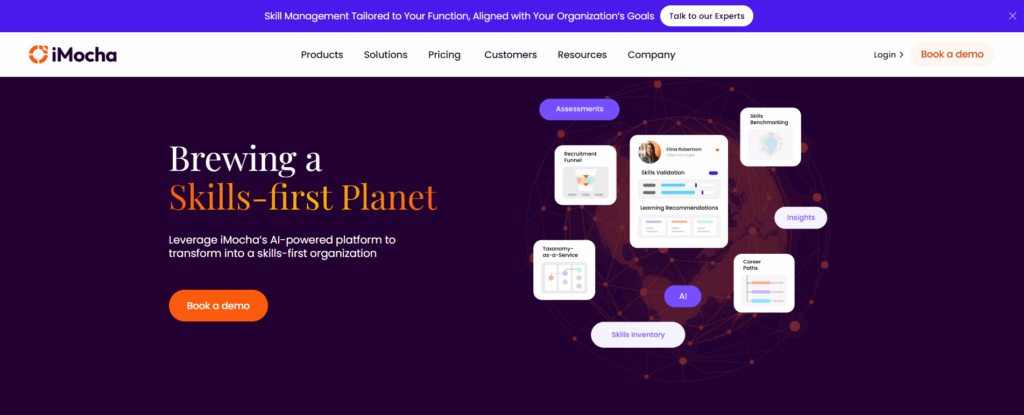
iMocha has moved past pre-hire testing into skills intelligence, which means mapping what your existing workforce can do as well as what applicants can. That is a different purchase from a screening catalogue, and worth knowing before you compare prices.
Key features
- A very large test library with skills mapped to job roles, including SAP, cybersecurity and financial services.
- Custom test builder combining existing and new questions with flexible scoring.
- A conversational AI interviewer for real-time chat-based assessment.
- Reporting broken out by domain, skill group and question category.
Best for
Organisations that want one skills taxonomy covering hiring and internal mobility.
8. HireVue
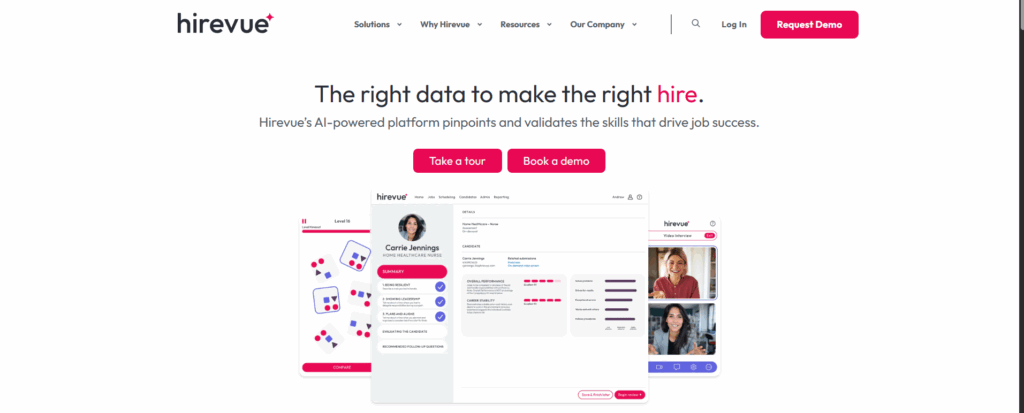
HireVue is an interviewing platform first and an assessment platform second, aimed at hiring thousands rather than dozens. If your bottleneck is interview scheduling rather than test coverage, it solves a problem Total Testing never addressed.
Key features
- A validated question library grounded in industrial-organisational psychology.
- On-demand and live structured video interviews with scoring rubrics.
- Game-based cognitive assessments.
- Interview scheduling automation and ATS connectors.
Best for
Enterprise high-volume hiring where interview logistics are the constraint.
9. TestDome
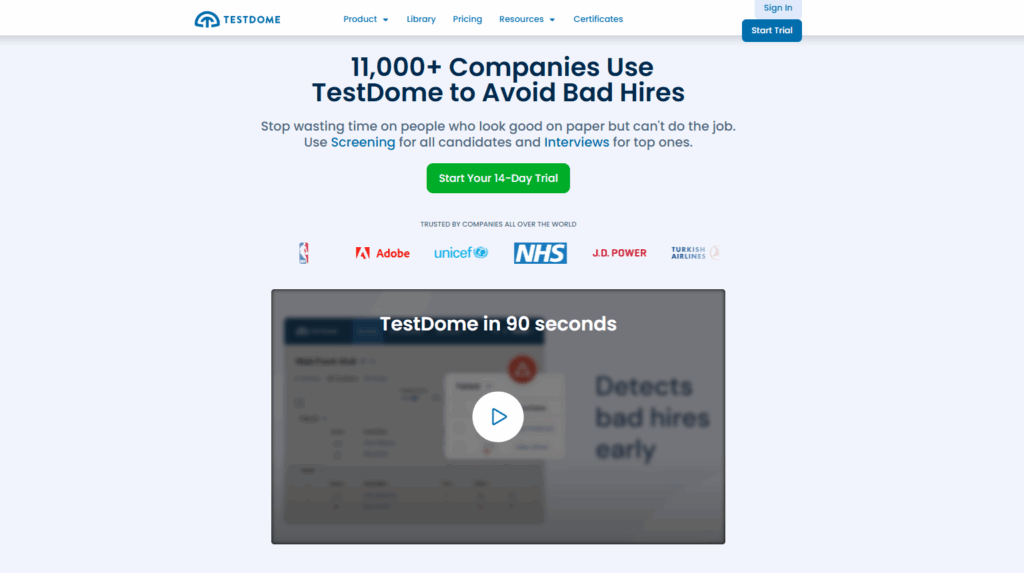
TestDome is deliberately narrow: short, task-based tests that simulate real job work rather than quiz trivia. It is a first-pass filter, not a full evaluation stack.
Key features
- Work-sample tasks that mirror day-to-day job responsibilities.
- Pre-built tests across software development, accounting, customer service and data entry.
- Custom question creation alongside the standard library.
- Visual scorecards with percentile rankings and pass or fail indicators.
Best for
Cutting a large applicant pool down quickly before anyone spends interview time.
10. Coderbyte
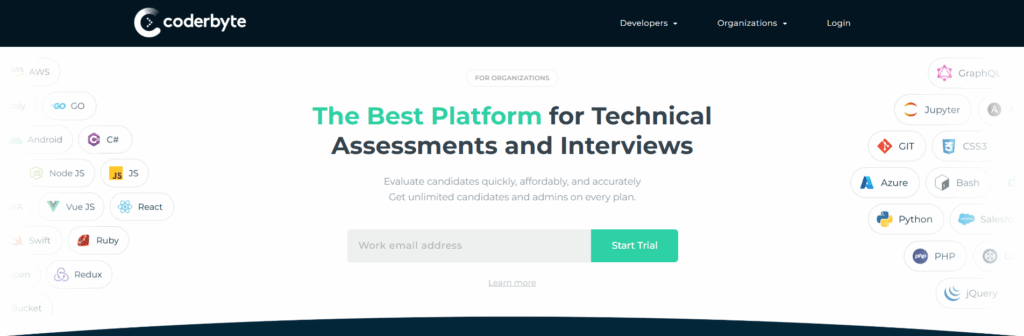
Coderbyte is a technical assessment platform pitched at startups and mid-sized teams, with a flat subscription that removes the per-candidate maths entirely.
Key features
- A large challenge library spanning 30+ programming languages and 100+ technical skills, plus take-home projects.
- Mixed question types including coding tasks, multiple choice, written answers and SQL queries.
- Live interview tools with a shared code editor, notebooks and a whiteboard.
- Replayable sessions, automated scorecards and benchmarking charts.
Best for
Fast-growing engineering teams that want unlimited screening at a fixed cost.
11. TalentClick
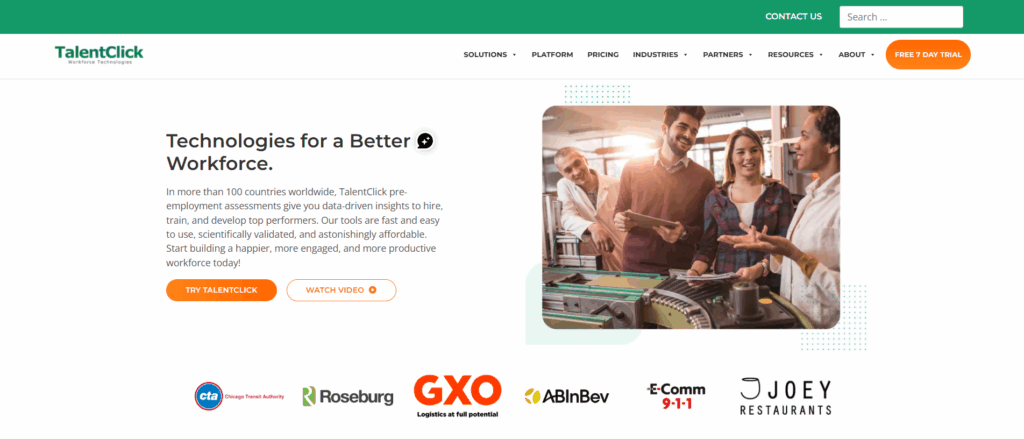
TalentClick is a behavioral and safety-risk assessment specialist. For industrial, driving and field roles it measures something a skills test does not: how likely someone is to take a dangerous shortcut.
Key features
- Flat-rate unlimited-use plans with no per-assessment fee.
- Validated instruments including Attitude-Values-Personality, Safety Quotient, Driver Safety Quotient and Cognitive Quotient.
- Fit Scores that rank candidates against a predefined performance profile.
- A reporting portal with team analytics and usage tracking.
Best for
Construction, manufacturing, logistics and any role where a safety incident is the real cost of a bad hire.
12. HackerEarth
HackerEarth is enterprise developer screening with the heaviest proctoring in the technical group, which makes it the pick when a coding test result has to survive scrutiny.
Key features
- A very large question bank across software development, data science, AI, DevOps and cloud.
- Collaborative coding interviews with a shared editor and whiteboard.
- Webcam monitoring, tab tracking, audio detection and optional live human proctoring.
- Custom assessments with configurable scoring, difficulty and time limits.
Best for
Large technical intakes where cheating risk is a stated concern.
13. HackerRank
HackerRank is the best known developer hiring platform, and its strength is running screening, take-homes and live interviews through a single workflow rather than three tools.
Key features
- A curated question library across 45+ programming languages covering frontend, backend, data, security and QA.
- Screening, take-home tests and live interviews in one pipeline.
- Pair-programming and system-design boards for interviews.
- Proctoring with webcam recording, copy detection and time analysis.
Best for
Engineering organisations standardising technical hiring across many teams.
14. TestInvite
TestInvite is exam software rather than a hiring product, and it gives you more control over scoring rules than anything else here. That control is the point, and also the learning curve.
Key features
- Custom test creation with multiple choice, essay, coding and video response types.
- A pre-built library covering problem-solving, communication and role-specific competencies.
- Deep reporting control over metrics, benchmarks, score categories and written interpretations.
- Lockdown browser, randomised question banks and video or audio monitoring.
Best for
Certification bodies, training providers and high-stakes internal exams.
15. eSkill
eSkill covers much the same ground as Total Testing: clerical, software proficiency, literacy and maths, accounting, legal and call-centre scenarios. Of everything on this list it is the most conservative swap, which is either reassuring or limiting depending on why you are leaving.
Key features
- Hundreds of ready-made tests plus custom batteries assembled from a large question pool.
- Interactive job simulations such as a customer service call or a data entry task.
- Anti-cheating monitoring for copy-paste, window switching and irregular response patterns.
- Candidate reports broken down by subject area and question type.
Best for
Teams that want the Total Testing catalogue model with a different vendor behind it.
Which test company competitors and alternatives fit best?
Match the tool to the constraint you actually have, not to the longest feature list.
- You hire hourly, local and clerical staff, and the current setup works. Stay. Total Testing or eSkill will keep doing this job. Switching costs you money and buys nothing.
- You hire remotely and need the first score to be trustworthy. You need real remote proctoring, which rules out an unproctored first stage. Testlify's dual-device setup and Mercer Mettl's live invigilation are the two strongest answers here.
- Your candidates drop out mid-assessment. Shorten the test or change the format. Adaface and TestDome are both built around that problem.
- Most of your open roles are technical. A general catalogue will not help. Codility, HackerRank, HackerEarth and Coderbyte are the shortlist, split by intake size and budget shape.
- You run three or more tests per candidate. Move off per-test billing. On 180 completed tests the difference between per-test and per-candidate pricing is thousands of dollars a year, not hundreds.
- You want tests, interviews and proctoring in one tool. That narrows fast. Testlify and HireVue are the two that genuinely cover both halves, at opposite ends of the company-size range.
One more filter that people skip: who is going to run this? A team of two with no dedicated recruiter should weight setup time and published pricing heavily. A quote-only vendor with a six-week implementation is not a better product, it is a different kind of purchase.
Compliance questions to ask any vendor
Three questions, and the answers should arrive in writing.
Can you show adverse-impact data for this test? The Uniform Guidelines on Employee Selection Procedures, 29 CFR Part 1607, treat a selection rate below four-fifths of the highest-scoring group's rate as evidence of adverse impact. A vendor selling validated tests should be able to report against it.
Does an automated tool score or rank candidates, and has it been audited? New York City's Local Law 144 requires an annual independent bias audit and candidate notice for automated employment decision tools, per the city's guidance for employers. If you hire in New York, this is not optional.
Can a human override the machine? Candidate trust is thin: a Gartner survey published in July 2025 found just 26% of job applicants trust AI to evaluate them fairly. A platform where AI scoring can be set to advisory, and a named reviewer makes the call, is easier to defend to a candidate and to a regulator.
Run a skills test with Testlify this week
Testing 15 vendors is its own project. Pick the two that match your constraint, run the same role through both, and compare what the reports actually tell you.
Testlify's 7-day free trial needs no card, and the assessment library is open to browse before you sign up. If you would rather see the proctoring and AI interview setup on a real role first, book a demo and bring the job description. For the head-to-head on one vendor, read the Testlify and Total Testing comparison.
Key Takeaways
- The pricing unit decides the bill. Per completed test scales with how many tests you run, per candidate does not. At 60 candidates on a three-test battery that is roughly $5,400 against $1,668, so any shortlist that ignores the unit is comparing the wrong numbers. Work out your own candidate count and test count before you look at a single price.
- Unproctored first-stage testing is a real constraint, not a detail. Total Testing's supervised confirmation test assumes candidates can visit your office. If they cannot, the first score is the only score you get, and Gartner's 2028 fake-profile prediction is a reason to care. Ask exactly when identity is verified.
- Library size is a weak signal. Sackett and colleagues' 2022 re-analysis moved several long-quoted validity figures downward, and Kuncel's 2013 meta-analysis showed consistent score combination beats expert eyeballing. Ask how scores combine, and ask for difficulty and discrimination indices per question.
- Match the tool to the bottleneck. Drop-off needs a shorter format, technical roles need a technical platform, and interview logistics need an interviewing platform. Buying breadth you will not use is the most common way these purchases go wrong.
- Get compliance answers in writing before you sign. Adverse-impact reporting under 29 CFR Part 1607, a Local Law 144 bias audit if you hire in New York, and a documented human override on any AI score. A vendor who cannot answer these in a sales call will not answer them in a dispute.
- Switching is not free. If the current catalogue covers your roles and your candidates are local, staying put is a legitimate answer, and cheaper than a migration nobody asked for.
FAQs

Director of Marketing
Akash Patange is the Director of Marketing at Testlify, where he works closely with HR leaders and recruiters to help organizations improve hiring outcomes. He writes about talent assessment, recruitment technology, and data-driven hiring practices.
LinkedInRelated resources
View all
Alternatives
Top 15 ThriveMap Alternatives and Competitors
Alternatives
Top 15 UbiAptitude Alternatives and Competitors
Alternatives
Top 15 Zapilio Alternatives and Competitors
Alternatives
Top 15 TalentClick Alternatives and Competitors
Alternatives
Top 15 ASC Smarter Assessment Alternatives and Competitors in 2026
Alternatives
Top 15 Canditech Alternatives and Competitors
Get started.
Hire on proof, not resumes.
Run your first skills-based assessment free — no credit card required.