
Interview Questions Bank: 30+ HR Questions to Ask
Learn an essential interview question bank for HR professionals, with tips on effective preparation, identifying red flags, and role-specific questions.
A hiring manager can ask ten candidates ten different questions and still have no fair way to compare them. That is the quiet problem an interview question bank solves. An interview question bank is a ready set of vetted questions, sorted by type and mapped to the skills a role needs, so every candidate faces the same core questions and every answer can be judged on evidence instead of a gut feeling. This guide gives HR professionals that bank: general, behavioral, and role-specific questions, what a strong answer actually shows, the red flags to watch, and a simple way to score what you hear. Structured interviews like these are the single strongest predictor of job performance in recent selection-science research, so the way you ask matters as much as what you ask.
TL;DR
- An interview question bank is a reusable, competency-mapped set of questions every candidate answers, so hiring rests on evidence rather than memory.
- Use three buckets: general fit questions, behavioral questions that pull real examples, and role-specific questions tied to the job’s core skills.
- Structured interviews (same questions, scored the same way) predict on-the-job performance far better than a free-flowing chat.
- Score each answer against a short rubric and pair the interview with a skills assessment, so one weak or polished answer never decides the hire.
- Watch patterns, not single moments: vague answers, blame, and pay-first focus matter when they repeat across questions.
 ChatGPT
 Gemini
 Claude
 Grok
Grok Perplexity
What is an interview question bank?
An interview question bank is a curated library of interview questions, organized by category and tied to the competencies a role requires, that a hiring team reuses for every candidate. Instead of inventing questions on the spot, interviewers pull from the same set, ask them in the same order, and compare answers side by side. The bank turns interviewing from an improvised conversation into a repeatable, fair process.
Think of it as the question layer of a bigger system. A good bank does not just list questions; it says which skill each question tests and what a strong answer looks like. That is the difference between a page of prompts and a tool a team can actually hire with.

Why does a structured question bank win?
Because consistency is what makes an interview predictive. When every candidate gets the same planned questions and answers are scored against a set rubric, the interview becomes a real measurement instead of a popularity test. Unstructured chats reward whoever is most comfortable talking, not whoever can do the job best.
The research is blunt about this. Recent selection-science work now ranks structured interviews above cognitive-ability tests for predicting performance, and they roughly double the accuracy of an unstructured chat. Getting the hire wrong is expensive on both ends: SHRM benchmarking puts the average cost per hire near $4,129 and time to fill around 42 days, and a mis-hire means paying that bill twice. The people asking the questions matter too. Gallup finds managers account for at least 70% of the variance in team engagement, which is a strong argument for training every interviewer on the same bank rather than letting each one wing it.
Dimension | Structured question bank | Unstructured chat |
|---|---|---|
Questions | Same core set for every candidate | Different for each person |
Scoring | Rubric, agreed before interviews | Gut feel, decided after |
Comparability | Answers line up side by side | Hard to compare fairly |
Bias exposure | Lower, criteria are fixed | Higher, first impressions lead |
Defensibility | Clear evidence trail | Little record of why |
How do you build an interview question bank?
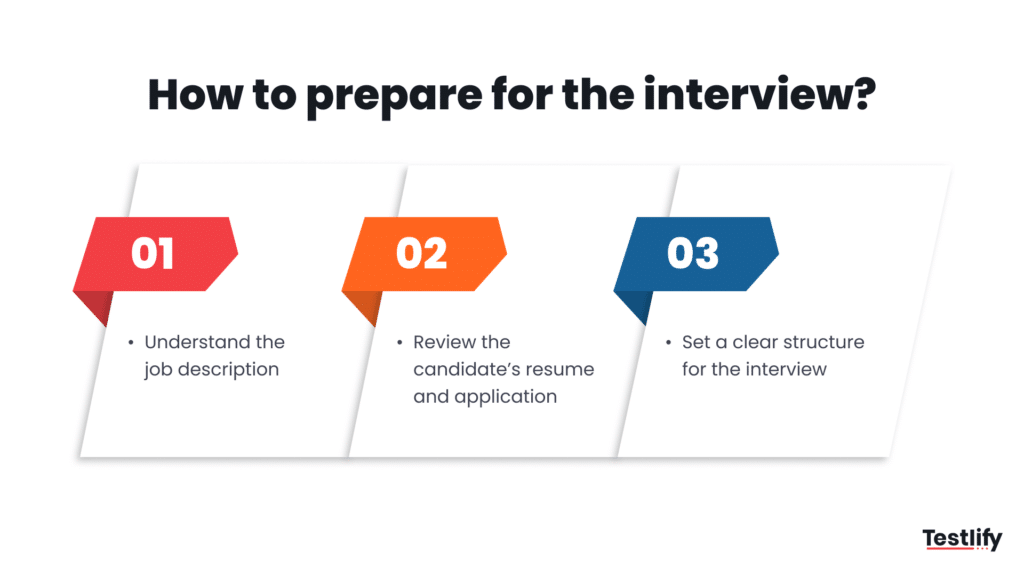
Start with the role, not the questions. The fastest way to a useful bank is to work from competencies to evidence, which is the idea behind the Testlify Competency-to-Evidence Matrix: map every role to the four to six competencies that predict success, then connect each competency to the evidence that proves it, including interview questions, skills assessments, and structured reviewer feedback. Build the bank in five steps:
- List the core competencies. For a support lead that might be problem-solving, written communication, de-escalation, and ownership. Skip generic traits nobody scores.
- Write two or three questions per competency. Mix a behavioral prompt (a real past example) with a situational one (how they would handle a live scenario).
- Note what a strong answer shows. One line per question keeps every interviewer scoring the same thing, not their own hunch.
- Set the core set and the order. Ask every candidate the same anchor questions first, then allow a few role-specific follow-ups.
- Add a simple 1-to-5 rubric. Agree the scale before interviews start so scores mean the same thing across the panel.
Keep the bank alive. Retire questions candidates have clearly rehearsed, add new ones as the role changes, and review it each hiring cycle. For the full interviewing workflow around the bank, our guide on running an effective job interview walks through scheduling, panels, and note-taking, and the primer on how structured interviews work covers the scoring side in depth.
How many questions belong in the bank?
Enough for choice, few enough to score well. A practical bank holds three to four questions per competency, so interviewers can swap one out when a candidate has clearly rehearsed the usual prompt, while still asking the same core anchors every time. That usually lands the bank somewhere between 20 and 30 questions for a single role.
In any one interview, aim for 8 to 12 questions you actually score, not a rapid-fire list. A 45 to 60 minute interview leaves room to ask a follow-up when an answer is thin, and to hold back 10 minutes for the candidate’s own questions. Depth on a handful of questions beats a shallow sweep of 30, because a scored, probed answer tells you far more than a rushed one.
General interview questions to ask
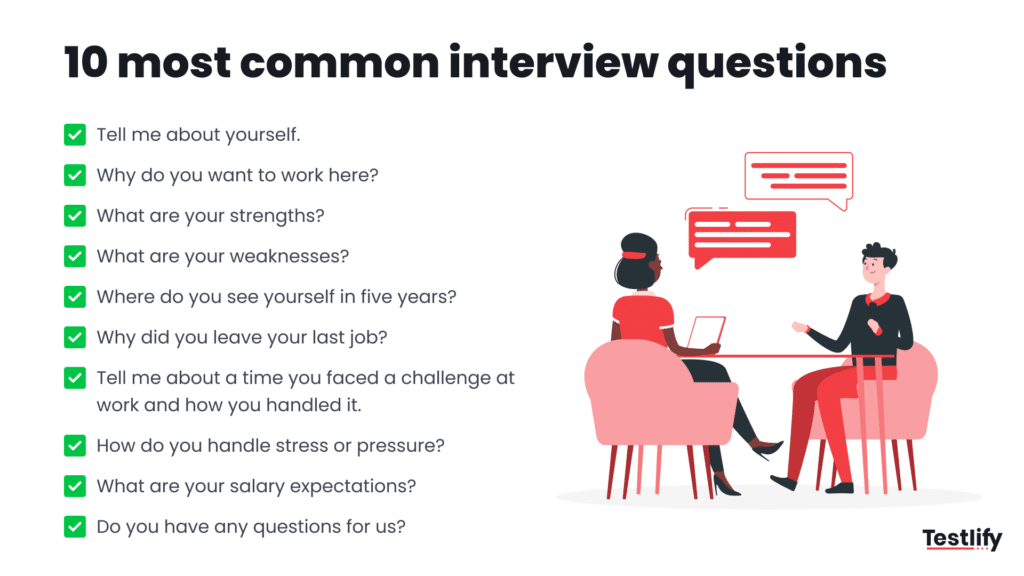
General questions open the interview and check basic fit: motivation, expectations, and how someone talks about their work. They are not the deciding round, so keep them short and move to evidence quickly. Strong versions and what each one reveals:
- Why are you interested in this role? Shows whether they researched the job or are applying to everything. Look for specifics about the work, not the perks.
- Walk us through a project you are proud of. Reveals what they consider good work and how they explain it to someone outside their team.
- What does your ideal team look like? Surfaces working style and whether it matches how your team actually operates.
- Where do you want to grow in the next two years? Tests self-awareness and whether the role can realistically get them there.
- What questions do you have for us? A candidate with no questions has usually not thought hard about the job.
What are the best behavioral questions?
The best behavioral questions ask for one specific thing that already happened, not a hypothetical. Past behavior is the closest thing to a preview of future behavior. Score each answer with the STAR shape (situation, task, action, result), and weight the action and result most, since that is where real ownership shows.
- Tell us about a time you missed a deadline. What they did next matters more than the miss. Listen for ownership over excuses.
- Describe a conflict with a coworker and how it ended. Reveals emotional control and whether they can disagree without burning a bridge.
- Give an example of feedback that was hard to hear. Coachability is one of the best predictors of ramp speed; you want a real story, not a humblebrag.
- Walk us through a decision you got wrong. A candidate who cannot name one is either untested or not honest.
- Tell us about a time you improved a process. Shows initiative and whether they measure their own impact.
Behavioral answers are strong signals, but they are self-reported. Pairing them with a behavioral assessment gives a second, independent read on the same traits, so a rehearsed story does not carry the whole decision.
What situational questions should you ask?
Situational questions describe a scenario the candidate has not lived yet and ask what they would do. They are useful when a role is a step up, or when a candidate is early in their career and has fewer past examples to draw on. Judge the reasoning, not the exact answer, since there is rarely one right move.
- A key project is a week from launch and clearly slipping. What do you do first? Look for prioritization and honest communication, not heroics.
- A teammate takes credit for your work in a meeting. How do you handle it? Tests composure and whether they solve it directly or let it fester.
- You are handed a task with no clear instructions and no one to ask. What now? Reveals how someone deals with ambiguity, which most jobs eventually demand.
- A customer is angry about a problem that was not your fault. Walk us through your next five minutes. Shows ownership and service instinct under pressure.
Role-specific interview questions to ask
Role-specific questions test whether someone can actually do the job. Keep them tied to real tasks the person will face in week one, not trivia. A few starting points by function:
For sales roles
- Walk us through how you qualified your last deal that fell through. What would you change?
- How do you handle a prospect who goes quiet after a strong first call?
- Pick a product you do not sell and pitch it to us in 90 seconds.
Sales answers are easy to polish, so back them with a practical check. A short pre-hire assessment for sales roles shows how a candidate reasons through a real scenario, not just how well they interview.
For software developer roles
- Describe a bug that took you days to find. How did you finally track it down?
- When do you reach for a quick fix versus a proper refactor, and how do you decide?
- How do you review a teammate’s code without slowing the team down?
For marketing roles
- Show us a campaign that underperformed. What did the data tell you, and what did you change?
- How do you decide which channel gets the next dollar when the budget is tight?
- Explain a technical product to someone who has never used it, in plain language.
For customer support roles
- Describe the hardest customer you have handled. What did you do, and how did it end?
- How do you say no to a customer request without losing the relationship?
- Walk us through how you would explain a billing error you caused to the customer.
For operations and project roles
- Tell us about a process you inherited that was broken. How did you fix it, and how did you measure the result?
- Two priorities collide and both stakeholders want theirs first. How do you decide?
- How do you keep a cross-team project on track when you have no direct authority over the people doing the work?
Which questions should you never ask?
Some questions are not just unhelpful; in many places they are unlawful and can expose the company to a discrimination claim. Keep every question tied to the job. Train each interviewer on the line, because one careless question in one interview can sink a hire and invite legal risk. Steer clear of anything that probes:
- Age, or when someone graduated. Ask whether they meet the role’s requirements, not how old they are.
- Marital or family status and plans for children. None of it predicts job performance, and asking invites bias.
- Religion, nationality, or first language. You may confirm work authorization; you may not ask where someone is from.
- Health, disability, or medical history. Ask if they can perform the role’s essential functions, with reasonable accommodation.
- Arrest record or salary history where local law restricts it. Rules vary by region, so check what applies before you build the bank.
A well-built question bank is the simplest guardrail here. When every interviewer works from the same vetted set, off-limits questions rarely get asked in the first place.
What red flags should you watch for?
One odd answer is not a red flag; a pattern across several is. The strongest question bank in the world will not help if interviewers ignore the signals candidates give. Watch for these, and weigh them only when they repeat:
- Answers that never land on a real example. Vague, shifting responses often mean the experience is not there.
- Blame aimed at every past manager and team. Everyone has had a rough job; a candidate who owns none of it will not own much here either.
- Pay and perks before the work. Compensation questions are fair. Leading with them, and only them, is a signal about motivation.
- No questions of their own. Curiosity about the role usually tracks with genuine interest in doing it well.
- Inconsistent timelines or facts. Small contradictions across an hour can point to a story that was built rather than lived.
Pro Tip: Give every interviewer a one-line note under each question describing what a strong answer shows, and a 1-to-5 score box. Teams that write down what good looks like before the interview disagree far less afterward, and their notes hold up when a hiring decision is questioned.
How do you score interview answers fairly?
Score each answer against the rubric right after it is given, not from memory at the end. A number next to each competency turns a fuzzy impression into something a panel can compare and defend. The goal is not to remove judgment; it is to make judgment consistent. When two interviewers land far apart on the same answer, that gap is a gift: it usually means the rubric is vague, and a five-minute calibration chat before the next round tightens every score that follows. Have each interviewer score alone first, then compare, so one loud opinion does not pull the whole panel toward it.
An interview is one signal, and it should not be the only one. Skills change fast: the World Economic Forum expects 39% of workers’ core skills to shift by 2030, so what a single conversation captures ages quickly. Skills-based hiring pairs the interview with objective evidence of what someone can actually do. Testlify lets a team combine a structured interview bank with skills assessments and reviewer scorecards in one place, so the final call rests on several independent signals instead of a single conversation. AI helps organize and surface the evidence; the hiring decision stays with your team.
Turn a question bank into better hires
Build your interview question bank on evidence, not guesswork. Testlify pairs structured interview questions with role-based skills assessments and shared scorecards, so every candidate is measured the same way and your shortlist is scored before the first call. Start a free trial or book a demo to see it on your own roles.
Key Takeaways
- A question bank is a system, not a list. It maps each question to a competency and to what a strong answer shows, which is what lets a team hire on evidence instead of recall. Without that mapping, a bank is just prompts.
- Structure is the source of accuracy. Asking every candidate the same scored questions is what makes an interview predictive; it roughly doubles the accuracy of an unstructured chat, so the format is worth the small extra effort to set up.
- Use three question types together. General questions check fit, behavioral questions pull real evidence, and role-specific questions test the actual job. Leaning on any one type alone leaves a blind spot the others would have caught.
- Score in the moment, against a rubric. A 1-to-5 score written right after each answer beats a summary judgment at the end, and it gives the panel a shared record when a decision is challenged later.
- Read patterns, not single moments. Vague answers, constant blame, or a pay-first focus matter when they repeat across questions, not on their own. One awkward answer rarely predicts anything.
- Never let the interview be the only signal. Pair the bank with skills assessments and multiple reviewers, so one polished or weak answer never decides a hire on its own.
Frequently asked questions (FAQs)

Content Writer
Yashika Khandelwal is a Content Writer with 3+ years of experience creating research-backed content on hiring, talent assessment, and HR technology. She is a registered Organizational Psychologist and subject matter expert who combines behavioral science with practical recruitment insights to produce accurate, evidence-based content.
LinkedInRelated resources
View all
HR & recruitment
AI vs human-led hiring assessments: Which is better?

HR & recruitment
What makes a hiring test legally compliant?

HR & recruitment
30 Onboarding Email Templates: Pre-Boarding to 90-Day (2026)

HR & recruitment
How long should the hiring process take?

HR & recruitment
10 free job offer email templates

HR & recruitment
How Dedicated Development Teams Improve Project Delivery and Efficiency
Get started.
Hire on proof, not resumes.
Run your first skills-based assessment free — no credit card required.