
Internal job posting template: free copy and email examples
Copy a ready internal job posting template, see two filled-in examples, and send one of five announcement emails to your team this week.

An internal job posting template is a reusable form HR fills in to tell current employees about an open role before, or alongside, the outside search. A good one lists the job title, team, purpose, duties, required skills, eligibility, pay range, how to apply, the deadline and a contact. Below you get a copy-ready template, two filled-in examples, five announcement emails and the rules that keep internal hiring fair.
TL;DR / Key takeaways
- An internal job posting template is a fixed form with nine fields: title and team, purpose, duties, required skills, preferred skills, eligibility, pay and work model, how to apply with a deadline, and selection steps with a contact.
- Internal moves keep people: LinkedIn's 2025 data shows employees who moved internally were 66% to 72% more likely to still be with their employer a year later.
- Keep a posting open for 5 to 10 working days on one main channel, then send a short announcement email that links to it.
- Split required from preferred skills, and test internal and external applicants on the same criteria with the same assessment.
- Tell the current manager when an employee reaches the shortlist, not when they apply.
- Reply to every internal applicant who is not selected with one real reason and one next step.
 ChatGPT
 Gemini
 Claude
 Grok
 Perplexity
What is an internal job posting?
An internal job posting is an announcement of an open role shared only with current employees, so people already inside the company can apply before or alongside external candidates. HR teams also call it an internal vacancy notice or internal job advertisement. It usually lives on the intranet or internal job board and is promoted by email or in Slack or Teams.
An internal posting is shorter than a public job ad. Employees already know the company, the benefits and the culture, so the posting focuses on the role, the skills it needs, who may apply and how the decision will be made. It is one part of a wider internal mobility program.

Why use an internal job posting template?
An internal job posting template keeps every vacancy notice consistent, complete and fair. Without one, each manager writes postings in their own style, key details go missing, and employees cannot compare roles or trust that the process is the same for everyone.
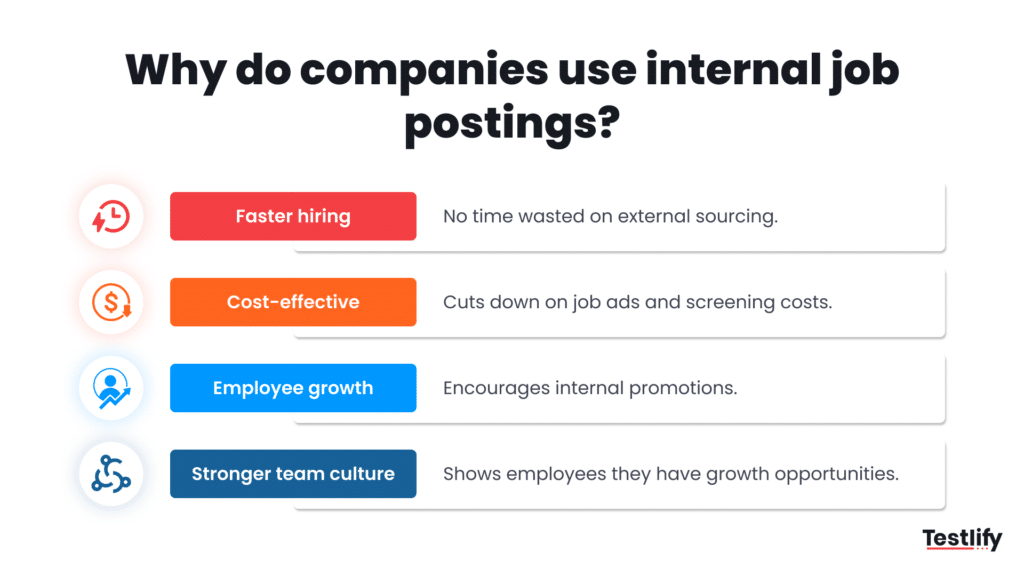
The business case for posting internally is strong. In its October 2025 report on retention, LinkedIn Economic Graph research found that employees who moved internally, by promotion or a lateral move, were 66% to 72% more likely to still be at the same company the following year. Lateral moves were just as effective as promotions. A template makes those moves easier to offer, because every opening is visible and reads the same way.
A template also helps HR in four practical ways:
- Speed: HR fills in fields instead of drafting from scratch, so a role can be posted the day it is approved.
- Completeness: Fixed fields work as a checklist, so pay, eligibility and deadlines are never forgotten.
- Fairness: Every applicant sees the same criteria, which makes decisions easier to explain later.
- Reuse: One template covers entry-level, lateral and leadership roles with small edits.
For a wider view of the trade-offs, see the pros and cons of internal recruitment.
What should an internal job posting include?
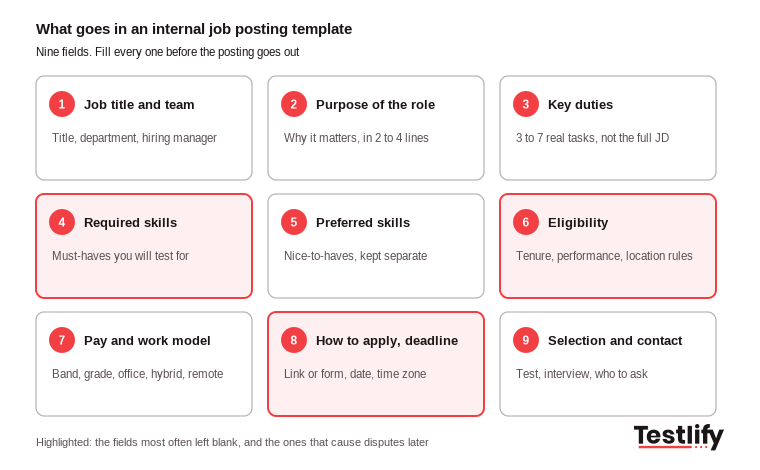
An internal job posting should include nine fields: job title and team, purpose of the role, key duties, required skills, preferred skills, eligibility rules, pay range and work model, how to apply with a deadline, and the selection steps with a contact person. The fields most often left blank are eligibility, pay and the deadline, and those are the ones that cause disputes later.
The same clarity rules apply to public ads; Testlify's guide to writing clear and engaging job postings covers wording in more depth.
What does an internal job posting template look like?
An internal job posting template looks like a short fill-in form with fixed headings, and the version below works in a document, an intranet page or an ATS internal job board. Copy it, replace the bracketed text and delete any line that truly does not apply.
``` INTERNAL JOB POSTING
Job title: [Job title] Department / team: [Department] Hiring manager: [Name, title] Location and work model: [Office city / hybrid / remote] Grade or pay range: [Band or range] Posted on: [Date] Closes on: [Date, time, time zone]
About the role [Two to four lines: why the role exists and what success looks like in the first six months.]
Key duties
- [Duty]
- [Duty]
- [Duty]
- [Duty]
Required skills and experience
- [Must-have skill or experience]
- [Must-have skill or experience]
- [Must-have certification, if any]
Preferred skills
- [Nice-to-have]
- [Nice-to-have]
Who can apply
- [For example: permanent employees with 12+ months in their current role]
- [For example: no active performance improvement plan]
- [Location or right-to-work rules, if any]
How to apply Apply through [link / form / ATS] by [deadline]. Include [updated resume and a short note on why you want the role].
Selection process
- Review against the required skills
- [Skills assessment, for example a 30-minute online test]
- [Structured interview with hiring manager and panel]
- Decision and feedback to all applicants by [date]
Questions Contact [HR partner name, email]. Your application stays confidential. Your current manager is told only if you reach the shortlist. ```
Pro tip: Save the template as a form in your ATS or HR system, not a document. Required fields then cannot be skipped, and every posting lands in the same internal job board.
What do internal job posting examples look like?
Internal job posting examples look like the template with every field filled in, short enough to read in a minute. Here are two filled-in versions, one for a lateral move and one for a promotion.
Example 1: Lateral move (customer support to quality analyst)
``` Job title: Quality Analyst, Customer Support Team: Support Operations | Hiring manager: Priya N., Support QA Lead Work model: Hybrid, Pune office 3 days a week | Grade: B2 Posted: 3 November | Closes: 14 November, 6 pm IST
About the role: Review 60+ support conversations a week, score them against our quality rubric and coach agents on what to fix.
Required: 12+ months as a support agent, quality scores above team average, clear written English. Preferred: Experience coaching new hires, basic spreadsheet skills.
Who can apply: Support agents with 12+ months in role. How to apply: Internal job board, resume plus 3 lines on why. Selection: Written English and attention-to-detail test, then a 45-minute structured interview. Decision by 21 November. ```
Example 2: Promotion (senior engineer to engineering manager)
``` Job title: Engineering Manager, Payments Team: Platform Engineering | Hiring manager: Director of Engineering Work model: Remote, US time zones | Grade: M1 Posted: 3 November | Closes: 21 November, 5 pm ET
About the role: Lead a team of 7 engineers, own the payments roadmap with Product and keep the service at 99.9% uptime.
Required: 3+ years as a senior engineer, led at least one project across teams, experience running code reviews. Preferred: People management or mentoring experience.
Who can apply: Senior engineers and tech leads with 12+ months in role. How to apply: Internal portal, resume plus a one-page plan for the first 90 days. Selection: Leadership judgment assessment, panel interview with a peer manager and HR, then a chat with the VP. Decision by 5 December. ```
Which internal job posting emails can you send?
Internal job posting emails come in five common types: a standard announcement, a short notice, a leadership call, a cross-team invite and a deadline reminder. An internal job posting email announces the role and points people to the full posting; it should not repeat the whole template. Keep it under 150 words, put the job title in the subject line and include the deadline. Copy the one that fits.
Email 1: Standard announcement
Subject: Internal opening: [Job title], [Team]. Apply by [date]
Hi everyone,
We are hiring a [Job title] in [Team] and want to hear from colleagues first. The role [one line on purpose].
You can apply if you [eligibility in one line]. The full posting, with duties, skills and pay range, is here: [link].
Applications close on [date and time]. Questions? Contact [HR contact].
[Name], [Title]
Email 2: Short notice for chat or a busy inbox
Subject: New internal role: [Job title]
Hi team, [Job title] in [Team] is open to internal applicants until [date]. Details and how to apply: [link]. Questions go to [HR contact].
Email 3: Leadership role or promotion
Subject: Leadership opportunity: [Job title]
Hello all,
We are opening the [Job title] role to internal candidates first. This person will lead [team size and area] and report to [leader].
We are looking for people who [two key requirements]. The selection includes [assessment] and a panel interview, and every applicant will get feedback.
Read the full posting and apply by [date]: [link].
[Name], [Title]
Email 4: Cross-team or lateral move
Subject: Try a new team: [Job title] in [Department]
Hi everyone,
Want to build new skills without leaving [Company]? [Department] has an opening for a [Job title], and we welcome people from any team who [core requirement].
You do not need experience in [Department] to apply; we will train for [area]. See the posting and apply by [date]: [link].
[Name], [Title]
Email 5: Reminder before the deadline
Subject: 2 days left: [Job title] internal applications
Hi team, a reminder that internal applications for [Job title] close on [date]. If you have been thinking about it, now is the time: [link].
Writing from the employee side instead? Testlify has a separate guide with an email template for internal job application and referral emails.
How do you announce and run an internal job posting?
An internal job posting runs best as a six-step process: agree the criteria and window with the hiring manager, post the template on one main channel, collect applications for 5 to 10 working days, assess every applicant the same way, run structured interviews, and tell internal candidates the outcome before any external offer goes out.
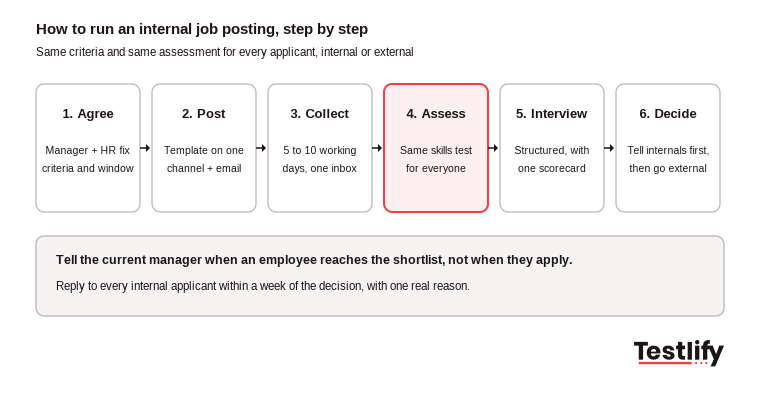
- Agree the criteria: The hiring manager and HR fix the must-have skills, the pay band and the posting window before anything is published.
- Post on one main channel: Use the internal job board or intranet as the single source of truth, then promote it by email, chat and team meetings.
- Collect in one place: Send every application to one inbox or ATS view so nothing gets lost in direct messages.
- Assess the same way: Give every applicant, internal or external, the same skills test so the shortlist rests on evidence.
- Interview with structure: Use the same questions and an interview scorecard for every candidate.
- Decide and tell internals first: Share the outcome with internal applicants before announcing the hire or making an outside offer.
Channel | Best for | Watch out for |
|---|---|---|
Internal job board or intranet | The full posting and applications | Few people browse it unprompted |
Company-wide email | Reach and a clear deadline | Easy to miss in busy inboxes |
Slack or Microsoft Teams | Quick reminders and shares | Threads bury details; always link the posting |
Manager 1:1s and team meetings | Encouraging quieter people to apply | Must not become a pre-selection step |
Newsletter | Regular roundup of open roles | Too slow for short windows |
What rules keep internal job postings fair?
Internal job postings stay fair when every eligible employee sees the same posting, at the same time, and is judged on the same written criteria. Most complaints about internal hiring come from roles that seemed pre-filled, unclear eligibility or managers blocking applications.
- Publish before you decide: Do not post a role that already has a chosen candidate. If you plan a direct promotion, say so openly instead of running a token posting.
- Use neutral wording: The EEOC says job ads must not show a preference for, or discourage, applicants because of protected traits such as age, sex or disability. Its example: asking for "recent college graduates" can discourage people over 40.
- Write down eligibility: Tenure or performance rules belong in your policy and in the posting, and should apply to everyone the same way.
- Keep applications confidential: Tell the current manager only when an employee reaches the shortlist, so people can explore a move safely.
- Share pay where you can: Several US states and cities now require pay ranges in job postings; check whether your local rules also cover internal roles. Testlify's guide to pay transparency explains the basics.
- Test skills, not familiarity: Internal candidates are known, which invites bias in both directions. A structured interview and a shared assessment keep the decision on evidence.
Key takeaway: Fairness in internal hiring comes from three things written down in advance: who can apply, what will be assessed and when people will hear back.
What should you tell internal applicants who are not selected?
Internal applicants who are not selected should hear the outcome from a person, before the new hire is announced, with one real reason tied to the role and one concrete next step. Silence or a vague reply hurts trust more than a clear no, because the applicant still works with the hiring team every day.
Career conversations matter here. In a July 2024 study of people who quit, Gallup found that 42% of voluntary leavers said their manager or organization could have done something to keep them. Among leavers whose manager did talk with them in their last three months, only 29% discussed their future career with the organization. A rejection from an internal posting is the moment to have that talk.
A short note works:
"Thank you for applying for [Job title]. We chose a candidate with deeper experience in [skill], which is central to the role right now. Your [strength] stood out in the assessment. I would like to set up 20 minutes with you and [manager] to plan how you could build [skill] for the next opening."
For more wording, see these rejection emails for unsuccessful candidates and adapt the tone for a colleague.
What mistakes should you avoid in internal job postings?
Internal job postings usually fail for the same few reasons: a vague subject line, missing pay, no deadline and silence after the decision. Each one has a simple fix.
Mistake | What happens | Fix |
|---|---|---|
Vague subject line | The email is ignored | Put the job title and deadline in the subject |
Missing pay or grade | People will not risk applying blind | Add the band, or say when it will be shared |
Required and preferred mixed together | Strong candidates rule themselves out | List must-haves and nice-to-haves apart |
No deadline | Applications trickle in for weeks | Set a date, time and time zone |
Manager approval needed to apply | People fear being seen as disloyal | Notify managers at shortlist stage instead |
Posting the full public job ad | Key internal details get buried | Use the shorter internal template |
No feedback to unsuccessful applicants | Fewer people apply next time | Reply to everyone with a reason and next step |
How can Testlify help you assess internal candidates fairly?
Testlify helps by giving internal and external candidates the same skills assessment. Internal candidates deserve the same fair, evidence-based screening as external ones. You can send every applicant for a role one assessment, built from 3,500+ tests covering role-specific skills, software, cognitive ability, situational judgment and personality, with automated scoring and a ranked shortlist. Results sit side by side, so the decision rests on skills rather than on who the hiring manager already knows.
See how teams use it for internal mobility with Testlify, browse the Testlify test library, or start a 7-day free trial with no credit card.
Frequently asked questions

B2B SaaS Content Writer
Rishav Kumar is a B2B SaaS content writer with 4 years of experience. He loves crafting engaging content. Always exploring fresh ideas, he's passionate about helping businesses grow through impactful writing.
LinkedInRelated resources
View all
HR & recruitment
Internship & probation confirmation emails: templates & guide

HR & recruitment
12 HR communication email templates for hiring managers

HR & recruitment
Discriminant validity: meaning, examples and how to test it

HR & recruitment
Candidate rejection email template: 16 examples for every hiring stage

HR & recruitment
Interview Invitation Email Templates: 17 Free Samples for 2026

HR & recruitment
Interview Questions Bank: 30+ HR Questions to Ask
Get started.
Hire on proof, not resumes.
Run your first skills-based assessment free — no credit card required.