
What is human resource development: Guide for recruiters
Discover the essentials of Human Resource Development for recruiters, including key strategies, processes, and benefits to boost employee growth.

Human resource development is one of the most important and focused areas for any organization that seeks to tap into maximum workers’ potential. As a recruiter, you will understand how HRD can be used to locate the right talent and ensure employees grow and develop in their roles.
Let’s see the essential concepts and strategies in HRD and how you can play a leading role in nurturing talent and driving business success.
 ChatGPT
 Gemini
 Claude
 Grok
Grok Perplexity
What is Human Resource Development?
Its essence is subsequently described as a process through which employees develop their skills, knowledge, and competencies to realize individual and organizational objectives. The inclusion of training, career development, organizational development, and performance management all become part of this HRD process.
For recruiters, it is more than filling positions because HRD fosters a continuous culture of learning and development that cares for and cares about employees and empowers them toward success.

Why is HRD important?
HRD is important for the achievement of employee satisfaction as well as organizational success. Here are a few reasons why HRD should be placed at the front of any recruitment program:
1. Boosts employee engagement and retention
The employees are retained for a longer period in the company since they feel that the growth of their employees has improved. HRD creates opportunities for employees to develop different skills to build their careers and fulfill professional goals. This leads to increased job satisfaction, higher engagement, and, thus, better retention.
2. Increases organizational efficiency
The productive workforce is more competent, productive, and able to cope with complex situations. HRD will ensure that employees will always improve and reshape industry changes, leading to better performance and higher organizational efficiency.
3. Attracts top talent
This way, organizations that invest in HRD become attractive employers to the best candidates. The people looking for a job want to know whether the employer will allow them to grow, develop their skills, and advance their careers. Thus, by investing in HRD, organizations gain some form of competitive advantage in the market for talent and make them more attractive to any potential hires.
Key components of human resource development
HRD is a multifaceted process that covers several core areas. Below are the main components that contribute to a robust HRD strategy:
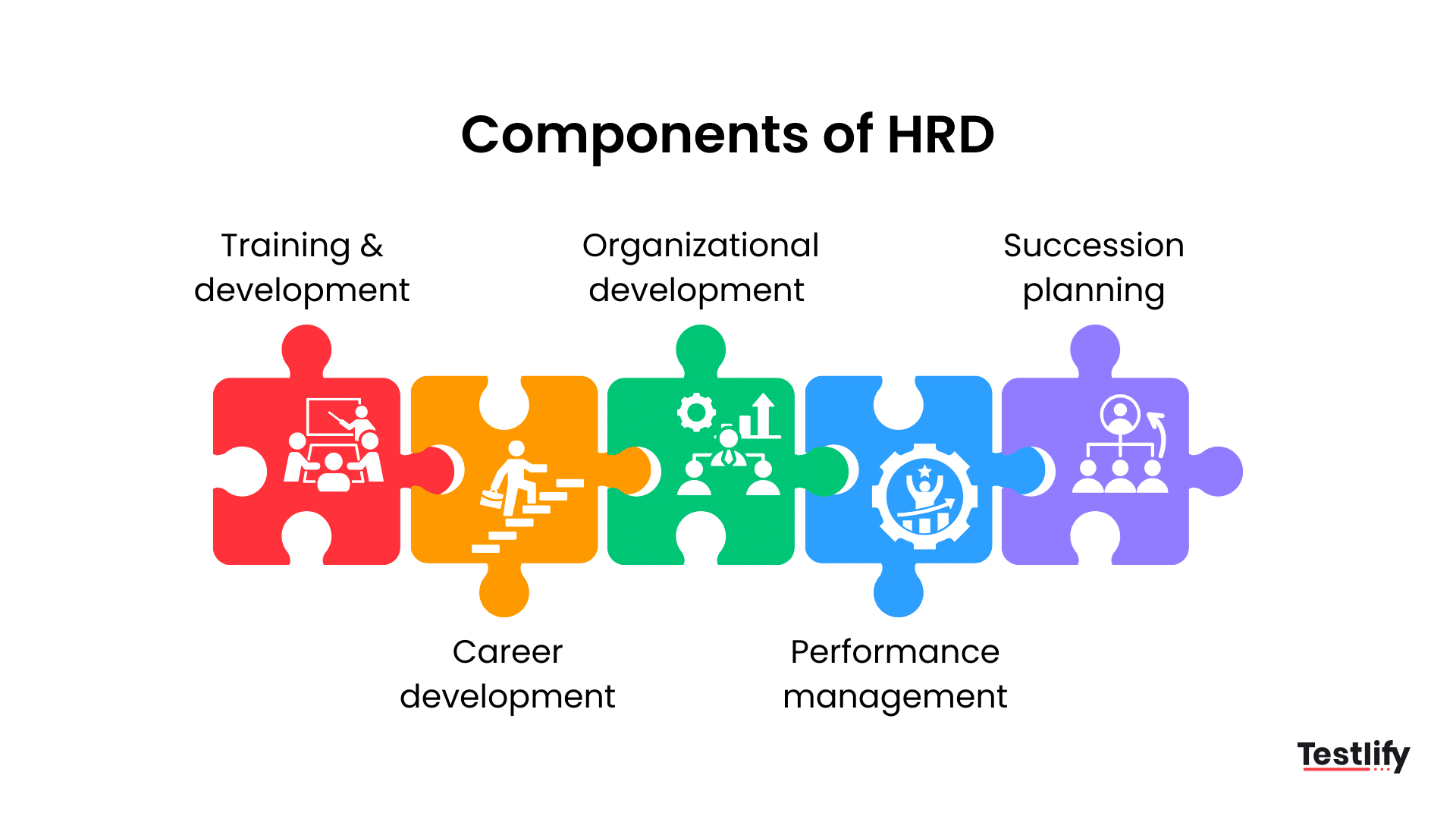
1. Training and development
Training and development are the foundational elements of HRD. They focus on equipping employees with the knowledge and skills they need to perform their current jobs and prepare for future organizational roles.
According to LinkedIn, companies that invest in employee training and development experience a 24% higher profit margin and 34% higher retention rate than those that don’t.
Types of Training:
- Onboarding training: Introduces new employees to the company culture, policies, and job expectations.
- Skills development: Aimed at improving specific skills related to an employee’s current role.
- Leadership development: Focuses on developing managerial and leadership skills for future leaders.
- Soft skills training: Enhances interpersonal skills like communication, teamwork, and conflict resolution.
2. Career development
Career development refers to helping employees grow by providing opportunities for advancement, new experiences, and greater responsibility.
An SHRM survey reveals, 94% of employees say they would stay longer at a company if it invested in their career development.
Career development plans can include:
- Mentorship programs: Pairing employees with experienced leaders to guide their career progression.
- Job rotation: Giving employees the chance to work in different roles to gain broader experience and skills.
- Career pathing: Clearly define potential career paths within the organization and provide employees with the tools to achieve their career goals.
3. Organizational development
Organizational development is about improving the overall effectiveness of the organization. This includes changes to the company culture, structure, and processes to ensure the organization can meet its strategic objectives.
OD often involves:
- Leadership change management: Helping leaders manage organizational changes and align their teams with the new direction.
- Culture shaping: Creating an environment that encourages collaboration, innovation, and continuous improvement.
- Team development: Strengthening teams by improving communication, collaboration, and collective problem-solving.
4. Performance management
Performance management involves setting clear expectations, providing regular feedback, and assessing employee performance to ensure alignment with organizational goals.
Performance management includes:
- Regular performance reviews: Offering constructive feedback on an employee’s strengths and areas for improvement.
- Setting SMART goals: Ensuring that employees have clear, measurable objectives to strive for.
- Recognition and rewards: Acknowledging employees’ achievements to boost morale and motivation.
5. Succession planning
Succession planning involves identifying and developing internal talent to fill key leadership and critical organizational roles. This ensures the organization has a pool of qualified candidates ready to step into important positions when needed.
Benefits of succession planning:
- Business continuity: Minimizes disruption when key employees leave or retire.
- Employee retention: Shows employees that there are growth opportunities within the organization.
- Faster transitions: Reduces the time it takes to fill leadership positions with qualified candidates.
Role of recruiters in human resource development
The role of a recruiter in HRD is not just filling in the holes. A recruiter can be considered an effective business partner at all levels since they help develop an efficient, future-ready workforce.
1. Identifying talent with growth potential
The recruiter has a privileged position in evaluating the long-term potential of candidates. Recruiting seeks those who are willing to learn and are ambitious and quick to adapt. These are the characteristics that are required for career development within an organization.
2. Aligning recruitment with HRD strategy
Work closely with HR and hiring managers to ensure the recruiting strategy aligns with the company’s HRD goals. For instance, if the company focuses on leadership development, prioritize candidates who have potential for a leadership role or are willing to participate in some type of leadership training.
3. Promoting development opportunities to candidates
Engage the organization’s commitment to HRD in recruiting and available training programs, career development opportunities, and advancement paths. This will attract the best talent and help realize the long-term benefits of working with your organization.
4. Encouraging onboarding and training
Facilitate easy transition to the organization through appropriate onboarding and orientation programs, which are comprehensive enough to include the company policies and ensure the employees have the right skills and knowledge to carry out their functions.
5. Collaborating on succession planning
You would like to keep track of succession planning as part of the recruiting process. You would work with senior leaders to map critical roles within the organization and then identify who can enter and lead those functions into the future.
Best practices for implementing HRD in recruitment
If you wish to implement HRD in your recruitment strategy, here are some best practices that you should follow:
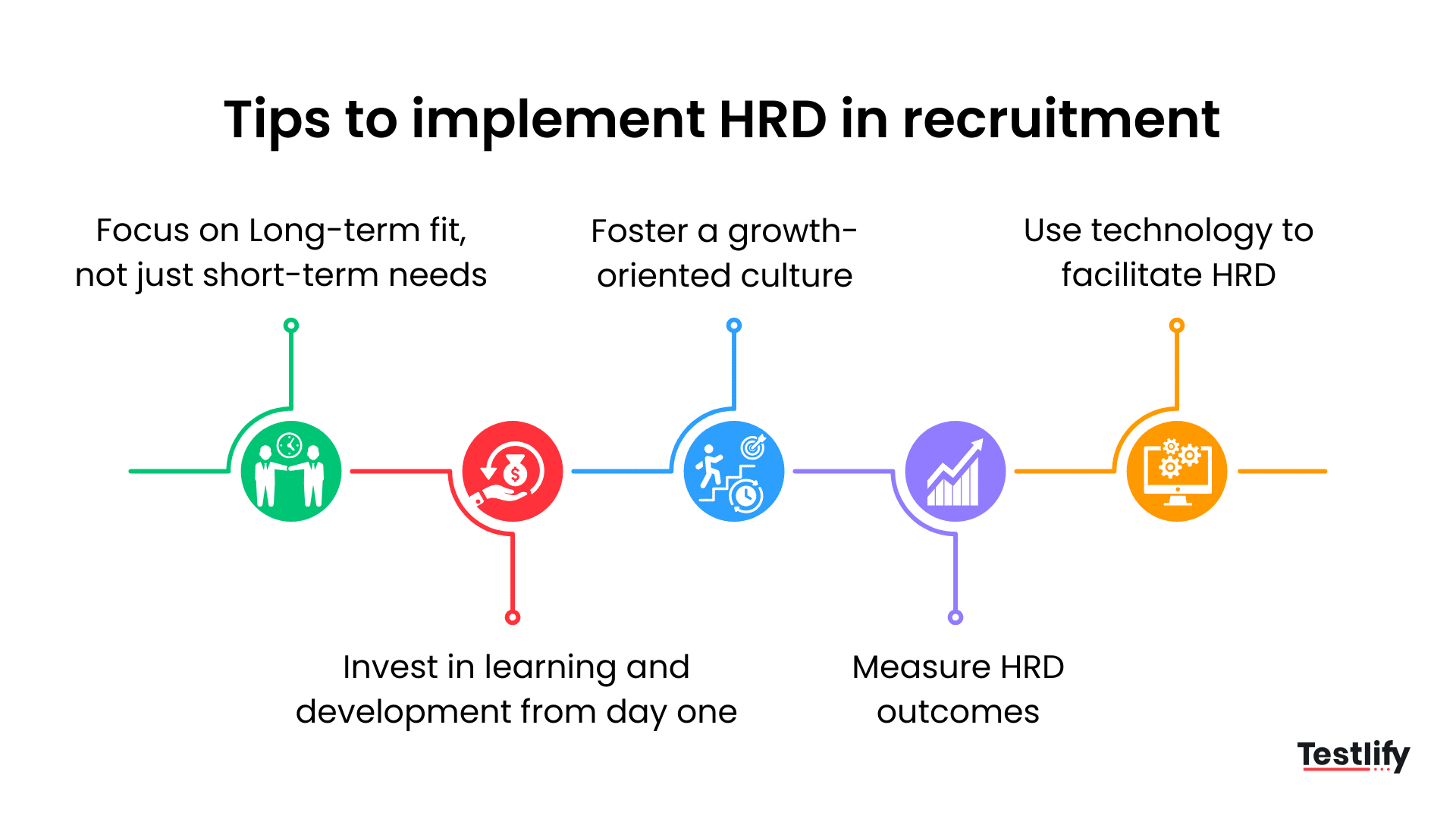
1. Focus on long-term fit, not just short-term needs
While hiring according to immediate needs may be a temptation, ensure that you hire candidates who can grow with the company. Consider how candidates align with your organization’s long-term HRD objectives. Will they fit into the company culture? Do they have growth potential?
2. Invest in learning and development from day one
When an organization recruits a new employee, then the growth of that employee must start. There should be well-defined roadmaps for training and career development opportunities. This will encourage them to join learning programs and let them know that growth is part and parcel of their travel plan with this company.
3. Foster a growth-oriented culture
Promote a culture of continuous learning, constructive feedback, and improvement. According to Deloitte, organizations with strong learning cultures are 92% more likely to innovate and 52% more productive than those without such a culture.
Encourage training, questions, and challenges. Maintain an environment wherein personal and professional development is considered the core of success in that organization.
4. Measure HRD outcomes
Monitor whether the HRD strategies are effective through results evidenced in training programs, performance reviews, and career development activities. Achieve measurable outputs and results such as increased productivity, better retention rate, and employee skill or competency.
5. Use technology to facilitate HRD
Technology has transformed the role of HRD. Technology such as skills assessment platforms, Learning Management Systems, Performance Management tools, and many other HR tech solutions support training delivery, monitor employees’ progress, and help employees with personal and professional development.
Conclusion
You must source talented candidates, make onboarding for new employees easy, and facilitate employee development. HRD is a continuous investment that requires effort, focus, and commitment to an environment where work is easy. Understand the fundamental building blocks of HRD and align recruitment practice accordingly; you’ll support building a high-performing, engaged, and talented workforce.
HRD is not just a development process but also creates an environment where growth is met mutually by the organization and the people working within it. There could be no culture for learning and development other than that promoted by HRD, through which the workforce remains agile, capable, and prepared for the challenges of tomorrow.
Frequently asked questions (FAQs)

Content Writer
Yashika Khandelwal is a Content Writer with 3+ years of experience creating research-backed content on hiring, talent assessment, and HR technology. She is a registered Organizational Psychologist and subject matter expert who combines behavioral science with practical recruitment insights to produce accurate, evidence-based content.
LinkedInRelated resources
View all
HR & recruitment
What Is an HR Toolkit? Components, Tools, and How to Build One

HR & recruitment
What is predictive hiring and why does it matter?

HR & recruitment
Top 8 HR communities recruiters should join

HR & recruitment
10 best recruitment books every recruiter should read in 2026
HR & recruitment
What is talent intelligence? Definition, benefits, and implementation guide

HR & recruitment
What is a job leveling matrix? 3 powerful reasons to use it
Get started.
Hire on proof, not resumes.
Run your first skills-based assessment free — no credit card required.