
Cultural awareness in hiring: how to assess it fairly
How to assess cultural awareness in hiring: the skills to test, interview questions to ask, a scoring rubric and the legal risks to watch.

Cultural awareness in hiring means two things at once: checking that a candidate can recognize, respect and adapt to cultural differences at work, and running a hiring process that judges people from every background on the same evidence. Teams that do both hire people who work well in mixed teams and with global customers, and they cut the bias that creeps in when interviewers read unfamiliar behavior as a weak answer.
TL;DR / Key Takeaways
- Cultural awareness in hiring is assessed with a short situational judgment test plus a few structured behavioral questions, scored on one shared rubric.
- Six skills show cultural awareness in a candidate: self-awareness, cultural knowledge, communication, empathy, adaptability and handling cross-cultural conflict.
- Ask about real past situations, not opinions. Fluent talk about diversity is not proof that someone acts on it.
- Score every answer from 1 to 4 against written anchors, so eye contact, accent or self-promotion style never decide the score.
- Accent and national origin are protected under Title VII, and "culture fit" with no written criteria is a common route to biased hiring.
- Give cultural awareness the most weight for customer-facing, global and people-leading roles, and less for solo local roles.
 ChatGPT
 Gemini
 Claude
 Grok
 Perplexity
What is cultural awareness in hiring?
Cultural awareness in hiring is the practice of assessing whether candidates can understand and work with people from other cultural backgrounds, and of making sure the hiring process itself treats candidates from every culture fairly. The first part is about the candidate's skills. The second part is about the interviewers, questions and scoring.
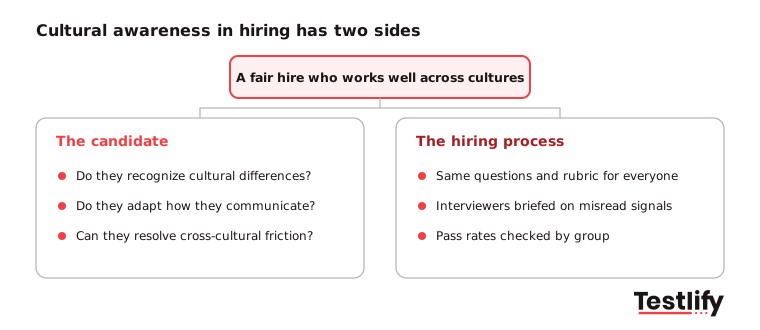
On the candidate side, cultural awareness is the ability to notice that people's norms, values and communication styles differ, to respect those differences and to adjust behavior to them. It goes beyond knowing facts about other countries or simply tolerating difference. A culturally aware engineer explains a design choice differently to a colleague in Tokyo than to one in Toronto, and checks that the message landed.
On the process side, cultural awareness means interviewers know which signals are cultural rather than job-related. Direct eye contact, comfort with self-promotion and the length of pauses all vary by culture, and none of them predict how well someone writes code or handles a customer.

How is cultural awareness different from cultural sensitivity and cultural intelligence?
Cultural awareness, cultural sensitivity and cultural intelligence describe three levels of the same ability. Awareness is noticing that differences exist, sensitivity is responding to them with respect, and cultural intelligence (CQ) is adapting behavior effectively in a new cultural setting. Hiring teams often use the terms loosely, so define the one you score.
Term | What it means at work | What you can observe in hiring |
|---|---|---|
Cultural awareness | Knows that norms, values and styles differ, including their own | Names a moment they noticed a difference and what it was |
Cultural sensitivity | Responds to differences with respect, avoids stereotypes | Describes adjusting language or behavior so others felt respected |
Cultural intelligence (CQ) | Adapts effectively in unfamiliar cultural settings | Shows a changed approach and a better result in a new setting |
Cross-cultural competency | The combined skill set of the three above | Scores well across a scenario test and a structured interview |
Culture fit | Matches the current team's habits and values | Risky when undefined; prefer "culture add" against written values |
For a deeper look at the umbrella term, see intercultural competence. The Universal Competency Framework is a useful reference when you write the competency definition for a role.
Why does cultural awareness in hiring matter?
Cultural awareness in hiring matters because most teams are already multicultural, and the cost of cross-cultural friction shows up in teamwork, customer relationships and retention. BLS data released in May 2026 show that foreign-born workers made up 19.1% of the US civilian labor force in 2025, so nearly 1 in 5 colleagues brings a different cultural starting point.
The business case rests on five points carried over from years of HR practice:
- Global business: Companies that sell, build or support across borders need people who can work with partners and clients from many backgrounds. Candidates who adapt their style open doors in new markets.
- Better teamwork: Mixed teams solve problems from more angles, but only when people communicate well across differences. Culturally aware hires reduce the misreads that slow projects down.
- Stronger client relationships: In customer-facing roles, culturally aware staff understand different expectations and courtesies, which supports satisfaction, loyalty and repeat business.
- Fewer conflicts: Many workplace disputes start as a misunderstood email, joke or silence. Hiring for cultural awareness lowers the number of clashes that reach a manager or HR.
- Engagement and retention: People who feel their background is respected stay longer and contribute more. Assessing cultural awareness signals to candidates that respect is part of the job.
Key takeaway: Cultural awareness is a working skill, not a values badge. Assess it the way you assess any other skill: with defined behaviors, the same questions for everyone and a written scoring guide.
Which skills show cultural awareness in a candidate?
Cultural awareness in a candidate shows up as six observable skills: self-awareness, cultural knowledge, communication that adapts to the listener, empathy, adaptability and the ability to resolve cross-cultural conflict. A strong candidate does not need all six at the same level, but should show at least the three the role uses most.
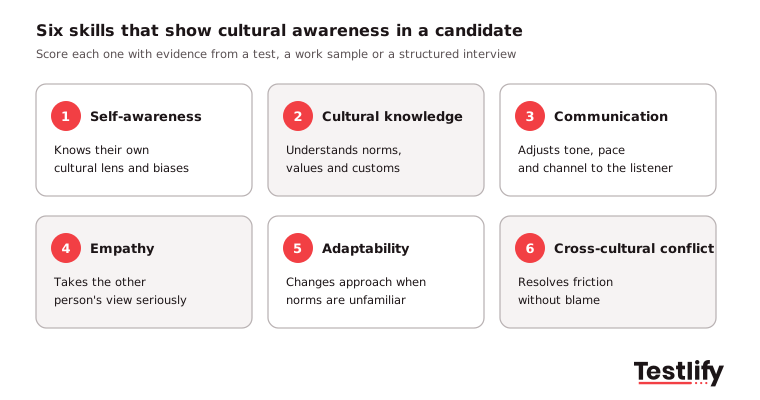
- Self-awareness: Knows their own cultural lens and admits their assumptions. Watch for candidates who can name a bias they caught in themselves.
- Cultural knowledge: Understands that norms, values and traditions differ, and avoids stereotypes about any one group.
- Adaptive communication: Adjusts tone, pace, directness and channel to the listener, including in cross-cultural communication over chat and video.
- Empathy and active listening: Takes the other person's view seriously and listens before deciding what they meant.
- Adaptability: Changes approach when norms are unfamiliar, for example a new market, a new client or a new team.
- Cross-cultural conflict resolution: Resolves friction caused by cultural differences without blaming either side.
Candidates also bring transferable skills from study abroad, volunteering or work in multilingual communities. Count them, even if the experience does not look like a traditional career path.
How do you assess cultural awareness in candidates?
Cultural awareness in candidates is assessed in five steps: define the skills the role needs, pick the measurement tools, place them at the right point in the funnel, score on a shared rubric, and review the results over time. Each step keeps the assessment tied to the job instead of to personal taste.
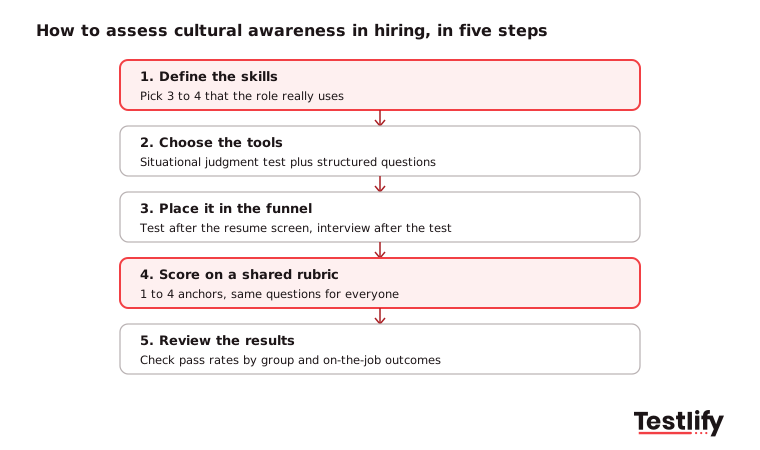
- Define the skills: Pick 3 to 4 of the six skills that the role really uses. A support agent serving 4 regions needs adaptive communication and empathy. A regional manager needs conflict resolution and adaptability.
- Choose the tools: Use a situational judgment test for scale and consistency, scenario-based simulations for customer roles, and 4 to 6 structured behavioral questions for depth. Self-report CQ questionnaires are easy to game, so do not use them alone.
- Place it in the funnel: Run the test after the resume screen and before interviews, so interviewers can probe low-scoring areas. For senior roles, add one scenario to the final round.
- Score on a shared rubric: Every interviewer uses the same anchors (see the rubric below). Score each answer alone before discussing candidates.
- Review the results: Every 6 to 12 months, compare scores with on-the-job outcomes such as manager ratings, customer feedback and early attrition. Ask hiring managers and new hires what the assessment missed, and adjust.
Pro tip: Write the skills into the job description too. Candidates prepare better, and the test and interview feel connected rather than like a surprise values check.
What interview questions reveal cultural awareness?
Interview questions reveal cultural awareness best when they ask for a specific past situation, the candidate's own action and the result. Use a structured interview so every candidate gets the same questions in the same order, then use follow-ups to test depth.
Working across cultures:
- Tell me about a time you worked closely with someone whose cultural background was different from yours. What did you do differently?
- Describe a project where you had to understand more than one culture to get the result. What did you learn?
Communication:
- Tell me about a time you had to change how you communicated so a colleague or customer from another culture understood you. How did you check it worked?
- Describe giving difficult feedback to someone from a different background. What did you adjust?
Self-awareness:
- Tell me about a cultural mistake you made at work. How did you handle it and what changed afterwards?
- When did you realize one of your own assumptions about another culture was wrong?
Conflict and adaptation:
- Describe a conflict in a team that was caused, at least in part, by cultural differences. What was your role in resolving it?
- Tell me about joining a team or market with unfamiliar norms. What did you do in the first month?
What to listen for: concrete detail, the candidate's own action, an honest account of what went wrong, and a change in behavior afterwards. A polished speech about the value of diversity, with no example, scores low.
How should you score cultural awareness answers?
Cultural awareness answers should be scored on a 1 to 4 scale with written anchors for each level, agreed before the first interview. Anchors keep scores tied to behavior rather than to how confident, fluent or familiar the candidate sounds. Record the score and one line of evidence on an interview scorecard.
Score | Anchor | Example of evidence |
|---|---|---|
1, no evidence | Gives opinions or general statements only; may stereotype | "I get along with everyone, culture doesn't matter to me." |
2, basic | Notices a difference but describes no change in their own behavior | Mentions a colleague's different style, then moves on |
3, solid | Gives a specific situation, adjusts their behavior and names the result | Changed meeting format so a quieter colleague's ideas came through |
4, strong | Shows self-awareness, adapts, checks the impact and applies the lesson later | Spotted their own assumption, fixed it and changed team habits after |
Score each answer before the panel talks, then compare. Large gaps between interviewers on the same answer mean the anchors need sharper wording.
How do you make your own hiring process culturally aware?
A culturally aware hiring process uses the same questions and rubric for every candidate, briefs interviewers on signals that read differently across cultures, and removes language that only insiders understand. These steps protect the assessment of every other skill, not just cultural awareness.
Signal interviewers notice | Why it can mislead | What to score instead |
|---|---|---|
Little direct eye contact | In many cultures, steady eye contact with a senior person feels disrespectful | The content of the answer |
Modest self-promotion ("we did it") | Some cultures credit the team, not the individual | Ask "what was your part?" and score that |
Very direct answers | Directness is polite in some cultures and blunt in others | Accuracy and reasoning |
Long pauses before answering | Silence can signal careful thought, not uncertainty | The answer once given |
Accent or non-native grammar | Says nothing about job skill unless the role needs a set language level | A language test at the level the role needs |
- Brief everyone in the chain: Interviewers, hiring managers and outside recruiters all need the same briefing. A Government of Western Australia hiring guide recommends that everyone involved in recruitment, including third-party recruitment consultants, has an appropriate level of cultural awareness.
- Use diverse panels: Two interviewers from different backgrounds catch more misreads than one.
- Plain language: Drop idioms, sports metaphors and local slang from questions and job ads.
- Inclusive job ads: Remove requirements that screen out good candidates for no job reason, such as "native speaker" where fluency is enough.
- Check your tools: Ask assessment and AI vendors for bias audits, and compare pass rates by group at each stage.
For a full checklist, see how to design a fair and inclusive hiring process and how to overcome unconscious bias in hiring.
What legal and fairness risks should you watch?
Legal and fairness risks in cultural awareness hiring come from three places: protected characteristics, vague "culture fit" judgments and over-trusting any single tool. Handle all three before you add a new assessment step.
- Protected characteristics: Under Title VII, the EEOC's national origin guidance covers ethnicity, accent and perceived ethnic background, and applies to job ads and every stage of hiring. Never score accent, name, country of origin or religious practice.
- Undefined culture fit: "Not a fit" with no written criteria is where personal similarity bias hides. Score culture add against written values instead; see culture fit vs skill fit.
- No bias-free guarantee: Assessing cultural awareness reduces bias, but no process removes it fully. Keep human review, monitor results by group and give candidates a way to ask for adjustments.
- Local rules: In New York City, automated tools used to screen candidates need a yearly bias audit and candidate notice under Local Law 144. Check local rules wherever you hire.
Which roles need cultural awareness most?
Roles that need cultural awareness most are those where people work daily with customers, colleagues or partners from other cultures, or lead mixed teams. Weight the skill by how often the role crosses cultures, not by a general wish for diversity.
Role type | Weight in the hiring decision | Assessment that fits |
|---|---|---|
Customer support, BPO and contact center agents serving several regions | High | Situational judgment test plus a customer scenario |
Sales, account management and business development in new markets | High | Test plus 2 structured questions on adapting communication |
People managers of distributed or mixed teams | High | Test plus conflict and feedback questions in the final round |
HR, TA and recruiters | High | Test plus questions on fair interviewing |
Healthcare, education and public-facing roles | Medium to high | Scenario questions tied to patients, students or the public |
Engineers and analysts in global teams | Medium | 1 to 2 structured questions on cross-team communication |
Solo or local back-office roles | Low | Optional; keep the general interview fair instead |
How does Testlify help assess cultural awareness?
Testlify helps hiring teams assess cultural awareness with ready-made situational judgment tests that score every candidate the same way, and with structured interviews that sit next to them in one workflow. Results land in a ranked report, so recruiters can see which candidates to probe further.
- Cultural Sensitivity test: A 15-minute situational judgment test with 15 questions, covering recognizing cultural nuances, tailoring communication, understanding others' views, resolving cultural tensions and collaborating across cultures. Cultural Sensitivity test
- Cultural Adaptability test: A 20-minute situational judgment test with 18 questions, covering cultural awareness, flexibility, cross-cultural communication, empathy, intercultural competence and resilience. Cultural Adaptability test
- Cross-cultural communication: Add the Cross-cultural communication test for roles where written and spoken exchanges across cultures are daily work.
- One assessment, many skills: Combine a cultural test with role skills from 3,500+ tests, and add custom scenario questions or one-way video questions from the 25+ question types.
- Fairness checks: Testlify's matching model completed a third-party bias audit under NYC Local Law 144 on June 16, 2023. NYC bias audit
Ready to assess cultural awareness with Testlify?
Pick the cultural test that fits your role, add 2 or 3 role skills and send it to your next batch of candidates. Browse the Testlify test library or start a 7-day free trial, no credit card needed. For a walkthrough with your own roles, book a demo.
Frequently asked questions (FAQs)

Wordpress Developer
Yash Patel is a Wordpress and SEO Specialist at Testlify with 3+ years of experience in technical SEO, on-page optimization, and content strategy. He works on improving Testlify's organic presence and produces content focused on hiring, talent assessment, and HR technology.
LinkedInRelated resources
View all
HR & recruitment
Early career talent assessments: how to spot who will grow

HR & recruitment
What is SharePoint and benefits of LMS with SharePoint integration

HR & recruitment
Should HRs consider using peer interviews in pre-hiring assessments?

HR & recruitment
How do pre-hiring assessments impact time-to-hire metrics?

HR & recruitment
What are the potential legal risks of pre-hiring assessments?

HR & recruitment
Peer Interviews in Hiring: Should HR Use Peer Reviews?
Get started.
Hire on proof, not resumes.
Run your first skills-based assessment free — no credit card required.