
Why is a performance marketing test essential for recruiting?
A performance marketing test shows who can run paid campaigns, read ROAS and CAC and manage budget before you hire. How to run and score it.

A performance marketing test is a timed skills assessment that checks whether a candidate can plan, track, measure and improve paid campaigns before you hire them. It replaces guesswork from CVs and polished interview answers with scored evidence on the skills that decide whether ad spend turns into revenue.
 ChatGPT
 Gemini
 Claude
 Grok
 Perplexity
TL;DR
- A performance marketing test is essential for recruiting because CVs and interviews cannot show whether a candidate can read ROAS, CAC, and conversion data or move budget to what works.
- Paid media is the biggest line in most marketing budgets, about 30.6% according to Gartner's 2025 CMO Spend Survey, so a weak hire wastes real money fast.
- A good test covers six areas: paid media, tracking, metrics, testing, budget, and reporting.
- Run a 15 to 20 minute skills test for every applicant, then a 45 to 60 minute work sample for the top group only.
- Score every candidate on the same 1 to 5 scorecard and judge the reasoning, not one right answer.
- Raise the bar by seniority: specialists on execution, managers on budget and testing, and heads of paid on strategy and team design.

Why is a performance marketing test essential for recruiting?
A performance marketing test is essential for recruiting because it shows, before the offer, whether a candidate can turn ad spend into measurable results. Performance marketers own budgets, tracking, and targets, and those skills are hard to judge from a CV or a conversation. A short, scored test gives every applicant the same chance to prove it.
The money at stake makes this more than a nice-to-have. Paid media takes about 30.6% of marketing budgets, and marketing budgets sit at 7.7% of company revenue, according to Gartner's 2025 CMO Spend Survey. Gartner also found 59% of CMOs say their budget is not enough for their plans. A hire who misreads attribution or scales the wrong campaign burns that budget within weeks.
Five reasons hiring teams add the test:
- Proof of hands-on skill: Candidates show they can set up tracking, read a dashboard, and pick the right metric, not only talk about it.
- Faster shortlists: Automated scoring ranks every applicant, so recruiters stop reading 200 near-identical CVs that all mention "ROI-driven campaigns."
- Fairer comparisons: Everyone answers the same questions under the same time limit, which cuts the pull of school names and big-brand logos.
- Better interviews: The hiring manager walks into round two knowing each finalist's weak spots and can probe them.
- Lower hiring risk: A wrong hire in a budget-owning role costs salary, agency fees and lost revenue at the same time.
What does a performance marketing test measure?
A performance marketing test measures the skills a person needs to spend an ad budget well: running paid channels, tracking conversions, reading performance metrics, testing ideas, allocating budget and explaining results. The best tests use short scenarios from real campaigns instead of definitions to recall.
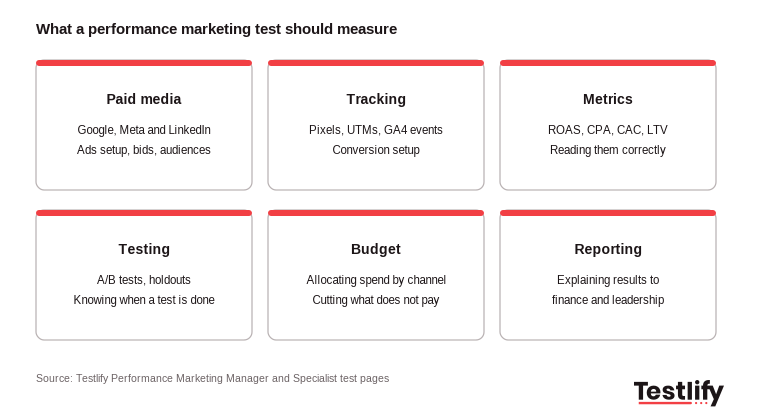
- Paid media execution: Campaign setup, bidding, audience targeting and creative testing on Google Ads, Meta and LinkedIn.
- Tracking and data hygiene: Pixels, UTM parameters, conversion events and Google Analytics setup, so the numbers can be trusted.
- Metric judgement: ROAS, CPA, CAC, LTV and conversion rate, and which one matters for a given goal.
- Testing and experiments: A/B tests on ads and landing pages, holdout groups, and knowing when a result is real.
- Budget allocation: Moving spend between channels and campaigns, and cutting what does not pay back.
- Reporting and communication: Turning a dashboard into a short recommendation for finance and leadership.
The Testlify Performance Marketing Manager test covers campaign planning, audience targeting, copywriting, landing page optimization, A/B testing, data analysis and Google, Facebook and LinkedIn Ads in 18 questions and 15 minutes. For hands-on roles, the Performance Marketing Specialist test runs 20 minutes and leans on scenarios.
Pro tip: Pair the role test with a channel test when one platform carries most of your spend, for example the Google Ads specialist test for a search-heavy team or the marketing analytics test for a measurement-heavy one.
Why are CVs and interviews not enough for performance marketers?
CVs and interviews are not enough for performance marketers because both reward how well someone describes results, not whether they produced them. A CV line like "scaled spend 3x at 4.0 ROAS" cannot tell you what the attribution model was, who set the targets or whether an agency did the work.
Skills-based screening also widens the pool. According to LinkedIn's March 2025 skills-based hiring report, looking at skills instead of job titles and degrees gives a median 6.1x increase in eligible candidates for a typical job, and 15.9x in the United States. For performance marketing, that means analysts, ecommerce managers and agency staff who never held the title can still prove they can do the job.
Method | What it shows | What it misses | Time per candidate |
|---|---|---|---|
CV screen | Titles, brands, claimed results | Who did the work, how results were measured | 1 to 2 minutes |
Interview | Communication, confidence, story | Hands-on skill with data and tools | 45 to 60 minutes |
Performance marketing test | Scored skill in metrics, tracking, testing, budget | Depth on your specific channel mix | 15 to 20 minutes, auto-scored |
Work sample | How they think through a real campaign problem | Breadth across all skills | 45 to 60 minutes plus review |
Across the teams we work with, we have seen the same pattern: the strongest storytellers in interviews are not always the strongest operators in the account. A test plus a short work sample covers both.
How do you evaluate candidates with a performance marketing test?
Evaluating candidates with a performance marketing test works best in five steps: define the skills, screen everyone with the test, give the top group a work sample, interview on the results, and decide with one scorecard. The test does the wide filtering, and people spend their time only on finalists.
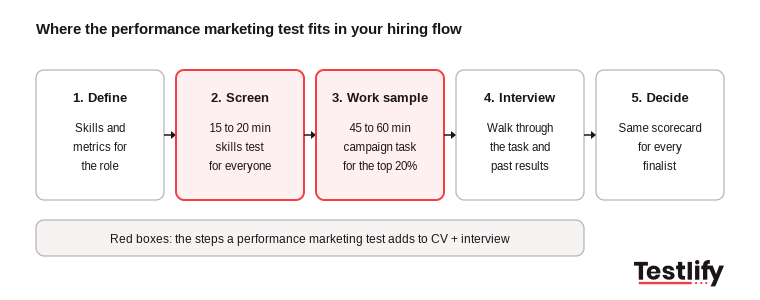
- Define the skills: List the channels, metrics and budget size the role owns. Pull them from the job description; the digital marketing manager job description template is a useful starting list.
- Screen with the test: Send the 15 to 20 minute test to every applicant who meets the basic requirements. Set a pass mark before results come in.
- Add a work sample: Invite roughly the top 20% to a short practical task (examples below).
- Interview on evidence: Ask finalists to walk through their task and one past campaign, including what failed.
- Decide with one scorecard: Rate every finalist on the same criteria and compare side by side.
Lack of good tools is a common blocker here. According to SHRM's Skills-First Movement research (2025 survey), 29% of HR professionals name a lack of assessment tools as a top barrier to skills-first hiring, and only 34% of organizations often or almost always use skills-first methods. A ready-made test removes that barrier for marketing roles.
Which practical tasks reveal real performance marketing skills?
Practical tasks reveal real performance marketing skills when they copy a decision the person will make in the first month. Keep each one to 45 to 60 minutes live, or no more than 2 to 4 hours as a take-home, and use made-up company data.
- Budget split: Give a $50,000 quarterly budget across Google Ads, Meta and LinkedIn with last quarter's results. Ask for a split, expected CPA per channel and what they would cut first.
- Dashboard diagnosis: Share a mock dashboard where ROAS dropped 30% in two weeks. Ask for the three most likely causes and how they would check each.
- Test plan: Ask for an A/B test plan for a landing page, including the metric, sample size reasoning and when to stop the test.
- Tracking audit: Show a campaign with broken UTMs and a duplicate conversion event. Ask what is wrong and how it changes the reported numbers.
Testlify's question types make these easy to run inside the same assessment: a candidate can upload a Google Sheet or Excel file, answer by video, or complete a practical task, and the answer sits next to the test score.
How should you score and compare performance marketing candidates?
Performance marketing candidates should be scored on one shared scorecard, with each criterion rated 1 to 5 and a short note on the evidence behind the rating. Agree on the criteria and what a 3 and a 5 look like before anyone reviews a submission.
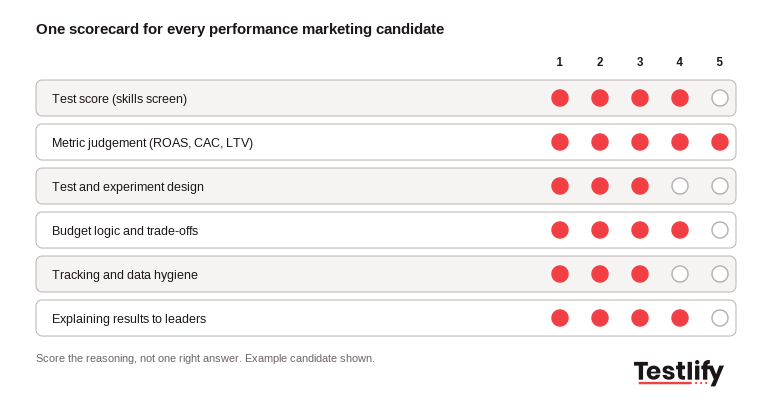
Criterion | What a 3 looks like | What a 5 looks like |
|---|---|---|
Metric judgement | Picks a sensible metric | Picks the metric that matches the goal and explains the trade-off |
Test design | Proposes an A/B test | Defines the success metric, the stopping rule and the risk |
Budget logic | Splits the budget evenly | Moves money by marginal return and names what to cut |
Tracking | Spots obvious errors | Explains how each error changes the reported numbers |
Communication | Clear notes | A one-page recommendation a CFO could act on |
Watch for these red flags:
- No numbers in the answers: Strong performance marketers reach for data by habit.
- One-channel thinking: Every problem gets solved with more spend on the channel they know.
- No failed campaigns: Candidates who cannot name a test that lost usually have not run many.
- Vanity metrics: Clicks and impressions presented as success for a revenue goal.
Key takeaway: Judge the reasoning, not one right answer. A well-argued plan you would not have picked is often a better sign than a copy of your current strategy.
How should the test change by seniority?
The test should change by seniority because a specialist, a manager and a head of paid media make very different decisions. Keep the same core skills test, then raise the weight of budget, testing and strategy as the role grows.
Level | Focus of the test | Work sample | Weight on strategy |
|---|---|---|---|
Specialist | Campaign setup, tracking, daily optimization | Tracking audit or dashboard diagnosis | Low |
Manager | Budget allocation, testing, channel mix | Budget split with expected CPA | Medium |
Head of paid or growth | Measurement strategy, forecasting, team and agency design | 90-day plan presented to the panel | High |
Senior roles carry real cost if you get them wrong. Data from the US Bureau of Labor Statistics puts median pay for advertising, promotions and marketing managers at $165,780 in 2025, with about 36,300 openings a year. A test that filters out one wrong hire at that level pays for itself many times over. The Testlify digital marketing manager hiring guide covers the full process for the manager level.
What mistakes make a performance marketing test less useful?
Performance marketing tests lose value when they test trivia, run too long or are scored by gut feel. Most problems come from the setup, not the test itself.
- Testing definitions: "What does CPC stand for?" tells you nothing. Use scenarios with numbers.
- Long unpaid take-homes: Anything over 4 hours puts off strong candidates who already have a job. Pay for longer tasks or keep them live.
- Testing too late: A test after three interviews wastes everyone's time. Put it right after the application.
- No pass mark: Without a pre-set threshold, the team rationalizes its favourite candidate.
- No feedback: A short note on results keeps your employer brand strong in a small talent market.
- No cheating controls: Unproctored tests invite copy-paste answers and outside help.
How does Testlify help you run a performance marketing test?
Testlify helps you run a performance marketing test by giving you ready role tests, practical question types, cheating controls and ATS sync in one place. You can send the Performance Marketing Manager test as it is, or build your own from the job description.
- Ready tests: 3,500+ tests in the test library, including performance marketing, PPC, Google Ads and marketing analytics tests.
- AI test builder: Turn a job description into a role-specific assessment in under a minute.
- 25+ question types: Coding, file upload, Google Sheets and Excel, video, audio and practical tasks, so the work sample sits next to the test.
- 20+ proctoring checks: Full-screen enforcement, tab and copy-paste tracking, webcam snapshots and AI assistance detection on the anti-cheating and proctoring side.
- 100+ ATS integrations: Two-way sync with tools such as Greenhouse, Lever and Workday through Testlify integrations.
- Scoring and reports: Automated scoring, weighted scoring, benchmarks and AI-written candidate insights for every applicant.
Ready to hire performance marketers on proof?
Start with the Performance Marketing Manager test, send it to your next applicant group and compare the ranked results with your current shortlist. Testlify is credit-based, so you pay only when a candidate starts an assessment, and you can try it free for 7 days with no credit card. For a walkthrough on your own roles, book a demo.
Frequently asked questions (FAQs)

Senior SEO Specialist
Soham is a senior SEO specialist specializing in B2B HR tech. He covers search, answer, and generative engine optimization (SEO/AEO/GEO) for talent acquisition, skills-based hiring, and assessment-driven recruiting audiences.
LinkedInRelated resources
View all
Skill assessment
Why is a customer success manager test essential for recruiting?

Skill assessment
Business judgment test: what it measures and how to use it

Skill assessment
Why is an attention to detail visual test essential for recruiting?

Skill assessment
How can an NLP test unveil candidates hidden abilities?

Skill assessment
How can a performance marketing test unveil candidates’ hidden abilities?

Skill assessment
How to assess adaptability in candidates: a 2026 guide
Get started.
Hire on proof, not resumes.
Run your first skills-based assessment free — no credit card required.