
How to assess business judgment in candidates: a 2026 guide for hiring teams
Assess business judgment with a short scenario test, reasoning-first interview questions, a case exercise and one shared scoring rubric.

Knowing how to assess business judgment in candidates means testing how people reason through realistic business decisions, not reading it off a resume. The most reliable approach combines four things: a short scenario-based test for every applicant, behavioral and situational interview questions about real decisions, a case exercise for finalists, and one scoring rubric that every interviewer uses.
TL;DR / Key takeaways
- Assess business judgment by watching candidates make realistic business decisions: a scenario test to screen, reasoning-first interview questions, a case exercise for finalists and one shared rubric.
- Judge the reasoning, not the outcome. A good decision can end badly and a poor one can get lucky.
- The strongest signal is how a candidate handles the options they rejected and the trade-offs they accepted.
- A scenario-based test of about 10 questions in 10 minutes is enough to screen every applicant before interviewers spend time.
- Score six criteria on a 1-to-5 scale: problem framing, options and trade-offs, use of data, risk, ethics and stakeholders, and ownership.
- Red flags are blaming others, seeing only one path, deciding on gut feel alone and never changing course.
- Keep every exercise job-related and give every candidate the same questions; EEOC guidance expects tests to fit the job.
 ChatGPT
 Gemini
 Claude
 Grok
 Perplexity
What is business judgment in a candidate?
Business judgment is a candidate's ability to make sound decisions in a business context: understand the problem, weigh the options against the organization's goals, accept sensible trade-offs and act on incomplete information. It draws on analytical thinking, decision-making, business acumen, risk awareness and ethics, and it shows in how someone decides more than in what they know.
A business judgment assessment is any structured way of observing those decisions before you hire. It is not a review of the resume or work history. Experience tells you where someone has been; judgment tells you how they will decide when the situation is new.
Component | What it looks like at work | How to test it |
|---|---|---|
Analytical and critical thinking | Spots patterns in data, separates facts from assumptions, draws sound conclusions | Scenario test items, data-based case |
Decision-making and problem solving | Defines the real problem, compares options, decides on time | Behavioral questions, situational questions |
Business acumen and strategic insight | Understands the market, competitors, costs and how the company makes money | Case exercise, acumen questions |
Risk assessment and mitigation | Sizes risks, plans a fallback, knows when a risk is worth taking | Risk questions, case with uncertainty |
Ethical and legal judgment | Spots compliance, safety and data privacy issues, acts in line with company values | Ethics scenarios, behavioral questions |
Communication of decisions | Explains the reasoning so others can act on it | Presentation, written problem-solving plan |
Communication sits in the table because a decision nobody understands rarely gets carried out. Flexibility matters too: good judgment includes changing course when new facts arrive.

Why does business judgment matter when hiring?
Business judgment matters because most roles now ask people to decide without a manager in the room, and the cost of poor decisions grows with seniority. A resume shows titles and results, but results mix skill with luck, so they say little about how someone reached a decision.
Hiring teams also have less room for a wrong hire. SHRM's 2025 Talent Trends survey found that 69% of organizations are still struggling to fill roles, and 28% now require new skills for full-time positions. Employers name problem solving as the attribute they most want to see: according to NACE's Job Outlook 2025, nearly 90% of employers look for evidence that a candidate can solve problems, and more than two-thirds seek analytical skills.
For business consultants, analysts, business development managers, operations leads and senior leaders, judgment is a core part of the job. Testing it directly gives you evidence the resume cannot.
How to assess business judgment in candidates: a 5-step process
The process below puts the cheapest method first and the most time-consuming one last, so interviewers only spend time on people who already showed sound judgment.
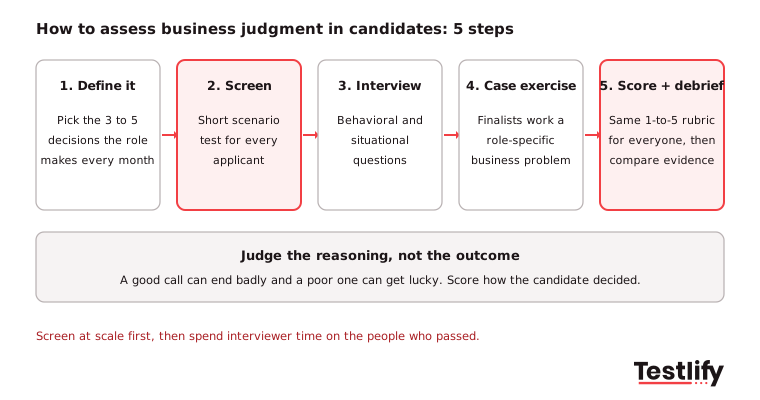
- Define judgment for the role: List the three to five decisions the person will make every month, such as pricing a deal, choosing a supplier, prioritizing a roadmap or handling an unhappy client. Every question and exercise you use later should map to one of them.
- Screen with a scenario-based test: Give every applicant the same short test of realistic business scenarios. It removes guesswork at the top of the funnel and gives you comparable scores.
- Interview on real decisions: Ask behavioral questions about decisions the candidate actually made and situational questions about decisions they might face. Probe the options they rejected.
- Run a case exercise for finalists: Give two or three finalists a role-specific business problem to solve in writing or present to a panel.
- Score and debrief: Every interviewer scores the same criteria on the same 1-to-5 rubric before the debrief, then the panel compares evidence, not impressions.
Pro tip: Write the rubric before the first interview. Interviewers who score against criteria agreed in advance disagree less and are harder to sway by a confident delivery.
Which methods work best for assessing business judgment?
Business judgment is best assessed with a mix of methods, because each one shows a different side of it. A scenario test is fair and fast at scale, interviews show reasoning in the candidate's own words, and a case exercise shows how they handle a messy problem from start to finish.
Method | What it shows | Best stage | Effort per candidate | Watch out for |
|---|---|---|---|---|
Scenario-based test | Choices in realistic business situations, scored the same way for all | Screening | Low | Generic scenarios that do not match the role |
Behavioral interview | How the candidate decided in real past situations | Shortlist | Medium | Rehearsed stories; probe the alternatives |
Situational questions | Reasoning on problems the candidate has not faced | Shortlist | Medium | Rewarding confident talk over sound reasoning |
Case exercise or presentation | Problem framing, use of data, strategy and communication | Final stage | High | Cases that reward outside knowledge over judgment |
Written problem-solving plan | Structure, priorities and risk thinking on paper | Final stage | Medium | Time limits that are too tight or too loose |
Assessment center | Several methods combined, with group exercises | Senior roles | Very high | Cost; keep it for critical hires |
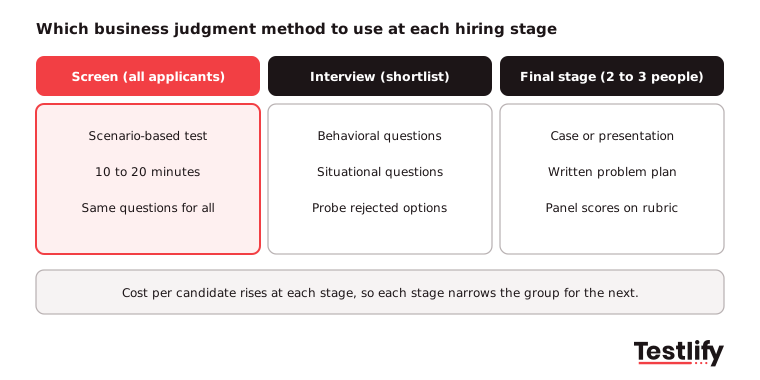
A typical sequence for a mid-level role is a scenario test for every applicant, one structured interview for the top ten to fifteen, and a case exercise for the final two or three. For structured interviews, ask every candidate the same questions in the same order.
What does a scenario-based judgment assessment measure?
A scenario-based judgment assessment measures how a candidate chooses between realistic options in business situations, such as a client asking for an unplanned change, a project slipping behind schedule or a cost decision with incomplete data. Each question has better and worse answers, so the score shows how often the candidate picks a sensible course of action.
Most of these assessments follow the format of situational judgment tests: short scenarios, a set of possible responses and a score per answer. They test judgment rather than memorized frameworks, so recent graduates and experienced professionals can both show what they would do.
Testlify's business judgement test is a situational judgment test of 10 questions in 10 minutes at intermediate level. It covers project management, client management, problem solving, leadership judgment, and operation and production judgment, and suits roles such as business consultant, business development manager, management analyst, head of growth and COO. It is available in English, French, Spanish, Dutch and German.
When you read the results, look past the total score:
- Skill breakdown: A candidate who scores high on client management but low on project management may need support in one area, not a rejection.
- Pairing with other tests: For analyst roles, pair the judgment score with a critical thinking test. For commercial roles, add a business acumen test.
- Cut-off score: Set it after you see how your current strong performers score, not before.
Which interview questions reveal business judgment?
Interview questions reveal business judgment when they ask for a real decision and then probe the reasoning behind it. Ask about a specific situation, then follow up on the options considered, the information used and what the candidate would change. Avoid leading phrasing such as "and how did it work out?", which tells the candidate you expect a success story.
Analytical and critical thinking:
- Tell me about a time the data pointed one way and your instinct pointed another. What did you do?
- Walk me through how you would decide whether a falling sales number is a real problem or noise.
- Listen for: separating facts from assumptions, checking the data before acting.
Decision-making and problem solving:
- Describe a decision you had to make with limited information. What did you know, what did you not know, and how did you decide?
- Tell me about a decision you later reversed. What made you change course?
- Listen for: options compared, a clear reason for the choice, willingness to update.
Business acumen and strategic insight:
- Where do you think a company like ours is most exposed to competitors, and what would you do first?
- Tell me about a time you saw an opportunity or a problem others had missed. How did you build support?
- Listen for: how the business makes money, market awareness, short-term versus long-term thinking.
Ethical and legal judgment:
- Describe a time a quicker route conflicted with a rule, a safety standard or data privacy. What did you do?
- Listen for: spotting the risk early, acting in line with company values, escalating when needed. For deeper coverage, see how to assess ethical judgment of candidates.
Risk assessment and mitigation:
- Tell me about a decision that carried real financial or client risk. How did you decide the risk was acceptable, and what was your fallback?
- Listen for: sizing the risk, a contingency plan, honest hindsight.
For each answer, ask one more question: "What else did you seriously consider, and why did you rule it out?" The quality of the rejected options often tells you more than the option the candidate chose. Notice composure as well: whether the candidate stays calm and structured when you push back on the reasoning.
How should you score business judgment answers?
Business judgment answers should be scored against the same six criteria for every candidate, each on a 1-to-5 scale with a written description of what a 1, 3 and 5 look like. Interviewers score alone, write down the evidence behind each score, and only then compare notes.
Criterion | 1: Weak | 3: Adequate | 5: Strong |
|---|---|---|---|
Problem framing | Jumps to an answer | States the problem | Finds the real problem behind the symptom |
Options and trade-offs | Sees one path only | Two options, thin reasoning | Weighs several options and names what each costs |
Use of data | Decides on gut feel | Uses some numbers | Uses the right data and says what is missing |
Risk and mitigation | Ignores risk | Names a risk | Sizes the risk and plans a fallback |
Ethics and stakeholders | Ignores who is affected | Mentions people affected | Balances stakeholders and company values |
Ownership and learning | Blames others | Owns the result, few lessons | Owns it and shows a changed approach |
Weight the criteria to fit the role. A finance lead might weight risk and use of data double, while a client-facing manager might weight stakeholders higher. An interview scorecard keeps the weights and evidence in one place.
Key takeaway: Score the decision process, not the result. A candidate whose sound decision failed for reasons outside their control should outscore one who got lucky with a weak decision.
What are the red flags of poor business judgment?
Poor business judgment usually shows up as a pattern across answers rather than in one weak reply. Watch for these signs:
- One path only: The candidate cannot name any alternative they considered.
- Outcome-only stories: Every example ends well and none explains the reasoning.
- Blame: Failures are always caused by a manager, a client or the market.
- Gut feel without facts: Choices are justified with "I just knew" and no data.
- Total certainty: No risks, doubts or open questions are acknowledged.
- Rigidity: The candidate never changed a decision when new facts arrived.
- No lessons: Past mistakes are described but nothing changed afterwards.
A single negative outcome is not a red flag. How the candidate analyzes it and what they changed afterwards matters far more.
What are the pros and cons of a business judgment assessment?
A business judgment assessment gives hiring teams comparable evidence on decision-making that interviews alone rarely produce, but it takes planning and it is not a complete picture on its own.
Pros | Cons |
|---|---|
Every candidate faces the same scenarios and is scored the same way | Stress or fatigue on the day can lower a score |
Shows strengths and weaknesses by skill, not just a pass or fail | Custom cases take time to write and score |
Screens large applicant pools before interviewers spend time | Generic scenarios may not fit a specialist role |
Gives the panel shared evidence for the debrief | A score alone misses context such as team fit and motivation |
Combine the test score with interview and case evidence, so no single bad day decides the outcome.
How do you keep judgment assessments fair?
Judgment assessments stay fair when every exercise is tied to the job, every candidate gets the same questions and scoring, and people who need adjustments get them. EEOC guidance on employment tests says a test must be job-related and its results appropriate for the employer's purpose, and that employers should provide reasonable accommodation, such as a reader or an audio version of the test, for applicants with disabilities.
- Map every scenario to the role: Use decisions from your step 1 list, not general business trivia.
- Same questions, same order, same rubric: Consistency is what makes scores comparable.
- Do not reward insider knowledge: A case about your own industry favors people who already work in it; give the facts candidates need.
- Check results by group: If one group passes at a much lower rate, review the questions before you keep using them.
- Tell candidates when AI scores answers: Rules such as New York City Local Law 144 expect notice and bias audits for automated tools.
How does Testlify help you assess business judgment?
Testlify helps you assess business judgment by running the screening and interview stages on one platform, with the same questions and scoring for every candidate. You can start from a ready-made test or build your own:
- Test library: Pick the business judgement assessment or combine it with critical thinking, decision-making and business acumen tests from a library of 3,500+ tests.
- AI test builder: Paste a job description and get a role-specific assessment in under a minute, with suggested competencies and scoring criteria.
- 25+ question types: Add your own scenario questions, written problem-solving plans, one-way video answers or Chat AI interviews that ask every candidate the same questions.
- Scoring and reports: Weighted scoring, per-skill breakdowns and AI-suggested follow-up questions for the live interview.
- 20+ proctoring checks: Anti-cheating and proctoring helps make sure the answers are the candidate's own.
- 100+ ATS integrations: Scores sync back to your applicant tracking system.
Browse the Testlify test library or start a 7-day free trial with no credit card. To see how it fits your hiring process, book a demo.
Frequently asked questions

Senior SEO Specialist
Soham is a senior SEO specialist specializing in B2B HR tech. He covers search, answer, and generative engine optimization (SEO/AEO/GEO) for talent acquisition, skills-based hiring, and assessment-driven recruiting audiences.
LinkedInRelated resources
View all
Skill assessment
How to evaluate candidates’ skills with a Ruby assessment

Skill assessment
How to evaluate insurance agent candidates: a 2026 guide

Skill assessment
Mechanical reasoning assessment: how to evaluate candidates in 2026

Skill assessment
How to measure empathy in candidates: methods, questions and a scoring rubric

Skill assessment
How to evaluate candidates’ skills with a SpringBoot assessment

Skill assessment
How to evaluate candidates’ skills with a C++ assessment
Get started.
Hire on proof, not resumes.
Run your first skills-based assessment free — no credit card required.