
How to handle sensitive HR issues with confidentiality: A practical guide
A practical guide to sensitive HR issues: what HR must keep private, when it can share, and a seven-step process to handle each case well.

Sensitive HR issues are workplace matters that involve private information about a person or the business, such as a harassment complaint, a medical condition, a disciplinary case or a planned layoff. Handling them with confidentiality means sharing details only with people who need them to act, keeping records secure, and being honest with employees about what can and cannot stay private.
 ChatGPT
 Gemini
 Claude
 Grok
 Perplexity
TL;DR
- Confidentiality means sharing sensitive HR details only with people who must act on them. Keep records secure and be honest about what cannot stay private.
- HR confidentiality is real but limited. HR has no legal privilege, and must share information for investigations, safety risks or legal duties.
- Never promise total secrecy. Tell the employee what stays private, who may need to know and why, before they share details.
- Write down the smallest need-to-know group for every case. It takes two minutes and prevents most accidental leaks.
- Keep medical and investigation records in separate restricted files. A manager gets the work restriction, not the diagnosis.
- Follow up with the person who raised the issue at 30, 60 and 90 days. HR Acuity found only 46% of resolved allegations were monitored for retaliation.
- HR Acuity also found 46% of employees who did not report misconduct stayed silent out of fear of retaliation.

What are sensitive HR issues?
Sensitive HR issues are situations where mishandling information could hurt an employee, expose the company to legal risk or damage trust. Most fall into a few groups: complaints about harassment, discrimination, bullying or retaliation; health, disability and leave; discipline, performance and terminations; pay and personal data; and business plans such as restructuring.
The volume is not small. HR Acuity's 2026 workplace misconduct research found that 55% of employees experienced or witnessed misconduct in 2025, up from 41% a year earlier. The most common issues were favouritism (37%), bullying or intimidation (36%), and code of conduct breaches (27%), with sexual harassment, age discrimination, and gender discrimination each at 22%.
Common examples of sensitive HR issues:
- An employee reports harassment by a manager.
- A team member shares a diagnosis and asks for an adjustment to their schedule.
- A manager wants to start a performance plan or a disciplinary process.
- Payroll data or a personnel file is sent to the wrong person.
- Leadership plans a reorganisation that will affect jobs.
- A candidate's background check or assessment report raises a question.
Why does confidentiality matter when handling sensitive HR issues?
Confidentiality matters because people only raise sensitive HR issues when they trust the process, and a leak can turn one complaint into a legal claim. The same HR Acuity research found that 46% of employees who chose not to report misconduct stayed silent out of fear of retaliation, and only 56% knew their employer had anonymous reporting tools.
The legal pressure is rising too. The EEOC's 2024 Annual Performance Report states the agency received 88,531 new discrimination charges in fiscal year 2024, more than 9% above the year before. A badly handled complaint, where details spread, or the person who spoke up is treated differently, is exactly what turns an internal issue into one of those charges.
Data exposure is expensive as well. IBM's Cost of a Data Breach Report 2026 puts the global average cost of a breach at $4.99 million, a record high and 12% more than the previous year. Personnel files, payroll and medical records are among the most sensitive data a company holds.
What information must HR keep confidential?
HR must keep four kinds of information confidential: personal employee data, health and medical information, investigation records, and sensitive business plans. The list below follows the grouping in ERC's guide to what HR needs to keep confidential, with the details most HR teams handle every week.
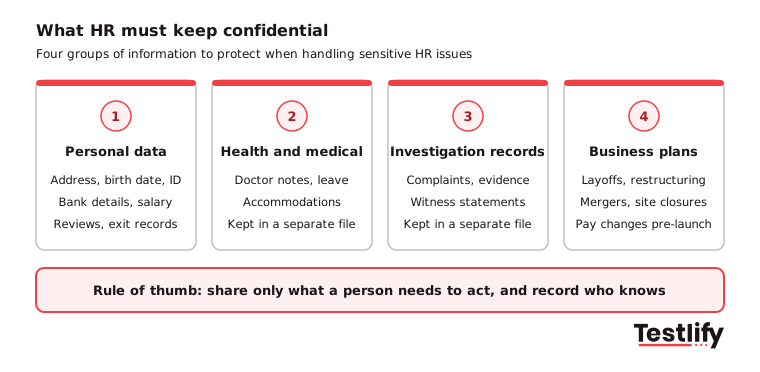
- Personal employee data: Home address, date of birth, ID and tax numbers, bank details, family and dependant details, salary, benefits, performance reviews and termination records.
- Health and medical information: Doctor's notes, accommodation requests, leave certifications, drug test results, workers' compensation and benefit claims. In the US, the ADA, FMLA and GINA set rules here, and medical records belong in a file kept apart from the general personnel file.
- Investigation records: Complaints, witness statements, interview notes, evidence and outcomes. Keep them in a separate investigation file so a routine personnel file request does not expose witnesses.
- Business plans that affect people: Layoffs, restructuring, site closures, mergers and compensation changes before they are announced.
Pro tip: Treat a document as confidential by default if it names a person and describes their health, conduct, pay or a complaint. Labelling files by sensitivity makes access rules much easier to apply.
Is HR confidential, and when can HR share information?
HR confidentiality is real but limited. HR professionals do not have the legal privilege that doctors or lawyers have, and their duty runs to the organisation as well as the employee. HR keeps information as private as possible, shares it only on a need-to-know basis, and must act when the law or a risk to people requires it.
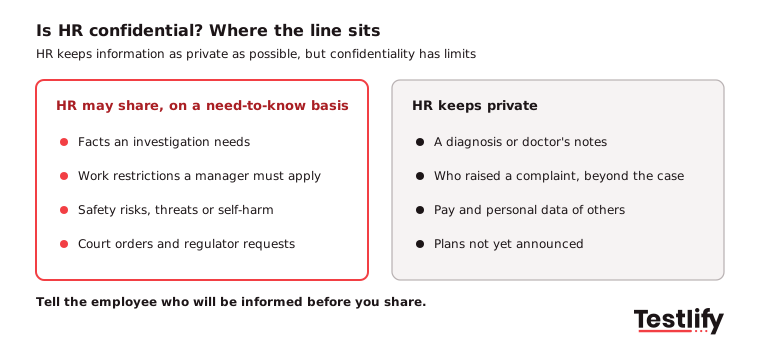
HR can, and often must, share information when:
- An investigation needs it: Witnesses and the accused person need enough detail to respond fairly.
- Managers need to apply a restriction: The EEOC's guidance on disability-related inquiries says medical information is a confidential medical record that may be shared only in limited cases, such as with supervisors and managers about work restrictions, with first aid and safety staff, and with government officials checking compliance.
- Someone is at risk: Threats of violence, self-harm or a serious safety hazard override a request for privacy.
- The law requires it: Court orders, regulator requests and mandatory reporting rules.
What HR should never do is share a diagnosis, a complaint or a pay detail as gossip with a curious manager, or in a wider channel than the case needs.
How do you handle a sensitive HR issue step by step?
Handling a sensitive HR issue well follows the same seven steps every time: listen in private, set honest expectations, record the facts, decide who needs to know, act or investigate, close the case with an outcome, and check for retaliation afterwards. A repeatable process protects the employee, the accused person and the company.
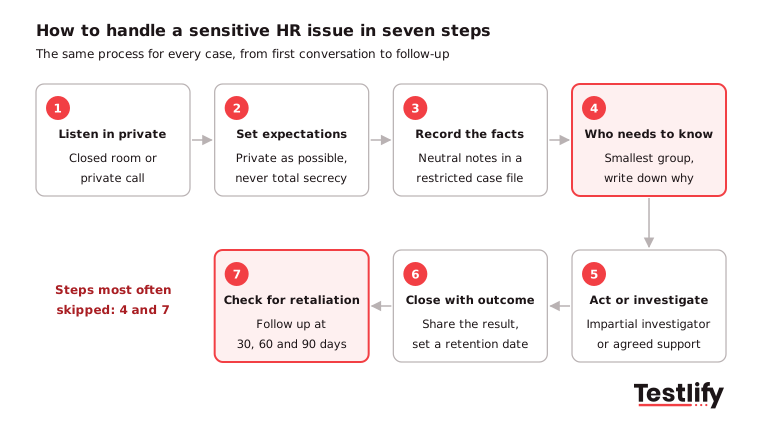
- Listen in private: Use a closed room or a private video call, not an open office or a shared chat thread. Let the person finish before asking questions.
- Set honest expectations: Explain that you will keep the matter as confidential as you can, who may need to know and why. Never promise total secrecy.
- Record the facts: Write down dates, names, what was said and what was seen, in neutral language. Store the notes in the restricted case file, not in email or a personal drive.
- Decide who needs to know: List the smallest group that must be involved (see the table below) and write down why each person is on the list.
- Act or investigate: For complaints, run a fair investigation with an impartial investigator. For health or personal matters, agree the adjustment or support with the employee first.
- Close with an outcome: Tell the people involved what they need to know about the result, keep the full file restricted, and set a retention date.
- Check for retaliation: Follow up with the person who raised the issue after 30, 60 and 90 days. HR Acuity reports that only 46% of investigated and resolved allegations were monitored for retaliation, so this step is where many teams fall short.
Across the teams we work with, step 4 is the one most often skipped. Writing down the need-to-know list takes two minutes and prevents most accidental leaks. For conflicts between colleagues, see our guide on how to handle workplace conflicts with professionalism and confidentiality.
Who needs to know about each type of sensitive HR issue?
Who needs to know depends on the issue type, and the right group is almost always smaller than people expect. The table below is a starting point for HR teams; adjust it to your own policy and local law.
Issue type | Who usually needs to know | What they need | Keep out of the general file |
|---|---|---|---|
Harassment or discrimination complaint | Investigator, HR lead, legal counsel, accused person (allegations only), relevant witnesses | Facts needed to respond or give evidence | Witness statements, interview notes |
Medical condition or accommodation | Employee's manager (restrictions only), first aid or safety staff if relevant | Work restrictions and schedule changes, not the diagnosis | Diagnosis, doctor's notes, test results |
Disciplinary or performance case | Direct manager, HR partner, next-level manager for sign-off | Expectations, evidence, timeline | Draft notes and unproven allegations |
Pay or personal data error | Payroll, data protection lead, the affected employee | What was exposed, to whom, and the fix | Copies of the exposed data |
Planned layoff or restructuring | Leadership, HR, legal, finance | Roles affected, timing, legal steps | Names before the announcement |
What should HR say when an employee asks to keep something secret?
HR should thank the employee, explain clearly what can stay private and what cannot, and agree next steps before the person shares details. Being honest at the start protects trust far better than a promise HR cannot keep.
A simple script many HR teams use:
"Thank you for coming to me. I will keep this as private as I can and only share it with the people who need to act on it. If what you tell me involves a risk to someone's safety or a breach of the law or our policy, I will have to act on it, and I will tell you who I am involving before I do."
If the employee then chooses not to go ahead, record that the conversation happened and what you advised. If the issue involves serious misconduct, such as harassment by a manager, the company may still need to look into it. You can also point the person to an anonymous reporting channel if your company has one. For background on formal complaints, see our HR glossary entry on grievances.
How do you protect HR records and data?
HR records stay protected through a mix of access control, secure tools and clear retention rules. Most leaks come from everyday shortcuts, such as a spreadsheet emailed to the wrong person or a file saved on a personal laptop, rather than from sophisticated attacks.
- Role-based access: Give each person access only to the records their role needs, and remove access the day someone changes role or leaves.
- Separate files: Keep medical and investigation records apart from the main personnel file, with tighter access.
- Encryption and secure channels: Encrypt files at rest and in transit. Discuss cases in your HR system or a secure channel, not in group chats or personal email.
- Audit logs: Use tools that record who viewed or changed a record, and review the log for sensitive cases.
- Retention and disposal: Set how long each record type is kept, then delete or shred it on schedule. Keeping data forever only increases what can leak.
- Backups: Back up HR data securely and test that you can restore it.
- Care with AI tools: Do not paste personal or case details into public AI chat tools. Use only tools your company has approved for HR data.
If you operate in the EU or UK, these controls also support your GDPR duties. Our GDPR compliance page shows how Testlify approaches them for hiring data.
What should an HR confidentiality policy include?
An HR confidentiality policy should define what information is confidential, who can access it, how it is stored and shared, how long it is kept, and what happens when someone breaches it. A short, plain policy that people actually read beats a long one that sits in a folder.
Include at least these sections:
- Scope: Which people (HR, managers, payroll, IT, contractors) and which records the policy covers.
- Definitions: What counts as confidential, using the four groups above.
- Access rules: Need-to-know access by role, and who approves exceptions.
- Handling rules: Approved channels, storage locations and rules for printing and sharing.
- Limits of confidentiality: When HR must share information, written in plain language for employees.
- Retention: How long each record type is kept and how it is destroyed.
- Breach response: How to report a leak, who investigates, and the consequences.
- Training and sign-off: Yearly training and a signed confidentiality agreement for everyone with access to HR data.
Review the policy every year and after any incident, and audit compliance against it.
What are common examples of a breach of confidentiality in the workplace?
Common examples of a breach of confidentiality in the workplace are usually small and avoidable, not dramatic leaks. In my work with HR and talent teams, the same handful come up again and again:
- Promising an employee complete secrecy, then having to break that promise.
- Discussing a case in an open office, a hallway or a shared chat channel.
- Copying too many people on an email about an investigation.
- Leaving medical notes or witness statements in the general personnel file.
- Telling a manager the diagnosis when they only need the work restriction.
- Keeping case files on personal devices or in unapproved apps.
- Forgetting to check on the person who raised the issue once the case is closed.
Key takeaway: Confidentiality is a process, not a promise. A written need-to-know list, separate restricted files and a follow-up for retaliation prevent most of the damage.
How does confidentiality apply to candidate and assessment data?
Confidentiality applies to candidates as much as to employees. Resumes, background checks, interview notes, assessment results and video answers are personal data, and in some cases they reveal disability, health or other protected details. Hiring teams should apply the same need-to-know access, retention rules and secure tools to candidate data as they do to personnel files.
For a deeper look, read our guide on how to handle sensitive information in the hiring process.
Testlify is built with this in mind. The platform holds ISO 27001 and SOC 2 Type II certifications, supports GDPR and CCPA, offers role-based access control, and lets customers choose a region for data storage. You can see the details on the Testlify security page, or try Testlify free for 7 days, no credit card needed.
Frequently asked questions (FAQs)

Wordpress Developer
Yash Patel is a Wordpress and SEO Specialist at Testlify with 3+ years of experience in technical SEO, on-page optimization, and content strategy. He works on improving Testlify's organic presence and produces content focused on hiring, talent assessment, and HR technology.
LinkedInRelated resources
View all
HR & recruitment
How to foster a culture of continuous learning within the organization

HR & recruitment
How to navigate challenges in cross-cultural communication
HR & recruitment
How to design and implement effective employee development programs

HR & recruitment
How to implement effective employee feedback mechanisms for continuous improvement

HR & recruitment
How to build strong employer-employee relationships in the workplace

HR & recruitment
How to develop and maintain strong HR partnerships with other departments
Get started.
Hire on proof, not resumes.
Run your first skills-based assessment free — no credit card required.