
40 corporate trainer interview questions to ask job applicants
Interview questions for corporate trainer candidates, grouped by skill, with sample answers, a teach-back test, a scorecard and red flags.

The best corporate trainer interview questions test four things: how a candidate finds the real skill gap, how they design a program around it, how they hold a room (in person or on a video call) and how they prove the training changed anything. This list gives you 40 questions grouped by those skills, sample answers to the six that matter most, a short teach-back exercise and a scorecard, so every interviewer judges candidates the same way.
TL;DR:
- Ask corporate trainer candidates about needs analysis, program design, delivery and measurement, not just presentation style. Those four skills decide whether training changes performance.
- Always add a 10-minute teach-back: give the candidate a topic a week ahead and score the session with a rubric. A trainer who cannot teach in the interview will not teach on the job.
- Strong answers name a method (ADDIE, Kirkpatrick or their own steps), a tool and a business number that moved. Weak answers stop at "participants loved it".
- The job is growing: the US Bureau of Labor Statistics projects 11% growth for training and development specialists from 2025 to 2035, with a median pay of $69,280.
- 71% of L&D professionals are already exploring or using AI in their work (LinkedIn, 2025), so ask how a candidate uses AI to build and update content.
- Score every candidate on the same six skills with weights before the interview starts, and test communication and presentation skills before the first live round to shorten the shortlist.
 ChatGPT
 Gemini
 Claude
 Grok
 Perplexity
What does a corporate trainer do?
A corporate trainer finds the skills employees are missing, designs training to close that gap, delivers it in person or online, and measures whether people now work differently. The role sits in L&D or HR and works with managers who own the business result, such as faster onboarding, fewer errors or better sales calls.
The US Bureau of Labor Statistics counts 472,500 training and development specialist jobs in the US in 2025, with about 46,000 openings a year and a typical entry requirement of a bachelor's degree. It lists analytical, collaboration, communication, creativity and instructional skills as the qualities that matter. Your interview should test each of them, plus comfort with learning technology.
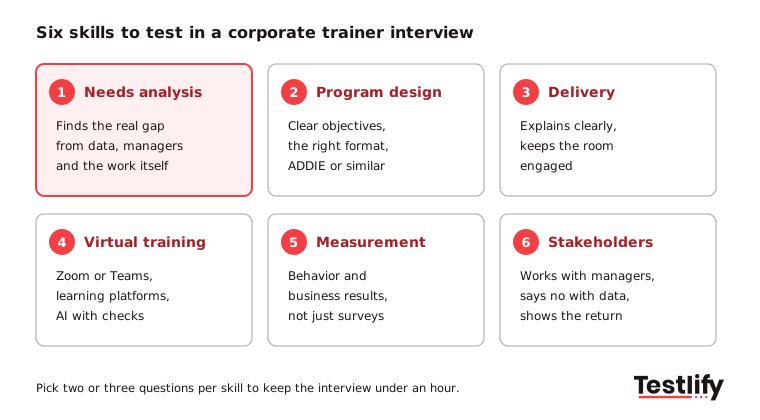
Before you write the interview plan, agree on the role with the hiring manager. Use a corporate trainer job description as the starting point and mark which skills are must-haves and which can be learned on the job.

What are the best corporate trainer interview questions?
The best corporate trainer interview questions ask for a real example with a method and a result. If you only have time for ten, use these:
- Walk me through the last training program you built from start to finish.
- How do you work out what a team actually needs to learn?
- Which design model do you use, and where do you change it?
- How do you measure whether a program changed behavior on the job?
- Tell me about a session that went badly. What did you change?
- How do you keep a virtual session as engaging as a classroom one?
- How do you handle a participant who thinks the training is a waste of time?
- How do you work with a subject matter expert who is not a good teacher?
- How are you using AI to build or update training content?
- Teach us one concept from your field in five minutes.
The rest of this list goes deeper on each skill. Pick two or three questions per skill so the interview stays under an hour.
What general and experience questions should you ask a corporate trainer?
General and experience questions open the interview and show the range of a candidate's experience: audiences, industries, delivery formats and the size of programs they have run.
- What kinds of employees have you trained, and in which industries?
- What is the largest program you have owned, in number of learners and sessions?
- Which topics do you train best, and which ones do you avoid?
- How did you move into corporate training, and what keeps you in it?
- What certifications or courses have shaped how you train?
- How do you split your time between designing content and delivering it?
- What learning platforms and authoring tools have you used?
- What would you want to learn in your first 30 days with our teams?
What questions test training design and needs analysis?
Design questions separate trainers who run sessions from trainers who solve problems. Listen for how the candidate gathers evidence before building anything. If you want a refresher on the terms, see the glossary entries for training needs analysis and instructional design.
- How do you run a training needs analysis? Give a recent example.
- How do you tell a skill gap from a process or motivation problem?
- Walk me through how you use ADDIE or another design model.
- How do you write learning objectives a manager can check?
- How do you decide between a classroom session, e-learning, coaching or a job aid?
- How do you turn a 60-page manual into a two-hour course?
- How do you adapt one program for new hires and for experienced staff?
- How do you keep content current when the product or policy changes every quarter?
What questions test delivery and virtual training skills?
Delivery is where most interviews stop, but it is only one skill. Ask for specifics: the tools, the timing and what the candidate does when a session goes off plan.
- How do you open a session so people stop checking email?
- What changes when you deliver the same content on Zoom or Teams instead of in a room?
- How do you run breakout groups and polls in a virtual session?
- How do you adjust when some learners move faster than others?
- How do you handle a senior leader who dominates the discussion?
- How do you make training accessible for people with different needs or languages?
- What do you do when the technology fails ten minutes in?
- How are you using AI tools to draft content, quizzes or role plays, and what do you check by hand?
Question 24 matters more each year. In LinkedIn's 2025 Workplace Learning Report, 71% of L&D professionals said they are exploring, experimenting with or integrating AI into their work. A good candidate uses AI for speed and still checks facts, tone and accuracy before anything reaches learners.
Which behavioral and situational questions work best?
Behavioral questions ask for past examples. Ask the candidate to answer with the situation, the action they took and the result, and push for numbers.
- Tell me about a time employees resisted a training program. What did you do?
- Describe a program that did not deliver the result you expected. What did you learn?
- Tell me about a time a manager disagreed with your training plan.
- Describe a time you had to build training with almost no budget.
- Tell me about feedback from learners that changed how you train.
- Describe how you trained people on a technical topic you did not know well at the start.
- Tell me about a time you had to deliver training on a very short deadline.
- Describe a time you coached another trainer or a subject matter expert to teach.
For sales-specific roles, where the trainer coaches reps on calls and pipeline skills, use our separate list of trainer interview questions for sales trainers.
What should you ask senior trainers and L&D leads?
For senior hires, the job is less about delivery and more about tying learning to business goals. LinkedIn's 2025 report found that 49% of L&D and talent development professionals agree their executives are worried employees lack the skills to deliver the business strategy. A senior trainer should be able to talk to those executives in their language.
- How do you decide which training requests to say no to?
- How do you show a business leader the return on a training program?
- Which Kirkpatrick level do you usually reach, and how?
- How have you built a leadership or manager training program?
- How do you build a training calendar for a year with a fixed budget?
- How do you choose and roll out a learning platform?
- How do you build a team of internal trainers from subject matter experts?
- What would your 30-60-90 day plan look like in this role?
LinkedIn's report also found that 71% of organizations offer leadership training, the most common career development program. If your role includes manager training, give question 36 extra time.
What do good answers to corporate trainer interview questions sound like?
Good answers to corporate trainer interview questions name a method, a tool and a result. The sample answers below show what a strong response sounds like for the six questions that matter most. Use the "look for" notes to score answers, not to expect the exact words.
1. Walk me through the last training program you built from start to finish.
Look for: a clear sequence (analysis, design, build, delivery, evaluation), the business problem that started it, and a result.
Sample answer: "Our support team's first-contact resolution had dropped to 61%. I listened to 40 call recordings and interviewed four team leads, and found the gap was troubleshooting for one product line, not product knowledge in general. I built a three-week program: two short virtual workshops, a decision-tree job aid and weekly call reviews with team leads. Resolution for that product line went from 58% to 72% over the next quarter, and we kept the job aid as part of onboarding."
2. How do you work out what a team actually needs to learn?
Look for: more than one source of evidence (data, observation, manager and employee input), and the habit of checking whether training is the right fix at all.
Sample answer: "I start with the result the manager wants to change and the data behind it. Then I watch the work, talk to top performers and to people who struggle, and run a short skills check. Sometimes the answer is not training. Once, a team kept making order errors because the form was confusing, so we fixed the form and skipped the course."
3. How do you measure whether a program changed behavior on the job?
Look for: measurement beyond satisfaction scores, such as observation, manager check-ins and a business metric, planned before the program starts.
Sample answer: "I agree the success measure with the manager before I design anything. Satisfaction surveys and a quiz tell me the session worked. For behavior, I ask managers to observe a specific task at 30 and 60 days with a short checklist. For results, I track the metric we agreed on, like ramp time or error rate, against a group that has not been trained yet when that is possible."
4. Tell me about a session that went badly. What did you change?
Look for: honesty, a specific cause and a concrete change in how they work. Be careful with candidates who cannot name a single failure.
Sample answer: "My first virtual compliance session was a 90-minute lecture. Cameras went off after 15 minutes and the quiz scores were poor. I cut it into three 30-minute sessions, added a scenario every ten minutes and used polls to check understanding. Quiz scores went up and the session became the model for our other virtual courses."
5. How do you handle a participant who thinks the training is a waste of time?
Look for: curiosity before control. Strong trainers ask why, link the content to the person's work and keep the rest of the room on track.
Sample answer: "I talk to them at the break, not in front of the group. Usually they already know part of the content or do not see how it applies to them. I ask what problems they deal with, use one of their examples in the next exercise, and sometimes ask them to help a newer colleague. Most of the time the skeptic becomes one of the most active people in the room."
6. How are you using AI to build or update training content?
Look for: practical use with clear checks, and awareness of accuracy, data privacy and company policy.
Sample answer: "I use AI to draft first versions of quizzes, scenarios and role-play scripts, and to turn long documents into outlines. I never publish anything without checking it against the source and with a subject matter expert. I do not paste customer data or internal documents into public tools, and I follow the company's AI policy."
How do you score a corporate trainer interview?
A corporate trainer interview is scored best with a short scorecard: six skills, a weight for each and a 1 to 5 scale with examples of what a 1, 3 and 5 look like. Every interviewer scores alone before the debrief, so the loudest opinion does not decide the hire.
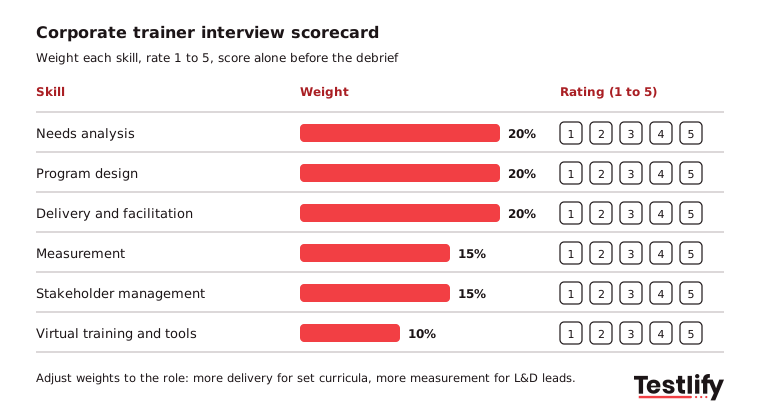
Skill | Weight | Questions to use | A strong answer shows |
|---|---|---|---|
Needs analysis | 20% | 2, 9, 10 | More than one data source; checks whether training is the right fix |
Program design | 20% | 11 to 16 | A clear model, objectives a manager can check, the right format for the goal |
Delivery and facilitation | 20% | 17 to 23, teach-back | Clear explanations, timing, handles questions and difficult participants |
Virtual training and tools | 10% | 7, 18, 19, 24 | Named tools, adapts design for screens, uses AI with checks |
Measurement | 15% | 4, 34, 35 | Measures behavior and business results, not only satisfaction |
Stakeholder management | 15% | 27, 33, 37 | Pushes back with data, speaks the business leader's language |
Adjust the weights to the role. A trainer who mostly delivers a set curriculum needs more weight on delivery. An L&D lead needs more weight on measurement and stakeholders.
Pro tip: Write down the score and one piece of evidence for each skill straight after the interview. Across the teams we work with, scores written the next day drift toward the overall impression and lose the detail that separates two good candidates.
How do you run a teach-back exercise in a corporate trainer interview?
A teach-back exercise asks the candidate to teach a short session to the interview panel, and it is the closest preview you will get of how they perform in a real room. Every employer guide on this topic suggests a presentation, but few say how to run or score one. Keep it to four steps.
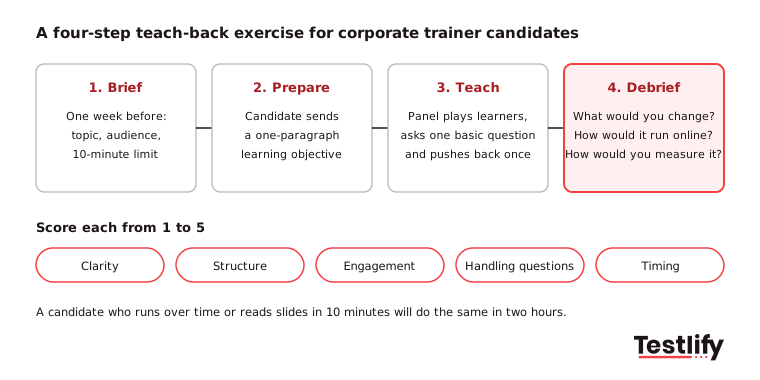
- Brief: one week before, send a topic from your own business (for example, how to give feedback in a one-to-one), the audience and a 10-minute limit.
- Prepare: let the candidate bring slides or a handout, but ask for a one-paragraph learning objective in advance.
- Teach: the panel plays learners. One panelist asks a basic question and another pushes back once, so you see how the candidate reacts.
- Debrief: ask what they would change, how they would run it online, and how they would check that learners use the skill a month later.
Score the session on clarity, structure, engagement, handling questions and timing, each from 1 to 5. A candidate who runs over time or reads from slides in a 10-minute session will do the same in a two-hour one. For a deeper look at this skill, read our guide to assessing presentation skills in recruitment.
What are the red flags in corporate trainer interview answers?
The biggest red flags in corporate trainer interview answers are vague results, a one-size-fits-all approach and no interest in the business problem. Watch for these patterns:
- Results stop at satisfaction: "People loved it" or "we got 4.8 out of 5" with no sign of behavior or business change.
- No needs analysis: the candidate starts with the course they want to build, not the problem the team has.
- One format for everything: every answer is a classroom workshop, even for a skill better taught on the job.
- No failures: a trainer with years of experience who cannot describe a session that went wrong is either not reflecting or not being honest.
- Talks more than teaches: in the teach-back, the candidate lectures for the full time and never checks understanding.
- Blames learners: resistance is always the participants' fault, never the design or the relevance of the content.
Key takeaway: A good corporate trainer talks about the learner's job and the manager's numbers. A weak one talks about slides and smile sheets.
How do skills tests help you hire a corporate trainer?
Skills tests help you hire a corporate trainer by checking communication, presentation and judgment before you spend panel time on live interviews. A short test stage means the people who reach the teach-back can already explain ideas clearly and handle workplace situations well.
A typical test stage for this role combines three or four of these:
- The presentation skills test for structure, clarity and audience awareness.
- The communication skills test for written and verbal clarity.
- The emotional intelligence test for reading a room and handling resistance.
- Situational judgment questions built around training scenarios, such as a manager who wants a course for a process problem.
- A one-way video question where the candidate explains a concept in two minutes, using Testlify's video interviewing tool.
Testlify's library has 3,500+ tests and 25+ question types, including video, audio and file upload, so you can add a short teach-back recording or ask candidates to upload a sample lesson plan. Results come back scored, with a per-skill breakdown, and sync to 100+ ATS and HRIS tools such as Workday, Greenhouse and SAP SuccessFactors.
We have seen hiring teams use the test stage to cut a long list of applicants to a shortlist of five or six, then spend their live interview time only on the 40 questions and the teach-back above.
Ready to hire your next corporate trainer?
Build a test stage for your corporate trainer role from the Testlify test library, add a one-way video teach-back, and share a ranked shortlist with your hiring manager. Start a 7-day free trial with no credit card, or book a demo to see it set up for an L&D role. Hiring for other learning roles too? See our learning and development specialist interview questions.
Frequently asked questions about corporate trainer interviews

Wordpress Developer
Yash Patel is a Wordpress and SEO Specialist at Testlify with 3+ years of experience in technical SEO, on-page optimization, and content strategy. He works on improving Testlify's organic presence and produces content focused on hiring, talent assessment, and HR technology.
LinkedInRelated resources
View all
HR & recruitment
60 Procurement Analyst interview questions to ask job applicants

HR & recruitment
60 Digital Content Specialist interview questions to ask job applicants

HR & recruitment
60 Talent Acquisition Coordinator interview questions to ask job applicants

HR & recruitment
60 Market Analyst interview questions to ask job applicants

HR & recruitment
30 UX researcher interview questions to ask in 2026

HR & recruitment
60 Licensing and Compliance Specialist Interview Questions
Get started.
Hire on proof, not resumes.
Run your first skills-based assessment free — no credit card required.