
Compassionate leave: A guide for HR and employees
Learn what compassionate leave is, why it matters, and how employers can support employees during personal crises with clear leave policies and legal compliance.
Compassionate leave is time off work for a personal crisis: a death in the family, a life-threatening diagnosis, a miscarriage, or an emergency that makes the next few days impossible. Most employers grant 3 to 5 days. Very few countries guarantee any of it.
That gap between what people assume they are owed and what the law actually gives them is where most of the friction happens. An employee thinks bereavement leave is a legal right. Their manager thinks the handbook covers it.
Neither has checked, and the conversation happens on the worst day of somebody's year. This guide covers what compassionate leave means, the rules in the US, UK and elsewhere, how long it usually runs, and what a policy needs to say so nobody has to improvise.
TL;DR
- Compassionate leave covers personal emergencies beyond a death: serious illness, caregiving, miscarriage, and trauma. Bereavement leave is the narrower subset that deals with a death.
- There is no US federal right to bereavement or compassionate leave. The FMLA gives 12 weeks of unpaid leave, but a funeral is not one of its qualifying reasons.
- A growing number of US states fill that gap. California requires up to 5 days for employers with 5 or more staff.
- The UK gives unpaid emergency time off for dependants with no set limit, plus 2 weeks of Parental Bereavement Leave if a child dies. Paid bereavement leave is not a general legal right.
- Three to five days is the common default, and it is usually too blunt. The return matters more than the count.
- A policy that says who qualifies, how long, paid or unpaid, and what proof is needed removes the guesswork from a manager's worst conversation.
 ChatGPT
 Gemini
 Claude
 Grok
Grok Perplexity
What is compassionate leave? Meaning and definition
Compassionate leave is job-protected time off granted when an employee faces a serious personal crisis, such as the death or life-threatening illness of a close family member, a miscarriage, or a traumatic event. It can be paid or unpaid depending on company policy and local law. Its purpose is to let someone step away without risking their job.
The term is broader than it looks. Bereavement is the obvious trigger, but the same leave usually stretches to a parent going into intensive care, a partner's miscarriage, or a child in crisis. (It is often misspelled as compasionate leave, with a single s.) Some employers call it personal emergency leave or crisis leave. The label matters less than the scope written into the policy.
One thing worth being precise about: compassionate leave is not a wellness perk. It sits closer to sick leave in how it should be administered, which means it needs the same clarity about eligibility, notice and proof. Treating it as a discretionary favour is how two employees in the same week end up with different answers.
Explore more:Employee well-being initiative

Compassionate leave examples
The situations that qualify are more varied than most handbooks admit. Common compassionate leave examples include:
- A death in the immediate family. A parent, partner, child, sibling or grandparent dies, and the employee needs time to grieve and handle the funeral and estate paperwork.
- A life-threatening diagnosis. A spouse is admitted for emergency surgery, or a parent receives a terminal diagnosis and the family has decisions to make this week.
- Miscarriage or stillbirth. Either the employee or their partner. This one is left out of a surprising number of policies, and the omission is felt.
- Caring for someone in crisis. A family member has an accident or a sudden mental-health emergency and there is nobody else to be there.
- Witnessing or surviving a traumatic event. A serious accident, a violent crime, or a house fire.
- A dependant's emergency. Childcare collapses, a care home calls, a school sends a child home mid-shift.
Notice how few of these are predictable. That is the design constraint: a policy written around planned absence will fail every one of them.
Why does compassionate leave matter at work?
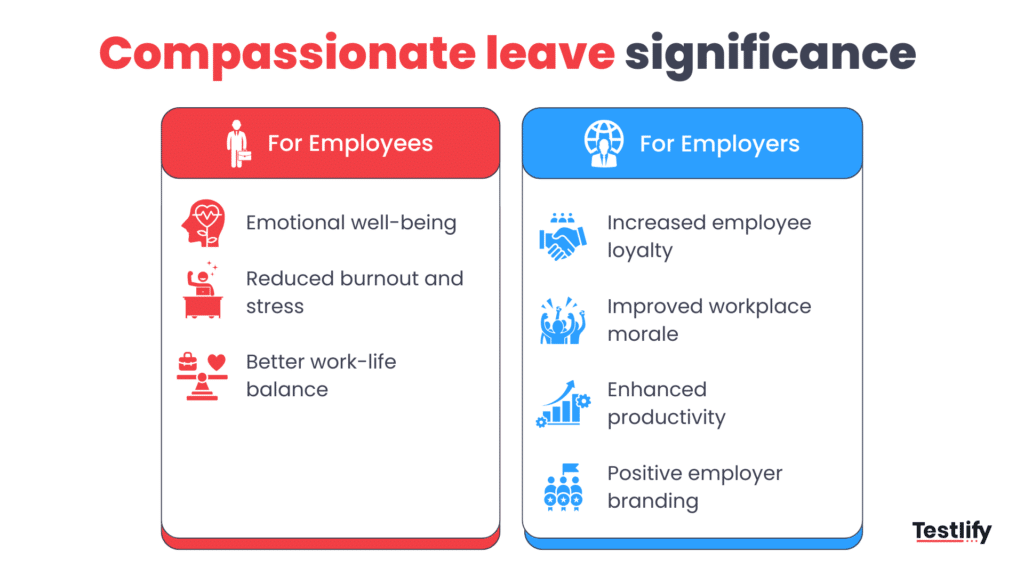
Compassionate leave gives employees the time and space to deal with a significant personal loss or family emergency without the added pressure of work. It also helps employers build a workplace culture where employee well-being is treated as a genuine priority.
How compassionate leave supports employees
- Room to grieve without a second crisis. Nobody should be calculating their remaining paid days off while arranging a funeral. Job protection removes the financial panic that sits on top of the loss.
- Lower risk of a long absence. People pushed back to work too early tend to come back again, for longer. A short, properly supported absence is usually cheaper than a rushed one.
- A clearer line between work and life. Knowing the policy exists before you need it changes how safe a job feels. It also feeds broader employee satisfaction.
How compassionate leave benefits employers
- Retention at the moment loyalty is decided. How a company behaves during a death is remembered far longer than any engagement survey. People talk about it for years.
- Fewer discrimination risks. A written policy applied consistently is the defence against a claim that one employee got two weeks and another got two days.
- Better handover. A policy with a notice and cover process means work gets reassigned deliberately instead of quietly dropping.
- An employer brand that holds up. Candidates ask about this now, and the answer travels.
Who is eligible for compassionate leave?
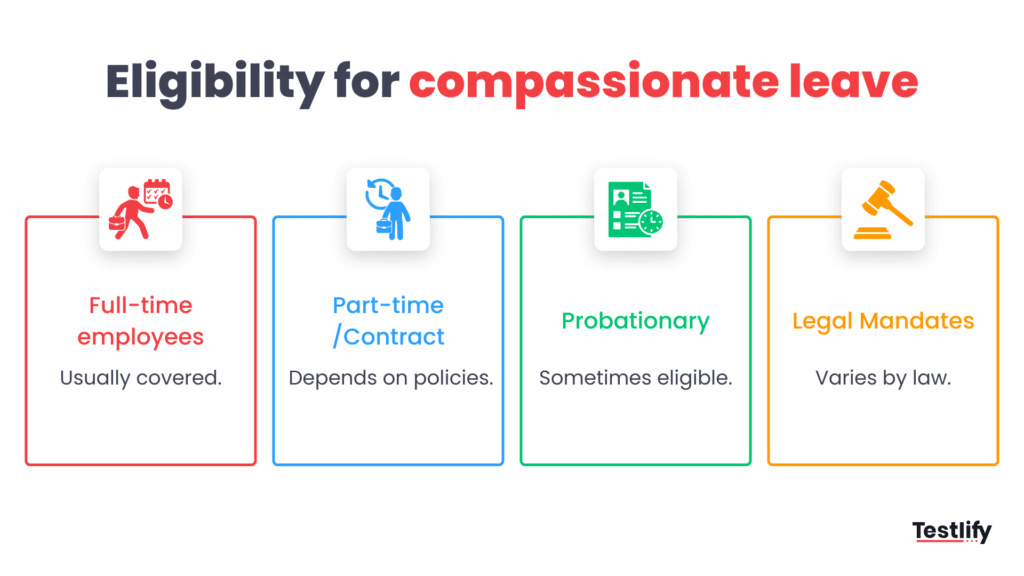
Eligibility depends on the policy and the jurisdiction, but most schemes sort people into four groups:
- Full-time employees. Almost always covered, usually from day one.
- Part-time and fixed-term employees. Usually covered, sometimes pro-rated. Pro-rating grief is a decision worth thinking twice about.
- Employees on probation. Frequently excluded by default, which is the wrong call. Nobody times a bereavement around their probation period.
- Contractors and casual staff. Often outside the policy entirely, and where statutory rights do apply they are usually unpaid.
Where a legal minimum exists it sets the floor, not the ceiling, and most decent policies sit well above it.
Types of compassionate leave
Compassionate leave is an umbrella. Underneath it sit several distinct entitlements that are worth naming separately in a policy, because they have different triggers and different durations.
Leave type | What it covers | Typical duration |
|---|---|---|
Bereavement leave | Death of a family member or close friend, including the funeral and estate admin | 3 to 5 days |
Parental bereavement leave | Death or stillbirth of a child. A statutory right in the UK | 2 weeks |
Emergency or dependant leave | Urgent, unforeseen crises involving someone who depends on the employee | 1 to 3 days per event |
Caregiver leave | Caring for a relative with a serious illness or injury | Days to several weeks |
Crisis or trauma leave | Accidents, violent crime, natural disaster, acute mental-health events | Case by case |
Splitting them out matters because a single pooled allowance forces people to choose. An employee who spent 4 days on a parent's funeral in March should not be short when their child is hospitalised in September.
Compassionate leave vs bereavement leave
These two get used interchangeably, and they are not the same thing. Bereavement leave is triggered by a death. Compassionate leave covers that plus every other personal emergency, including the ones where the person is still alive and that is precisely the problem.
Aspect | Compassionate leave | Bereavement leave |
|---|---|---|
Trigger | Any serious personal or family crisis | A death |
Scope | Illness, injury, trauma, caregiving, miscarriage, bereavement | The death and its immediate aftermath |
Typical duration | Varies widely with the situation | Usually 3 to 5 days |
Legal status | Rarely a standalone statutory right | Increasingly legislated at state or national level |
Proof usually asked for | Medical note or none | Death certificate or funeral notice |
Is compassionate leave paid or unpaid?
It depends almost entirely on the employer. Paid compassionate leave is common in policy and rare in law. In the UK, Acas is direct about it: there is no legal right to paid time off for bereavement, unless the employee qualifies for parental bereavement pay after the death of a child.
Most employers land in one of three places. Full pay for a fixed number of days, which is the cleanest to administer. Paid for a death in the immediate family and unpaid beyond it, which is the most common and the most argued about. Or unpaid throughout, with the employee free to use accrued vacation or sick time instead.
The third option looks neutral and is not. Telling someone to spend their vacation on a funeral is a policy choice, and people read it as one.
How long is compassionate leave usually granted?
Three to five days is the default across most handbooks, stretching to two weeks for the death of a child or a partner. Caregiver situations run longer, sometimes into months, and are usually handled through a separate medical or family-leave route rather than compassionate leave itself.
Here is the part most policies get wrong. Five days is not a measure of grief; it is a measure of paperwork. It roughly covers a funeral. It does not cover the week after, which is when people tend to fall over. The teams that handle this well set a baseline number and then build a phased return on top of it: reduced hours for a fortnight, no client-facing work for the first few days back, and a manager check-in at 30 days rather than a single conversation on day one.
Pro tip: put a hard rule in the policy that no performance review, PIP or major deadline lands within 30 days of a return from bereavement leave. It costs nothing, and it prevents the single most damaging thing a well-meaning manager can do.
What does the law say about compassionate leave?
Legal protection varies more than almost any other leave type. Assume nothing travels across a border.
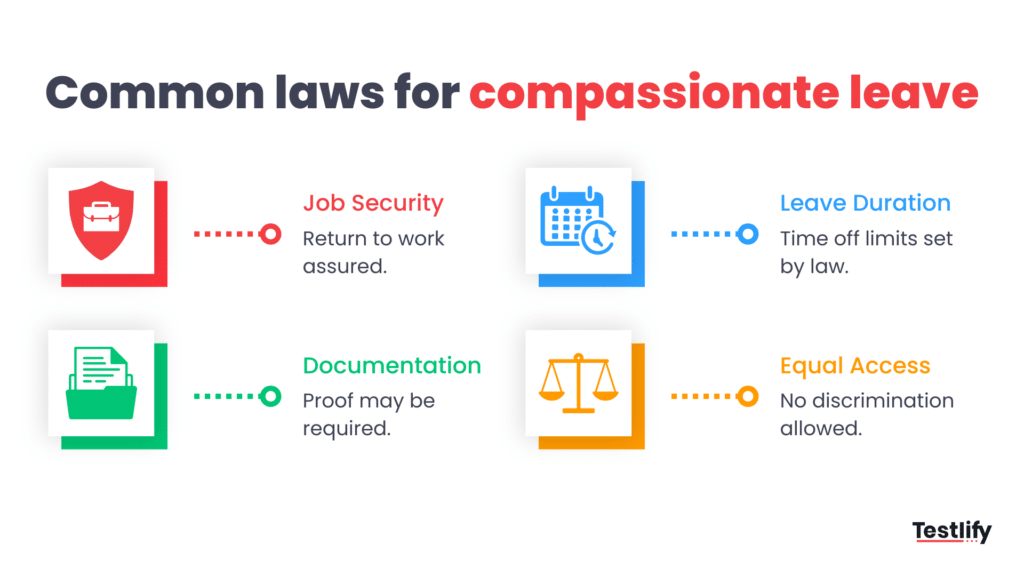
United States: No federal right, a patchwork of state law
There is no federal entitlement to bereavement or compassionate leave. The Family and Medical Leave Act gives eligible employees up to 12 workweeks of unpaid, job-protected leave in a 12-month period (26 workweeks for military caregiver leave), but attending a funeral is not one of its qualifying reasons.
A covered employer is one with 50 or more employees in 20 or more workweeks in the current or previous calendar year. To be eligible an employee must have worked for that employer for at least 12 months, logged at least 1,250 hours in the year before the leave, and work at a site with at least 50 employees within 75 miles.
States have started filling the hole. California requires covered employers to provide up to 5 days of bereavement leave for employees with at least 30 days of service, at businesses with 5 or more employees, to be completed within 3 months of the death. Several other states have passed or proposed similar rules, so a multi-state employer should check each one rather than writing a single national policy and hoping.
United Kingdom: Emergency time off, mostly unpaid
UK employees have a statutory right to a reasonable amount of unpaid time off to deal with an emergency involving a dependant, including a death. There is no set number of days and no limit on how often it can be used, but it only applies to genuine emergencies, not to anything the employee knew about in advance.
The one paid statutory exception is Parental Bereavement Leave. A parent whose child dies under 18, or who has a stillbirth after 24 weeks, can take 2 weeks of leave from day one of employment, paid at GBP 194.32 a week or 90% of average weekly earnings, whichever is lower. The leave has to finish within 56 weeks of the death.
Everywhere else: Check before you promise
Some countries write compassionate leave into national employment standards with a set number of paid days per occasion. Others, including much of Asia, leave it entirely to the employment contract. A global policy should state the company minimum and then defer to local law wherever local law is better, which is the only version that survives an audit.
How should employers manage compassionate leave requests?
Start with the assumption that the request is genuine. Abuse of compassionate leave is rare and the cost of treating everyone as a suspect is high.
Beyond that, four things separate a process that works from one that generates complaints:
- Approve fast, verify later. Nobody should wait 48 hours for a decision. Let managers approve on the spot within the policy limit and sort documentation afterwards.
- Ask for proof sparingly. Requesting a death certificate in week one is legal and tone-deaf. Set a threshold, such as absences beyond five days, and hold to it.
- Protect confidentiality. The team needs to know someone is out, not why. That decision belongs to the employee.
- Redistribute the work explicitly. Name who picks up what, in writing, before the person leaves. Work that is not reassigned is waiting for them when they get back, which defeats the point.
The honest tradeoff: consistency and compassion pull against each other here. A manager who bends the rules for a well-liked employee creates a precedent the next person will hear about. A policy applied rigidly feels cold on the day it matters most.
The way through is a generous written baseline plus a documented escalation path, so the exception is a process rather than a favour, and so discrimination claims have nothing to attach to.
You might find helpful: How to create a positive work culture
What should a compassionate leave policy include?
A usable policy fits on two pages and answers the questions a manager will actually be asked at 8am on a Monday.
How to define compassionate leave in your policy
Write the definition before the entitlement. State which events qualify, name the relationships covered (and say whether chosen family and long-term partners count, because the default legal definitions often exclude them), and say plainly whether the leave sits separately from sick and annual leave. A definition that lists only a death will be read as excluding everything else.
The rest of the policy checklist
- Eligibility. Which employment types, from what date, including probation.
- Duration. The number of days per event, whether events pool, and what happens when someone needs more.
- Pay. Paid, unpaid, or partially paid, stated in one unambiguous sentence.
- Notice. How to request it, who approves, and what happens when nobody is reachable.
- Evidence. What is required, when, and the threshold below which nothing is asked.
- Confidentiality. Who is told what.
- Return to work. Phased hours, workload protection, and the 30-day rule above.
- Support. Counselling, an employee assistance programme, or a hardship fund if one exists.
Then test it against a real case before publishing. Take last year's hardest absence and walk it through the draft. If the policy produces an answer a reasonable person would call harsh, fix it now rather than in front of an employee.
Can compassionate leave be denied?
Yes, where no statutory right applies, and the request falls outside the policy. An employer can decline leave for a relationship the policy does not cover, or refuse an extension beyond the stated limit. Where a legal entitlement does exist, such as UK dependant leave or California bereavement leave, refusing it is unlawful.
A flat no is almost always the wrong answer even when it is permitted. Offer something: unpaid days, flexible hours, remote work for a week, or accrued vacation. A denial with an alternative reads as a constraint. A denial with nothing attached reads as a verdict on how much the person matters, and that is what gets repeated to everyone else on the team.
Plan for the gap before it opens
Extended compassionate leave can leave a team short-handed, but urgency should not come at the expense of hiring quality. When a role needs to be filled quickly, it is easy to settle for a resume that looks close enough or make a decision before the candidate has been properly evaluated.
Testlify helps teams bring structure to urgent hiring with role-based skills assessments, a large test library, structured scorecards, and multi-reviewer scoring. This gives hiring teams a consistent way to evaluate candidates, even when time is limited and multiple people are involved in the decision.
Book a demo to see how Testlify can help you build a stronger shortlist when you need to hire quickly.
Key takeaways
- Compassionate leave is broader than bereavement leave, and the difference is operational. Bereavement covers a death; compassionate covers illness, caregiving, miscarriage and trauma too. A policy that names only death will be applied narrowly by managers who have nothing else to go on, and the employee with a parent in intensive care gets nothing.
- Assume no legal safety net in the US. There is no federal right to bereavement leave and the FMLA does not cover a funeral. If a US policy is silent, the practical entitlement in most states is zero, so the handbook is doing all the work.
- State and national law is moving, unevenly. California mandates 5 days; the UK gives unpaid dependant leave plus 2 weeks of paid parental bereavement leave. A multi-country employer that writes one global number will be under the law somewhere, so set a company floor and defer upward to local rules.
- The day count matters less than the return. Five days covers a funeral, not the week after. Pair the baseline with phased hours and a 30-day protection window on reviews and deadlines, which costs nothing and prevents the most common avoidable harm.
- Consistency is the fairness control. Discretion applied case by case produces two employees with different outcomes and a defensible-looking claim. Write a generous baseline, document the escalation path, and treat exceptions as a process rather than a favour.
- Ask for proof late and sparingly. Approving quickly and verifying afterwards costs almost nothing in abuse and buys a great deal of trust. Set a documentation threshold and leave the first few days alone.
- Plan the coverage, not just the absence. Reassign work in writing before the person leaves, and if the gap needs a hire, score the shortlist on skills rather than filling it on instinct under time pressure.
FAQs

Human Resources Lead
Snehi Parmar leads People at Testlify, owning hiring, culture, performance, and retention for a 90-person team. She writes on practical HR strategy and building people processes that scale.
Related resources
View all
HR & recruitment
What is E-Recruitment? Pros, cons, strategies for 2026

HR & recruitment
11 core HR functions every recruiter should know in 2026

HR & recruitment
Interview to hire ratio: A complete guide for hiring teams

HR & recruitment
Revenue per FTE: Formula, Benchmarks, and How to Improve It

HR & recruitment
What is job restructuring and how to do it?

HR & recruitment
Cost-effective employee training solutions: using SCORM-compliant authoring tools to create E-learning courses
Get started.
Hire on proof, not resumes.
Run your first skills-based assessment free — no credit card required.