
Candidate screening methods: 12 ways to build a better shortlist
The 12 candidate screening methods recruiters use most, what each one checks, when to use it, and how to combine them into a fair process.

Candidate screening methods are the checks recruiters use to decide which applicants move forward to interviews: resume and application review, knockout questions, phone screens, one-way video and AI interviews, skills tests, work samples, structured interviews, and reference and background checks. The best results come from layering a few methods in the right order, cheap filters first and stronger evidence as the pool shrinks.
 ChatGPT
 Gemini
 Claude
 Grok
 Perplexity
TL;DR
- The 12 main candidate screening methods are resume review, knockout questions, phone screens, one-way video and AI interviews, skills tests, cognitive and situational judgment tests, work samples, take-home tasks and paid trials, structured interviews, personality assessments, reference and background checks, and social media checks.
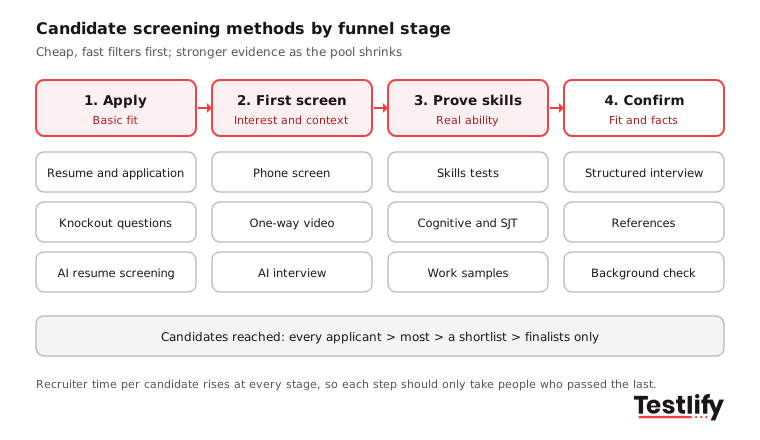
- No single method is enough. Use fast filters (resume review, knockout questions) first, then proof of skill (tests, work samples), then verification (references, background checks) only for finalists.
- Skills tests and work samples give the strongest early evidence. LinkedIn found 93% of TA pros say accurate skills assessment is crucial to quality of hire.
- Keep a screening assessment under 60 minutes and a take-home task to two or three hours, or strong candidates drop out.
- Match the mix to the role: knockout questions and short tests for high-volume roles, work samples for technical roles, structured interviews for leadership roles.
- Every method must be job-related and applied the same way to every candidate. AI screening tools in New York City also need a yearly bias audit and candidate notice.

What is candidate screening?
Candidate screening is the early stage of hiring where recruiters check whether an applicant meets the basic needs of the role and should move to the next step. It sits between the application and the first full interview, and its job is to turn a large applicant pool into a smaller group of qualified people worth more of the team's time.
At this stage recruiters look at relevant experience, must-have skills and qualifications, availability, salary range, work authorization, and early signs that the person can do the work.
Candidate screening vs candidate evaluation vs candidate selection
The three terms are connected, but they are not the same step.
- Candidate screening: Happens early and checks basic fit. Does the person meet the main needs of the role, and should they move forward?
- Candidate evaluation: Goes deeper, through interviews, assessments, and work samples. The focus moves from basic fit to actual ability.
- Candidate selection: The final stage, where the team compares the strongest people left and decides who gets the offer.
Pre-screening vs screening
Pre-screening is the first filter before anyone talks to the candidate: knockout questions, resume review, and application questions. Screening is the wider set of checks that follows, including phone screens, tests, and short interviews. Many teams automate pre-screening and keep people in charge of everything after it.
Why do candidate screening methods matter?
Candidate screening methods matter because the first filter shapes the whole shortlist. A weak filter wastes interview time on the wrong applicants and drops strong people before anyone has seen what they can do.
Hiring is still hard. Nearly 7 in 10 organizations (69%) report difficulty recruiting for full-time roles, according to SHRM's 2025 Talent Trends research. The SHRM 2025 recruiting benchmarking brief puts the median cost per hire at $1,200 for nonexecutive roles and $10,625 for executive roles, with a median time to fill of about a month and a half. In extra-large organizations, nonexecutive roles take 61 days to fill.
Quality matters as much as speed. LinkedIn's Future of Recruiting 2025 report found that companies running the most skills-based searches were 12% more likely to make a quality hire. That is a clear signal to screen on evidence of skill, not job titles or polished resumes.
Good screening also protects the business. A structured, documented process is easier to explain to a hiring manager, a candidate, or a regulator than a pile of gut calls.
What are the 12 most effective candidate screening methods?
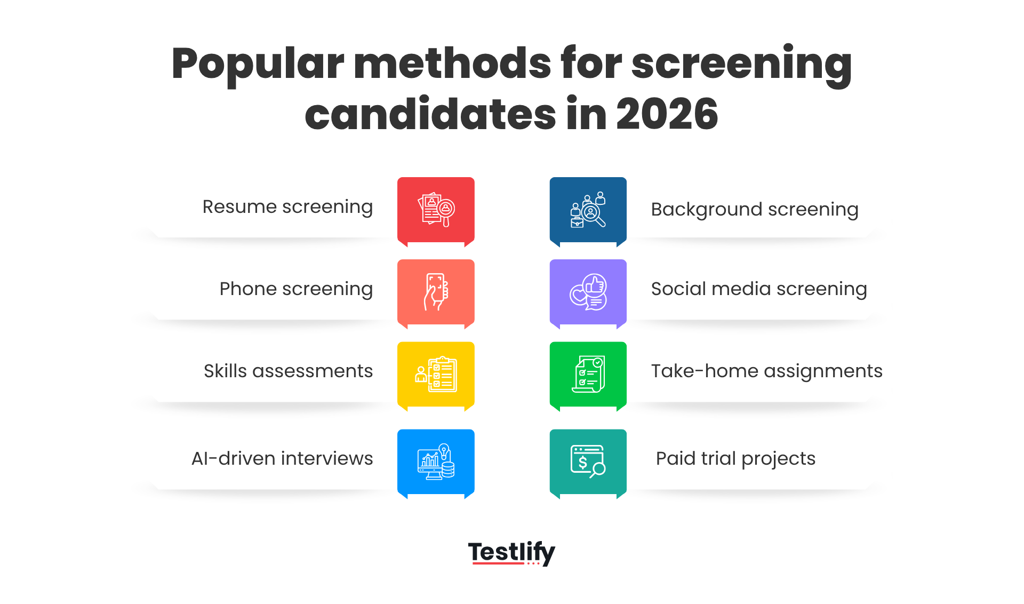
The 12 most effective candidate screening methods are resume and application screening, knockout questions, phone screens, one-way video and AI interviews, skills tests, cognitive and situational judgment tests, work samples and job simulations, take-home tasks and paid trials, structured screening interviews, personality and behavioral assessments, reference and background checks, and social media screening. Most teams use four or five of them per role.
1. Resume and application screening
Resume screening is where most processes start. Recruiters, or an applicant tracking system (ATS), check each resume and application against the role's requirements: relevant experience, qualifications, location, notice period, and industry background.
Resume review is a useful entry point but a weak final answer. A resume shows where someone worked, not how well they work, and it rewards polished writing over real ability. Generic keyword matching also rejects people who describe the same skills in different words.
Testlify's AI resume screener scores each resume against role-specific criteria, gives an explainable match score with High, Medium, or Low fit labels, and can move shortlisted candidates to the next step and sync results back to the ATS.
Cover letters belong here too. Many teams now replace them with two or three open-ended application questions, which are easier to compare and harder to copy from a template.
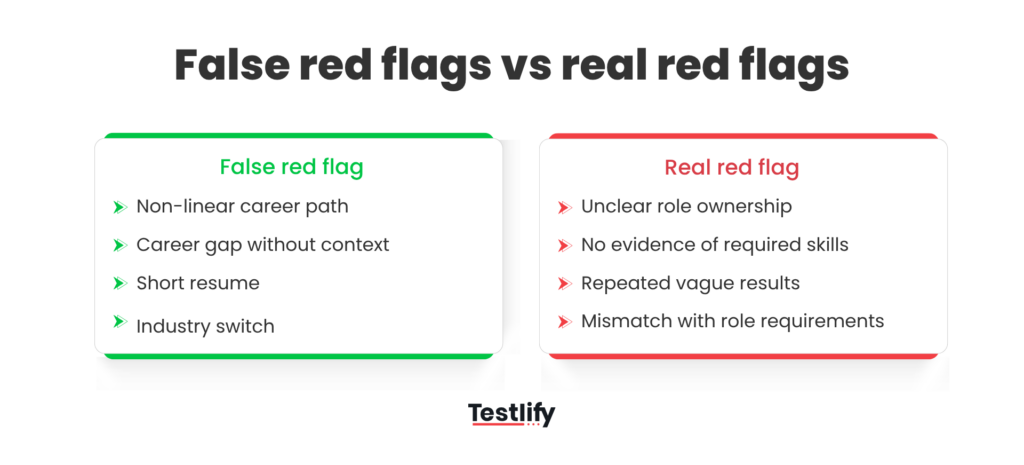
Pro tip: Treat a career gap, a short resume, an industry switch or a non-linear path as a question for the phone screen, not a reason to reject. Missing evidence of a required skill is the real red flag.
2. Knockout questions
Knockout questions are short yes-or-no filters on the application form that remove candidates who miss a non-negotiable requirement: work authorization, a required license or certification, shift availability, location or a language the job needs.
Knockout questions save the most time in high-volume hiring. They also do the most damage when teams turn preferences into hard filters. Use one only when the answer truly decides whether someone can do the job.
3. Phone screens
A phone screen is a 15 to 30 minute call to confirm interest, communication, salary expectations, notice period and whether the experience on the resume matches the role. Phone screens catch mismatches a resume cannot show, such as a candidate who expected a different role or a timeline that does not fit.
A phone screen should answer one question: is this person strong enough to move forward? Use the same short list of questions for every candidate so the answers can be compared. The screening interview guide has question ideas.
4. One-way video and AI interviews
One-way video interviews ask every candidate the same recorded questions, and candidates answer when it suits them. Conversational AI interviews go a step further: An AI interviewer asks role-based questions by chat, voice, or video, follows up on answers, and scores them against a fixed rubric.
Both remove scheduling from the first round, which matters when 200 people apply for one role. Because every candidate gets the same questions and criteria, results are easier to compare than unstructured first calls. Testlify runs both through its AI video interviewing tool and chat AI interviews.
5. Skills tests
Skills tests check what a candidate can actually do: write, analyze data, use Excel, code, handle a support ticket, or sell. If a resume says what a candidate claims to know, a skills test shows it.
Skills tests are the strongest early screening method for most roles. LinkedIn's Future of Recruiting 2025 found 93% of TA pros say accurately assessing a candidate's skills is crucial for improving quality of hire. Skills tests also widen the talent pool, because people from non-traditional backgrounds get a fair chance to show ability.
Shorter is better. Pick two to four tests that match the role's must-have skills and keep the total under 60 minutes. The Testlify test library has 3,500+ tests across technical and non-technical roles.
6. Cognitive ability and situational judgment tests
Cognitive ability tests check reasoning, numerical and verbal skills, and how quickly someone learns, which suits roles where people solve new problems every day. Situational judgment tests show candidates realistic work scenarios and ask how they would respond, which suits customer-facing, team lead, and graduate roles.
Both work best next to a role-specific skills test, not instead of one, and every test should link back to something the job needs.
7. Work samples and job simulations
Work samples ask candidates to do a small piece of the real job: write a short email to an upset customer, fix a bug, build a formula in a spreadsheet, or prioritize a list of tasks. Job simulations put the same idea in a realistic setting, such as a mock inbox, a chat with a simulated customer, or a live coding environment.
Work samples tell hiring managers more than another resume pass because they show how someone thinks and works, not only what they know.
8. Take-home tasks and paid trial projects
Take-home tasks ask finalists to complete a longer, relevant task on their own time. Examples: a copywriter drafts a short piece for a fictional brief, a product manager makes a recommendation from a dataset, or an analyst outlines how they would approach a business problem.
Respect the candidate's time. Two to three hours is reasonable at a late stage. Asking for 10 to 15 hours of unpaid work is not, and strong candidates will walk away.
Paid trial projects go further: the candidate works on a real, short project for two to five days and is paid for it. Paid trials are common in freelance, contractor, and senior hiring, and they give people who do not interview well a fair way to show their value.
9. Structured screening interviews
A structured screening interview asks every candidate the same core questions, tied to the skills the role needs, and scores each answer against the same rating guide. Behavioral questions ("Tell me about a time you...") fit well here because they ask for real examples instead of opinions.
Structure is what makes interviews fair and comparable. The guide to structured interviews covers how to write the questions, and an interview scorecard keeps scoring consistent across interviewers.
10. Personality and behavioral assessments
Personality and behavioral assessments describe work style, how someone handles pressure, and how they work with others. Testlify offers Big Five, DISC and picture-based personality tests and culture tests.
Use these as one input, never as a pass or fail filter. Look for culture add, the values and strengths a person brings, rather than culture fit, which tends to favor people who look like the current team.
11. Reference and background checks
Background checks confirm past facts: employment history, education, professional licenses and, where the law allows, criminal records. Reference checks are structured conversations with past managers or colleagues about how the candidate actually works.
Both belong at the end, once a candidate is close to an offer. Running them too early slows the process and adds cost before anyone has seen the candidate's ability. Ask every reference the same behavioral questions so the answers can be compared, and get written consent before a third-party background check.
12. Social media screening
Social media screening means reviewing a candidate's public online presence. A LinkedIn profile, a portfolio or published writing can show work that never made it into a resume, and for marketing or executive roles a public profile can be a real data point.
Social media screening also carries the most risk. Profiles reveal protected characteristics such as religion, ethnicity, family status and political views, which can bias the decision. If you use it, apply it the same way to every finalist, have someone other than the decision-maker do the review, and document what was checked and why.
How do candidate screening methods compare?
Candidate screening methods differ in what they prove, how much recruiter time they take and where they fit in the funnel. Fast, low-cost methods suit the top of the funnel; methods that prove real ability or verify facts cost more and belong later.
Method | What it checks | Best stage | Recruiter time | Main risk |
|---|---|---|---|---|
Resume and application review | Background, basic requirements | Apply | Low with AI, high by hand | Rewards polish over ability |
Knockout questions | Non-negotiables | Apply | Very low | Filtering on preferences |
Phone screen | Interest, logistics, communication | First screen | Medium | Inconsistent questions |
One-way video or AI interview | Communication, role knowledge | First screen | Low | Weak scoring criteria |
Skills test | Job skills | Prove skills | Low | Tests that do not match the job |
Cognitive or SJT test | Reasoning, judgment | Prove skills | Low | Used without a job link |
Work sample or simulation | Real work output | Prove skills | Medium | Too long for candidates |
Take-home or paid trial | Depth of thinking and execution | Finalists | High | Unpaid hours, drop-off |
Structured interview | Skills, examples, motivation | Confirm | High | Interviewers going off script |
Personality assessment | Work style | Prove skills or confirm | Low | Used as pass or fail |
Reference and background check | Past facts, conduct | Confirm | Medium | Run too early, no consent |
Social media screening | Public work, professionalism | Confirm | Medium | Bias, legal exposure |
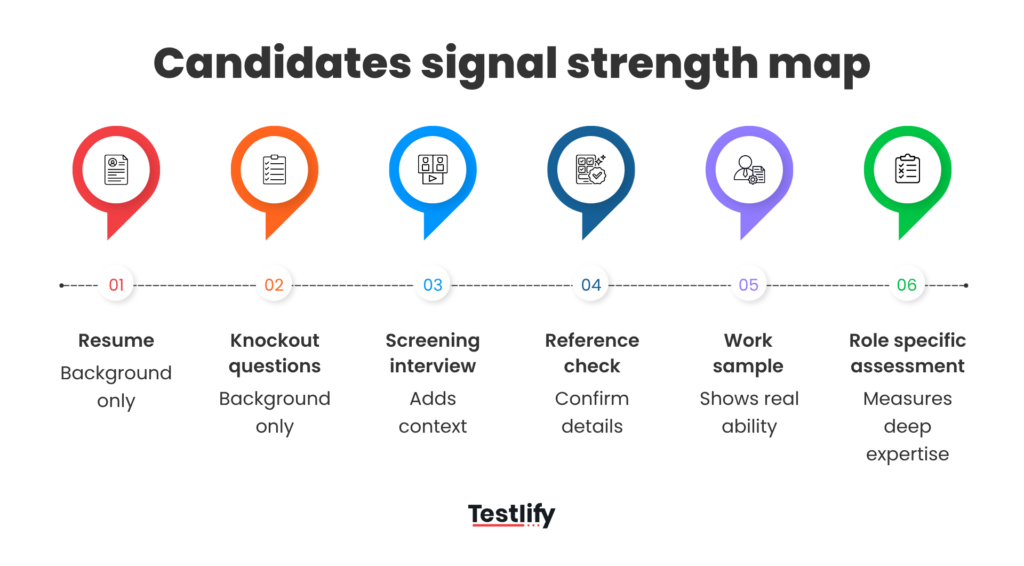
Key takeaway: Resumes and knockout questions tell you who might fit. Skills tests, work samples and structured interviews tell you who can do the job. Use the first group to narrow the pool and the second to decide.
How do you run a candidate screening process step by step?
A candidate screening process works best in seven steps, where each step answers one question: does this person deserve to move forward? Teams that try to answer everything at once end up with long, slow processes and weak comparisons.
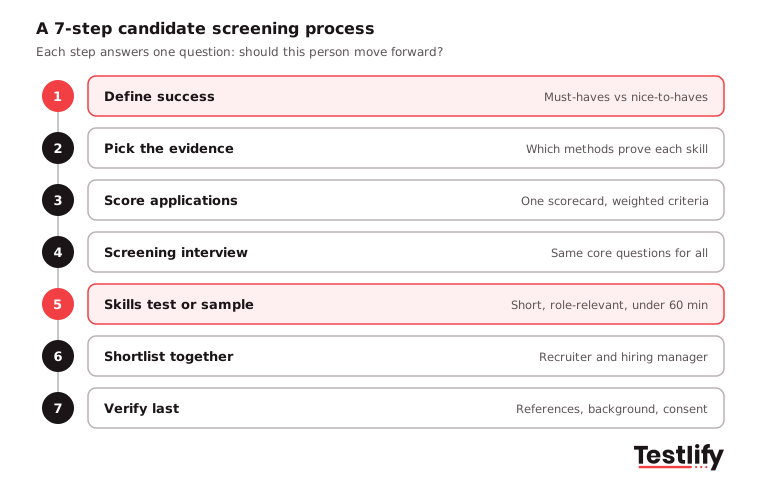
- Define success before you review applicants: The recruiter and hiring manager agree on the main responsibilities, the must-have skills, the non-negotiables and the nice-to-haves. Put them in a clear job description. NACE's professional standards tell recruiters to evaluate candidates against the essential job functions and key performance criteria, because focusing on them improves selection and reduces bias.
- Choose the evidence for each skill: A support role may need communication and judgment, a sales role objection handling, a technical role a practical task. Pick the screening methods that prove each must-have.
- Review applications with a scorecard: Score every application on the same few criteria, with weights so no single signal dominates. Testlify supports qualifying questions, 25+ question types and weighted scoring in one assessment.
- Run a focused screening interview: Confirm experience, motivation and logistics. Ask everyone the same core questions and rate the answers against the same standard.
- Add a role-relevant test or work sample: A short writing task, case prompt, coding exercise or scenario test. Keep the total under 60 minutes to limit candidate drop-off.
- Shortlist with the hiring manager: Review the same scorecards, test results and notes together. Involving more than one reviewer brings different views and reduces individual bias.
- Verify last: Run reference checks, employment verification and background checks only for finalists, with consent, and in line with local law.
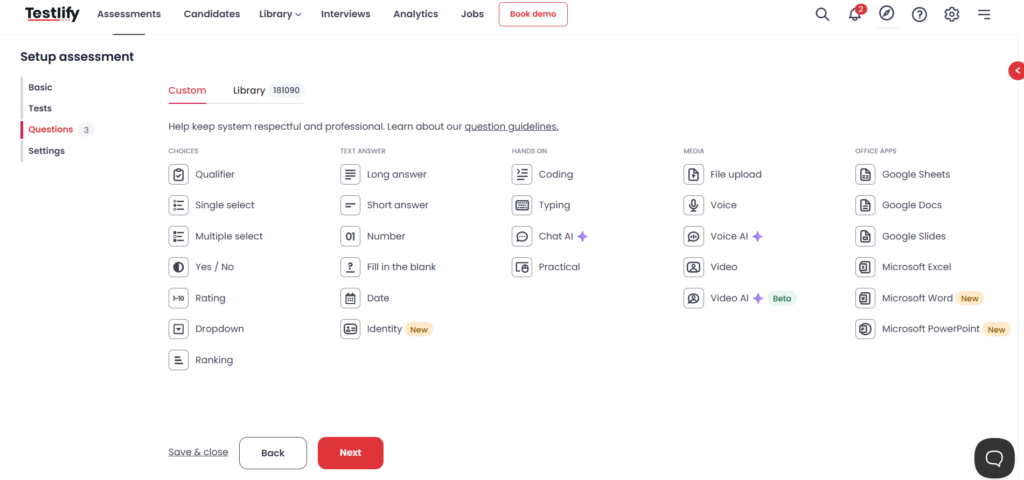
Assessment data is easier to act on when it sits in the same place as the rest of the hiring workflow. Testlify connects with 100+ ATS and HRIS tools through its integrations, so scores flow back to the candidate record.
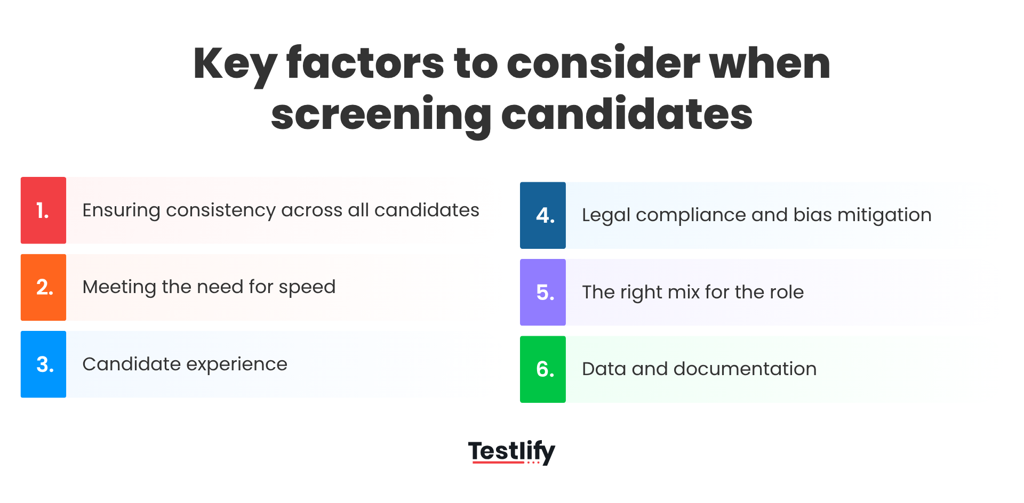
Six things keep the process working once it is live: the same stages and criteria for every candidate in a role, speed (strong candidates are in other processes too), a clear candidate experience with status updates, legal compliance and bias checks, the right mix of methods for the role, and a documented reason for every decision.
Which candidate screening methods fit each type of hiring?
Candidate screening methods should change with the role. A frontline role with hundreds of applicants needs speed and consistency, a technical role needs proof of skill early, and a leadership role needs more context and judgment before anyone moves forward. The rule stays the same: job-related criteria, applied the same way to everyone.
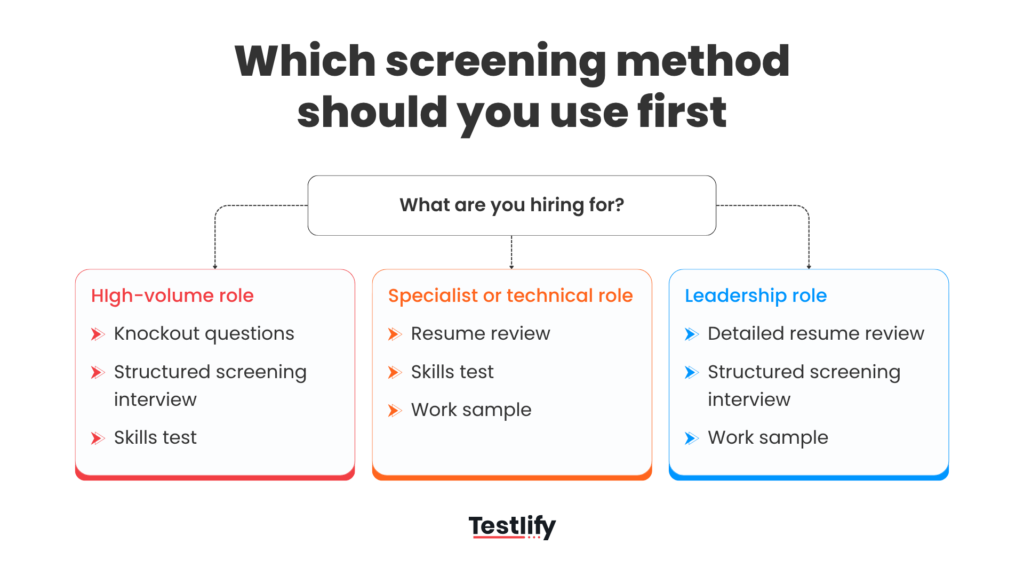
- High-volume hiring: The challenge is volume, not only fit. Use knockout questions, AI resume screening, a short skills test and a one-way video or AI interview, so recruiters see a ranked shortlist instead of 500 resumes. The high-volume hiring checklist covers the rest.
- Specialist and technical roles: A list of tools on a resume proves little. Use a coding or technical test, a work sample and a structured technical interview early.
- Leadership roles: The question is whether the person can lead through complexity and make sound decisions. Use structured interviews, a case or strategy task, and panel discussions with clear rating guides.
- Entry-level and graduate roles: Candidates have little work history. Use cognitive and situational judgment tests and a short work sample instead of filtering on degrees or past titles.
Hiring type | What screening should focus on | Methods that usually work best | Common mistake |
|---|---|---|---|
High-volume | Speed, consistency, basic fit | Knockout questions, AI resume screening, short skills tests, AI interviews | Manual review of every resume |
Specialist or technical | Proof of skill and problem-solving | Technical tests, work samples, structured technical interviews | Treating a resume as enough evidence |
Leadership | Judgment, communication, stakeholder fit | Structured interviews, case tasks, panels | Screening on keywords or past titles |
Entry-level and graduate | Potential and learning speed | Cognitive and SJT tests, short work samples | Filtering on degree or school |
How should hiring teams use AI in candidate screening?
Hiring teams should use AI in candidate screening for the repetitive, high-volume steps: sorting applications against criteria, scheduling, running first-round interviews and scoring answers against a rubric. People should still own the criteria, review the shortlist and make every rejection and offer decision.
AI speeds up whatever process it is given. With clear, job-related criteria, it makes screening faster and more consistent. With vague criteria, it only produces weak decisions faster. Adoption is still early: LinkedIn found 37% of organizations are integrating or experimenting with generative AI in recruiting.
Three checks before switching an AI screening tool on:
- Explainable scores: Recruiters should see why a candidate was ranked high or low, not only the score.
- Bias audits: In New York City, Local Law 144 requires a bias audit of an automated employment decision tool within one year of use, a published summary and notice to candidates. Testlify completed a third-party NYC Local Law 144 bias audit of its Matching Model in June 2023.
- Integrity checks: AI-polished applications and AI-assisted answers are common. Testlify includes 20+ proctoring checks, such as tab tracking, copy and paste blocking and AI assistance detection, through its anti-cheating and proctoring features.
What legal rules apply to candidate screening methods?
Candidate screening methods must be job-related and applied consistently, and a few methods carry extra rules. In the US, the EEOC's guidance on employment tests says a test that disproportionately excludes people of a protected group must be job-related and consistent with business necessity, even when nobody intended to discriminate.
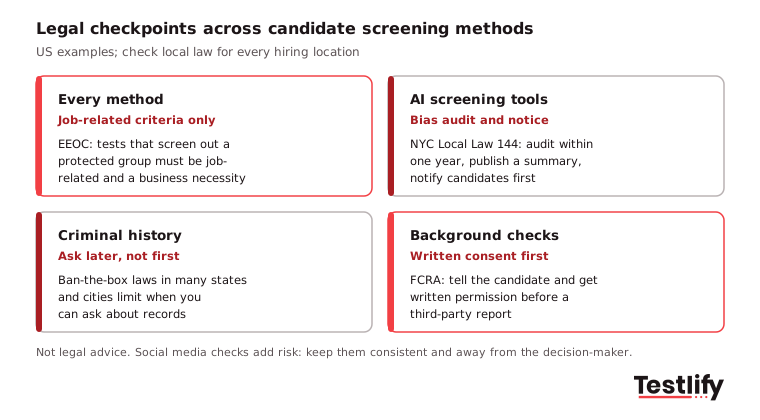
- Every method: Base each filter, question and test on a real job requirement, and offer reasonable accommodation to candidates with disabilities.
- Criminal history: Many US states and cities have ban the box laws that limit when employers can ask about records, often until after an interview or a conditional offer.
- Background checks: Under the Fair Credit Reporting Act, employers must tell the candidate and get written permission before getting a background report from a third-party screening company.
- AI tools: Check for local rules such as NYC Local Law 144, and keep a person in the loop for every decision.
- Social media and language: Avoid collecting information about protected characteristics, and make sure tests do not penalize candidates for reading-heavy instructions when language is not part of the job. The guide to language fairness in assessments explains how.
This section is general guidance, not legal advice. Check the rules in every location you hire in.
What are the most common candidate screening mistakes?
The most common candidate screening mistakes come from moving fast without enough structure. The result is usually the same: weak shortlists, inconsistent decisions and too much time spent on the wrong applicants.
- Starting with a vague job description: If the role is not clearly defined, recruiters and hiring managers screen for different things.
- Relying too much on resumes: A resume shows background, not ability, especially for skill-heavy roles.
- Using different standards for different candidates: Different questions and scoring make comparisons unreliable. Use the same questions and the same scorecard.
- Over-filtering too early: Too many knockout questions remove good candidates before anyone sees their skills.
- Confusing preference with requirement: Treating nice-to-haves as must-haves shrinks the pool for no good reason.
- Leaving hiring managers out until the end: A shortlist built without early alignment gets challenged later. Agree on criteria first.
- Ignoring unconscious bias: Train reviewers to spot common types of hiring bias, and let structured tests carry more of the early decision.
- Adding automation before fixing the process: Tools cannot fix weak criteria. They only speed up poor decisions.
- Checking backgrounds too soon: Verification supports the final decision. It does not replace screening.
- Making candidates wait: Long, silent processes push strong people to other offers. Send status updates at every stage.
How do you know if your screening methods work?
Screening methods work when the people who pass them go on to succeed in the role, and when the process stays fast and fair. Track a few numbers for every role, review them each quarter, and change the method that is not pulling its weight.
- Pass-through rate by stage: The share of candidates who move from each step to the next. A stage that passes almost everyone is not filtering; one that passes almost no one may be too strict.
- Time to screen: Days from application to shortlist. Compare it with your overall time to fill.
- Assessment completion and drop-off: A low completion rate usually means the test is too long or poorly explained.
- Hiring manager acceptance: How many shortlisted candidates the hiring manager agrees to interview.
- Quality of hire: First-year performance and retention of people hired through each method. LinkedIn reports that 89% of TA pros say measuring quality of hire will become more important, but only 25% are highly confident they can measure it today.
- Fairness check: Compare pass rates across groups at each stage to spot a method that screens out one group more than others.
How can Testlify help you screen candidates?
Testlify brings the main candidate screening methods into one workflow: AI resume screening, knockout and qualifying questions, 3,500+ skills, cognitive and personality tests, one-way video and AI interviews by chat, voice or video, and automated scoring with ranked results. Tests are available in 15+ languages, and results sync to 100+ ATS tools.
Teams can browse the Testlify test library and start a 7-day free trial with no credit card, or book a demo to see how the screening workflow fits their hiring process.
Frequently asked questions (FAQs)

B2B SaaS Content Writer
Rishav Kumar is a B2B SaaS content writer with 4 years of experience. He loves crafting engaging content. Always exploring fresh ideas, he's passionate about helping businesses grow through impactful writing.
LinkedInRelated resources
View all
Candidate Screening
Screening interview explained: Purpose, stages, and tips

Candidate Screening
Candidate Screening Dos and Don’ts: Best Practices for 2026

Candidate Screening
Candidate screening automation: how to set it up in 7 steps

Candidate Screening
Asynchronous video interview: a hiring team's 2027 guide

Candidate Screening
Overt vs covert integrity tests: What is the difference?

Candidate Screening
Preliminary Screening: How to Run the First Filter in Hiring
Get started.
Hire on proof, not resumes.
Run your first skills-based assessment free — no credit card required.