
Overt vs covert integrity tests: What is the difference?
Overt tests ask about honesty directly. Covert tests infer it from personality traits. Here is the difference and which to use.

An integrity test is a pre-employment assessment that helps employers judge how likely a candidate is to behave honestly at work, and it comes in two main forms. An overt integrity test asks directly about theft, honesty and rule-breaking. A covert integrity test asks personality-style questions that are linked to integrity but do not look like an honesty test at all.
 ChatGPT
 Gemini
 Claude
 Grok
 Perplexity
TL;DR / Key Takeaways
- Overt integrity tests ask directly about theft, dishonesty and rule-breaking, so candidates can tell what is being measured.
- Covert integrity tests ask personality-style questions about traits like dependability and respect for rules, so the purpose is less obvious.
- Overt tests are easier for candidates to answer strategically. Covert tests are harder to game but less direct.
- Written integrity tests are not polygraphs. US federal law (the Employee Polygraph Protection Act) restricts mechanical lie detector devices, not paper or online honesty questionnaires.
- Most hiring teams get the best signal from a blend of both types, used alongside other screening steps and reviewed by a person before any rejection.
- Add the test after an initial resume or skills screen, for roles with real trust exposure such as cash handling, inventory or financial data access.

What is an integrity test?
An integrity test is a standardized set of questions used during hiring to estimate how a candidate is likely to behave around honesty, theft, rule-following and workplace conduct. Employers use them most for roles with direct access to cash, inventory, financial accounts or sensitive data, where a bad hire carries real financial or compliance risk. For TA and HR teams already screening for quality-of-hire and fairness, adding an integrity test is a small step that strengthens both without slowing down the pipeline.
Integrity tests sit alongside other screening steps such as reference checks, background checks and skills assessments. They are not designed to replace those steps, and no single test should decide a hiring outcome on its own. For a broader look at where this fits in a hiring process, see our guide to integrity testing in pre-hiring evaluations. The two main formats, overt and covert, differ mainly in how directly they ask about honesty.
What is an overt integrity test?
An overt integrity test asks candidates directly about dishonest behavior, attitudes toward theft and past rule-breaking. Questions might ask how often the candidate thinks coworkers steal from employers, whether taking small amounts of company property is acceptable, or how they would react to seeing a colleague break a safety rule.
Because the purpose is obvious, overt tests are easier to understand and explain to candidates, but also easier for a motivated candidate to answer in a way that looks good rather than honest. Most overt tests include a few control questions designed to flag answers that look too perfect, which helps catch some of that strategic answering. Our piece on candidate dishonesty looks at other ways dishonest answers show up earlier in the hiring funnel.
What is a covert integrity test?
A covert integrity test, also called a personality-oriented integrity test, asks about general personality traits that research links to integrity, such as dependability, conscientiousness, impulse control and respect for authority. The questions read like an ordinary personality questionnaire and do not mention theft, honesty or rule-breaking at all.
Because the link to integrity is not obvious, candidates have a harder time guessing which answer looks best, which tends to reduce the kind of "fake good" answering that overt tests can invite. The tradeoff is that covert tests measure integrity indirectly, through broader personality traits, rather than asking about the behavior itself.
What is the difference between overt and covert integrity tests?
The core difference is directness: overt tests ask about honesty and theft in plain language, while covert tests infer integrity from general personality traits without naming the topic. That one difference drives most of the practical tradeoffs between the two formats.
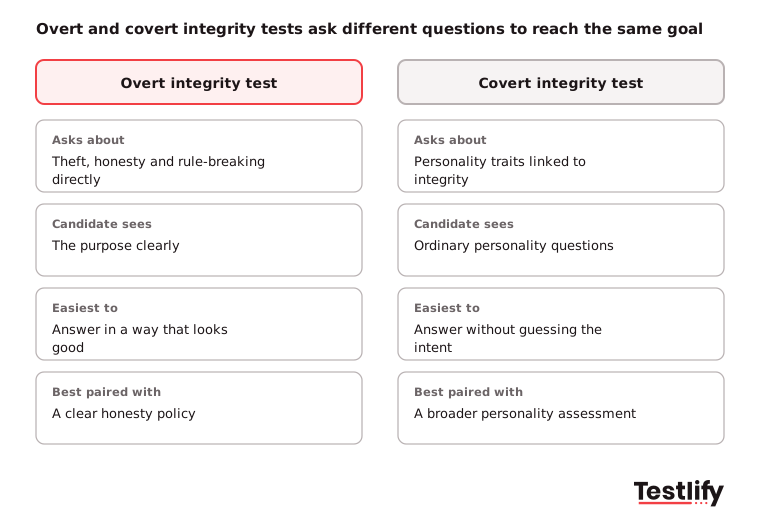
Both formats are standardized, both are scored against a benchmark, and both work best combined with other hiring signals rather than used alone.
Are integrity tests legal to use?
Written integrity tests are legal for most US employers to use in hiring, and they are legally distinct from a polygraph or other mechanical lie detector. The Employee Polygraph Protection Act generally bars private employers from requiring or requesting a lie detector test for most pre-employment screening, with narrow exceptions for certain security and pharmaceutical roles.
The law targets mechanical and electrical devices built to render a diagnostic opinion on honesty, not paper or online questionnaires. A written overt or covert integrity test falls outside that ban.
That said, legality is not the only question. According to the EEOC, any employment test, including an integrity test, can create legal exposure if it produces adverse impact on a protected group or is applied inconsistently across candidates for the same role. SHRM's guide to pre-employment testing covers this ground in more depth, and a few US states and localities add their own rules on pre-employment testing. Check current state and local law, and run any test past employment counsel before you roll it out broadly.
How accurate are integrity tests?
Integrity test scores are a useful signal, not a guarantee. Scores correlate with broader measures of workplace conduct, such as rule-following and disciplinary outcomes, more reliably than they predict a specific act like theft by one person.
A low score is a reason to look closer, not an automatic disqualifier. A high score is not a promise of honest behavior either.
Key takeaway: Treat an integrity test score as one input to weigh, never as the single reason to reject or advance a candidate. Treat any single test, integrity tests included, as one input among several rather than the deciding factor; SHRM's guide to pre-employment testing is a useful starting point for building that broader process.
Pro tip: Use integrity test results to flag areas worth a follow-up question in the interview, such as asking how the candidate has handled a situation involving someone else's mistake or a tempting shortcut. That turns a score into a real conversation instead of a pass or fail line.
The practical fix for this uncertainty is the same one good hiring teams already use for any single assessment: combine the integrity test with skills tests, structured interviews and reference checks, and have a person review any borderline or failing result before it affects a decision.
Should you use overt, covert, or both?
Most hiring teams get the strongest signal from using both formats together rather than picking one. An overt test gives a clear, explainable result tied directly to honesty and rule-following. A covert test adds a check that is harder for a candidate to manage strategically. According to common practice among assessment providers, running both formats together and comparing the two results catches more inconsistencies than either format alone.
- Use overt alone when: you need a fast, explainable screen and the role has moderate trust exposure, such as retail or hospitality shifts with limited cash access.
- Use covert alone when: you already run a broader personality assessment or culture-fit test and want an integrity signal folded into it without adding a second obvious test.
- Use both when: the role carries real financial, safety or data risk, such as finance, warehouse, healthcare or IT access roles, where a stronger combined signal is worth the extra testing time.
How do you add an integrity test to your hiring process?
Adding an integrity test works best as one extra, well-placed step rather than a separate hurdle bolted onto the end of the process. For more on fitting it into an existing pipeline, see how to incorporate an integrity test into your recruitment strategy.
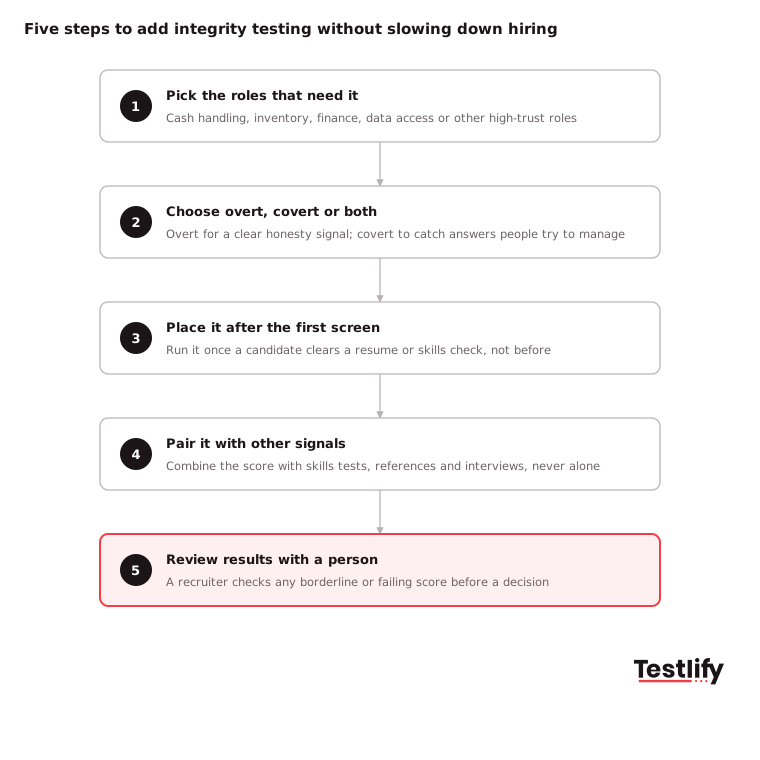
- Pick the roles that need it: Start with cash handling, inventory, finance, data access or other high-trust roles rather than testing every candidate for every role.
- Choose overt, covert or both: Match the format to the role's risk level and to whether you already run a personality assessment.
- Place it after the first screen: Run the test once a candidate clears a resume or skills check, so you are not asking every applicant to sit through it.
- Pair it with other signals: Combine the score with skills tests, references and structured interview questions, never as the sole basis for a decision.
- Review results with a person: Have a recruiter or hiring manager check any borderline or failing score before it rules a candidate out.
Ready to screen candidates on more than a resume?
Browse the Testlify test library for personality and integrity-linked assessments you can add to a role in minutes, alongside the skills tests that already cover your hiring process.
Frequently asked questions (FAQs)

Content Writer
Yashika Khandelwal is a Content Writer with 3+ years of experience creating research-backed content on hiring, talent assessment, and HR technology. She is a registered Organizational Psychologist and subject matter expert who combines behavioral science with practical recruitment insights to produce accurate, evidence-based content.
LinkedInRelated resources
View all
Candidate Screening
Preliminary Screening: How to Run the First Filter in Hiring

Candidate Screening
Technical assessment with live proctoring: a guide for hiring teams

Candidate Screening
Language fairness in assessments: The complete guide for global hiring teams

Candidate Screening
Best Pre-Hire Assessment Platforms for Enterprises: An Honest Buyer’s Guide (2026)

Candidate Screening
What to look for in candidate screening software

Candidate Screening
Candidate screening methods: 12 ways to build a better shortlist
Get started.
Hire on proof, not resumes.
Run your first skills-based assessment free — no credit card required.