
Preliminary Screening: How to Run the First Filter in Hiring
Preliminary screening is the first filter in hiring. The steps, the questions to ask, what never to screen on, and how to automate it.

Preliminary screening is the first filter in hiring: a short, consistent check that every applicant meets the must-have requirements of a role before anyone spends time interviewing them. Done well, it removes the clearly unqualified in minutes, ranks the rest on job-relevant evidence, and hands recruiters a shortlist they can trust.
TL;DR: This guide explains what preliminary screening is, why it matters more now that a typical job draws over 240 applications, and the five common ways to run it. It walks through a six-step process, the questions worth asking, the things you should never screen on, and how preliminary screening differs from the secondary rounds that follow. The last section shows how to set the whole stage up in Testlify so qualified candidates move forward automatically and a person still reviews every decision.
 ChatGPT
 Gemini
 Claude
 Grok
Grok Perplexity
What is preliminary screening?
Preliminary screening is the stage between receiving applications and the first real interview, where recruiters check each applicant against a short list of non-negotiable criteria. Those criteria are usually work authorization, location or shift availability, required licences, minimum experience and a basic skills check. Anyone who passes moves on; anyone who does not is told quickly.
Preliminary screening is also called pre-screening or candidate pre-screening. The goal is narrow on purpose. It does not decide who gets hired. It decides who is worth a hiring manager's time.
Volume is the reason it matters. Greenhouse's recruiting benchmarks show applications per job rising from 116 in 2022 to 244 in 2025, a 111% increase, while applications per recruiter grew from 1,610 to 4,890 a year. No team can read that many resumes carefully by hand.

Why does preliminary screening matter?
Preliminary screening matters because it protects the two scarcest resources in hiring: recruiter hours and hiring manager attention. A clear first filter cuts the pile to people who meet the basics, makes every applicant face the same criteria, and shortens the wait for candidates who are a real fit.
- Speed. Fewer unqualified applicants reach interviews, so qualified ones get scheduled sooner.
- Fairness. The same checks for every applicant are easier to defend than a recruiter's quick skim.
- Better interviews. Hiring managers spend their time on depth, not on confirming basics a form could check.
- Candidate experience. Applicants who do not meet a hard requirement hear back in days, not weeks.
The pressure is real. SHRM's 2025 Talent Trends found that 69% of organizations still struggle to fill full-time roles, and AI use in HR tasks climbed to 43% in 2025 from 26% a year earlier. Recruiters are also choosing where the saved time goes: LinkedIn's Future of Recruiting 2025 reports that 35% of TA teams using generative AI put that time into candidate screening, and 93% say accurately assessing skills is crucial for quality of hire.
What are the types of preliminary screening?
Preliminary screening usually takes one of five forms: qualifier (knockout) questions, resume screening, a short phone screen, a short skills test, or a one-way video or AI interview. Most teams combine two or three, ordered from cheapest to most expensive per candidate.
Method | What it checks | Recruiter time per candidate | Best for | Watch out for |
|---|---|---|---|---|
Qualifier questions | Hard requirements: authorization, location, shifts, licences | None after setup | Every role | Too many questions raise drop-off |
Resume screening | Experience and background against the role | 1 to 5 minutes by hand, near zero with AI | Specialist and senior roles | Rewards polished resumes, not skill |
Short skills test | Can the candidate do the core task? | None after setup | Volume and skills-heavy roles | Keep it short at this stage |
One-way video or AI interview | Communication, motivation, role basics | A few minutes to review | Customer-facing and volume roles | Tell candidates how answers are scored |
Phone screen | Interest, pay range, notice period, red flags | 15 to 30 minutes | Small pools, senior roles | Hard to scale, notes vary by recruiter |
For a closer look at the call itself, see the screening interview guide.
How does the preliminary screening process work?
The preliminary screening process works in six steps: define the must-haves, turn them into qualifier questions, score resumes against the role, add a short skills test, set pass thresholds, and review the shortlist before anyone is rejected. Each step removes a slice of applicants at the lowest possible cost.

- Define the must-haves. Agree with the hiring manager on three to five requirements that are truly binary. "Five years of experience" is often a preference; "a valid forklift licence" is a requirement.
- Turn them into qualifier questions. Ask each must-have as a yes/no or multiple-choice question at the start of the application or assessment.
- Score resumes against the role. Match experience to the job description, by hand for small pools or with an AI resume screener for large ones.
- Add a short skills test. A 15 to 20 minute test on the core task of the job shows ability that resumes cannot.
- Set pass thresholds. Decide the score that moves a candidate forward, and the score below which a reviewer must look before rejection.
- Review and hand over. A recruiter checks the ranked shortlist, overrides where needed, and sends it to the hiring manager.
Pro tip: Put the cheapest checks first. Qualifier questions cost seconds; a phone screen costs half an hour. If a candidate fails a must-have, they should learn it before you or they spend more time.
What questions should a preliminary screening include?
Preliminary screening questions should cover only what decides whether an applicant can do the job and accept it: eligibility, availability, required credentials, core skills and basic expectations. Every question should map to a requirement in the job description, and every candidate should get the same ones.
Qualifier (knockout) questions:
- Are you legally authorized to work in this country without sponsorship?
- Can you work the shift pattern listed for this role, including weekends?
- Do you hold the licence or certification this role requires?
- Are you able to work from the office or site location listed?
- Is the pay range in the job post acceptable to you?
Short open questions for a screen or one-way interview:
- Walk us through the most recent time you did the core task of this role.
- What made you apply for this role in particular?
- What is your notice period?
For more on writing them, read how to create a job pre-screening test.
What should preliminary screening not check?
Preliminary screening should not check anything unrelated to the job or anything that reveals protected characteristics. That means no filtering on employment gaps without context, school names, graduation years, photos, names, or personal social media. These shortcuts feel efficient but screen out capable people and raise legal risk.
- Employment gaps. A gap is not a skill signal; ask about it later if it matters.
- Degree or school as a proxy. Use a skills test instead when the degree is not a legal requirement.
- Social media. Reviewing profiles early can expose protected information the decision maker should not see.
- Unexplained automated rejections. If software scores candidates, someone should be able to explain the score.
Automated screening also carries rules. In New York City, Local Law 144 lets employers use an automated employment decision tool only if it had a bias audit within one year of use, a summary of results is public, and candidates get notice 10 business days before use.
Human review is not a formality. In a November 2025 Greenhouse survey of job seekers and recruiters, 34% of U.S. recruiters said they spend up to half their week filtering spam and junk applications, yet only 21% were very confident their systems were not rejecting qualified candidates.
What is the difference between preliminary and secondary screening?
Preliminary screening confirms that an applicant meets the basics; secondary screening tests how well a qualified candidate fits the role. The first stage is fast, standard and largely automated. The second goes deeper with longer assessments, structured interviews and work samples, and involves the hiring manager.
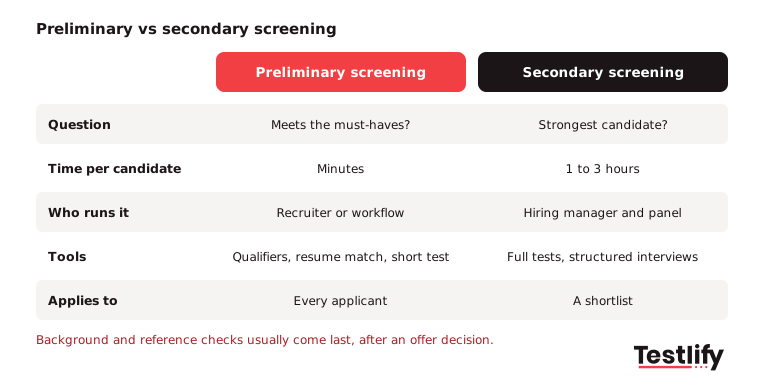
Preliminary screening | Secondary screening | |
|---|---|---|
Question it answers | Does this person meet the must-haves? | Is this the strongest candidate? |
Time per candidate | Minutes | 1 to 3 hours |
Who runs it | Recruiter or automated workflow | Hiring manager and interview panel |
Typical tools | Qualifier questions, resume match, short test | Full assessment, structured interviews, work sample |
Share of applicants | All of them | A shortlist |
Output | Pass, review or decline | Ranked finalists for an offer decision |
Background and reference checks usually come last, after an offer decision. For the full sequence, see the candidate screening guide.
Key takeaway: Preliminary screening should be the cheapest, most consistent stage in your process. Check only what is binary, rank on job skills, and keep a person in the loop for every rejection.
How do you run preliminary screening in Testlify?
Testlify runs preliminary screening as one automated stage: qualifier questions check the must-haves, the AI resume screener scores job fit, a short skills test ranks ability, and thresholds move candidates forward. Recruiters review the ranked list and scores sync back to the ATS, so nobody copies results by hand.
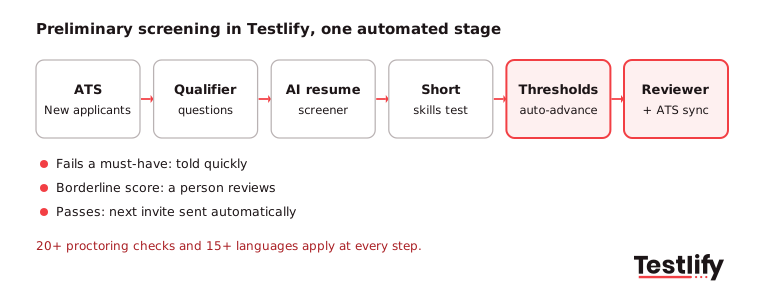
- Start from the job description. The AI test builder turns a job description into a role-specific assessment and suggests competencies and scoring criteria. You can also pick from 3,500+ tests in the test library.
- Add qualifier questions. Qualifier questions sit at the start of the assessment and filter out candidates who miss a basic requirement such as location, availability or experience. They are one of 25+ question types.
- Score resumes automatically. The AI resume screener pulls resumes from your ATS and returns an explainable match score with a High, Medium or Low fit label.
- Set thresholds once. Candidates above your bar move to the next assessment automatically, and multi-stage pipelines send the next invite without a recruiter stepping in.
- Add a short interview where it helps. One-way video or Chat AI interviews check communication for customer-facing roles.
- Protect the result. 20+ proctoring checks, including tab proctoring, copy-paste blocking and AI assistance detection, keep scores honest. Assessments run in 15+ languages.
- Review and sync. Recruiters see per-skill scores and can override any decision. Results flow back to 100+ ATS and HRIS integrations.
Testlify's matching model completed a third-party bias audit under Local Law 144 on June 16, 2023. For high-volume roles, see how teams use the same setup in volume hiring.
Testlify uses a credit model, so you pay only when a candidate starts an assessment. Start a 7-day free trial, no credit card needed, and build your first preliminary screening stage from a live job description.
Frequently asked questions

Content Writer
Yashika Khandelwal is a Content Writer with 3+ years of experience creating research-backed content on hiring, talent assessment, and HR technology. She is a registered Organizational Psychologist and subject matter expert who combines behavioral science with practical recruitment insights to produce accurate, evidence-based content.
LinkedInRelated resources
View all
Candidate Screening
Which technical assessment platforms support in-browser coding with live proctoring?

Candidate Screening
Language fairness in assessments: The complete guide for global hiring teams

Candidate Screening
Best Pre-Hire Assessment Platforms for Enterprises: An Honest Buyer’s Guide (2026)

Candidate Screening
Effective methods for screening candidates in 2026

Candidate Screening
What to look for in candidate screening software

Candidate Screening
Candidate screening: Methods, process, and best practices
Get started.
Hire on proof, not resumes.
Run your first skills-based assessment free — no credit card required.