
How to screen digital marketing candidates: a 6-step guide
A 6-step way to screen digital marketing candidates: the skills to check, a short test, a work sample, interview questions and scoring.

Knowing how to screen digital marketing candidates means checking what a person can actually do across SEO, content, paid media, social, email, and analytics before you spend interview time on them. A good screen replaces resume claims with evidence: a short skills test, one real task, and a structured interview, all scored the same way for every applicant.
 ChatGPT
 Gemini
 Claude
 Grok
 Perplexity
TL;DR
- Screen digital marketing candidates in six steps: define the role, check resumes, run a skills test, set a work sample, interview, and then score.
- Check six skill areas: SEO, content, paid media, social and email, analytics, and strategy. Match the mix to the role.
- In resumes, look for outcomes with numbers like cost per lead, not channel lists. Followers and impressions alone are a warning sign.
- Send every applicant the same 10- to 30-minute skills test before any interview. LinkedIn found 93% of TA pros call accurate skills assessment crucial to quality of hire.
- Give only the top 5 to 10 candidates one real task, capped at 90 minutes. Pay for anything over 2 hours.
- Weight a scorecard before you see candidates, for example, work sample 40%, skills test 25%, interview 25%, and resume 10%. Set a bar such as 70% overall.
- AI can rank resumes and run first-round interviews, but a person should sign off on every rejection. NYC Local Law 144 requires a yearly bias audit.

How to screen digital marketing candidates: what are the 6 steps?
Screening digital marketing candidates works best in six steps: define the must-have skills, check resumes and portfolios for proof of results, give every applicant the same short skills test, set one real task for the shortlist, run a structured interview, then compare everyone on a weighted scorecard. Each step is cheaper than the next, so weak fits drop out early.
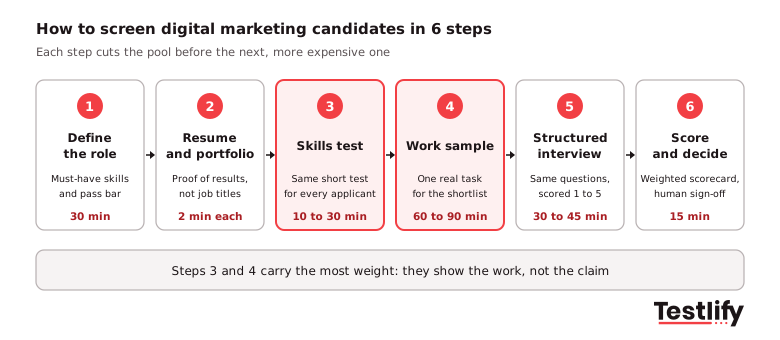
- Define the role: List the 3 to 5 skills the job needs on day one and the bar for each. A PPC specialist and a content marketer share a title family, not a skill set.
- Check resumes and portfolios: Look for numbers tied to outcomes (leads, revenue, cost per acquisition), not lists of channels.
- Run a skills test: Send the same short test to every applicant who meets the basics. Testing early is what lets you screen at volume.
- Set a work sample: Ask the top 5 to 10 candidates for one task that mirrors the job, capped at 90 minutes.
- Hold a structured interview: Ask every finalist the same questions and score each answer from 1 to 5.
- Score and decide: Combine the results on a weighted scorecard, and have a person sign off on every rejection.
Why is it hard to screen digital marketing candidates?
Digital marketing candidates are hard to screen because the job titles are loose, the tools change every year, and almost every resume lists the same channels. "Managed social media" can mean posting three times a week or running a six-figure paid budget, and a resume cannot tell you which.
Demand makes it harder. SHRM's 2025 Talent Trends found that 69% of organizations still struggle to fill roles, and 28% now require new skills for full-time positions. When the pool is thin and the skills keep moving, a resume filter rejects good people with odd titles and lets through people who know the vocabulary but not the work.
The fix is to screen on demonstrated skill early, which also cuts the influence of unconscious bias around a candidate's school or past employers. Candidates can take a test from anywhere with a stable internet connection, so a large pool costs no more to screen than a small one.
What skills should you screen digital marketing candidates for?
Digital marketing candidates should be screened on six skill areas: SEO, content, paid media, social and email, analytics, and strategy. Not every role needs all six at the same depth, but every role needs enough of each to work with the rest of the team.
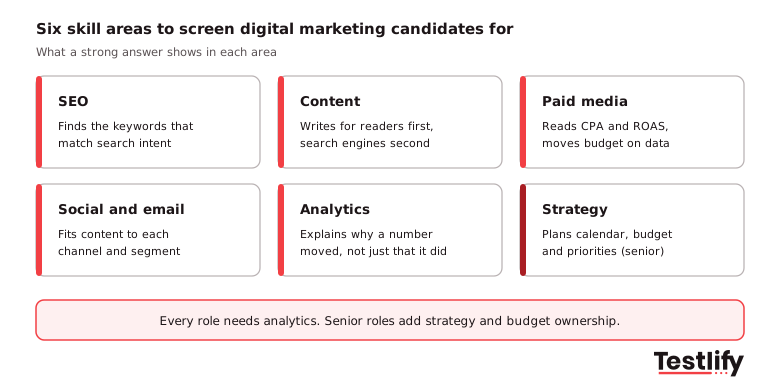
Skill area | What to check | What good looks like | Red flag |
|---|---|---|---|
SEO | Keyword research, on-page and technical SEO | Picks keywords by intent and places them naturally | Stuffs keywords that do not fit the text |
Content | Writing for readers and search, structure, multimedia | Short sentences, clear subheadings, consistent formatting | Inconsistent formatting across portfolio pieces |
Paid media (PPC) | Campaign setup, bids, ad copy, budget | Talks in CPA, ROAS and conversion rate | Reports clicks and impressions only |
Social and email | Platform fit, segmentation, automation | Adapts one idea to each channel and audience | Same post copied across every platform |
Analytics | Google Analytics, KPIs, attribution | Explains why a number moved and what to do next | Describes dashboards without conclusions |
Strategy (senior) | Content calendar, budget, team | Ties the plan to revenue and ROI | No view of budget or trade-offs |
SEO knowledge: An SEO expert is as vital to a content team as the writer. The candidate should understand keyword research and how to insert keywords so they read naturally, plus the technical basics that help search engines find and index content:
- URL structure and hierarchy
- Internal linking strategies
- Site speed optimization
- XML sitemaps
- Robots.txt configuration
- Mobile optimization, since phones are now the main way people reach the web
Content creation: Writers balance writing for search engines with writing for people, and writing for humans is the harder part because it depends on understanding user intent. A strong writer also suggests where images, infographics, or videos belong, even without design skills.
Digital marketing fundamentals: Candidates should understand the marketing funnel, the customer journey, and how each channel gets traction. On social media, that means knowing which platforms want short, snappy posts and which reward long-form value and reading audience feedback without taking every comment to heart. Email is its own skill set: repurposing content, newsletters, automation, and segmentation.
Analytical skills: Middle and senior marketers, and SEOs at every level, need to spot patterns across data sources, recognize anomalies and their causes, connect data points into a story, and draw conclusions from complex data. Most of that work splits into two streams: traffic, which is a permanent concern, and campaigns, which are temporary and need faster responses. Both end in the same question: what is the ROI, and how do we improve it?
Strategic abilities: Senior roles such as SEO lead, marketing team lead, or content manager add content planning and calendar management, team management, and budgeting. Keep an eye out for junior and mid-level people who already show this kind of thinking.
Which skills matter for each digital marketing role?
Each digital marketing role needs a different mix: a content writer leans on writing and SEO, a PPC specialist on paid media and analytics, and a marketing manager on strategy and analytics. Map the role before you choose a test so you screen for the skills the job uses every week.
Role | Essential skills | Desirable skills | Best screening task |
|---|---|---|---|
Content writer | Content, SEO basics | Social, multimedia | Rewrite a weak page for one keyword |
SEO specialist | SEO, analytics | Content | Audit 3 pages and rank the fixes |
PPC specialist | Paid media, analytics | Copywriting | Diagnose a mock ad account |
Social media manager or strategist | Social, content | Paid social, analytics | One-week content plan for 2 platforms |
Email marketer | Email, analytics | Content | Plan a 3-email nurture for one segment |
Marketing executive | Fundamentals across channels | Analytics | Short campaign brief |
Marketing manager | Strategy, analytics | Budgeting, team leadership | 90-day plan with budget split |
Basic skills are enough for teams with an established marketing setup and steady goals. Companies planning aggressive growth need a highly skilled marketer who can build strategy, not only run it.
Senior roles carry real stakes. The US Bureau of Labor Statistics projects about 36,300 openings a year for advertising, promotions, and marketing managers, with a median pay of $165,780 in May 2025, so a wrong senior hire is an expensive one. For senior screens, see how to use skills assessments for executive roles.
How should you screen digital marketing resumes and portfolios?
Digital marketing resumes and portfolios should be screened for proof of results, not lists of tools. Spend about 2 minutes per resume and look for three things: outcomes with numbers, work you can see, and current tool knowledge.
- Outcomes with numbers: "Cut cost per lead by 30% in 2 quarters" beats "managed Google Ads." Vanity metrics alone (followers, impressions) are a warning sign.
- Work you can see: Live articles, campaign screenshots, a personal blog, and a LinkedIn presence. A digital marketer who cares about their own online brand usually shows it.
- Current tools: Familiarity with the tools your team uses shortens ramp-up. Common ones include:
- SEO: Ahrefs, SEMrush, Google Search Console, Moz
- Social: Hootsuite, Sprout Social, HubSpot, Bitly
- Analytics: Google Analytics, Meta Business Suite
- Email: Mailchimp, Constant Contact, ConvertKit
- Copy: Grammarly and generative AI writing tools
Do not reject on job title or degree. A strong freelancer or a career switcher with a real portfolio can outperform someone with a bigger brand on their resume. For more on this stage, see resume screening techniques.
How to screen digital marketing candidates with a skills test?
A skills test screens digital marketing candidates by giving every applicant the same questions, the same time limit, and the same scoring, so you compare skill rather than presentation. Use it right after the resume check, before any interview, and keep it short enough that good candidates finish it.
Recruiters agree on why this matters. LinkedIn's Future of Recruiting 2025 found that 93% of talent acquisition professionals say accurately assessing skills is crucial to improving quality of hire, and companies that search on skills the most are 12% more likely to make a quality hire.
A good digital marketing test covers:
- Fundamentals: the marketing funnel, customer journey and channel strategy
- SEO: on-page optimization, keyword research and best practices
- Content marketing: creating content for each platform and measuring its performance
- Social media marketing: scheduling, metrics and paid campaigns on platforms like Facebook, Instagram, X and LinkedIn
- Email marketing: segmentation, copy, templates and campaign metrics
- PPC: Google Ads and Microsoft Ads setup, keyword research, ad copy, bids and tracking
- Analytics: Google Analytics, KPIs and data-driven decisions
- Technical skills: CMS platforms like WordPress, basic HTML and CSS, marketing automation
- Creativity, communication and collaboration: new campaign ideas, explaining results to stakeholders
Mix formats to test both knowledge and judgment: multiple-choice questions for fundamentals, scenario questions for decisions, and short case studies for applied skill. Add behavioral or situational questions when soft skills matter for the role.
Tracking deserves extra weight. Michal Gawel, a digital marketing consultant at Voluum, put it this way: "Without tracking, marketing skills lose their power. Optimization and automation depend on accurate data. It's the only way to improve performance and maximize ROI. The ability to track and analyze numbers separates guesswork from informed, scalable strategy."
Testlify's digital marketing assessment is a 10-minute, 12-question intermediate test covering content marketing, digital marketing channels, website visual elements and SEO. For channel roles, pair it with a focused test such as SEO, Google Ads or email marketing.
Pro tip: Add 2 or 3 custom questions about the tools your team actually uses. A candidate who knows your stack ramps up weeks faster than one who knows the theory.
What work sample should digital marketing candidates complete?
A digital marketing work sample should be one short task that mirrors the job, given only to the shortlist and capped at 60 to 90 minutes. The task shows how a candidate thinks through a real problem, which a test or interview alone cannot.
Good work samples share four traits:
- Same brief for everyone in that role, so results are comparable.
- Realistic data: Use a sample campaign report, an anonymized page or a mock ad account, never live client work.
- Clear scoring: Write the rubric before you send the task: what a 1, 3 and 5 look like.
- Respect for time: Long unpaid projects push strong candidates out. If a task needs more than 2 hours, pay for it.
Ask candidates to explain their choices in a short note or a 5-minute recording. The reasoning matters as much as the output: why this keyword, why this budget split, what they would test next.
What should you ask in a digital marketing screening interview?
A digital marketing screening interview should use the same 6 to 8 questions for every finalist, each scored from 1 to 5 against a written answer guide. A structured interview keeps the comparison fair and makes the scores defensible.
Questions that separate strong candidates:
- Walk me through a campaign that underperformed. What did the data show, and what did you change?
- How do you decide how to split a budget across channels?
- Which metric would you report to a CFO for this campaign, and why?
- How do you keep up with search and platform changes?
- Tell me about a time you disagreed with a designer, writer or sales lead. How did you resolve it?
- Talk me through the work sample. What would you do with another week?
Red flags to score down: success measured only in followers or impressions, no link between work and revenue, blaming others for failed campaigns, and tool knowledge that stopped a few years ago. For role-specific lists, see digital marketing interview questions.
How do you score and compare digital marketing candidates?
Digital marketing candidates are best compared on a weighted scorecard that combines the skills test, work sample, interview and resume into one number, with weights set before you see any candidate. Weights stop one impressive interview from outweighing a weak task.
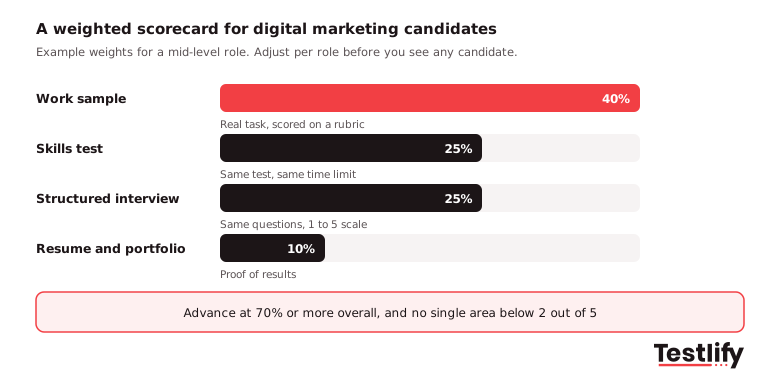
Stage | Example weight | Scored on |
|---|---|---|
Work sample | 40% | Rubric written before the task went out |
Skills test | 25% | Automatic score, benchmarked against other candidates |
Structured interview | 25% | Average of 1 to 5 scores per question |
Resume and portfolio | 10% | Proof of measurable results |
Set a bar such as 70% overall with no area below 2 out of 5. For junior roles, lower the test weight and raise the work sample: potential shows more in how someone approaches a task than in what they already know. Do not auto-reject on one low score if the role allows training; treat it as a topic for the interview.
Key takeaway: Decide what good looks like before you see the first candidate. Weights, rubric and pass bar written in advance are what make a screen fair and repeatable.
Can AI help you screen digital marketing candidates fairly?
AI can help screen digital marketing candidates by ranking resumes against the job description and running first-round interviews at scale, as long as a person reviews the decisions. AI speeds up the early steps; it should not make the final call on its own.
Two uses fit this process well. An AI resume screener scores each resume against the role and sorts applicants into fit bands, which cuts manual shortlisting. AI interviews by video, voice or chat ask every candidate the same questions and score each answer against the same criteria, which suits high applicant volume.
Check the rules where you hire. In New York City, Local Law 144 lets employers use an automated employment decision tool only if it had a bias audit within one year of use, a summary of the results is public, and candidates get notice. Keep a person in the loop for every rejection, wherever you hire.
How does Testlify help you screen digital marketing candidates?
Testlify helps you screen digital marketing candidates by putting the test, the interview and the scoring in one place, so every applicant goes through the same steps. Teams use it to replace resume-first screening with evidence of skill.
- Tests for every channel: 3,500+ tests, including SEO, PPC, email, social media and Google Analytics, plus custom tests built by subject matter experts. Mix and match several tests in one assessment, and add personality and culture fit tests for team fit.
- Your own questions: 25+ question types, including video, file upload and practical tasks, so the work sample can live inside the same assessment.
- AI screening and interviews: An AI resume screener with explainable match scores, and AI interviews by video, voice or chat.
- Fair, cheat-resistant results: 20+ proctoring checks, session recording and AI assistance detection. See anti-cheating and proctoring.
- Scoring and fit: Automatic scoring, benchmarking against other candidates, 15+ languages and 100+ ATS integrations.
Ready to screen your next digital marketing hire?
Start with one short test and one real task, and compare every candidate on the same scorecard. Browse the test library or book a demo to set up your first digital marketing screen. Testlify offers a 7-day free trial, no credit card needed.
Frequently asked questions (FAQs)

Wordpress Developer
Yash Patel is a Wordpress and SEO Specialist at Testlify with 3+ years of experience in technical SEO, on-page optimization, and content strategy. He works on improving Testlify's organic presence and produces content focused on hiring, talent assessment, and HR technology.
LinkedInRelated resources
View all
HR & recruitment
What is the halo effect? Examples and how to stop it in hiring
HR & recruitment
What is employee profiling? A 2026 guide for HR teams
HR & recruitment
Reverse recruiting: what it is and what it means for employers
HR & recruitment
Technical screening: process, test formats and questions
HR & recruitment
Structured vs. Unstructured Interviews: Key Differences, Pros and Cons
HR & recruitment
Proactive Recruitment: Definition, Strategies & Examples
Get started.
Hire on proof, not resumes.
Run your first skills-based assessment free — no credit card required.