
Affiliative leadership: Importance, tips and benefits
Discover affiliative leadership, its benefits, challenges, and best use cases for HR. Learn how it fosters team harmony, morale, and collaboration.

One of the most crucial aspects of an HR’s role is to build and sustain healthy, collaborative, and high-performing teams. To achieve this, HRs must know different leadership styles and how they impact employees. One such leadership style that is gaining prominence is affiliative leadership.
An SHRM leadership survey revealed that 20.6% of respondents identify with the affiliative leadership style, highlighting its prevalence in fostering team harmony and morale.
In this blog, we’ll explore everything you need to know about affiliative leadership: its characteristics, benefits, potential drawbacks, and how it can be applied in HR settings. Whether you’re looking to adopt affiliative leadership techniques or simply understand how it can enhance team dynamics, this article is created to help.
 ChatGPT
 Gemini
 Claude
 Grok
Grok Perplexity
What is affiliative leadership?
Affiliative leadership is a leadership style that prioritizes the emotional well-being of team members. It’s about fostering strong relationships, maintaining team harmony, and promoting a sense of belonging within the workplace.
Rather than focusing primarily on task completion or results, affiliative leaders emphasize the team’s feelings, connections, and support systems.
This leadership style is characterized by empathy, strong communication, and a focus on building relationships. Affiliative leaders understand that when people feel safe, supported, and valued, they are more likely to work together cohesively, engage with enthusiasm, and perform at their best.
Simply put,
- Emotional support and building relationships come first.
- Leaders aim to create team harmony and well-being.
- Collaboration is prioritized over competition.
This style works especially well in environments where the emotional needs of the team are vital for success. HR professionals, in particular, can leverage this leadership approach to create workplaces where employees are not only productive but also satisfied and engaged.

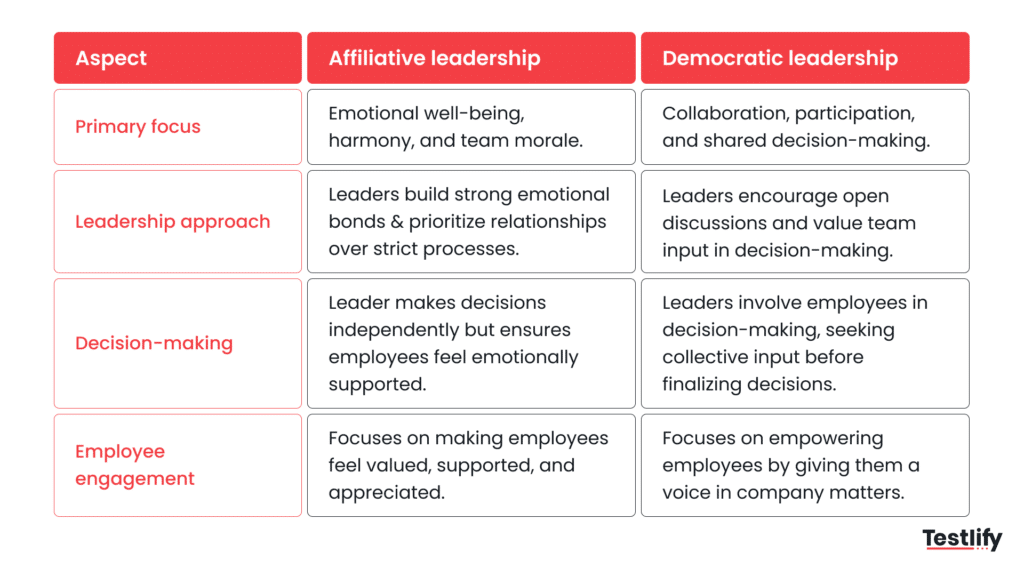
Is affiliative leadership the same as democratic leadership?
No, affiliative leadership and democratic leadership are not the same, though they share some similarities. Both styles value collaboration and prioritize employees’ well-being, but they differ in key ways:
Affiliative leadership characteristics
Affiliative leadership is distinctly different from other leadership styles because of its focus on emotions, relationships, and well-being. Here are some of the key characteristics that define affiliative leadership:
1. Empathy and emotional intelligence
One of the cornerstone qualities of an affiliative leader is empathy. Affiliative leaders actively listen, understand, and care for their employees’ emotional needs. They recognize when team members are experiencing stress or personal challenges and offer the necessary support to help them through tough times.
Studies show that emotionally intelligent leaders are able to build better relationships and trust with their teams. This trait is essential for HR professionals aiming to improve employee engagement and satisfaction.
2. Strong communication skills
Affiliative leaders communicate clearly and regularly with their teams. They make sure that their employees feel heard and understood. They are not only good at conveying their own thoughts but are also active listeners who pay attention to what their employees have to say.
In a survey conducted by Gallup, it was found that 70% of employees say they are more engaged when their managers communicate with them effectively. Open and honest communication fosters trust, which is at the heart of affiliative leadership.
3. Focus on team harmony
Affiliative leaders place a strong emphasis on maintaining a positive and harmonious work environment. They create a culture where collaboration and mutual support are the norms rather than encouraging competition among employees. Team harmony is key to building a productive and supportive workplace.
According to Harvard Business Review, when employees feel supported by their leaders and coworkers, their job satisfaction increases by 25%. An affiliative leader works hard to create and maintain this sense of community.
4. Conflict resolution
While affiliative leaders are focused on maintaining harmony, they also take a proactive approach to resolving conflicts. When disputes arise, they address them quickly and constructively. Instead of avoiding or ignoring conflicts, they engage employees in finding solutions that benefit the entire team. Affiliative leaders excel at de-escalating tensions and resolving disputes in a calm, empathetic manner.
5. Supportive and encouraging
Affiliative leaders act as mentors and coaches to their team members. They provide regular positive feedback, praise accomplishments, and encourage personal development. These leaders genuinely want to see their employees grow and succeed.
Gallup study shows, employees who receive regular feedback and encouragement are 20% more likely to stay with their company long-term.
Why is affiliative leadership important to HRs?
For HR professionals, affiliative leadership presents a unique opportunity to enhance employee engagement, retention, and overall organizational culture. Here’s why adopting this leadership style can be a game-changer in HR:
1. Promotes employee well-being
Affiliative leadership places a strong emphasis on employee well-being. HR professionals who embrace this leadership style can create a supportive environment where employees feel safe, valued, and cared for. When employees’ emotional needs are met, they are more likely to stay motivated and engaged.
Gallup found that employees who feel supported by their leaders are 57% more engaged. Emotional support from leaders can also reduce burnout and improve work-life balance, leading to a healthier workforce.
2. Fosters open communication
Affiliative leaders excel at communication, which is crucial in an HR role. By adopting this style, HR professionals can encourage an open dialogue between leaders and employees. This transparency helps address early concerns, ensuring that problems don’t fester and negatively impact the team.
An open line of communication also allows employees to voice their opinions, which leads to higher job satisfaction. According to SHRM, organizations with high levels of trust between employees and managers are 12 times more likely to have high-performing teams.
3. Reduces employee turnover
One of the primary benefits of affiliative leadership for HR professionals is its ability to reduce turnover. Employees who feel emotionally supported and appreciated are less likely to leave. This is particularly important in a competitive job market where retaining top talent can be challenging. Affiliative leadership helps reduce turnover by prioritizing employee satisfaction and trust.
4. Encourages collaboration and teamwork
Affiliative leadership creates an environment where collaboration thrives. By focusing on team well-being and emotional connection, HR professionals can encourage employees to work together toward common goals, increasing productivity and innovation.
Research by McKinsey & Company found that organizations with a collaborative culture are 5 times more likely to outperform their competitors.
When to use an affiliative leadership style?
Affiliative leadership is most effective when emotional support, harmony, and team morale are crucial. Here are four key scenarios where this leadership style is particularly beneficial:
1. Rebuilding team morale after a crisis or conflict
Workplace conflicts, layoffs, company restructuring, or external crises (Such as a global pandemic) Can leave employees feeling uncertain, stressed, or disconnected. Affiliative leadership is particularly useful in these situations because it helps restore trust, rebuild relationships, and create a sense of security.
An affiliative leader steps in with empathy and reassurance, focusing on emotional well-being rather than just operational efficiency. By actively listening to employees’ concerns, offering support, and fostering a sense of unity, the leader helps teams move forward with renewed motivation and a positive outlook.
2. Managing high-stress work environments
In fast-paced industries such as healthcare, finance, or technology, employees often face intense workloads and tight deadlines, leading to burnout and disengagement. Affiliative leadership helps counteract these effects by ensuring employees feel valued, supported, and encouraged.
A leader using this approach recognizes the emotional toll of high-pressure situations and prioritizes stress management. They encourage work-life balance, celebrate small wins, and ensure employees feel psychologically safe, ultimately leading to higher job satisfaction and productivity.
3. Strengthening team cohesion and collaboration
When a new team is formed, or an existing team struggles with poor communication and collaboration, affiliative leadership helps build stronger interpersonal relationships. This leadership style creates an environment where employees feel comfortable working together by fostering a culture of trust and mutual respect.
Affiliative leaders encourage teamwork through regular check-ins, open discussions, and team-building activities. By prioritizing emotional connections, they ensure that employees support one another, leading to improved cooperation and higher overall performance.
4. Supporting employees during organizational change
Mergers, acquisitions, leadership transitions, or company-wide changes in policies can create uncertainty and resistance among employees. People ,may feel insecure about their roles, leading to anxiety and decreased productivity.
An affiliative leader helps employees navigate these transitions smoothly by providing emotional reassurance and transparent communication. Instead of focusing solely on business outcomes, such leaders take the time to address individual concerns, clarify expectations, and emphasize the collective mission of the organization. This makes employees feel more secure, reducing resistance to change and improving overall adaptability.
How does the affiliative leadership style work?
Affiliative leadership is a relationship-focused style that creates a positive emotional climate within the team. Here’s how it plays out in a real-world setting:
1. Building trust
Trust is the foundation of affiliative leadership. Affiliative leaders build trust through consistency, reliability, and a genuine interest in their team members’ well-being. They are approachable, supportive, and always ready to listen.
Trust is critical for HR leaders because it enables them to resolve issues, make tough decisions, and maintain employee satisfaction. Affiliative leaders can bridge this gap by building personal connections with their team members.
2. Creating a positive work culture
Affiliative leaders intentionally cultivate a positive, inclusive, and supportive work culture. They encourage team-building activities, offer emotional support, and make sure that team members feel like they are part of a family, not just employees.
As per Forbes, 77% of employees believe that company culture plays a significant role in their job satisfaction. A positive, affiliative culture increases morale, loyalty, and performance.
3. Providing support during challenges
Affiliative leaders are especially effective during times of change or challenge. When employees face personal difficulties or business challenges, affiliative leaders offer a listening ear and practical support. They understand the importance of mental health and well-being in maintaining productivity and morale.
HR leaders who practice affiliative leadership can implement programs that support mental health, work-life balance, and personal development, creating a resilient workforce.
Tips to become an effective affiliative leader
For HR professionals looking to adopt an affiliative leadership style, here are a few practical tips:
1. Develop emotional intelligence (EQ)
To be an effective affiliative leader, you must develop your emotional intelligence. This means being aware of your emotions, understanding the emotions of others, and managing both in a way that fosters positive relationships.
2. Be an active listener
Make sure you listen to your team members truly listen. Pay attention to their concerns and offer support where necessary. Regular feedback and constructive conversations go a long way in making employees feel valued.
3. Create a safe environment
Encourage open communication by creating a safe space for employees to express themselves. Foster a culture where individuals feel comfortable discussing both professional and personal challenges without fear of judgment.
4. Celebrate success
Acknowledging achievements, big or small, can do wonders for morale. Make it a habit to celebrate milestones and show appreciation for the hard work of your team.
5. Offer continuous support
Be available to your team members whenever they need you. Whether they need guidance on a project or personal advice, an affiliative leader offers continuous support and guidance.
Benefits of affiliative leadership
Let’s take a closer look at the benefits of affiliative leadership for HR professionals:
1. Increased employee satisfaction
When employees feel supported and valued, they experience higher job satisfaction, which leads to greater retention and engagement. Happy employees are more productive and contribute positively to the organization’s culture.
2. Better collaboration
Affiliative leadership promotes teamwork and cooperation. This creates a culture of collaboration where team members support each other and work together to achieve common goals.
3. Higher employee engagement
Employees who are emotionally supported are more likely to be engaged in their work. Engaged employees perform better, are more innovative, and are committed to the organization’s success.
4. Enhanced communication
The open and empathetic communication practiced by affiliative leaders leads to greater transparency and trust within teams. This fosters a positive work environment and reduces misunderstandings.
Affiliative leadership disadvantages
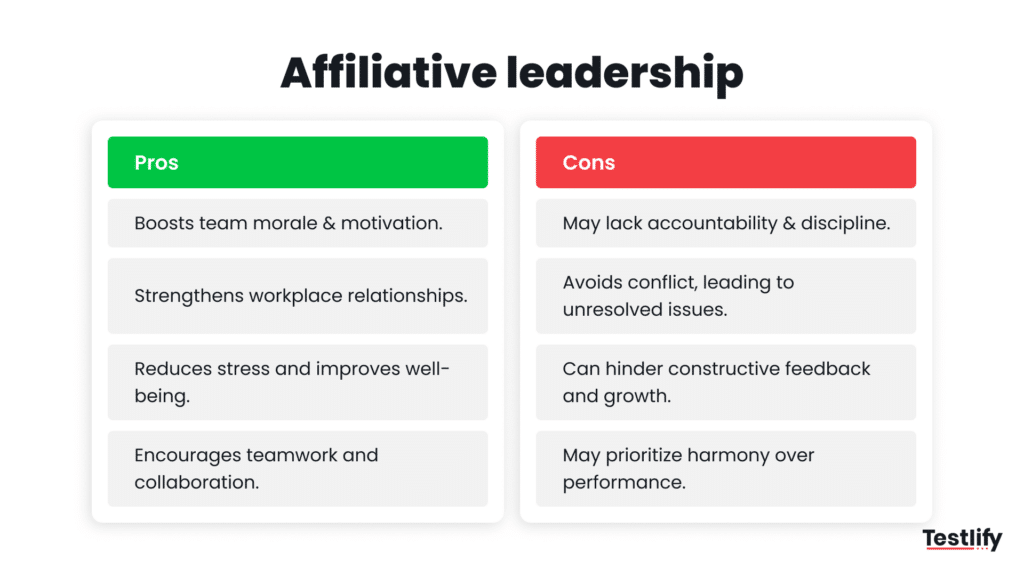
While affiliative leadership offers numerous benefits, there are a few drawbacks to consider:
1. Lack of clear direction
Affiliative leaders can sometimes struggle with providing clear direction or making tough decisions, as they prioritize relationships over results. This can lead to confusion and a lack of focus on organizational goals.
2. Overemphasis on emotions
In some cases, affiliative leaders may become too focused on emotional well-being, neglecting performance or task-related objectives. It’s essential to balance empathy with productivity.
3. Difficulty handling conflict
Although affiliative leaders excel at conflict resolution, they may avoid direct confrontations to maintain harmony. This can lead to unresolved issues and lingering tensions.
Affiliative leadership examples
1. Sheryl Sandberg at Facebook
Sheryl Sandberg, former COO of Facebook, is a great example of an affiliative leader. Known for her empathy and commitment to supporting employees, she worked to create an inclusive and supportive culture at Facebook, where employees felt heard, valued, and motivated to do their best.
2. Howard Schultz at Starbucks
Howard Schultz, former CEO of Starbucks, also embodies the principles of affiliative leadership. He prioritized employee well-being by offering benefits such as healthcare for part-time workers, creating a company culture of trust and loyalty.
Other leadership styles
While affiliative leadership is incredibly effective, it’s important to recognize that different leadership styles can also be useful in various contexts. Other leadership styles include:
- Authoritative leadership: Focuses on setting clear goals and motivating employees to achieve them.
- Coaching leadership: Develops employees’ potential through mentorship and guidance.
- Democratic leadership: Involves employees in decision-making processes.
- Laissez-Faire leadership: Provides autonomy and minimal intervention, often used when employees are highly skilled.
Conclusion
Affiliative leadership is valuable for HR professionals looking to foster a positive, collaborative, and emotionally supportive work environment. By emphasizing empathy, communication, and relationship-building, affiliative leaders can significantly enhance employee engagement, morale, and performance.
While there are potential challenges, the benefits, such as higher employee satisfaction, stronger team dynamics, and improved retention, make affiliative leadership a powerful tool for HR professionals aiming to create a thriving workplace.
Frequently asked questions (FAQs)

Content Writer
Yashika Khandelwal is a Content Writer with 3+ years of experience creating research-backed content on hiring, talent assessment, and HR technology. She is a registered Organizational Psychologist and subject matter expert who combines behavioral science with practical recruitment insights to produce accurate, evidence-based content.
LinkedInRelated resources
View all
HR & recruitment
HR hiring cycle: steps, tools, and best practices

HR & recruitment
Understanding Key Responsibility Areas in recruitment

HR & recruitment
Employee appreciation day 2026: Why it matters (10 ideas)

HR & recruitment
Recruitment Database: Definition, Benefits, Types

HR & recruitment
A complete guide to recruitment advertising in 2026

HR & recruitment
Garden leave meaning: pay, rules, and key benefits
Get started.
Hire on proof, not resumes.
Run your first skills-based assessment free — no credit card required.