
Agile recruitment: Step-by-step process and benefits
Discover the agile recruitment process! Learn flexible, efficient hiring strategies to improve collaboration and speed up your recruitment cycle.

Traditional hiring methods move and function slowly and rigidly. Agile recruitment, on the other hand, is flexible, collaborative, and efficient; it makes sense to hire the right talent needed immediately within a company.
Organizations using agile practices have reported a 50% reduction in project time, according to McKinsey, enabling faster, more efficient hiring processes
For any recruiter, knowing agile recruitment will be a game-changer as it evolves in response to changing needs while keeping a smooth, engaging candidate experience.
Let’s explore agile recruitment, its benefits, core principles, and practical strategies to speed up your hiring.
 ChatGPT
 Gemini
 Claude
 Grok
Grok Perplexity
What is agile recruitment?
Agile recruitment refers to hiring using all the principles of agile project management. Agile is a methodology first developed in the software development world, and it stresses flexibility and teamwork with quick iteration to implement change.
In application, recruitment becomes an exercise through dividing tasks into smaller sub-components that can be shared between the members and iterated upon time after time.
It replaces a rigid, step-by-step approach with flexible changes according to changing requirements, speedy decision-making, and making it more candidate-focused.

Why is agile recruitment important for recruiters?
Agile recruitment is not the buzz but the cure for all the problems plaguing the recruiter. In the following lines, the benefits of agile recruitment to your hiring strategy are explored.
Faster hiring cycles: Agile recruitment accelerates the hiring process, enabling one to make swift, data-driven decisions without compromising quality.
Better collaboration: The agile method encourages HR, hiring managers, and other departments to collaborate to achieve everyone’s goals and expectations.
Better candidate experience: Agile recruitment requires regular check-ins and feedback loops with candidates.
Improved adaptability: Agile recruitment is agile because it becomes easier to address shifting priorities. This way, you can easily respond to the changing nature of the markets and organizations.
Key principles of agile recruitment
As you see how to apply agile recruitment, you must understand the underlying principles that create this methodology. These principles will guide your decisions and actions as you adapt agile practices to your recruitment processes.
1. Collaboration over silos
Agile recruitment favors open collaboration between recruiters, hiring managers, or other people likely to be involved, like team members or candidates. This keeps one in constant communication, which means everybody is better informed and has the chance to address issues that may arise early on.
2. Iterative progress
Agile recruitment breaks a complete cycle into much smaller, manageable stages or “sprints” instead of trying to finish the whole cycle in one long process. Focusing on a certain task, like sourcing candidates, interviewing, or evaluating, will keep you generating decisions faster and improve your process over time.
3. Continuous feedback
One of the most valuable drivers of agile recruitment lies in its emphasis on feedback from candidates and within the recruitment team. It shall always gather feedback from candidates and stakeholders and use that as an improvement source to feed into the next part of recruitment.
4. Flexibility and adaptability
Whether it be about new candidate expectations, market trends, or hiring manager requests, agile recruitment still means being able to turn and pivot around this given situation based on what is happening in real time.
5. Data-driven decisions
Agile recruitment doesn’t rely on gut feelings; decisions are based on data and metrics. That can mean analyzing the success rate of different sourcing channels, time-to-hire metrics, or candidate satisfaction. Data helps you know what’s working and what isn’t and where you should improve your process.
Benefits of agile recruitment
As you know of agile recruitment, it is high time you learned about the benefits. The agile approach may involve various benefits for both recruiters and organizations.
1. Faster Time-to-Hire
Agile recruitment bifurcates the process into tractable pieces that recruiters could fill up much faster. There is an emphasis on a single task in a sprint, which means incremental progress is always made. Therefore, delays and acceleration of the entire recruitment cycle are reduced.
2. Improved Candidate Experience
Agile recruitment facilitates constant dialogue and feedback loops toward a highly transparent and positively scored candidate experience. The candidates will not feel left in the dark. Rather, they would love the updates kept through the process.
3. Better Alignment with Hiring Managers
Hiring managers also ensure close communication between recruiters and hiring managers; what is required is known by both. Agile recruitment enables changes in the job descriptions, candidate profiles, and interview processes because hired managers provide continuous feedback for effective hiring.
4. Enhanced Flexibility
Agile recruitment makes your process very flexible to changing needs. For example, if the hiring manager changes the requirements mid-way through the process, your related correspondence could be altered quickly, and you could continue without losing the tempo.
5. Improved Candidate Quality
Agile recruitment depends on constant feedback and iteration, so you’ll likely tighten up your sourcing methods and candidate criteria over time, which will further refine the recruitment process and, consequently, better hires.
The agile recruitment process: Step-by-step
Agile recruitment is more than just adopting new terms; it’s more about the philosophy of agility in the entire hiring process.
A study by Deloitte found that 76% of executives prioritize organizational agility to quickly adapt to changing workforce demands, including hiring.
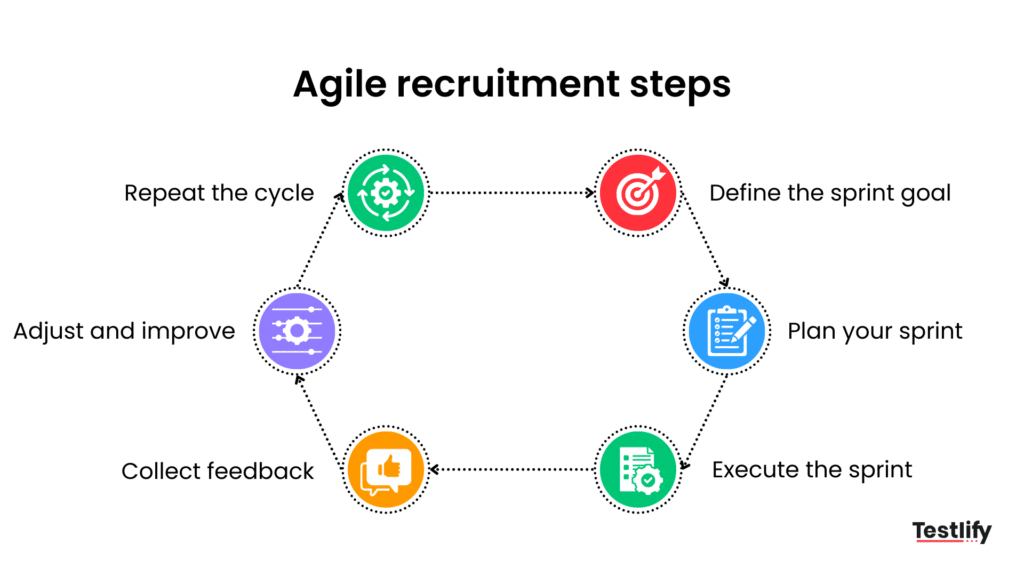
Here is how you can divide agile recruitment into practical steps:
Step 1: Define the sprint goal
Each sprint in agile recruitment should have a well-defined goal. You might be sourcing candidates, doing initial interviews, closing offers- whatever your goal is. This definition of your sprint goal will keep your efforts focused and ensure you steadily advance toward filling the position.
Step 2: Plan your sprint
Once you have a goal, you must plan how to achieve it. For example, if your sprint goal is to source candidates, you will decide which sourcing channels you would use: job boards, social media, referrals, etc., and your timeline.
Step 3: Execute the sprint
Now it’s time to do. Whether writing job advertisements, sending requests to candidates, or setting up interviews, this is the phase where you put your plan into action. Agile recruitment makes pace and gains momentum.
Step 4: Collect feedback
At the end of each sprint, gather feedback from all parties involved, including hiring managers, interviewers, and even candidates. What went well? What could have been better? This is the feedback gold for helping you improve the next sprint.
Step 5: Adjust and improve
After gathering feedback, spend time on what is working and what is not. Refine the strategy with any needed refinement in sourcing, job description, or interview questions. Agile recruitment is all about continuous improvement.
Step 6: Repeat the cycle
A single sprint cannot be enough for the recruitment process. Agile ensures continuous iteration. Once you have finished one sprint, start planning for the next to capitalize on the insights and feedback you have gathered. With every cycle, you are a step closer to achieving your goal as an ideal candidate.
Tools and techniques for agile recruitment
Successfully implementing agile recruitment is all about having the right tools and techniques for the job. Here are a few tools that can make your agile hiring process smooth:
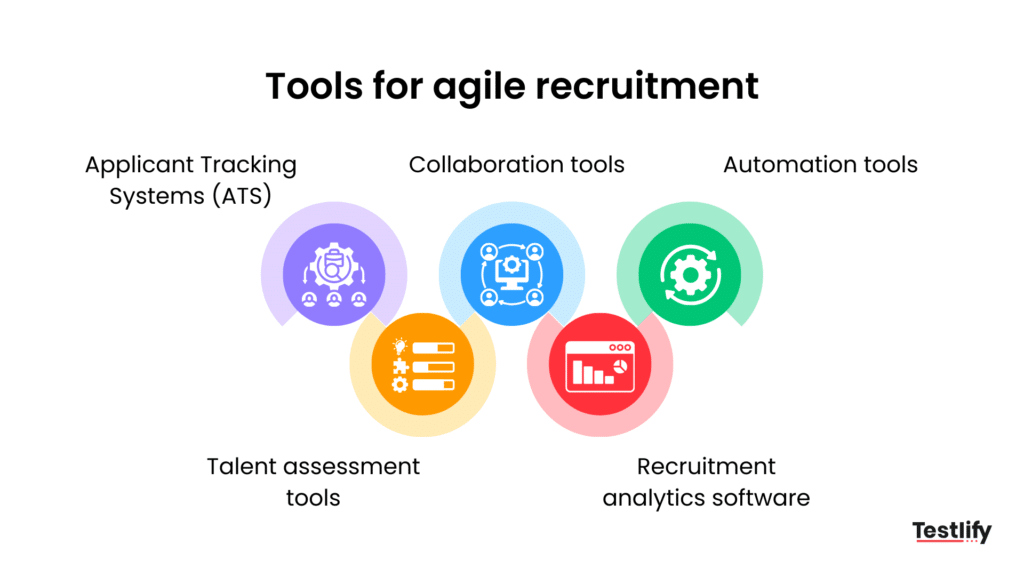
1. Applicant Tracking Systems (ATS)
An ATS needs to monitor candidates and know how they progress through the hiring cycle. Most modern ATS systems contain functionalities like collaborative hiring, real-time feedback, and assessment sharing, which suit an agile approach. Like Greenhouse, Lever, etc.
2. Talent assessment tools
Talent assessment toolplatforms like Testlify can help assess candidates’ adaptability, teamwork, decision-making, and other important skills for you to hire candidates as quickly as possible with the right skill set. Make sure you choose a talent assesment tool that integrated semalesly with you ATS for automated process.
3. Collaboration tools
Tools like Slack, Microsoft Teams, and Trello can facilitate communication among team members. These tools allow easy feedback sharing, goal setting, and real-time tracking.
4. Recruitment analytics software
Data is the heart of agile recruitment, and all recruitment analytics tools, such as LinkedIn Talent Insights or Google Hire, can provide you with data on how long it takes to hire, how effective your sourcing is, and even what quality candidates you hire. All those insights are hints of how you make decisions and then improve your process.
5. Automation tools
For one, recruiters’ automation of tasks saves time on what may have always been repetitive tasks or processes. Sourcing candidates and setting up interviews and follow-up emails are the duties that could save time. You will spend more time on high-value activities like conducting interviews and making decisions.
Challenges of agile recruitment
While agile recruitment comes with many benefits, it has challenges as well. Some of the common problems recruiters face in adopting this methodology and some ways to overcome them are listed below.
1. Resistance to change
Some members of the team might resist a new recruitment process. Train and clearly state how the new agile recruitment will benefit them. Start small, and as you bring in agile practices, show them how effective they can be.
2. Maintaining consistency
With multiple sprints and loops of feedback, candidate evaluation can easily go incoherent. Standardize the same process or stage recruitments, for instance, interview questions and scoring criteria, to maintain fairness and objectivity.
3. Managing multiple stakeholders
Agile recruitment involves a lot of teamwork, hence managing the input from multiple stakeholders. To avoid paralysis in decision-making, clear communication channels should be designed, and feedback should be captured in an ordered way.
4. Data overload
Since you depend heavily on data-driven decisions, you could easily feel drowned by the amount of data; instead, zero in on some pertinent KPIs, which are time to hire, candidate quality, and sourcing effectiveness, so you’re using data that drives results.
Conclusion
Agile recruitment is much more than a buzzword. It’s a different game that could improve your hiring process, making it faster, more flexible, and more collaborative. The principles of agile methodology thus translate into creating a more responsive recruitment process that is aware of and geared toward the needs of the candidate and the hiring manager.
Success in agile recruitment comes from continuous improvement. With every sprint, you gain good insight into what works and what doesn’t, so you can make actual time adjustments that can lead to better hires.
Now, recruiters must optimize their processes by beginning to embrace agile practices. Start small, iterate often, and watch how recruitment processes improve to be faster, better, and friendlier to candidates.
Frequently asked questions (FAQs)

Content Writer
Yashika Khandelwal is a Content Writer with 3+ years of experience creating research-backed content on hiring, talent assessment, and HR technology. She is a registered Organizational Psychologist and subject matter expert who combines behavioral science with practical recruitment insights to produce accurate, evidence-based content.
LinkedInRelated resources
View all
HR & recruitment
Job Crafting: Types, Examples, and How to Do It (2026)

HR & recruitment
Best practices to ensure authenticity in candidates’ skills assessment tests
HR & recruitment
Purple squirrel in recruitment: Are they worth the hype?

HR & recruitment
What is human resource development: Guide for recruiters
HR & recruitment
What Is an HR Toolkit? Components, Tools, and How to Build One

HR & recruitment
What is predictive hiring and why does it matter?
Get started.
Hire on proof, not resumes.
Run your first skills-based assessment free — no credit card required.