
Job Crafting: Types, Examples, and How to Do It (2026)
Discover how job crafting allows employees to enhance job satisfaction and performance. Learn key strategies HR can use to implement it effectively.

Job crafting is when employees reshape their own roles, the tasks they take on, the people they work with, and the way they think about the work, so the job fits their strengths and interests better. It is a bottom-up change made by the person doing the job, not a redesign handed down by a manager.
It matters right now because most people are checked out at work. Gallup puts global employee engagement at about 20%, roughly 1 in 5, and estimates that low engagement costs the world economy close to 9% of global GDP. On top of that, about two-thirds of U.S. workers (67%) reported at least one symptom tied to burnout in the past month, according to the APA’s 2024 Work in America survey. You cannot reorganize your way out of that from the top alone. Job crafting hands some of the steering wheel to employees, and that is often where the real change starts.
 ChatGPT
 Gemini
 Claude
 Grok
Grok Perplexity
TL;DR
- Job crafting is the process of employees proactively reshaping their tasks, relationships, or perspective to make their work more meaningful and better aligned with their strengths.
- The three main types of job crafting are task crafting, relational crafting, and cognitive crafting, and employees often use a combination of all three.
- When supported by managers, job crafting can improve employee engagement, job satisfaction, motivation, well-being, and performance.
- Effective job crafting balances individual preferences with team and business goals. Changes should enhance work without affecting collaboration or responsibilities.
- Organizations can encourage job crafting by giving employees autonomy, discussing strengths during one-on-ones, piloting small changes, and measuring outcomes through regular feedback and performance metrics.

What is job crafting?
Job crafting is the set of small, self-directed changes an employee makes to their own role so it lines up better with their strengths, interests, and values. The point is to make the work more engaging and meaningful from the inside, without waiting for a formal restructure.
The idea comes from organizational psychologists Amy Wrzesniewski and Jane Dutton, who named it in a 2001 paper and later described how it plays out in practice for Harvard Business Review in 2020. Their core insight still holds: two people with the exact same job title can experience that job in completely different ways, and a lot of that gap comes from how each one quietly shapes the role around themselves.
Here is a plain example. A marketing coordinator who loves data starts owning the campaign reporting that nobody else wants. Same title, same pay, but the job now leans toward what they are good at. That is job crafting. It works best where employees have a bit of room to move. In tightly scripted roles, there is less to craft, so managers have to build that room in on purpose.
What are the 3 types of job crafting?
There are three types of job crafting: task crafting, relational crafting, and cognitive crafting. Task crafting changes what you do, relational crafting changes who you do it with, and cognitive crafting changes how you see it. Most people use all three at once without ever naming them.
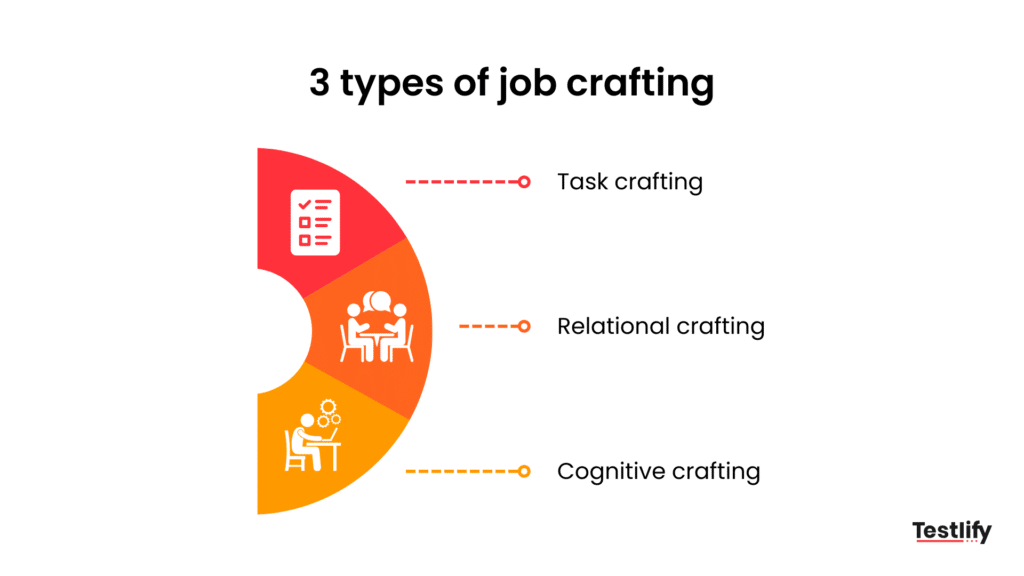
Task crafting
Task crafting is changing the actual work: taking on new tasks, dropping or trimming others, or doing the same task in a different way. A developer who enjoys writing might start owning the team’s documentation. A salesperson who is great with people might fold light customer-success work into their week. The work tilts toward what each person does best, which usually shows up as better output, not just a happier mood.
Relational crafting
Relational crafting is reshaping the people side of the job: building closer ties with certain colleagues, mentoring a junior teammate, or partnering with another team. A quiet analyst who starts running a monthly knowledge-share is crafting relationally. This is the type managers underestimate most. Stronger connections at work tend to lower stress and pull people back in when the job itself gets dull.
Cognitive crafting
Cognitive crafting is the mindset shift. Nothing about the tasks changes, but the way the person frames the work does. The classic study finding is hospital cleaners who saw themselves as part of patient care, not just cleaning, and reported far more meaning in the same job. A support agent who treats the role as solving real problems, not closing tickets, is doing the same thing. It is the cheapest type to start and the easiest to dismiss, which is a mistake.
Worth reading alongside this: what motivational fit is and why it matters in hiring. People craft most where the role already connects to what drives them.
Job crafting examples by role
Abstract definitions are easy to nod along to and hard to act on. Here is what crafting actually looks like across a few common roles, and which type each one leans on.
Role | What they craft | Type |
|---|---|---|
Software engineer | Takes ownership of code reviews, technical documentation, and mentoring new team members to better use their strengths. | Task |
Customer support agent | Views the role as helping customers solve problems rather than simply meeting ticket targets. | Cognitive |
HR generalist | Builds stronger relationships across departments to launch mentoring or employee engagement initiatives. | Relational |
Sales representative | Introduces post-sale follow-ups to strengthen customer relationships and improve retention. | Task and relational |
Teacher | Incorporates interactive projects and collaborative learning activities to improve student engagement. | Task and cognitive |
Marketing specialist | Volunteers to present campaign insights and lead brainstorming sessions that align with their communication strengths. | Task and relational |
Project manager | Reframes the role from managing deadlines to enabling team success and removing blockers. | Cognitive |
Nurse | Coordinates more closely with patients’ families to improve communication and continuity of care. | Relational |
Notice that none of these need a budget, a new title, or a sign-off from finance. That is the quiet power of crafting. In a 200-person company, even 10 or 12 people quietly reshaping their roles compounds by the end of a 13-week quarter. The change is small enough to start on a Monday and real enough to matter by quarter close.
What are the benefits of job crafting?
The main benefit of job crafting is higher engagement: when people shape work around their strengths, they care more and do more. Research consistently links crafting to stronger work engagement, motivation, and resilience, and engaged employees are more productive and stick around longer. For a People team staring at that flat engagement number, with only 20% of people checked in and the rest costing real productivity, that is not a soft perk. It is one of the few levers that works without a reorg.
Beyond engagement, crafting tends to do three things. It improves performance, because people spend more time on work they are good at. It strengthens relationships, because relational crafting pulls colleagues closer. And it builds adaptability, because employees who are used to reshaping their own roles handle change better when the org throws it at them. Those three compound. A team that crafts is usually a team that adjusts faster when priorities shift.
What are the risks of job crafting?
Job crafting is not always a win. The honest answer is that it can quietly hurt the organization even while it helps the individual. If someone reshapes their role toward the parts they enjoy and away from the parts the company actually needs, you get a happier employee and a slower team. That tradeoff is real, and pretending it is not is how crafting gets a bad name.
A few specific failure modes. Someone spends their best hours on a passion project while the core roadmap slips. Someone avoids a manager they find difficult, so problems surface late. Someone crafts so far from the job description that the next person to fill the role inherits a mess. The common thread is missing communication. Crafting that happens in the open, with a manager who knows about it, almost never causes these problems. Crafting that hides does.
So the manager’s job is not to approve every change. It is to set the guardrails: here is what the role has to deliver, here is the room you have to shape the rest. Inside those lines, encourage it. Outside them, talk early.
Job crafting vs job enrichment vs job design
These three get mixed up constantly, but they answer different questions. Job design and job enrichment are things managers do to a role. Job crafting is something employees do with a role. The direction of the change is the whole difference.
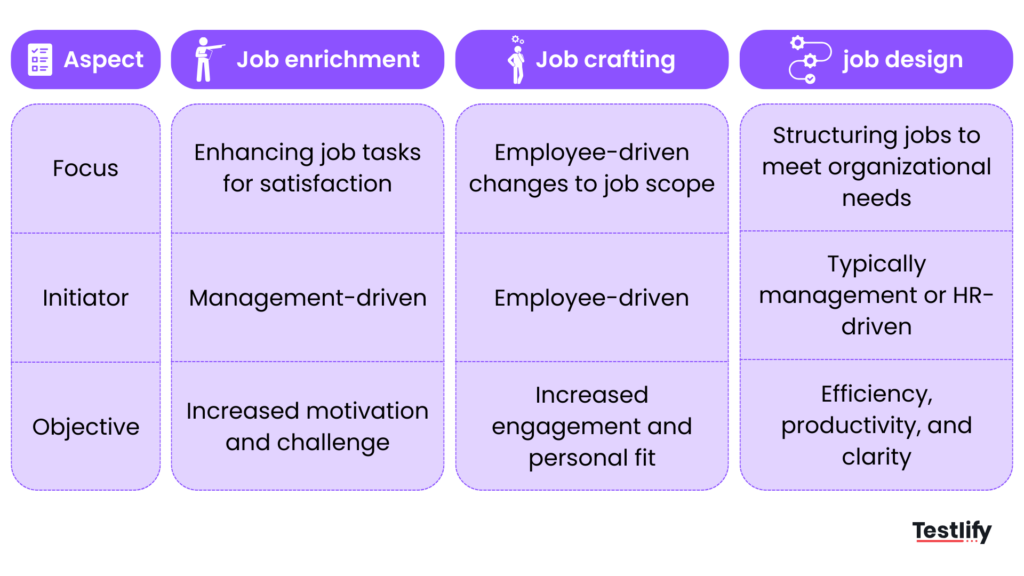
Concept | Who drives it | What it changes |
|---|---|---|
Job design | Manager or organization (before hiring or role creation) | Defines the role’s responsibilities, reporting structure, workflows, and required skills before the position is filled. |
Job enrichment | Manager or organization (during employment) | Expands an existing role by adding greater responsibility, autonomy, decision-making authority, or more challenging work. |
Job crafting | Employee (during employment) | Employees proactively modify their tasks, working relationships, or perspective on their work to better align with their strengths, interests, and goals. |
Job design is the blueprint stage, an employer-led practice that the CIPD treats as a core part of building good work. Job enrichment is the manager adding weight to a role that already exists. Job crafting is the employee adjusting that role once they live in it. They are not rivals. The best setups use all three: design the role well, enrich it where it is thin, and leave enough slack for people to craft.
How do you implement job crafting?
To introduce job crafting, start with a conversation, not a policy. Ask people what parts of their role energize them and what they would change if they could. Then run it as a small experiment before you scale it. Here is a sequence that works.
- Map strengths first. You cannot craft toward strengths you have not named. Use assessment data, manager input, and self-reflection to get a real picture of what each person is good at and what drives them.
- Try it yourself. Craft your own role or your team’s first, so you can share real before-and-after stories. People copy what they see working, not what they are told to do.
- Run small pilots. Pick a few teams, including one that is skeptical and one that is neutral, instead of rolling it out everywhere at once. Give it an 8 to 12-week window and watch the first 30 days closely. You learn more from a mixed test than a friendly one.
- Set the guardrails. Be clear about what each role must still deliver. Crafting lives inside those lines, not around them.
- Keep it talked about. Make crafting a normal thing to raise in one-on-ones, so changes stay visible and aligned instead of drifting underground.
Where assessments fit: know the strengths before you craft
Step one is the one teams skip, and it is the one that decides whether crafting works. This is the gap the Testlify Competency-to-Evidence Matrix is built to close. The idea is simple: map each role to the competencies that matter, then connect each competency to measurable evidence from assessments, structured feedback, and on-the-job signals, instead of guessing from a resume or a gut read. When a manager can see that someone scores high on analytical reasoning or is strong on collaboration, the crafting conversation gets concrete fast. You are not asking, “What do you feel like doing,” You are asking, “What are your strengths here? How do we shape the role toward that?”
The same evidence pays off earlier, at hiring time. Tools like a motivation assessment or a skills test surface what drives a candidate before they start so you can place people in roles that have room to craft and a reason to. Assessments inform the decision; the manager and employee still make the call. The data just means you are crafting from facts, not hunches.
How do you measure job crafting success?
Start by deciding what you are trying to move. Crafting can target engagement, performance, well-being, or retention, and the metric you track should match that goal. Pick the outcome first, then measure it before and after, so you can actually see whether the change worked.
The simplest signal is asking people directly. A 10-minute pulse of plain questions, run before a pilot and again 90 days in, tells you most of what you need:
- What changes have you made to how you work?
- Has crafting made your job more engaging?
- Would you recommend it to a teammate?
- Do you want to keep going?
Pair those answers with one or two hard numbers you already track, like employee satisfaction scores or team output, and you have a fair read on whether crafting is paying off, without building a heavy measurement machine to do it.
Key takeaways
- Job crafting is employee-led, and that is the point. The change comes from the person in the role, not a manager redesign. That is why it reaches engagement that top-down restructures miss, and why it needs trust to work.
- Three types, used together. Task, relational, and cognitive crafting each pull a different lever. Cognitive crafting costs nothing and is the easiest to overlook, so name it explicitly when you coach people.
- The upside is engagement you can feel. Crafting reliably tracks with higher engagement, motivation, and resilience. With only about 20% of employees engaged globally, that makes it one of the cheapest retention levers a People team has.
- The risk is drift. Crafting that pulls away from team goals or hides from a manager hurts the org even when the employee is happier. Open communication and clear guardrails are what keep it safe.
- It is not job design or enrichment. Design and enrichment are manager moves; crafting is an employee move. Strong teams use all three, leaving deliberate slack for people to shape their own roles.
- Start with evidence, then measure. Map strengths before you craft, run mixed pilots, and check a simple before-and-after pulse. Crafting from real assessment data beats crafting from a hunch every time.
Frequently asked questions (FAQs)

Related resources
View all
HR & recruitment
Best practices to ensure authenticity in candidates’ skills assessment tests
HR & recruitment
Purple squirrel in recruitment: Are they worth the hype?

HR & recruitment
What is human resource development: Guide for recruiters
HR & recruitment
What Is an HR Toolkit? Components, Tools, and How to Build One

HR & recruitment
What is predictive hiring and why does it matter?

HR & recruitment
Top 8 HR communities recruiters should join
Get started.
Hire on proof, not resumes.
Run your first skills-based assessment free — no credit card required.