
Communication channels formula: how to calculate n(n-1)/2
Count the links in any team with n(n-1)/2, avoid the PMP exam traps, and see how sub-teams and hubs cut the number of channels.

A team of 10 people has 45 communication channels, and a team of 20 has 190. Nobody planned those 190 links, yet every one of them is a place where a message can get lost.
Project managers, recruiters and HR teams feel this when a team grows and updates start to slip. The communication channels formula, n(n-1)/2, counts the direct links between people so you can spot the problem early.
You will see how to calculate it step by step and which traps PMP exam questions set. You will also learn how sub-teams and hubs cut the count, and how to use the number on a real project or hiring team.
TL;DR:
- The communication channels formula is n(n-1)/2, where n is everyone who communicates on the project. A team of 10 has 45 channels.
- Always count yourself, the sponsor and any vendors in n. Forgetting the project manager is the most common exam mistake.
- Adding one person to a team of n adds exactly n channels. Going from 10 to 11 people adds 10 channels, a 22% jump for 10% more people.
- The count grows with the square of team size, not exponentially. Doubling a team roughly quadruples its channels.
- Structure beats headcount: 12 people talking freely have 66 channels, two teams of 6 with leads have 31, and a hub and spoke has 11.
- Gallup found the average US manager had 12.1 direct reports in 2025, up from 10.9 in 2024. With the manager that is 13 people and 78 channels.
- In a spreadsheet, =COMBIN(A2,2) or =A2*(A2-1)/2 gives the channel count for the headcount in cell A2.
 ChatGPT
 Gemini
 Claude
 Grok
 Perplexity
What is the communication channels formula?
The communication channels formula is n(n-1)/2, where n is the number of people who take part in a project's communication. The result is the number of unique pairs of people who could talk to each other directly.
Each pair is one two-way channel, so the formula is a quick measure of how complex communication on a team can get.
The PMBOK Guide describes the result as the number of "potential" channels. Not every pair will actually talk, but every pair could, and each open link is one more place where a message can be missed, delayed or misread.
That is why the number matters more than the headcount: a team of 6 has 6 people but 15 channels.
The formula comes from simple counting. In combinatorics it is "n choose 2", the number of ways to pick 2 people out of n.
Spreadsheets call the same thing COMBIN(n,2).

How do you calculate communication channels?
To calculate communication channels, count every person who communicates on the project, multiply that number by itself minus one, then divide by two. The steps below use a team of 6 and work the same for any team size:
- Count n: List everyone who sends or receives project information directly, including you.
- Multiply n by n - 1: For 6 people, 6 x 5 = 30. This counts each link twice, once from each end.
- Divide by two: 30 / 2 = 15 communication channels.
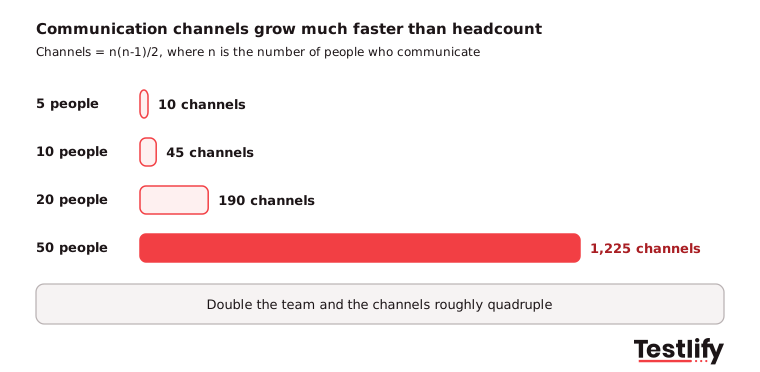
People (n) | Calculation | Communication channels | What it means day to day |
|---|---|---|---|
3 | 3 x 2 / 2 | 3 | Everyone hears everything |
5 | 5 x 4 / 2 | 10 | One group chat keeps everyone in sync |
10 | 10 x 9 / 2 | 45 | Sub-groups form and some people drop out of the loop |
15 | 15 x 14 / 2 | 105 | Decisions need an owner and a written record |
20 | 20 x 19 / 2 | 190 | The team needs a channel plan, not more chat |
50 | 50 x 49 / 2 | 1,225 | Structured channels and clear routing are a must |
Why the formula divides by two
The formula divides by two because a channel between two people is one two-way link. Each of the n people can reach n-1 others, which gives n(n-1) one-way links.
A conversation between Priya and Tom is the same channel whether Priya starts it or Tom does, so dividing by two counts each pair once. On a team of 4, that is 12 one-way links and 6 two-way channels.
Some articles present n(n-1) without the division as a second formula. It is not a different kind of channel; it is the same pairs counted from both sides.
Exam questions and project plans use the two-way count.
Who counts as n
The value of n is everyone who takes part in the communication, not only the core team. That means the project manager, the sponsor, team members and any vendors, contractors or client contacts who talk to the team directly.
For example, a project manager leading 8 team members, with one sponsor and 2 vendors, has n = 12. That gives 12 x 11 / 2 = 66 communication channels.
Leave yourself out and you get 11 x 10 / 2 = 55, which is the answer exam writers expect careless candidates to pick.
Pro tip: If the question says "stakeholders", read it as everyone, including the team and the project manager. The PMBOK Guide defines a stakeholder as anyone who can affect or be affected by the project.
How many channels does a new team member add?
A new team member adds as many channels as there are people already on the team. Going from n to n + 1 people adds exactly n channels, because the newcomer needs one link to each existing person.
A team of 6 has 15 channels; add one person and it has 21, an increase of 6.
For bigger jumps, calculate the total before and after, then subtract:
- Start with the current team: A team of 10, including you, has 10 x 9 / 2 = 45 channels.
- Add the new people: Three new hires take the team to 13, which has 13 x 12 / 2 = 78 channels.
- Subtract: 78 - 45 = 33 new channels.
The shortcut gives the same answer without the subtraction: add the team size at each step. The first hire adds 10, the second adds 11 and the third adds 12, so 10 + 11 + 12 = 33.
As a single formula, adding k people to a team of n adds k x n + k(k-1)/2 channels: 3 x 10 + 3 = 33.
Three new people added 33 new paths for information to travel, or get lost. This is why onboarding several hires at once can slow a team for weeks, even when every hire is strong.
How do you solve communication channels formula questions on the PMP exam?
PMP and CAPM questions on the communication channels formula rarely ask for a plain count. They test whether you include the project manager, whether you calculate the change rather than the total, and whether you can work backwards.
Practice these four patterns and you will recognise every version.
1. Find the total: "Your project has 15 stakeholders, so how many communication channels are there?" Answer: 15 x 14 / 2 = 105.
2. Find the change, with the project manager hidden: "You manage a team of 8 and three more people join, so how many channels were added?" The team was 9 with you, so it had 36 channels.
With 12 people it has 66, so the answer is 30 new channels (or 9 + 10 + 11 with the shortcut). Candidates who forget themselves answer 27.
3. Compare two sizes: "The team grows from 5 to 10 people, so how many more channels are there?" 5 people have 10 channels and 10 people have 45.
Answer: 35 more, because 45 is 4.5 times the original 10 channels for twice the people.
4. Work backwards: "A team has 28 channels and four people leave, so how many channels remain?" Solve n(n-1) = 56 to get n = 8.
Four people remain, so 4 x 3 / 2 = 6 channels. For any count c, n = (1 + the square root of (1 + 8c)) / 2.
Key takeaway: Read every question twice for who is included and whether it asks for the total or the difference. The arithmetic is easy; the wording is the trap.
Why do communication channels grow so fast?
Communication channels grow fast because every new person links to everyone already there, so the count rises with the square of team size. Many sources call this growth exponential, but it is quadratic: doubling a team roughly quadruples its channels, while exponential growth would double the count with every single person added.
The percentages show why this matters. Going from 10 to 11 people is a 10% increase in headcount but takes channels from 45 to 55, a 22% increase.
Going from 20 to 22 people adds 41 channels in one step. Small teams can absorb a new person; large teams feel every addition.
Team change | Headcount change | Channels before -> after | Channel change |
|---|---|---|---|
5 -> 6 | +20% | 10 -> 15 | +50% |
10 -> 11 | +10% | 45 -> 55 | +22% |
10 -> 20 | +100% | 45 -> 190 | +322% |
20 -> 22 | +10% | 190 -> 231 | +22% |
This is the arithmetic behind the advice that agile teams stay at around 5 to 9 people. A team of 9 has 36 channels, which a stand-up and a shared board can cover.
A team of 15 has 105 channels, which usually cannot be covered that way.
How does team structure change the channel count?
Team structure changes the channel count because the formula assumes everyone talks to everyone. Route communication through leads or a single hub and the number drops sharply, even though nobody leaves.
The same 12 people can have 66, 31 or 11 channels depending on how messages flow.
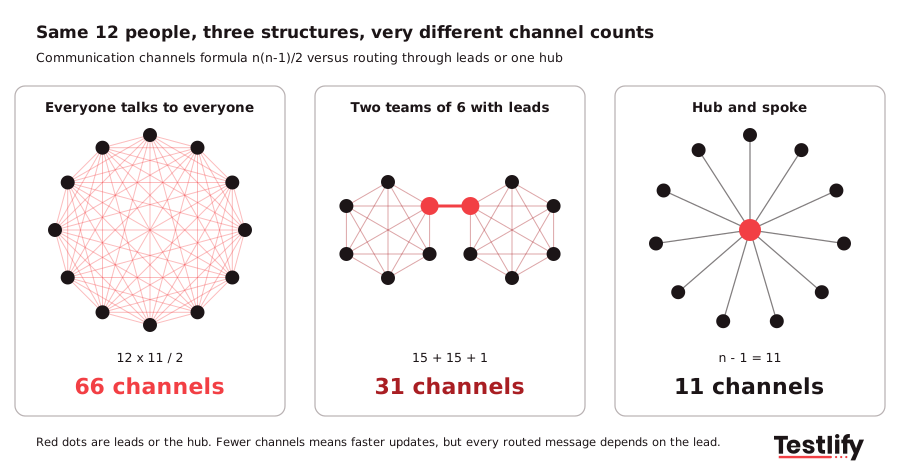
- Full mesh, n(n-1)/2: Everyone talks freely. Twelve people have 66 channels. Best for small teams where speed matters more than control.
- Sub-teams with leads: Split into k teams of m people and connect only the leads. The count is k x m(m-1)/2 + k(k-1)/2. Two teams of 6 give 15 + 15 + 1 = 31 channels. One team of 18 has 153 channels; two teams of 9 have 36 + 36 + 1 = 73.
- Hub and spoke, n - 1: Every message goes through one person, such as a project manager or coordinator. Twelve people have 11 channels. The count is lowest, but the hub becomes a bottleneck and a single point of failure.
The same math applies to managers and their reports. Gallup's span-of-control research found the average US manager had 12.1 direct reports in 2025, up from 10.9 in 2024, while the median stayed at about 5 to 6.
A manager with 6 reports leads a group of 7 people and 21 channels. A manager with 12 reports leads 13 people and 78 channels, close to four times as many for twice the reports.
Gallup also found that 13% of managers now oversee 25 or more people, which is 325 channels if the whole team talks freely.
A wide span of control is workable when the manager routes communication on purpose instead of joining every thread.
How do you use the formula on a real project or hiring team?
You use the communication channels formula on a real team by counting who is involved, calculating the channels, comparing the number with what your current setup can handle, and then routing messages through fewer, clearer paths. The number is a warning light for planning, not a target to hit.
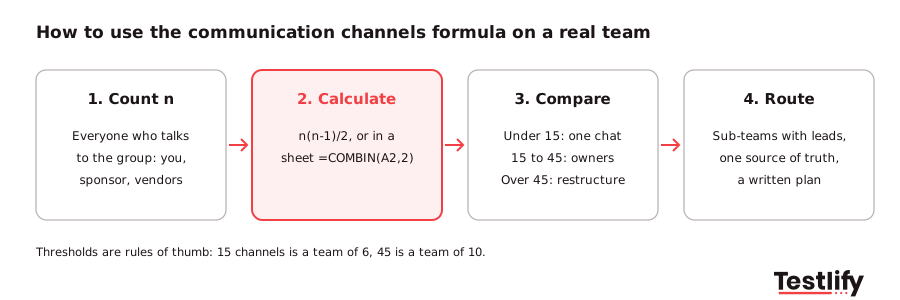
- Count n honestly: Include the sponsor, vendors, client contacts and anyone who will expect updates. Draw the list, not the org chart.
- Calculate the channels: Put headcounts in a spreadsheet column and use =COMBIN(A2,2) or =A2*(A2-1)/2 beside each one. Recalculate whenever someone joins.
- Compare against your setup: As a rule of thumb, under 15 channels (up to 6 people) one group chat works. From 15 to 45 channels (up to 10 people) each topic needs an owner. Above 45, plan sub-teams and leads.
- Route and write it down: Name the leads, keep one source of truth for decisions, and record who needs what, through which channel and how often. A workplace communication plan is where that lives.
Hiring is a good place to see this at work. A typical loop for one senior role has a recruiter, a hiring manager, a recruiting coordinator, four interviewers and an HR business partner who approves the offer.
That is 8 people and 28 channels before the candidate is counted, and 36 with the candidate. When feedback travels through side messages between interviewers, the loop slows and the candidate gets mixed signals.
Most hiring teams fix this with a hub and spoke: the recruiter or coordinator is the single channel to the candidate, and interviewers submit feedback to one place, such as an interview scorecard, instead of to each other. The candidate side drops from 8 possible contacts to 1, and the debrief starts from the same written evidence.
What does the formula count, and what does it miss?
The communication channels formula counts links between people, not the tools they use. A team of 10 has 45 channels whether those pairs talk by chat, email, phone or in person.
The word "channel" also describes those media, which is why the two meanings get mixed up.
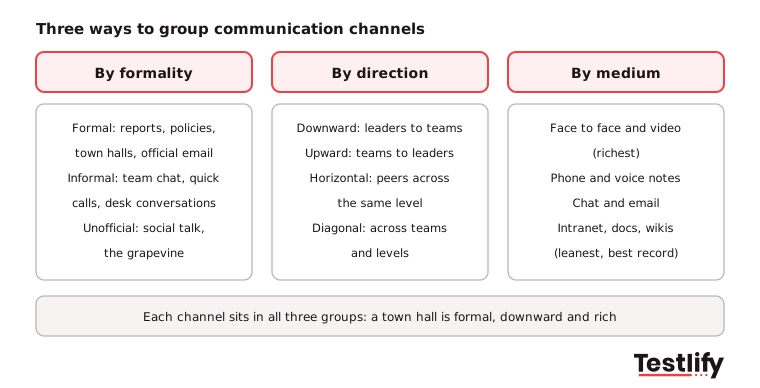
- Formal channels: Policies, reports and decisions of record that follow the reporting line.
- Informal channels: Quick calls and team chat outside the official structure. Informal communication is often where problems surface first.
- Media: Face to face, video, phone, chat, email and written documents, each richer or leaner in how much tone and detail it carries.
The formula also misses volume. Two people share one channel whether they exchange one message a week or fifty a day.
Microsoft's Work Trend Index special report from June 2025 found the average worker receives 117 emails and 153 Teams messages a day and is interrupted every two minutes during core hours, and that mass emails with 20 or more recipients rose 7% in a year. A team can have few channels on paper and still drown in messages.
Overload also lands on the people who act as hubs. The Gallup State of the Global Workplace report found manager engagement fell from 27% to 22% between 2024 and 2025, the largest one-year drop it has recorded.
If you route messages through managers, check that they can carry the load.
Checking whether each medium does its job is a separate exercise from counting links. Teams usually call it channel assessments: list every channel, give each one a single job, score it against that job and retire the duplicates.
Why do communication skills matter when you hire?
Communication skills matter when you hire because every new person adds channels, and each channel works only as well as the two people at either end. Hiring someone onto a team of 10 adds 10 new links at once.
A clear writer who listens well strengthens all of them; a poor communicator adds 10 links that leak.
Feedback between people is the clearest test of those links. Gallup and Workhuman research found that employees who strongly agree they receive valuable feedback from the people they work with are 5 times as likely to be engaged and 57% less likely to be burned out, as covered in Gallup's feedback research.
Most teams still judge communication from a resume and a friendly interview, which rewards confidence more than clarity. A better approach gathers evidence before the first call:
- Map the role to the skills that matter: Clear writing, active listening and adapting tone to the audience. The guide on how to evaluate communication skills covers what to look for.
- Test before you interview: A short communication skills test shows how a candidate writes and reasons. For coordinators and project leads, add a project management skills test.
- Ask everyone the same questions: A structured interview catches what a test misses, such as how someone explains a hard decision live. For project roles, these project manager interview questions are a starting point.
Testlify lets hiring teams combine role-based tests from a library of 3,500+ with AI interviews by video, voice or chat, then score every candidate on the same criteria. People still make the decision; the platform gives them the evidence.
Ready to hire people who keep every channel clear?
More channels mean more places for a message to break, and the people on each end decide whether it does. Start a 7-day free trial with no credit card to test communication and project management skills before the first interview, or book a demo to see Testlify on one of your open roles.
Frequently asked questions

Human Resources Lead
Snehi Parmar leads People at Testlify, owning hiring, culture, performance, and retention for a 90-person team. She writes on practical HR strategy and building people processes that scale.
Related resources
View all
HR & recruitment
How does a behavioral assessment impact hiring decisions?

HR & recruitment
Conflict Resolution Skills: What They Are and How to Build Them

HR & recruitment
5 effective workplace conflict resolution strategies

HR & recruitment
Glass ceiling: How unconscious bias holds women back (2026)

HR & recruitment
How to Attract Top Talent: 9 Techniques for 2026

HR & recruitment
How to Conduct a Remote Interview: A Hiring Team’s Guide (2026)
Get started.
Hire on proof, not resumes.
Run your first skills-based assessment free — no credit card required.