
How to improve diversity and inclusion in hiring with skills assessments
Eight practical steps to improve diversity and inclusion in hiring, from job ads and fair skills tests to structured interviews and metrics.

To improve diversity and inclusion in hiring, you widen who can apply and you judge every applicant on the same job-related evidence. Most hiring processes do not lose good candidates on purpose. They lose them through job ads that ask for more than the role needs, resume filters that reward a familiar background, and interviews where each interviewer asks different questions. Skills assessments fix the middle of that funnel, but only when the tests themselves are fair and accessible.
TL;DR / Key takeaways
- You improve diversity and inclusion in hiring by widening the applicant pool and standardizing how every candidate is judged, not by choosing people for a protected trait.
- The biggest leaks are early: inflated job requirements, narrow sourcing and resume screens that reward pedigree over skill.
- A skills-based approach could grow talent pools 6.1x globally, according to LinkedIn Economic Graph's 2025 research.
- A skills test is only fair if it is job-related, accessible and offered with accommodations, which is what EEOC guidance expects.
- In 2026, US employers can widen outreach and remove barriers, but slates, quotas or selection by race or sex carry real legal risk.
- Track pass rates at every stage. A gap at one stage tells you exactly which step to fix.
 ChatGPT
 Gemini
 Claude
 Grok
 Perplexity
What does it mean to improve diversity and inclusion in hiring?
Improving diversity and inclusion in hiring means two things. Diversity is about who reaches your pipeline: people from different backgrounds, education paths, ages, abilities and experiences. Inclusion is about how they are treated once they arrive: clear criteria, the same questions, accessible tests and a fair chance to show what they can do.
The two depend on each other. A wider pool is wasted if the screening step still filters on school names or years in a job title. A fair evaluation does little if only one kind of candidate ever applies.
The topic is also more contested than it was a few years ago. A Pew Research Center survey of US workers in October 2024 found that 52% say focusing on DEI at work is mainly a good thing, down from 56% in February 2023, while 21% say it is a bad thing.
That is why this guide sticks to practices that are both fairer and easy to defend: open access, job-related evidence and consistent scoring. For the core terms, see the diversity and inclusion glossary entry.

Where do hiring processes lose diverse candidates?
Hiring processes lose diverse candidates at five points: the job ad, sourcing, resume screening, interviews and the offer. Each stage has a different leak, so a single fix such as bias training rarely moves the numbers. Finding the leaking stage first saves months of effort on the wrong problem.
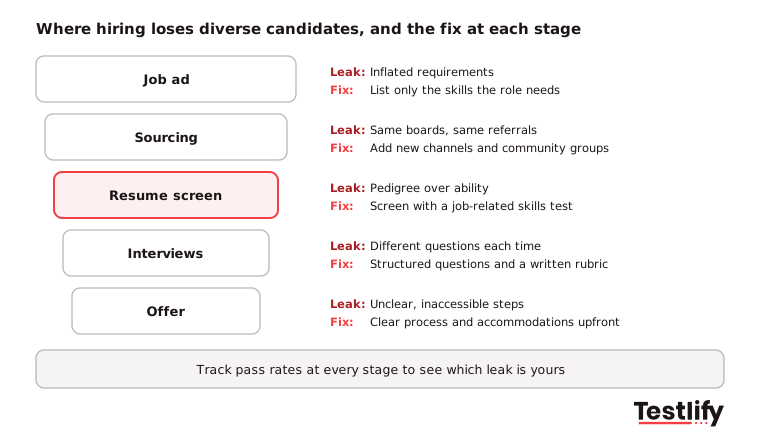
- Job ad: Long lists of "required" skills and degree requirements put off people who could do the job, especially career changers.
- Sourcing: Posting on the same two job boards and relying on referrals from a similar team brings in the same profile every time.
- Resume screening: Reviewers skim for familiar employers, schools and job titles, which is the stage where common hiring biases do the most damage.
- Interviews: Unstructured conversations reward rapport and confidence over ability, and every interviewer judges something different.
- Offer and onboarding: Candidates who felt the process was unclear or inaccessible drop out or decline late.
How do you improve diversity and inclusion in hiring?
You improve diversity and inclusion in hiring by widening who applies and standardizing how every candidate is judged. In practice that takes eight steps: define the skills a role needs, write inclusive job ads, source from more places, screen with skills assessments, make every step accessible, run structured interviews, train and diversify panels, and measure each stage.
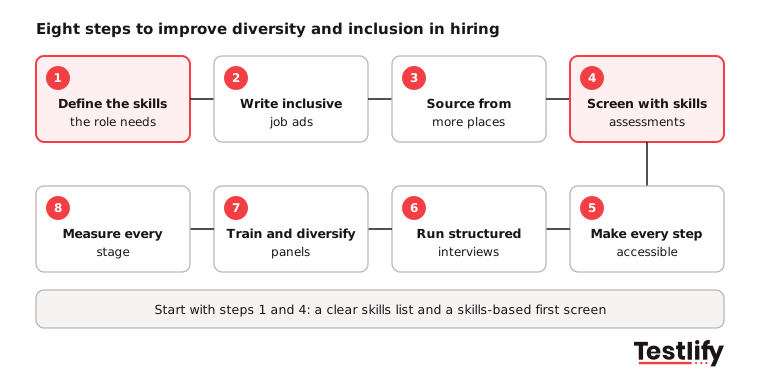
- Define the skills first: Agree with the hiring manager on the five to eight skills the role really needs and how each will be tested. Everything else in the process hangs on this list.
- Write inclusive job ads: Cut requirements that are nice to have, drop degree rules the job does not need, and use plain, neutral wording. This guide on how to attract diverse candidates to your job postings covers wording in detail.
- Source from more places: Add community groups, colleges you have not recruited from, returner programs and job boards for specific groups, alongside your usual channels. Outreach widens the pool without changing who gets selected.
- Screen with skills, not pedigree: Replace the first resume pass with a short, job-related skills assessment, so every applicant gets a scored chance to show ability. Pair it with blind hiring where your tools allow it.
- Make every step accessible: Tell candidates upfront how to request accommodations, and make sure tests and video steps work with screen readers and on mobile.
- Run structured interviews: Ask every candidate the same role-based questions and score answers against a written rubric. Our structured interview guide shows how to build one.
- Train and diversify interview panels: Brief interviewers on the rubric and on common biases, and include people from different teams and backgrounds on panels where you can.
- Measure every stage: Track how many applicants pass each step and compare the rates, so you can see where the process still leaks.
SHRM's guide to inclusive hiring practices adds two practices worth copying: offer accommodations without being asked, and review policies that automatically reject people with criminal records case by case.
Pro tip: Start with steps 1 and 4. A clear skills list and a skills-based first screen change who reaches the interview more than any other single change.
How do skills assessments make hiring fairer?
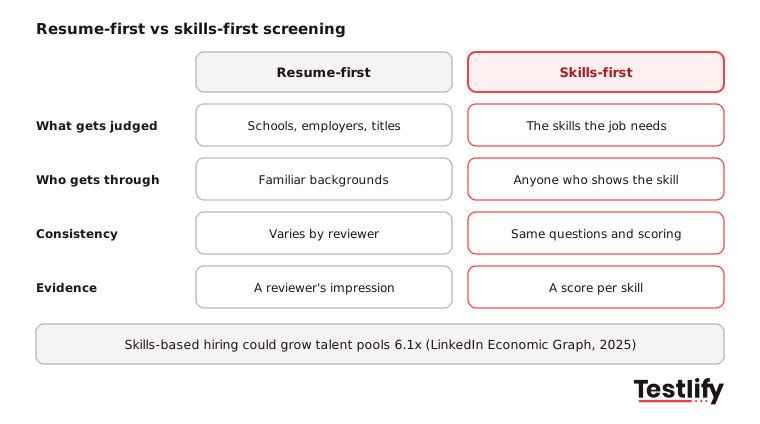
Skills assessments make hiring fairer by replacing proxies such as school, employer and job title with direct evidence of ability. Every candidate answers the same job-related questions, gets scored against the same criteria, and reaches the interview on merit, which opens the door to people with non-traditional paths.
Resume-first screening | Skills-first screening | |
|---|---|---|
What gets judged | Schools, employers, job titles, gaps | The skills the job needs |
Who gets through | People with a familiar background | Anyone who can show the skill |
Consistency | Varies by reviewer and mood | Same questions and scoring for all |
Evidence for the decision | A reviewer's impression | A score per skill you can explain |
Main risk | Pedigree bias, missed career changers | A badly designed or inaccessible test |
The data supports the shift. LinkedIn Economic Graph's March 2025 report, Skills-Based Hiring: Increasing Access to Opportunity, found that a skills-based approach could expand talent pools by 6.1x globally. Workers without a bachelor's degree would see a 6% bigger increase than degree holders, and in AI roles the share of women in the pool could rise by up to 24%.
Hiring teams see the quality side too. LinkedIn's Future of Recruiting 2025 reports that 93% of TA professionals say assessing skills accurately is crucial to quality of hire, and companies running the most skills-based searches are 12% more likely to make a quality hire. More on the approach in our skills-based hiring explainer.
How do you keep skills assessments fair and accessible?
Skills assessments stay fair and accessible when every question maps to the job, the test works for people with disabilities, the language level matches the role, and results are checked for gaps between groups. A test that fails any of these can shut out the very candidates it was meant to let in.
Use this checklist before you send a test to candidates:
- Job-related content: Every section tests a skill on your list from step 1. Drop trivia, puzzles and culture questions that are not tied to the work.
- Accommodations: Offer extra time, a screen reader, a reader, or another format on request, and say so in the invite. Our glossary entry on reasonable accommodation explains what employers must offer.
- Accessible design: Check tests against the W3C's WCAG 2.2 guidelines for contrast, keyboard use and screen readers, and make sure they run on a phone.
- Right language level: Write questions at the reading level the job needs, and offer tests in the candidate's language where the role allows.
- Realistic time limits: Time pressure should match the job. Tight limits on a role without deadlines mostly measure test nerves.
- Gap checks: Compare pass rates between groups. A large gap means you should review the test content and the cut-off score.
The EEOC's guidance on employment tests is clear on two points: a test that screens out a protected group must be job-related and consistent with business necessity, and the ADA requires reasonable accommodation in how tests are given, so results reflect the skill and not an impairment.
Key takeaway: A skills assessment improves diversity and inclusion in hiring only if the test itself passes the same fairness bar you set for interviewers.
Is diversity hiring legal in 2026?
Diversity hiring is legal in the US when it widens access and removes barriers, and risky when a protected trait plays any part in who is selected. Broad outreach, inclusive job ads, accessible tests and structured interviews are lawful. Reserved slates, numeric quotas and picking candidates by race or sex are not.
The EEOC's 2025 guidance on DEI-related discrimination says a hiring decision can be unlawful if race, sex or another protected trait motivated it even in part, and lists placement in or exclusion from a candidate slate or pool as disparate treatment. It also notes that Title VII has no "diversity interest" exception.
That shifts the focus from who is chosen to how the process works:
- Fine: Posting on more job boards, partnering with community groups, removing degree rules, blind screening, skills tests, structured interviews, accommodations.
- Risky: Shortlists that must include a set number from one group, hiring targets tied to protected traits, asking about race before selection decisions.
- Check locally: In New York City, Local Law 144 requires a yearly bias audit and candidate notice before employers use automated tools to score or rank candidates.
Laws differ by country and change often, so confirm your process with employment counsel before you roll it out. A skills-first process is easier to defend because every decision rests on documented, job-related evidence.
Which metrics show your hiring is getting more inclusive?
The metrics that show hiring is getting more inclusive are applicant pool mix, pass rates at each stage, time in each stage, candidate experience and early retention. Collect demographic data only through voluntary self-identification, keep it away from reviewers, and use it to find leaking stages rather than to choose people.
Metric | What it shows | What to do if it looks wrong |
|---|---|---|
Applicant pool mix | Whether outreach reaches new groups | Add sourcing channels, rewrite the job ad |
Pass rate per stage, by group | Which step screens people out | Review that step's content and cut-off |
Assessment completion rate | Whether the test is too long or hard to access | Shorten it, test on mobile, check accommodations |
Interview score spread by interviewer | Who scores out of line with the panel | Retrain on the rubric, add a second scorer |
Offer acceptance rate | Whether finalists trust the process | Ask declined candidates why |
90-day retention by hire source | Whether new hires stay | Check onboarding and the role preview |
Run the numbers every quarter for high-volume roles and every six months for the rest. Small groups give noisy rates, so look for patterns across several hiring rounds before you change a step.
How does Testlify support inclusive hiring?
Testlify supports inclusive hiring by giving every candidate the same job-related assessment and the same scoring, with reports reviewers can explain. Teams can turn a job description into a role-specific assessment, add structured AI interviews, and send results to their ATS, so the whole first stage runs on evidence.
- Job-related tests: 3,500+ validated tests across technical, role-specific, cognitive, situational judgment and personality areas, plus an AI test builder that drafts an assessment from your job description.
- Language access: Language tests from CEFR A1 to C2, and assessments in 15+ languages, with candidate-side question translation.
- Same questions, same scoring: Video AI, Voice AI and Chat AI interviews ask role-based questions and score every answer against the same criteria, with weighted scoring and per-skill breakdowns for reviewers.
- Audited matching: Testlify's matching model completed a third-party bias audit under NYC Local Law 144 on June 16, 2023. See the NYC bias audit.
- Fits your stack: Two-way sync with 100+ ATS and HRIS tools, including Workday, Greenhouse, Lever and SAP SuccessFactors.
For roles that lead people or shape culture, such as HR business partners and people managers, a diversity and inclusion assessment checks how well candidates understand inclusive practices at work. More on our approach is on the Testlify diversity and inclusion page.
Ready to build a fairer hiring process?
Pick one high-volume role, list the skills it needs, and replace the first resume screen with a skills assessment. Browse the Testlify test library or start a 7-day free trial, no credit card required, and compare who reaches your interviews after one hiring round.
Frequently asked questions
Related resources
View all
Skill assessment
How to identify high potential employees: signs, tools and steps

Skill assessment
Technical assessment: types, benefits and how to run one

Skill assessment
The future of coding assessments in the hiring process

Skill assessment
12 common mistakes to avoid while creating coding assessment tests

Skill assessment
How to use coding assessments to hire the right talent

Skill assessment
How to build a software development team in 2026
Get started.
Hire on proof, not resumes.
Run your first skills-based assessment free — no credit card required.