
How to build a software development team in 2026
A practical guide for TA and engineering leaders on team structure, roles, hiring order and testing both code and collaboration skills.

Knowing how to build a software development team comes down to five decisions: what the team must ship, how it is structured, which roles you hire and in what order, how you test each candidate, and how you check that the team works once it is in place. Teams that struggle usually got the hiring order or the testing wrong. This guide is written for talent acquisition leaders and engineering managers who are building or growing an in-house team at a mid-size or enterprise company.
 ChatGPT
 Gemini
 Claude
 Grok
 Perplexity
TL;DR
- To build a software development team, define the product goal, choose a structure, hire a technical lead first, then fill core roles in order, and test every candidate on real work.
- Keep each team small. The Scrum Guide puts a Scrum Team at 10 or fewer people; split into two teams before you pass that.
- A hybrid structure (a few specialists plus generalists) suits most product teams. Pure specialist teams suit complex or regulated systems.
- Test code and collaboration separately: a coding work sample or live pair-programming session for skill, and a structured interview plus soft-skill tests for how the person works with others.
- Hiring is hard right now. SHRM's 2025 Talent Trends found more than 2 in 3 organizations struggle to find qualified people for full-time roles, so a clear process saves weeks.
- Review the team at 90 days on delivery, quality of hire and retention, not on headcount.

What is a software development team?
A software development team is a group of engineers and related specialists (product, design, quality and operations) who plan, build, test and release software toward a shared goal. A small team may be three developers and a product owner. A larger one adds a tech lead, QA engineers, a designer and DevOps support.
Demand for these roles is still strong. The US Bureau of Labor Statistics reports a median pay of $134,040 for software developers (May 2025), projects 10% employment growth from 2025 to 2035 and expects about 106,100 openings a year. BLS also lists communication and interpersonal skills, the ability to "work well with others", among the qualities developers need. Technical skill gets a developer hired; working well with others decides whether the team delivers.
How to build a software development team: what are the 6 steps?
Building a software development team works best as a sequence, because each step sets up the next. Teams that skip the first two steps often get hired fast and then rebuilt a year later.
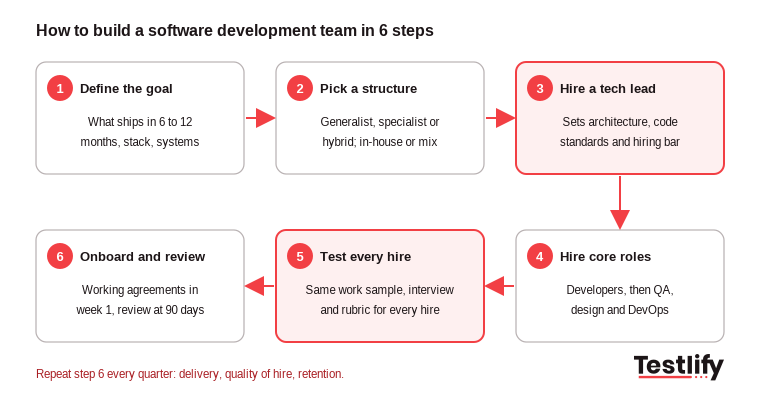
- Define the goal and scope: Write down what the team must ship in its first 6 to 12 months, the tech stack, and the systems it will own. This is your workforce planning input.
- Choose a structure and team model: Decide between generalist, specialist, or hybrid, and between in-house, contract or a mix (see the next section).
- Hire a technical lead first: The lead shapes the architecture, the coding standards, and the hiring bar for everyone after.
- Hire core roles in order: Add developers, then QA, design, and DevOps as the workload needs them, not all at once.
- Test skill and collaboration for every hire: Use the same work sample, interview questions, and scoring for each candidate in a role.
- Onboard, then review every quarter: Set working agreements in week one, then review delivery, quality of hire, and retention at 90 days.
Pro tip: Write the scorecard for each role before you open the job. A scorecard written after you meet candidates tends to describe the person you liked, not the job.
Which software development team structure should you choose?
The right software development team structure depends on how complex the product is and how fast you need to ship. There are three common structures, and many product companies end up with the hybrid.
Structure | What it looks like | Best for | Watch out for |
|---|---|---|---|
Generalist | Full-stack developers who each work across the product | Early products, small teams, fast iteration | Gaps in deep areas such as security or performance |
Specialist | Front-end, back-end, data, mobile and QA experts with clear lanes | Complex, regulated or high-scale systems | Hand-offs, silos and slower delivery |
Hybrid | A core of generalists plus 1 or 2 specialists where the risk is | Most product teams at mid-size and enterprise companies | Needs a strong lead to balance work |
Team size matters as much as structure. The Scrum Guide (2020 edition) describes a Scrum Team as typically 10 or fewer people, with three accountabilities: developers, a product owner, and a scrum master. When a team grows past that, split it into two teams that each own a clear part of the product. If you hire a dedicated Scrum Master, a Scrum Master skills test checks their grasp of the process.
You also need a team model. In-house hires give you long-term ownership of the code. Contractors fill short, specialist gaps. A dedicated external team can add capacity quickly, as covered in how CHROs use dedicated development teams. A common setup keeps the tech lead and core developers in-house and contracts the rest.
What roles does a software development team need?
Software development team roles fall into a core every team needs and support roles you add as the product grows. The infographic below shows a typical order.
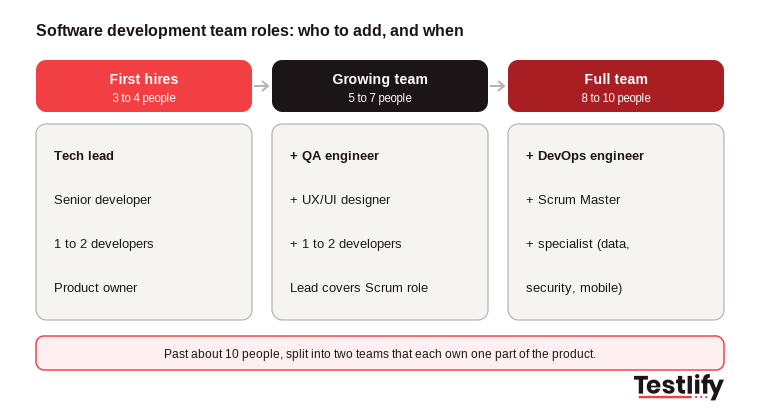
- Technical lead or engineering manager: Owns architecture, code quality, delivery and the hiring bar.
- Software developers: Build the product. Mix seniority: one senior for every two or three mid-level or junior developers keeps reviews fast and lets juniors learn.
- Product owner or product manager: Decides what gets built and in what order, and speaks for the customer.
- QA engineer: Owns test plans and automation, so developers are not the only check on their own code.
- UX/UI designer: Turns requirements into flows and screens; often shared across two teams at first.
- DevOps or platform engineer: Owns build pipelines, cloud infrastructure, and releases once deployments become frequent.
- Scrum Master or delivery lead: Runs the team's process; on small teams the tech lead often covers it.
In what order should you hire the team?
The hiring order should follow risk: hire the people who set direction first, then the people who build, then the people who scale. A typical sequence for a new product team inside a larger company is:
- Tech lead (weeks 0 to 6): Hire or move a senior engineer into the lead role first, and have them help write the other job scorecards.
- Two or three developers (weeks 4 to 12): Hire a senior and one or two mid-level developers who match the core stack.
- Product owner (in parallel): Often an internal move from product management.
- QA and design (months 2 to 4): Add them when the first features reach users.
- DevOps and more developers (month 4 on): Add them once release frequency and workload justify it.
Plan for a long search. In a June 2025 article, SHRM reported from its 2025 Talent Trends research that more than 2 in 3 organizations had difficulty finding qualified people for full-time roles. Track time to hire for each role from day one so you can see where the process stalls.
How do you assess technical and collaboration skills before you hire?
Assessing a developer well means testing two different things with two different tools: whether the person can do the work and how they work with others. Resumes and unstructured interviews are weak signals for both. SHRM's 2024 Talent Trends found that 78% of HR professionals believe pre-employment assessments improved the quality of their hires.
For technical skill, use a work sample that looks like the real job. Testlify coding tests support 45+ programming languages, single and multi-file projects and auto-grading, and live coding and pair-programming interviews let you watch how a candidate reasons through a problem. For collaboration, combine a structured interview with behavioral questions about code reviews, disagreements, and hand-offs, and a soft-skill test such as a teamwork assessment or a communication test.
Role | Technical check | Collaboration check | Testlify tests to start from |
|---|---|---|---|
Tech lead | System design discussion, code review exercise | Structured interview on conflict, mentoring and trade-offs | Conflict management, communication |
Full-stack developer | Multi-file coding task in the team's stack | Pair-programming session, review of their own code | Full-stack developer test, teamwork |
QA engineer | Write test cases and an automated test for a feature | How they report bugs and push back on releases | QA test, communication |
Product owner | Prioritise a backlog with constraints | Stakeholder role play, written spec review | Agile methodologies, communication |
DevOps engineer | Fix a broken pipeline or config | Incident write-up and hand-off | DevOps test, teamwork |
Across the teams we work with, the strongest signal comes from scoring every candidate in a role on the same task and the same rubric, then comparing scores side by side. Testlify's library has 3,500+ tests, including conflict management skills and agile methodologies, and 20+ proctoring checks keep remote coding tests fair.
Key takeaway: Never let one strong signal hide a weak one. A brilliant coder who cannot take review feedback slows down every developer around them.
How to build a software development team that works well together?
Software development team collaboration is built in the first weeks, through clear agreements, not through team-building events. Hiring the right people is only half the job.
- Write working agreements in week one: Agree on code review rules, definition of done, meeting times and how decisions get made.
- Give a structured first 30 days: Pair each new hire with a buddy, give them a small task that ships in week one, and follow a clear onboarding plan.
- Design for remote and hybrid work: The Stack Overflow Developer Survey 2025 found 32.4% of developers work fully remote (45% in the USA), and 54% use six or more tools at work. Put decisions in writing and keep one place for each type of work.
- Protect autonomy: Developers in the same survey ranked "autonomy and trust to manage your own tasks" as the top factor in job satisfaction. Set goals, then let the team decide how to reach them.
- Make conflict normal and safe: Teach the team to disagree about code in reviews and design discussions, and handle personal friction early, one-on-one.
How do you know the software development team is working?
A working software development team ships steadily, keeps quality up and keeps its people. Review it at 90 days and then every quarter with a short set of measures:
Area | What to track | Warning sign |
|---|---|---|
Delivery | Features shipped against plan, cycle time | Work piles up in review or testing |
Quality | Bugs found after release, rollbacks | Rising bug count after each release |
Hiring | Time to hire, quality of hire at 90 days | New hires still not shipping after 60 days |
People | Retention, engagement, review participation | One person does most reviews or decisions |
Engagement deserves attention. Gallup's State of the Global Workplace report found global employee engagement fell to 20% in 2025 and manager engagement to 22%, and estimates low engagement costs the world economy about $10 trillion, or 9% of global GDP. For a team lead, regular one-to-ones and clear goals are the cheapest fix. We have seen 90-day reviews catch a poor role fit early, while there is still time to coach or move the person.
What mistakes should you avoid when building a development team?
The most common mistakes in building a development team are about order and evidence, not about talent.
- Hiring developers before a lead: Without a lead, each developer sets their own standards and the code base splits.
- Hiring for the stack only: A perfect stack match who cannot explain their work or accept review feedback costs more than a slightly slower learner who can.
- Growing one team too large: Past about 10 people, meetings and hand-offs slow everything. Split the team.
- Changing the test from candidate to candidate: Different tasks and questions make candidates impossible to compare and invite bias.
- Skipping the 90-day review: Small problems in fit or process get harder to fix every month.
Ready to build your software development team?
Testlify helps hiring teams test real coding skill and the soft skills that make a team work, in one place. Build a role-specific assessment from your job description, combine a coding test with communication and teamwork tests, and send ranked results to your ATS through 100+ integrations. Browse the test library or start a 7-day free trial, no credit card needed.
Frequently asked questions (FAQs)
Related resources
View all
Skill assessment
Identify top talent using skill assessments

Skill assessment
Scale QA teams with attention-to-detail test

Skill assessment
Importance of accountability skills for responsible work performance

Skill assessment
Benefits of conflict management in the workplace

Skill assessment
How to Assess Positive Attitude in Candidates

Skill assessment
Assessing professionalism in candidates: a 2026 hiring guide
Get started.
Hire on proof, not resumes.
Run your first skills-based assessment free — no credit card required.