
Change management training: what it covers and how to measure it
What change management training teaches, which version fits leaders, managers and staff, and how to prove it changed how people work.
Change management training teaches people how to plan, lead and adopt change at work, from a new system or process to a reorganization or merger. Good change management training gives leaders, managers and employees practical skills: explaining why a change is happening, handling resistance, keeping teams productive during the switch and making the new way of working stick.
 ChatGPT
 Gemini
 Claude
 Grok
 Perplexity
TL;DR / Key Takeaways
- Change management training builds the skills to plan, communicate and sustain change, and it works best when each audience gets its own version.
- Managers need it most. Gallup found manager engagement fell from 31% in 2022 to 22% in 2025, and managers carry most of the day-to-day work of any change.
- Leaders need a short course on sponsorship, managers need one or two days of practice, change practitioners need a certification, and employees need a few hours on adapting.
- Build the program from a training needs analysis, real change scenarios and follow-up coaching, not from slides about change models.
- Measure skills before and after the training with a change management or adaptability test, then check behavior and adoption at 60 to 90 days.
- Hire from outside when a change role needs proven skills on day one and nobody inside can be ready in time.

What is change management training?
Change management training is structured learning that teaches employees at every level how to prepare for, lead and adopt organizational change. Leaders learn to sponsor change, managers learn to coach teams through it, practitioners learn to run change programs, and employees learn to adapt without losing productivity.
The training sits on top of the discipline of change management, which is the overall approach a company uses to move from one way of working to another. Training is how that approach becomes a skill people actually use. It differs from general management training because it focuses on one job: getting people through a specific shift, such as a new ATS, a restructure or the rollout of AI tools, with as little lost time and goodwill as possible.
Most programs borrow from a few well-known models, such as Kotter's 8 steps or Prosci's ADKAR model (awareness, desire, knowledge, ability, reinforcement). The model matters less than the practice. People learn change skills by working on a real change, not by memorizing a framework.
Why does change management training matter now?
Change management training matters now because the volume of change has gone up while the people expected to lead it are running low on energy. Restructures, new HR tech and AI tools land at the same time, and untrained managers either over-reassure their teams or go quiet. Both slow adoption.
The data points the same way:
- Change is a top priority: SHRM's 2025 CHRO Priorities and Perspectives report found that 30% of CHROs rank change management as a top organizational priority for 2025, and 50% name keeping morale and motivation as a top talent challenge. SHRM on change fatigue
- Change is constant for employees: The same SHRM article cites Gallup data showing that 73% of employees say their organization went through a major disruption at work in the past year.
- Skills are the worry: The LinkedIn Workplace Learning Report 2025 found that 49% of learning and talent development professionals agree their executives are concerned employees do not have the right skills to execute business strategy.
For HR and talent teams, this adds up to a simple point. A change plan only works if the people carrying it out have the skills to do so, and those skills can be taught, practiced and measured.
What does change management training cover?
Change management training usually covers eight topics: why change happens, how people react to it, planning, spotting and handling resistance, building buy-in, communicating through the change, putting it into practice and measuring whether it stuck. Strong programs spend most of the time on resistance, communication and reinforcement, where changes most often fail.
- Understanding change: The difference between a technical change (new software) and a people change (new habits, roles or reporting lines).
- Reactions to change: Why people resist, the stages most people move through, and how to tell confusion from opposition.
- Planning: Mapping who is affected, how much their work changes and what support each group needs. The organizational change glossary entry covers the main types.
- Resistance: Finding the real reason behind pushback and answering it, instead of pushing harder.
- Buy-in: Involving the people affected early, choosing change champions and showing quick wins.
- Communication: What to say, who says it and when. A useful split: senior leaders explain why the change is happening, and each manager explains what it means for their own team. See HR communication during organizational change.
- Putting it into practice: Training on the new tools or processes, timing the switch, and removing old workarounds.
- Measuring and reinforcing: Tracking adoption, coaching people who fall behind and recognizing people who make the new way work.
Who needs change management training?
Change management training is needed by four groups: senior leaders who sponsor change, people managers who lead their teams through it, change practitioners who plan and run it, and employees who have to adopt it. Each group needs different skills, so one generic course for everyone tends to fit nobody.
Audience | What they need to learn | Typical format | Typical length |
|---|---|---|---|
Senior leaders and sponsors | Making the case for change, staying visible, backing managers, removing blockers | Executive briefing or workshop | Half a day to 1 day |
People managers | Explaining change to the team, handling resistance one to one, coaching, spotting overload | Workshop with role play, plus follow-up coaching | 1 to 2 days, then short refreshers |
Change practitioners and HRBPs | Change models, impact assessment, stakeholder plans, measurement | Certification program | 3 days plus exam or project |
Employees | How change affects them, staying productive, where to get help, building adaptability | E-learning or a short live session | 1 to 3 hours |
Managers are the group to start with. Gallup's State of the Global Workplace research shows manager engagement fell from 31% in 2022 to 22% in 2025, while non-manager engagement stayed close to flat at 19%. Gallup State of the Global Workplace Managers who are themselves tired and unsupported are the ones asked to sell every change to their teams.
What are the main types of change management training?
The main types of change management training are certification programs, short instructor-led workshops, online self-paced courses, train-the-trainer programs and custom in-house programs. Certifications suit people whose job is change. Workshops and online courses suit managers and employees who need practical skills for a specific change.
- Certification programs: For change practitioners. Prosci, for example, runs a three-day certification program built around its ADKAR model. The Association of Change Management Professionals (ACMP) offers the CCMP credential.
- Instructor-led workshops: One or two days, in person or live online, often with role play. Prosci and many training firms offer one-day manager programs on leading teams through change.
- Online self-paced courses: Short courses on platforms such as LinkedIn Learning and Coursera, plus university short courses. Good for awareness and for employees, weaker for practice.
- Train-the-trainer programs: For L&D teams that want to run the training themselves across many sites or languages.
- Custom in-house programs: Built around one real change, such as an ATS migration or a merger, using the company's own scenarios and data.
Pro tip: If you are choosing a certification, check whether the people you certify will actually run change projects in the next 12 months. A certification without a live project to apply it to fades quickly.
How do you build a change management training program?
Building a change management training program takes five steps: find the skills gap, split the audience, design around a real change, practice and reinforce, then measure the results. Start with a needs analysis rather than a course catalog, because the gap usually sits with a few manager skills, not with knowledge of change models.
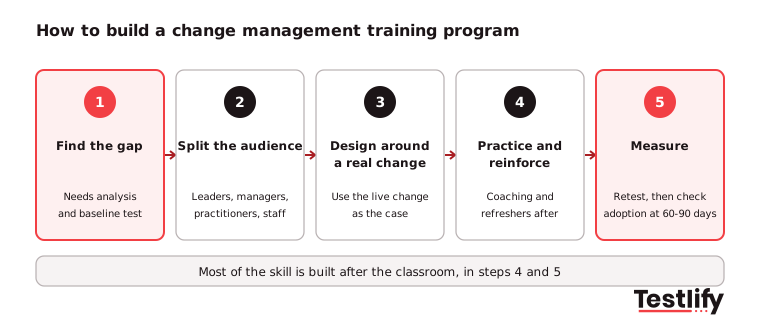
- Find the gap: Run a training needs analysis for the change ahead. A short skills test on change management or adaptability gives you a baseline per person instead of a guess.
- Split the audience: Group people by the role they play in the change (sponsor, manager, practitioner, employee) using the table above.
- Design around a real change: Use the actual project as the case study. Managers practice the conversation they will have with their own team next week.
- Practice and reinforce: Follow the session with coaching, manager huddles or short refreshers in the weeks after. Most of the skill is built after the classroom.
- Measure: Retest the same skills, then check behavior and adoption at 60 to 90 days. The next section covers how.
A skill gap analysis at step 1 also tells you who is ready to act as a change champion, which saves time when you pick people to lead pilots.
Tie the program to career growth where you can. LinkedIn's Workplace Learning Report 2025 argues that learning works best when it is combined with career development such as leadership training, coaching and internal moves, which is also what keeps trained change champions from leaving.
Which change management training activities work best?
Change management training activities that work best are the ones that copy real situations: role-playing a resistant team member, mapping the impact of a live change, rewriting a change announcement and practicing a team briefing. Activities that only explain models are easy to run but rarely change behavior.
- Resistance role play: One person plays an employee with a real objection. The manager practices listening, naming the concern and agreeing a next step.
- Impact mapping: Teams list every group the change touches and score how much each group's daily work changes.
- Announcement rewrite: Groups take a dense change email and rewrite it so a frontline employee understands what changes, when and why.
- Change simulation: A timed scenario, such as a tool switch with a hard deadline, where the group makes decisions and sees the effect on adoption.
- Personal change review: Each person looks back at a change they lived through and names what helped and what did not.
Across the teams we work with, the activity people remember most is the one where they rehearse the exact conversation they dread.
How do you measure whether change management training worked?
Measuring change management training means comparing skills before and after the training, then checking whether behavior and adoption actually changed. Completion rates and happy-sheet scores only show that people attended. A pre-test, a post-test and a 60 to 90 day check on adoption show whether the training did its job.
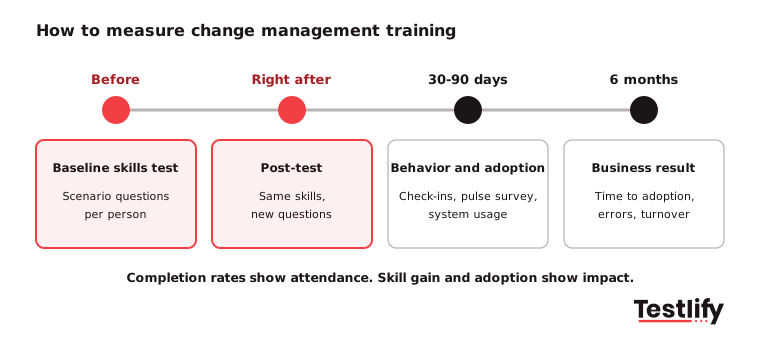
Scenario-based questions work better than knowledge questions here. Asking a manager what they would say to a team member who refuses to use the new system tells you more than asking them to list the stages of ADKAR. For a wider view of the method, see training effectiveness.
Key takeaway: Change management training succeeds when people use new skills on a real change. Measure the skill before and after, then measure adoption. If you only track who attended, you cannot tell good training from a day off.
When should you hire for change skills instead of training?
Hiring for change skills instead of training makes sense when a role needs proven change experience from day one, such as a change manager for a large ERP or HRIS rollout, or when nobody inside can be ready before the change starts. For most managers and employees, training is faster and cheaper.
- Train when: The change is months away, the skill gap is small, and the people involved already know the business. Promoting from within through internal mobility keeps that knowledge.
- Hire when: The project starts soon, the role is a dedicated change lead, or past changes failed for lack of a change specialist.
Either way, test the skill rather than trusting a job title or a certificate. Testlify's change management test uses scenario-based questions to check how a candidate or employee would plan and lead change, and the adaptability test checks how people respond when the way they work shifts. Both sit in a library of 3,500+ tests, and assessments run in 15+ languages, so global teams can take the same baseline. For interview ideas, see how to evaluate change management skills.
Ready to measure change skills before and after training?
Set a baseline before your next change program. Browse the change management, adaptability and leadership tests in the Testlify test library, or start a 7-day free trial, no credit card required, and send your first assessment today.
Frequently asked questions

Content Writer
Yashika Khandelwal is a Content Writer with 3+ years of experience creating research-backed content on hiring, talent assessment, and HR technology. She is a registered Organizational Psychologist and subject matter expert who combines behavioral science with practical recruitment insights to produce accurate, evidence-based content.
LinkedInRelated resources
View all
Workplace culture
Enneagram type 4: The Individualist at work and in life
Workplace culture
Enneagram type 1: The perfectionist at work, wings and growth
Workplace culture
40 stay interview questions to ask your employees
Workplace culture
How to read an Enneagram chart: wings, arrows and the triangle explained
Workplace culture
12 employee motivation strategies that actually work

Workplace culture
How to boost employee morale: 9 ways that work
Get started.
Hire on proof, not resumes.
Run your first skills-based assessment free — no credit card required.