
Enneagram type 1: The perfectionist at work, wings and growth
What drives an Enneagram Type 1, how 1w9 and 1w2 differ, and how to give feedback, review work and manage a perfectionist on your team.
An Enneagram type 1, often called the Reformer or the Perfectionist, is the personality type driven by a need to be good, correct and responsible. Ones notice what is wrong, feel a personal duty to fix it, and judge themselves hardest of all. At work, that shows up as high standards, careful reviews and a hard time with "good enough."
The Enneagram maps nine personality types around a circle. If you are new to it, start with how to read an Enneagram chart, which explains the nine points, wings, arrows and centers. This guide covers Type 1 only.
TL;DR:
- An Enneagram type 1 wants to be good and right, and fears being flawed, careless or wrong. The inner critic that comes with that fear is the key to understanding them.
- Ones make up roughly 10% to 15% of people in large type datasets, so most teams of ten or more have at least one.
- A 1w9 corrects quietly and avoids open conflict. A 1w2 corrects out loud and ties standards to helping people.
- Under stress a One moves toward Type 4 and turns moody and withdrawn. In growth a One moves toward Type 7 and gets lighter and more flexible.
- Give a One feedback against a clear standard, in private, with the reason and one fix. Vague or public criticism lands as a verdict on their character.
- Ones are strongest in roles where errors are costly: audit, quality control, compliance, editing, safety. Their main risk is slowing a team with too many review rounds.
- Never use a Type 1 result as a hiring filter. Test the job skills directly, and use the type for coaching after the hire.
 ChatGPT
 Gemini
 Claude
 Grok
 Perplexity
What is an Enneagram type 1?
An Enneagram type 1 is the personality type whose core motivation is to be good, ethical and correct, and whose core fear is being corrupt, defective or wrong. The Enneagram Institute names this type the Reformer. Other schools call it the Perfectionist or the Improver. All of them describe the same engine: a strong inner sense of how things should be.
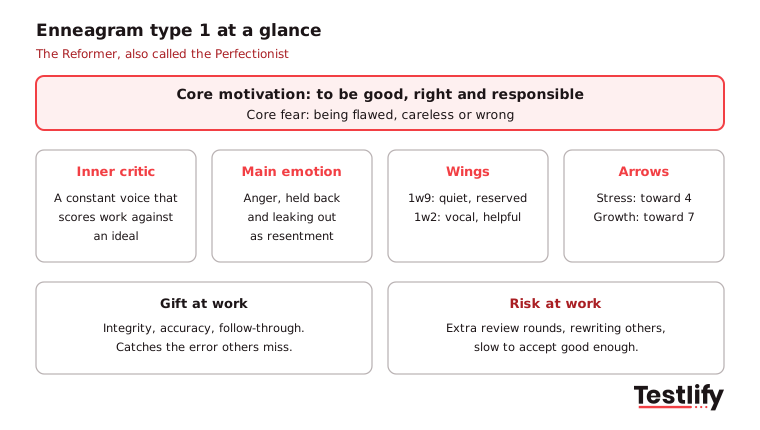
Type 1 sits in the gut, or body, center of the Enneagram, so Ones react first through instinct and a felt sense of right and wrong, then explain it with logic. That is why a One can tell a report is "off" before they can say why.
How common is Type 1? Truity found that about 10% of more than 54,000 test takers typed as Ones, with no gap between men and women. Cloverleaf reports a higher figure: 15% of more than 883,560 respondents. Either way, Type 1 is one of the more common types, and in a team of 12 you can expect one or two.
Type 1 basics | What it means at work |
|---|---|
Core motivation: be good, right and responsible | Takes ownership of quality without being asked |
Core fear: being flawed, careless or wrong | Over-checks work, finds it hard to ship a first draft |
Main emotion: anger, usually held back as resentment | Stays polite, then gets curt when others cut corners |
Gift: integrity and discernment | Spots the error in the contract, the bug before release |
Trap: perfectionism and fault-finding | Adds review rounds, rewrites other people's work |

Why is the Type 1 inner critic so loud?
The Type 1 inner critic is loud because Ones learned early that being good earns approval and making mistakes earns blame. The result is a voice that comments on everything they do, all day, with a running score against an ideal. Most Ones say the critic is far harsher on them than they ever are on colleagues.
At work, the inner critic shows up in small, specific habits:
- Rereading before sending: A One may reread a two-line Slack message three times to check tone and spelling.
- Should language: "We should have caught this." "This should be in the template." The word "should" is a tell that the ideal is speaking.
- Polite anger: Ones believe open anger is wrong, so it leaks out as tight replies, clipped emails or a long silence in a meeting.
- Resentment over fairness: Watching a colleague skip a step the One followed feels unfair, and the One keeps quiet score.
The critic is not all bad. It is also the source of the One's reliability: they keep promises, follow the process when no one is watching and hold the line on ethics. The goal is not to remove the critic but to turn its volume down so the One can hear that a task is done.
How is a 1w9 different from a 1w2 at work?
A 1w9 and a 1w2 share the same Type 1 core, but the wing changes how the standards come out. A 1w9 (the Idealist, in the Enneagram Institute's terms) is calmer, more reserved and more likely to fix problems quietly. A 1w2 (the Advocate) is warmer, more vocal and ties standards to helping people.
Wings are the two types next to Type 1 on the circle. The 9 wing adds a wish for peace and less conflict. The 2 wing adds a wish to help and be needed. Most Ones lean toward one wing.
1w9 at work | 1w2 at work | |
|---|---|---|
How they correct | Fixes the error themselves, often without saying anything | Points it out and offers to help fix it |
Conflict style | Avoids open conflict, goes quiet when annoyed | Raises issues directly, can sound preachy |
Best fit | Deep solo work: audit, research, documentation, data quality | People-facing quality work: training, compliance coaching, patient safety |
Common blind spot | Builds silent resentment, then withdraws | Over-helps, then feels unappreciated |
What they need from a manager | A clear invitation to disagree | Credit for the support they give, plus limits on scope |
A quick way to tell them apart in a review meeting: the 1w9 sends a tidy list of fixes afterward, while the 1w2 raises the issue in the room and volunteers to own it.
Where does an Enneagram type 1 go under stress and in growth?
An Enneagram type 1 under stress moves toward Type 4 and becomes moody, withdrawn and convinced no one understands how hard they try. In growth, a One moves toward Type 7 and becomes more spontaneous, playful and open to options. These two lines describe direction, not a change of type: a One stays a One.
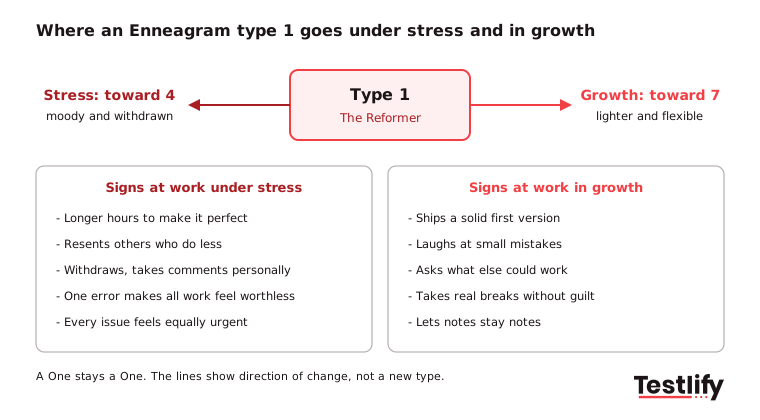
Signs a One is under stress at work:
- Works longer hours to make things perfect, then feels resentful that no one else does.
- Pulls back from the team and becomes sensitive to small comments.
- Sees their own work as worthless after one error, even when the rest is excellent.
- Treats every issue as equally urgent.
Signs a One is growing:
- Ships a solid first version and improves it later.
- Laughs at small mistakes, their own included.
- Asks "what else could work?" instead of defending one right way.
- Takes real breaks without guilt.
Managers can use this as an early warning. When a usually steady One starts saying "nobody cares about quality here" or goes quiet for days, the stress line is active and workload or fairness is usually the trigger.
How does an Enneagram type 1 handle mistakes and criticism?
An Enneagram type 1 handles their own mistakes harshly and replays them long after everyone else has moved on. A typo in a client deck can bother a One for days. Criticism from others is harder still, because Ones hear "this is wrong" as "you are not good," which touches the core fear.
Picture a finance analyst who is a One. Her manager says in a team call, "The Q3 numbers had an error." She fixed it within an hour, but she now rechecks every future report twice, stays late and quietly decides the manager thinks she is careless. The manager meant a one-line note. She heard a judgment of her character.
Three patterns are common when a One gets things wrong:
- Over-correcting: Adding a new checklist, a second review and a rule so the mistake can never happen again, even when the risk was small.
- Self-blame before facts: Apologizing for the whole project before anyone has checked what went wrong.
- Defending the standard: If the criticism seems unfair or inaccurate, a One will argue the point in detail, because being accused of something they did not do feels worse than the original error.
The Ones who handle mistakes best tend to have a manager who separates the error from the person every time, and says so out loud.
How do you give an Enneagram type 1 feedback that lands?
Giving an Enneagram type 1 feedback works best when it is specific, private, tied to an agreed standard and paired with one clear fix. Ones respect accuracy and fairness, so feedback that names the exact issue and the reason behind it lands far better than general praise or a vague "this needs work."
Feedback is rare for most people, not only Ones. Gallup's 2024 engagement update found that only 23% of employees strongly agree they received meaningful feedback in the past week. Ones notice that gap and fill it with their own inner critic, which is usually harsher than any manager.
A simple structure for feedback to a One:
- Name what is right first, specifically: "The reconciliation is clean and the notes are clear." Ones discount general praise, so be precise.
- State the standard, then the gap: "Our standard is to flag any variance over 2%. Two variances over that were not flagged."
- Give the reason: "The CFO uses those flags to decide what to ask the business units."
- Agree one fix: "Can you add a variance column to the template?" One fix, not five.
- Close the loop: Tell them when it is resolved. Ones carry open issues in their head until someone says they are done.
Pro tip: Never correct a One in front of the team unless the issue is urgent. A public correction, even a mild one, can cost you weeks of trust. Send a short private message instead, and keep public comments for credit.
What to avoid: sarcasm, jokes about their standards ("relax, it is not brain surgery"), and moving goalposts. A One will remember a changed standard as unfair long after the project ends.
How does a Type 1 review other people's work?
A Type 1 reviews other people's work thoroughly, fast to spot errors and slow to approve. Ones read every line, check every number and notice the formatting drift on page 14. That makes them excellent reviewers for anything where mistakes are costly, and frustrating reviewers when every comment carries the same weight.
A common problem is the "40 comments" review. A One returns a draft with 40 notes: three real errors, ten style preferences and 27 small edits. The author cannot tell which ones matter, feels judged and either fixes everything slowly or ignores the lot. Neither result is what the One wanted.
The fix is to ask Ones to sort comments by severity before sending:
Severity | What belongs here | Example |
|---|---|---|
Must fix | Errors, legal or compliance risk, broken logic | A pay figure that breaks the salary band |
Should fix | Clear improvements that change the reader's outcome | A missing step in a process doc |
Note | Style or preference, author decides | Comma use, word choice |
Ones usually take to this quickly because it is itself a clear standard. It also gives them permission to let small things go, since "note" items are logged but not required. In code reviews, the same idea works with labels such as "blocking" and "nit."
Ones also tend to rewrite work instead of returning it. A One manager who silently fixes a junior analyst's model teaches the analyst nothing and adds hours to their own week. A better habit is to return the work with the top two must-fix items and let the owner fix them.
When does Type 1 perfectionism slow a team down?
Type 1 perfectionism slows a team down when the effort spent polishing no longer changes the outcome. The usual signs are extra review rounds, approvals that wait on one person, missed deadlines for small fixes and a team that stops sharing early drafts because it expects heavy correction.
Perfectionism is not only a personal trait. On SHRM's All Things Work podcast, leadership consultant Vitale Buford Hardin shared her research that 85% of workplaces foster perfectionism, affecting 86% of leaders. A One in a culture like that gets rewarded for over-checking, which makes the habit stronger.
Watch for these signals on a team with a Type 1 lead or reviewer:
- More than two review rounds on routine work such as a weekly report or a standard job post.
- A single approval queue: Work waits for the One because "no one else checks it properly."
- Late for small reasons: A launch slips a day for a font change or a chart color.
- Fewer early drafts: Team members wait until work is "perfect" before showing the One, so problems surface late.
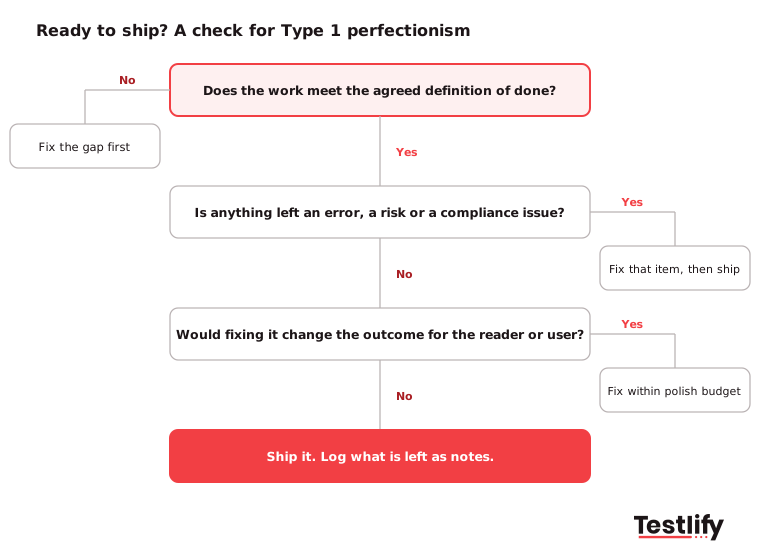
The most useful tool here is a written definition of done, agreed before the work starts. When "done" means "meets these five checks," a One can stop when the checks pass, and the inner critic has a standard to answer to.
Which roles suit an Enneagram type 1?
Enneagram type 1 careers tend to fit roles where accuracy, rule-following and ethics carry real weight and errors are expensive. Ones do well in audit, quality control, compliance, editing, finance control, safety, legal operations and data governance. They also make steady team leads in any function with a clear standard to uphold.
The data on these roles backs this up. O*NET, the US occupational database, rates the work style it calls Attention to Detail at the top importance score of 100 for accountants and auditors, actuaries, air traffic controllers and aviation inspectors, among 891 rated occupations. Those are the same habits a healthy One brings without being asked. Testlify has more on why attention to detail matters in the workplace.
Role | Where Type 1 strengths help | What to watch |
|---|---|---|
Internal or financial auditor | Finds gaps, follows evidence, stays objective | Treating every finding as equally serious |
Quality control or QA | Holds the line on standards, catches defects early | Blocking release over cosmetic issues |
Compliance and risk | Reads the rule closely, flags risk early | Rigid reading where judgment is needed |
Editor or proofreader | Accuracy, consistency, style rules | Rewriting the author's voice |
Finance control and accounting | Clean reconciliations, clear audit trails | Overtime to fix immaterial variances |
Health and safety | Will stop work when something is unsafe | Friction with teams under time pressure |
Data governance | Definitions, ownership, clean data | Slow sign-off on new data sources |
Personality does not decide whether someone can do these jobs. Plenty of strong auditors are not Ones, and plenty of Ones would be unhappy in compliance. Role fit is a starting point for a career conversation, not a placement rule.
How does a manager get the best from an Enneagram type 1?
A manager gets the best from an Enneagram type 1 by making standards explicit, giving them real ownership of quality and setting clear limits on how much polish each task deserves. Ones work hardest for leaders they see as fair and consistent, and they lose motivation fast in chaotic or ethically unclear teams.
Practical moves that work:
- Write the standard down: A checklist, style guide or definition of done gives the One something to meet instead of an ideal to chase.
- Set a polish budget: "This internal memo needs 30 minutes, not three hours." Ones need permission to stop.
- Give ownership, not just review duty: Let a One own the quality process for a workflow. Owning it is energizing; being everyone's last check is draining.
- Praise the specific thing: "Your reconciliation caught a $40,000 duplicate payment" means more than "great job."
- Name the fairness issue: If a One is resentful, ask what feels unfair. It is usually a workload gap or a rule others are skipping.
- Watch the hours: Ones rarely complain about overload. They just stay late. Check in before they burn out.
- Ask for disagreement: Especially with a 1w9, invite them to say what is wrong with the plan in the meeting, not after it.
When a One is given a clear standard and trusted to apply it, they often become the person who quietly raises the quality bar for everyone else.
What do people get wrong about Enneagram type 1s?
People often get Enneagram type 1s wrong by reducing them to neat freaks or rule police. Type 1 is about an inner standard of right and wrong, not tidy desks. A One's standards can apply to ethics, fairness, code quality or writing while their inbox stays a mess.
Five common misreadings:
- "Ones are always organized." Ones are exact about what matters to them. A One engineer may have flawless tests and a chaotic calendar.
- "Ones are calm and controlled." Ones look composed because they hold anger back. The anger is still there and leaks out as irritation.
- "Ones judge everyone." The harshest judgment is usually aimed inward. Many Ones are gentle with others and brutal with themselves.
- "Every perfectionist is a One." Plenty of people polish work to look good, avoid risk or win approval. A One polishes because the work itself should be right, whether or not anyone notices.
- "Ones cannot change." Ones grow a lot with age and feedback. The growth line toward Type 7 is a real, visible shift toward flexibility.
If you are unsure of your own type, the Enneagram test guide explains how the test works and what the results can and cannot tell you.
Should hiring teams screen for Enneagram type 1?
Hiring teams should never screen candidates in or out because they are, or are not, an Enneagram type 1. Personality type is not a pass or fail measure of whether someone can do a job, and treating it as one adds legal risk without adding accuracy. The EEOC's guidance on employment tests expects any test used in selection to be job-related.
If a role needs the strengths people associate with Ones, test those skills directly. Testlify's library of 3,500+ tests includes job-relevant options such as the attention to detail test, the quality control test and the internal auditor test. Those show whether a candidate can actually catch the error, whatever their type. The Enneagram personality test fits better after the hire, for team discussions and coaching.
Key takeaway: Use Type 1 insight to manage, coach and give feedback well. Use skills tests and structured interviews to hire. For the full view on the Enneagram in hiring, read how to use the Enneagram test in hiring, then browse the Testlify test library for skills tests that match the role.
FAQs

Content Writer
Yashika Khandelwal is a Content Writer with 3+ years of experience creating research-backed content on hiring, talent assessment, and HR technology. She is a registered Organizational Psychologist and subject matter expert who combines behavioral science with practical recruitment insights to produce accurate, evidence-based content.
LinkedInRelated resources
View all
Workplace culture
40 stay interview questions to ask your employees

Workplace culture
How to read an Enneagram chart: wings, arrows and the triangle explained

Workplace culture
12 employee motivation strategies that actually work

Workplace culture
How to boost employee morale: 9 ways that work

Workplace culture
How to reduce employee absenteeism: 10 steps that work

Workplace culture
External recognition programs: what they are and how to run one
Get started.
Hire on proof, not resumes.
Run your first skills-based assessment free — no credit card required.